Mike Retelle: Current Research and Recent Student Thesis Projects
Svalbard, Norwegian high arctic
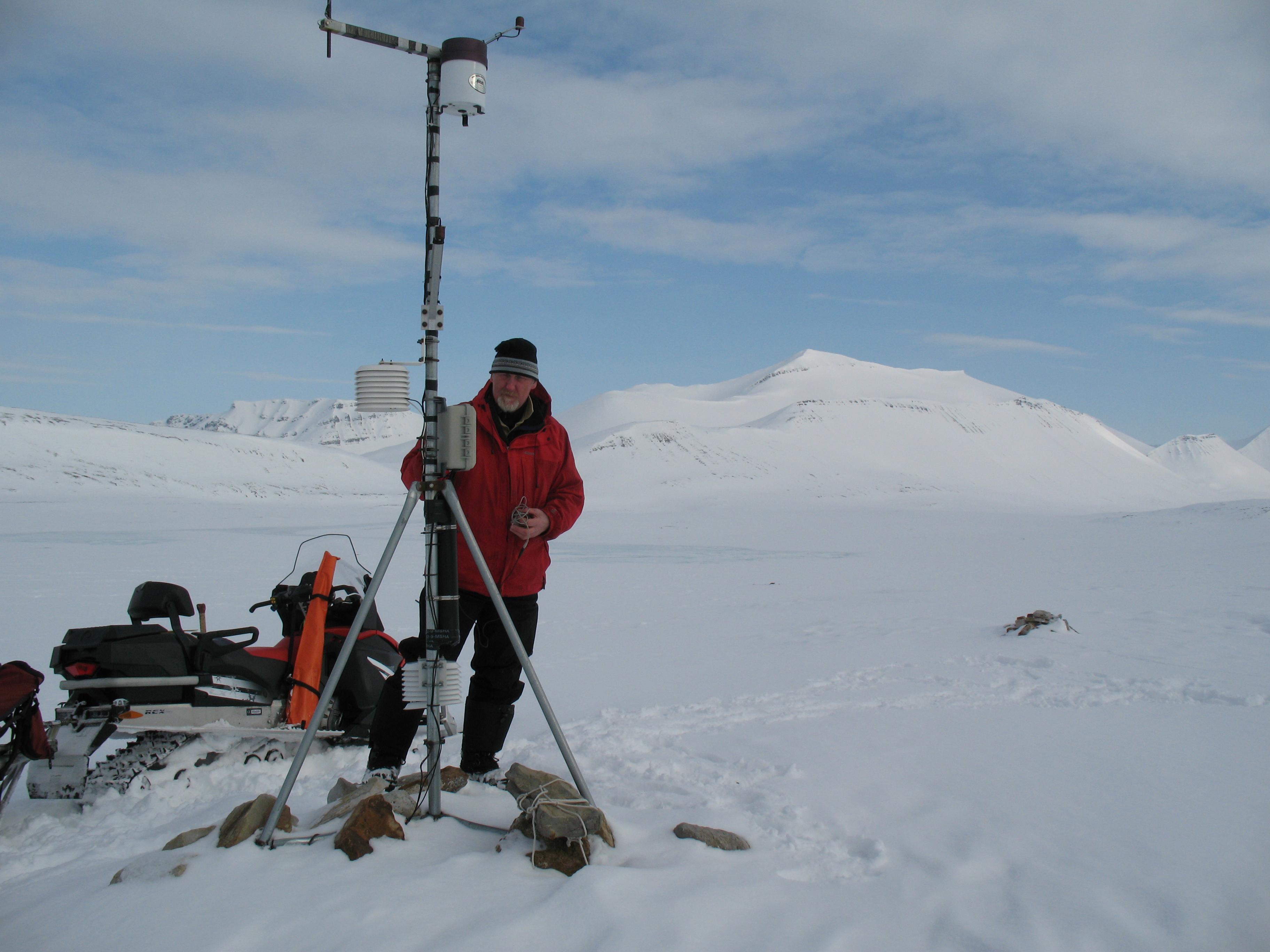
Downloading data from weather station in Lilnnedalen, west Spitsbergen, Svalbard, Norwegian arctic, April 2012.
The glaciated high arctic study site in west Spitsbergen is located at 78o at the northern end of the North Atlantic current, a sensitive area for detecting and monitoring changes in the cryosphere, the frozen part of the planet. I am interested in the glaciation and sea level history in Svalbard and other aspects of climate and environmental change in this high arctic setting. My colleagues and I have developed a long term monitoring site in Linnedalen, a valley in western Spitsbergen. This study site is well equipped with instrumentation from the top of the glacier to the bottom of the lake and includes weather stations, glacier stake network, time lapse cameras and arrays of instrumentation in the lake, all designed to detect timing and nature and changes in seasonal cryospheric processes.From 2003 to 2014, I was a co-leader in the Svalbard REU program: Holocene and modern climate change in the Norwegian High Arctic sponsored by the U.S. National Science Foundation Office of Polar Programs. The research program in Linnedalen is now as a course in the Arctic Geology Department at UNIS, the University Centre in Svalbard and involves an international cohort of student researchers.
Check out this link for info on a new three year project in Svalbard, in collaboration with Prof. Ray Bradley, UMass Amherst http://www.umass.edu/newsoffice/article/umass-amherst-study-changes-arctic
Sclerochronology: Clams and Marine Climate Change, Finnmark, Coastal Northern Norway
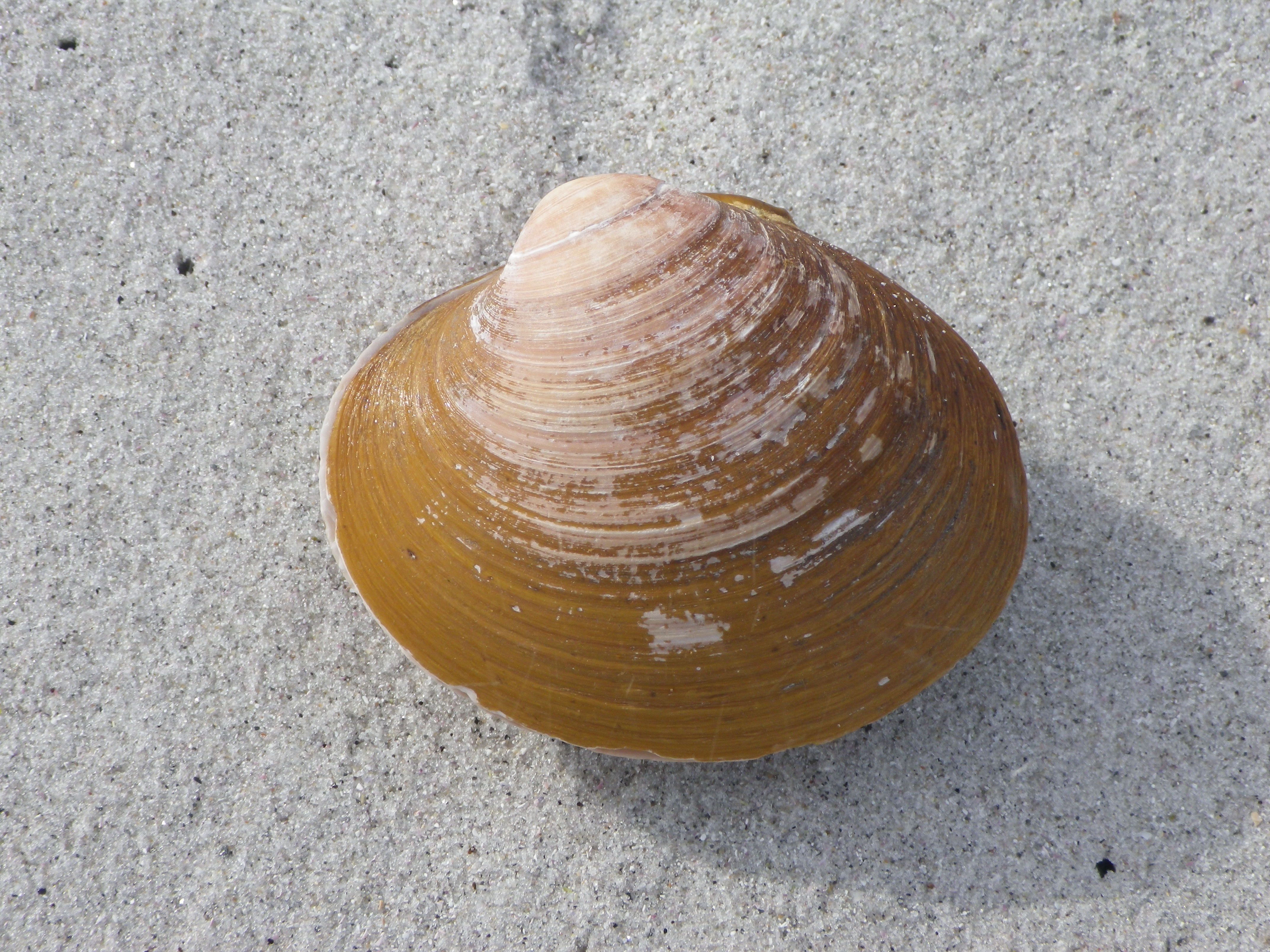
Arctic islandica shells on a Finnmark Beach
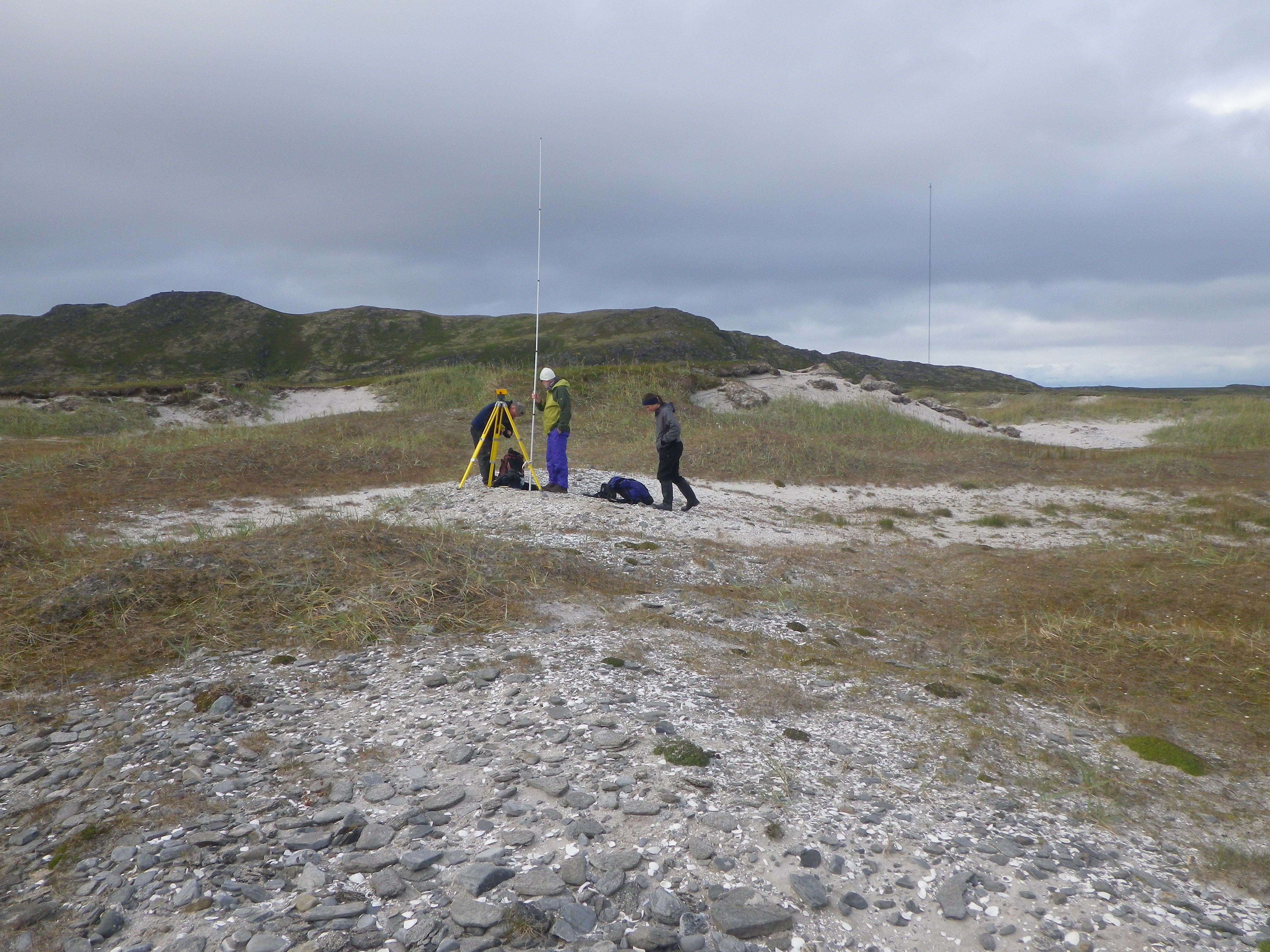
Surveying raised beaches on Ingoya, northern Finnmark, summer 2014.
This collaborative project was funded in 2014 by the National Science Foundation in cooperation with colleagues from Iowa State University, Norway and the Netherlands. One of the main goals of this study is to reconstruct late Holocene marine climate from northern coastal Norway using environmental information archived in long-lived clams. Arctica islandica , a common North Atlantic bivalve, can live up to 300 years or more and has well-defined annual growth increments – and we are attempting to reconstruct maritime climate from Medieval Time through the Little Ice Age to recent period of warming of the 20th Century by studying patterns of inter-annual growth and using stable isotope analysis of the annual layers. The study area along the north Norwegian coast is in a sensitive area for changing marine climate as it is bathed by the northern extent of the north Atlantic current (aka the Gulf Stream and changes in heat transport by the current may be responsible for major climatic shifts in the late Holocene. As a geologist on the interdisciplinary research team, my role is to investigate raised beaches, above current sea level. isolated from the sea by postglacial uplift of the land. The raised beaches contain clams up to 6,000 years old and will allow us to investigate marine climate beyond the last millennium.
Maine lakes
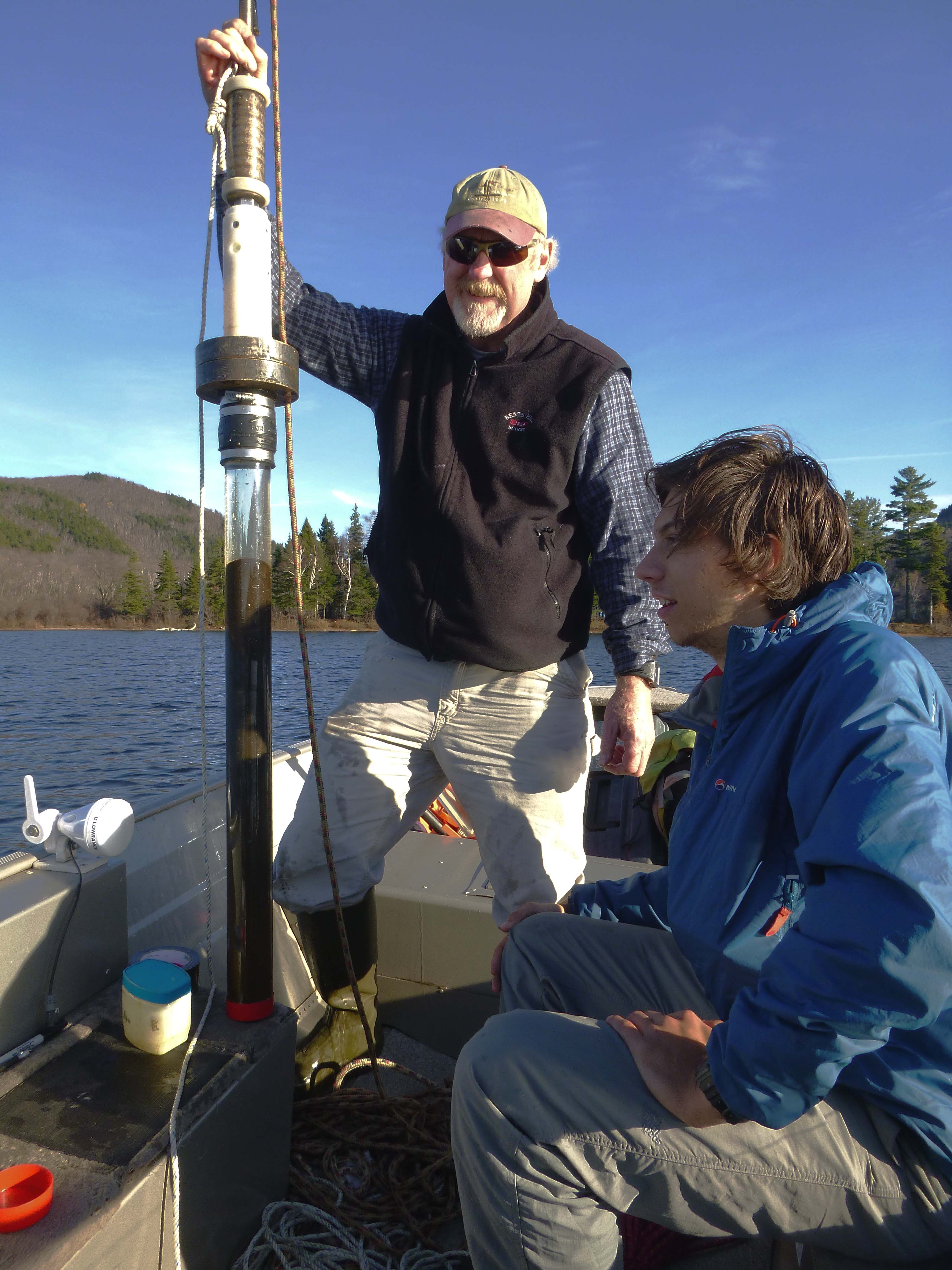
Sediment core recovered from Round Pond, Chain of Ponds Township, October 2012 with Colin Dowey, Bates 2013.
Bates is located just south of “the lakes region” in south-central Maine. My students and I have undertaken numerous projects in courses and in thesis research on many lakes ranging from coastal “isolation basin” lakes that were formerly depressed below sea level to density stratified lakes that contain laminated sediments that archive high resolution sediment records. One of our study sites in central Maine is Basin Pond, a 30 meter deep “meromictic” lake. The water column in this lake is permanently stratified and has a detailed sediment record of environmental change with annual resolution preserved in the finely layered deposits, similar to tree rings.
Maine coastal monitoring
Geology faculty and students have long utilized the Bates Morse Mountain Conservation area
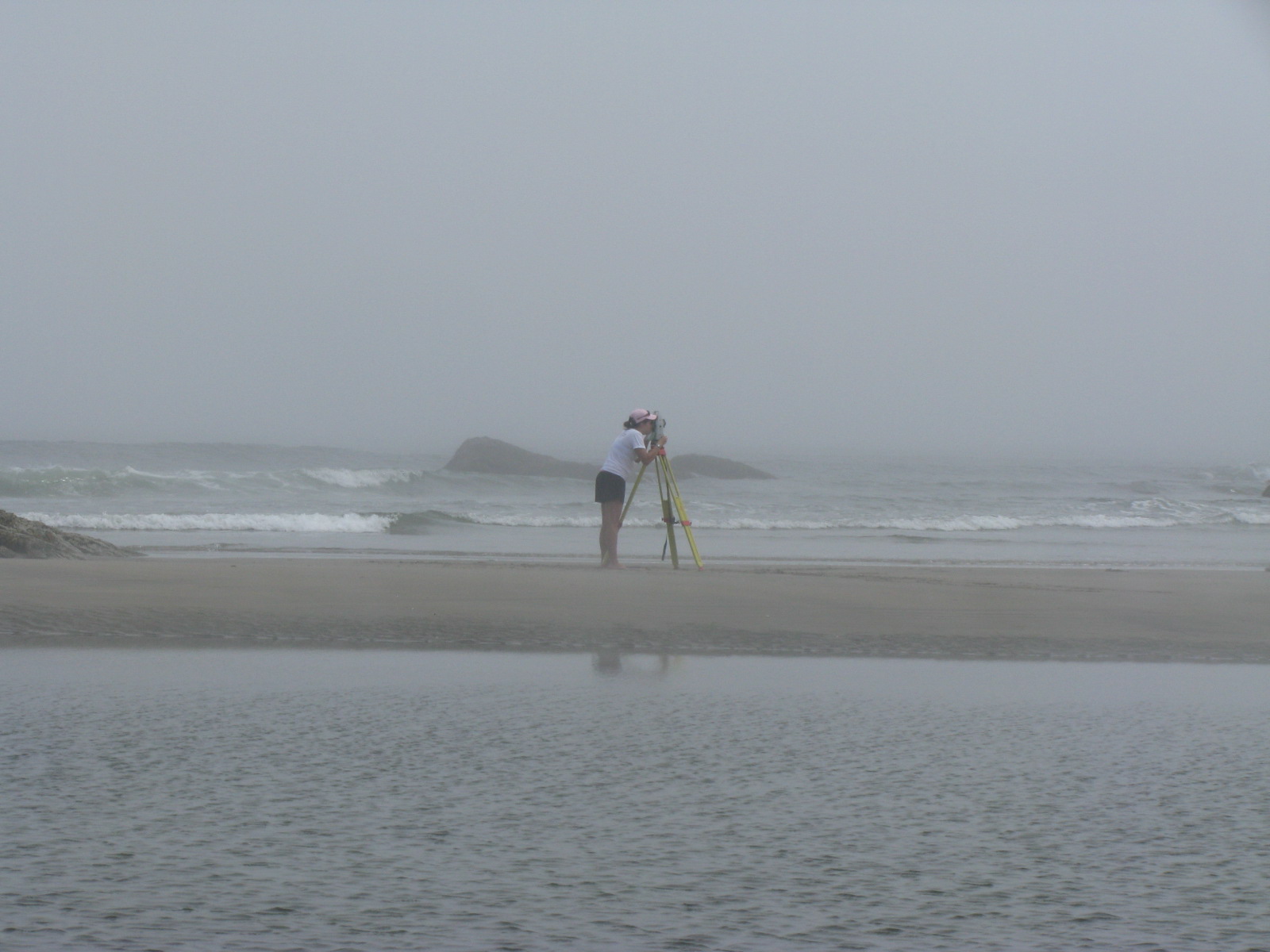
Surveying the summer beach profile at Small Point, Phippsburg Maine. Molly Newton, Bates 2011.
for geological research on the undeveloped barrier beach system. In 2009 we began a more intensive monitoring program on beaches in the Phippsburg area, in partnership with the Small Point community and Popham Beach State Park. The focus of the beach research is to monitor and evaluate the response of the sandy beach systems to changes brought about by storms, seasonal wave climate and rising sea level. Beach profiles and dune fronts are monitored using high resolution GPS, total station and traditional auto-level surveys in addition to time lapse photography from cameras installed at two of the beaches.
We have developed a Coastal Environmental Archive in collaboration with the community at Small Point. This archive will continue as an ongoing project designed to document change in the Maine coastline. Highlights of the archive include a collection of relevant undergraduate senior theses, satellite and air photographs, and a collection of historical photographs donated by the Small Point residents. Please visit the archive by following this link: https://sites.google.com/a/bates.edu/sea-wall-project/
Undergraduate Thesis Projects
2018
Gabe McGinn Sediment trap analysis in high-arctic lake Linnévatnet indicates a recent shift in the annual hydrological regime
Doug McNab A Zooarchaeological and Paleoclimate Analysis of Gadus Morhua Otoliths Recovered from the Sandwick South Site, Shetland Islands, United Kingdom
Sam Rickerich The postglacial sea level history of Ingøya, northern Norway
2017
Claire Markonic A Mid-Late Holocene Multi- Proxy Paleoenvironmental Reconstruction Using a Sediment Core from the Island of Ingøy, Norway
Noel Potter Late-Season High-Sedimentation Events in a Sediment Trap Record from Linnévatnet, Svalbard, Norway
Gwen Williams Paleoenviromental Reconstruction from the Sediment Record of the Varved Proglacial Linnévatnet, Svalbard, Norwegian High Arctic
2016
Nicole Cueli Recent Changes To The Dynamic Sandy Beach System At The Mouth of the Kennebec River, Mid-Coast Maine
Sam Mark Mid-Holocene Marine Paleoclimate Reconstruction Through Sclerochronological Analysis of Arctica islandica from Rolvsoya, Finnmark, Northern Norway
Christiane McCabe High Resolution XRF Sediment Analysis of Late Season Precipitation Events in a High Arctic Glaciated Watershed: Svalbard, Norway.
Julie Savage A Late-Holocene Marine Climate Reconstruction Using the Bivalve Arctica islandica from Northern Norway
2015
Tim Campbell Reconstructing Organic Carbon Accumulation and Climate History using Lake Sediments; Mealy Mountains, Labrador Canada
Ben Merkert Paleoclimate implications of lake sediment geochemistry in Linnevatnet, Spitsbergen, Svalbard
Tessa Walther Analysis of sediment traps for reconstruction of annual sediment flux and lacustrine processes, Linnévatnet, Svalbard:
Sean Enos Paleoenvironmental Evolution of the Peddock’s Island Salt Marsh, Boston Harbor, Massachusetts
2014
Allie Balter Paleoclimate reconstruction of a core from Linnévatnet in Svalbard using productivity proxies
Alec Douglas Monitoring the Effects of Hard Stabilization Rock Wall at Popham Beach State Park, Phippsburg Maine
Chris Halsted A study of historical sand movements in the Quendale region of south Mainland, Shetland Islands, UK
Sara May El Assaad Monitoring Sedimentation Patterns and Inlet Migration at Popham, Seawall and Small Point Beaches, Phippsburg, Maine
2013
Colin Dowey “Paleoenvironmental and paleoclimate reconstruction from laminated Holocene sediments, Linnevatnet, Svalbard, Norwegian High arctic”
Lauren Farnsworth “Periglacial processes and landscape in a high arctic karst setting, Vasrdeborgesletta, Kapp Linné, Svalbard ”
Amanda Wescott – “Beach response to storms and seasonal changes, Small Point and Phippsburg, Maine”
2012
Jen Lindelof Using sedimentary and geochemical proxies for Little Ice Age Climate Change reconstructions, South Mainland Shetland
2011
Gregory DeWet Analysis of sediment trap yields in glacial fed Linnévatnet: Calibrating watershed and lacustrine processes for paleoclimate analysis
Wesley Farnsworth Slope Processes of Linnédalen, Spitsbergen: Sedimentation through avalanching
Molly Newton Dynamics at barrier and pocket beaches at Small Point, Popham and Seawall Beaches, Phippsburg, Maine
2010
Kurt Schuler: Monitoring sediment transport and inlet migration at the Seawall Beach Complex, Phippsburg, Maine
Adam Nielson: The effects of road salt application on Lily Pond, White Mountain National Forest, New Hampshire
Laura Poppick: Modern depositional processes proximal to a polythermal tidewater glacier complex, Kronebreen-Kongsvegen, Kongsfjorden: Svalbard, Norway
Daniel Roop: The affects of road salt on two small New Hampshire Lakes
2009
Megan Arnold: Sedimentation in a High-Arctic lake, Linnévatnet, Svalbard: A modern process study using sediment traps
Emily Chandler: Seasonal processes affecting the Seawall barrier system and the evolution of the southwestern barrier spit and Sprague River inlet, Phippsburg, Maine
Christopher Hertz : Seasonal hydrological and limnological processes, Lily Pond, White Mountain National Forest, New Hampshire
Alex Hernandez (ES-Geo) Comprehensive stream survey and investigation of summer survival of stocked brook trout, Salvelinus fontinalis, Stetson Brook, Lewiston, Maine
Dana Oster : Mapping short term barrier beach processes at Seawall Beach, Phippsburg, Maine to model transgressive shorelines in 2100 from sea level rise
2008
Peter Dennehy: A limnological and hydrological assessment of three White Mountain, NH lakes
2007
Benjamin Lepesqueur: Limnological assessment of anthropogenic inputs into the watershed and water column of Lily Pond, Livermore, NH
Bennet Leon: Recent sedimentation in Linnévatnet, a High Arctic proglacial lake: Svalbard, Norway
Stephen A. Monsulick: Influences on water column structure and water quality evaluations of Meetinghouse Pond and Sprague Pond, Phippsburg, Maine
2006
Jonathan Duchette: Deglaciation and Late Wisconsinan history of Martin Stream Valley, Androsdcoggin County, Turner, Maine
Sarah Mazur : Sedimentological records of storms and climate in the Quendale Region of the Shetland Islands, Scotland
Brooks Motley: Sedimentation in Linnévatnet, Svalbard, during 2004-2005: A modern process study using sediment traps
Lauren Perreault: Mineralogical analysis of primary and secondary source sediments to Linnévatnet, Spitsbergen, Svalbard
2005
Christopher L. Cary: Modeling of sedimentation trends on Seawall Beach in Phippsburg, Maine, and their variations over daily, weekly and seasonal timeframes
Daniel Frost: Paleoclimate reconstruction using physical sedimentology and organic matter biogeochemistry of varved sediments, Basin Pond, Fayette, Maine
2004
Anna Felton: Organic carbon deposition in laminated sediments from coastal lacustrine and marine environments, Eastern Canada Arctic
Peter W. Klausmeyer: Fall and winter erosion and accretion at Seawall Beach, Phippsburg, Maine
Aaron Putnam: Recent sedimentation of a transect of High Arctic isolation basins: Southern Queen Elizabeth Islands Archipelago, Nunavut, Canada
2003
Elizabeth Cohen: Weather-induced erosion and accretion at Seawall Beach, Phippsburg, Maine
Amelia Rachel Haas: Paleoenvironmental reconstruction using laminated sediments from a High Arctic isolation basin: Depot Point Lake, Cornwallis Island, Nunavut, Canada
2002
Polly Carter: Late Holocene paleoenvironmental reconstruction from laminated sediments, Danielle Point Lake, Bathurst Island, Nunavit, Canada
Casey Saenger: Holocene basin evolution and paleoclimate reconstruction from laminated sediments, Cape Hurd Lake, Devon Island, Nunavit, Canada
2001
Mary-Katherine Fasy: Paleoenvironmental reconstruction from laminated sediments, Cape Hurd Lake, central Canadian Arctic Archipelago, Nunavut, Canada
2000
Jeffrey Hershberger (Geology): A paleomagnetic record of a High Arctic isolated marine inlet: Cape Hurd Lake, Devon Island, Nunavut, Canada
Megan Jones: Mechanisms of change for a coastal Maine barrier beach profile
Sarah Roberts: The evolution of a coastal meromictic basin from a marine inlet, Cape Hurd Lake, Devon Island, Nunavut, Canada