Doug Hubley

Doug writes and edits text for various Bates publications. He also edits listings of public events taking place at the college and handles certain media-relations duties, including publicity for arts events.

Stories by Doug Hubley
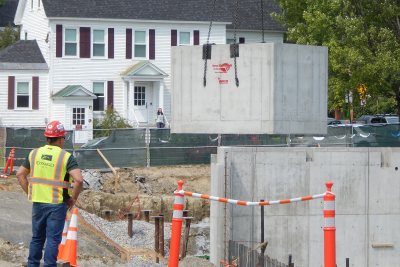
Campus Construction Update: Sept. 6, 2019

Thursday, September 5, 2019 2:19 pm

The weeks of clanging and sooty diesel puffs at Bates' Bonney Science Center site ended with the driving of pipe pile No. 260, the last pile driven to stabilize the marine clay underlying the site.
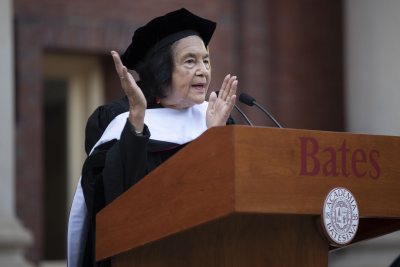
Convocation speaker Dolores Huerta to the Class of ’23: ‘We have the power’

Wednesday, September 4, 2019 4:04 pm

Not every Bates academic year begins with a legend of the American labor movement leading a chant of “Yes we can!”
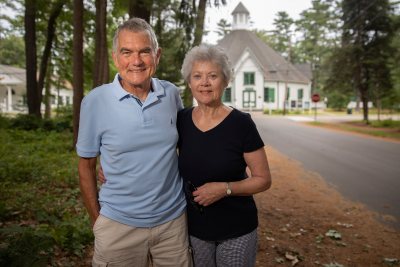
My Maine Summer: Bill Holt ’63 and Jean Holt ’62, ‘coming home to Ocean Park’

Monday, August 26, 2019 4:42 pm

Generations of Batesies are among those who cherish summers at Maine's "Chautauqua-by-the-sea."
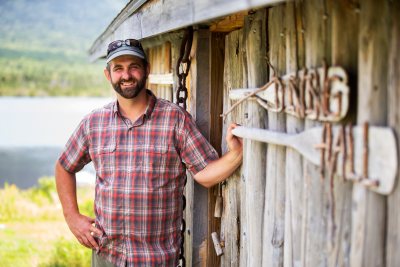
My Maine Summer: Eric Stirling ’97 and a faraway getaway

Wednesday, August 21, 2019 3:22 pm

Eric Stirling and his family represent a longstanding vacation tradition virtually unique to Maine: the wilderness sporting camp. In 2003, Eric became the sixth generation of his family to operate West Branch Pond Camps,
Campus events: Sept. 3–30, 2019

Wednesday, August 21, 2019 9:05 am

Greetings from Bates! This is a listing of public events at the college during September 2019.
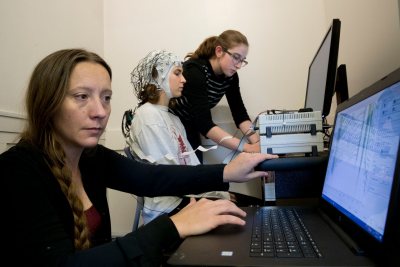
“We are piloting the experiment for these students’ thesis experiments. They were piloting Hannah’s experiment. She’s interested in looking at the extent to which visual masking actually inhibits perception. So when you take a visual mask, you take an image followed by another image, you’re impaired at understanding the first image. The question is why. So what we’re going to do is take the neural activity that we’re measuring. And the nice thing about EEG is that it measures millisecond by millisecond electrical potentials that are generated in the brain , we measure them from the scalp. And we can see over time what the brain is processing and we use machine learning, we put these signals into a computer system tha t reads out the extent to which there is information about what the picture is. We’re wondering, does that information persist when you change the image? Does that persist over time? Hannah’s made the experiment, and we are going to try it out to make sure everything’s ready for participants.”? Michelle Greene, assistant professor of neuroscience, says of three thesis students in neuroscience: “They’re all terrific, I might add.”Hanna De Bruyn ‘18, Old Lyme, Conn. (black striped sweater with glasses)Katherine “Katie” Hartnett ’18 of St. Paul, Minn. (wearing EEG cap with Bates sweatshirt)Julie Self ’18 of Redwood City, Calif. (blue plaid shirt)Email from Hanna: Katie Harnett and I will be testing out our computational neuroscience theses and will be hooking each other up to the EEG tomorrow, Friday, at 12:45-2:30ish in the Bates Computational Vision Lab (Hathorn 108). 
Bates announces $3.97 million National Science Foundation grant for visual database project

Friday, August 16, 2019 11:02 am

The largest-ever federal grant awarded to Bates, the award will fuel creation of a vast video gallery to support research in various fields, including artificial intelligence.
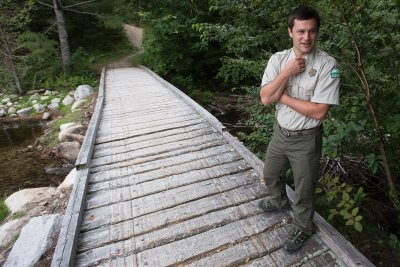
Baxter State Park, Maine—08-03-2018— Eben Sypitlowski waits to cross a snowmobile bridge at Abol Stream on his way to inspect recent trail improvements at Baxter State Park on Friday. Kevin Bennett Photo
My Maine Summer: Baxter State Park’s Eben Sypitkowski ’05 and a ‘step back in time’

Thursday, August 8, 2019 2:02 pm

Sypitkowski runs Baxter State Park, an icon of summer in Maine and home to the state's tallest mountain.
Campus Construction Update: Aug. 1, 2019

Wednesday, July 31, 2019 10:15 am

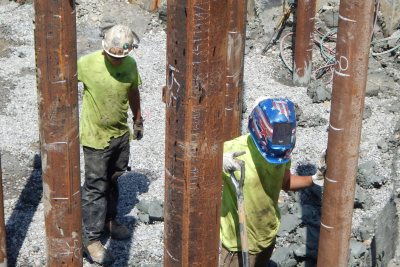
More cranes mean faster piledriving at the Bonney Science Center. Also: It's all over but the watering at Bates' returfed soccer field.
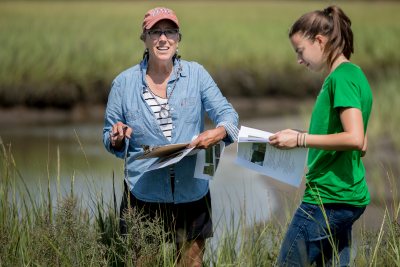
Professor of Geology Beverly Johnson uses a sediment elevation table to measure the height of the Sprague River Salt Marsh, part of the Bates–Morse Mountain Conservation Area..These data are used to measure the response of the marsh to rising sea level and storm activity, Johnson says. Four years ago, she and her Short Term geology students traveled to the Sprague, where they placed rods deep in the marsh as benchmarks to measure future changes.Show with Laura Sewall (in garnet baseball cap), Harward Center for Community Partnerships, Director of Bates Morse Mountain Conservation Area, and Vanessa Paolella '21 of Dingmen's Ferry, Pa., who has been working with Johnson on geology research over the summer.Also present: Clailre Enterline (in green shirt and blue baseball cap), Research Coordinator with the Maine Coastal Program. And (not in selects but wearing a blue baseball cap and blue shirt) Ellen Bartow-Gieelie, Coastal Fellow with the Maine Coastal Program.
Q&A: Laura Sewall on 11 years as Bates–Morse Mountain director

Friday, July 19, 2019 10:30 am

Sewall shares takeaways from the conservation area, including the role of "blue carbon," the toll of climate change, and the value in letting nature take its course.
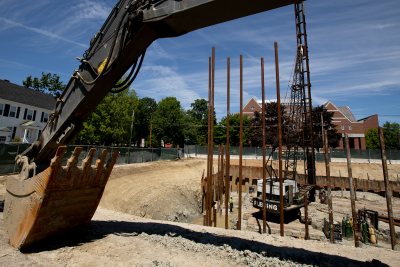
Campus Construction Update: July 8, 2019

Wednesday, July 3, 2019 3:10 pm

Summer's here and the time is right ... for construction projects at Bates. Campus Construction Update surveys how the major initiatives looked in early July.

Load more