Stories about "Bates values"
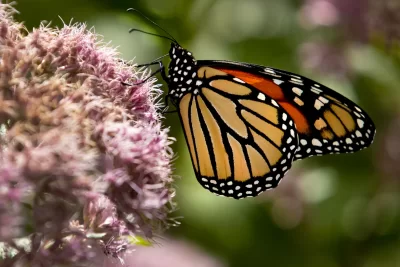
Fun facts and awesome abilities of the incoming Bates Class of 2028

Thursday, August 22, 2024 3:34 pm

From local heroes to global advocates, the incoming Bates Class of 2028 coruscates with myriad and fascinating talents, achievements, and successes.
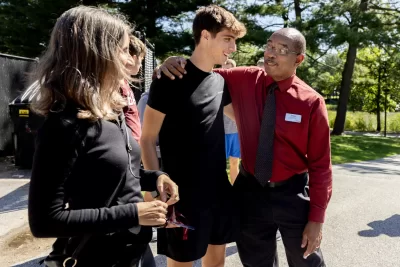
Record-breaking Bates Class of 2028 arrives to open arms on Aug. 29

Thursday, August 22, 2024 2:41 pm

Chosen from the largest applicant pool in Bates history and with record-breaking racial diversity, the 491-member Class of 2028 comes from 38 U.S. states and 29 countries.
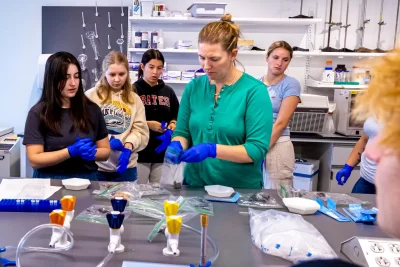
Associate Professor of Biology Larissa Williams teaches students in Bio s39f a lesson on “uses of Genetic analysis to understand the population of dynamics of crabs in Maine.” They met in Bonney 370 laboratory and received instruction on how to use a pipette, including closing their eyes in preparing to click the instrument. The course’s instructor is Jesse Minor ’00, a lecturer in biology.
Bates biology professor and three young graduates publish ‘worrisome’ research findings of a common industrial chemical’s harmful effects

Tuesday, August 13, 2024 8:22 am

New research from Bates reveals that daily exposure to triphenyl phosphate, a chemical used in many fire retardants as well as nail polish, harms developing zebrafish and, perhaps, humans.
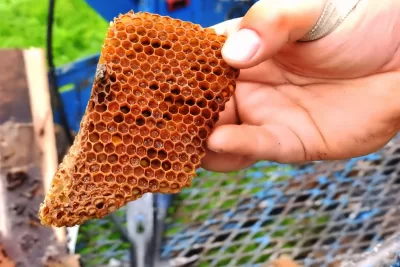
Brian Mason of Spicer Bees (purple shirt) removes a big honeybee hive from the college's oldest building, Hathorn Hall, on July 25, 2024. Discovered by a work crew painting the Hathorn trim, the hive was in a section of the soffit of the Hathorn portico, where the roof joins the main part of the building. Lifted to the second-story location by a Genie boom lift, Mason and Bates carpenter Matt Capone, with beard, worked together, the latter using a multitool and pry tools to remove trim to get at the hive, and the former using a homemade vacuum and hive tools to remove the bees and comb, relocating as much of the hive as possible to his apiary in Whitefield. Mason, who estimated the hive at upwards of 50,000 bees, gives credit to Bates for calling in a beekeeper for the project. "100 percent credit," he says, noting that the Bates hive was not only healthy but had apparently survived for at least one winter, if not more. Most wild honeybee hives die each winter, and commercially maintained hives typically rely on treatments to control mites. "Less human intervention is always valuable. The fact that this hive wintered without intervention means the bees might just have something going for them to survive. So now I can introduce the Bates bees into my apiary. That’s a win."
Beegone! From discovery to relocation, Hathorn Hall’s honeybee hive had Bates buzzing

Wednesday, July 31, 2024 1:46 pm

Historic Hathorn Hall is home to faculty offices in English, neuroscience, and mathematics, plus several administrative offices and classrooms. And until last week, it was also the residence of around 50,000 honeybees.

In Gomes Chapel, a Buddhist healing ritual grows, one grain of sand at a time

Friday, June 28, 2024 11:50 am

Created in Gomes Chapel this week by Tibetan nuns, the colorful, exquisite sand mandala will be dissolved into Lake Andrews, but its healing energy will remain.
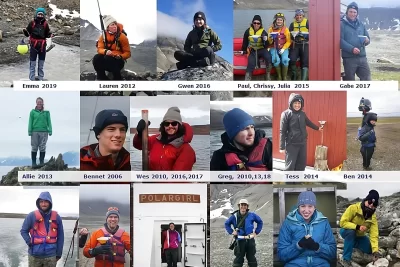
When it rains, it pours: Bates’ Mike Retelle coauthors research on extremes in Arctic weather patterns

Friday, June 21, 2024 10:27 am

Ask Professor Emeritus of Geology Mike Retelle about his contribution to a new paper in Nature, and he'll point to the pipeline of talented Bates students who’ve supported the Arctic research over the last two decades.

Picture Story: Alumni Parade at Bates Reunion 2024

Friday, June 14, 2024 1:11 pm

It's been called a grand jubilee of fun and frolic, with clangorous hullabaloo and everyone tremendously full of the dickens. We love a parade!
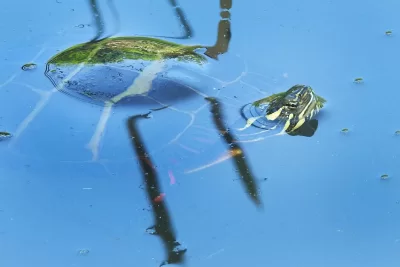
Basking turtles, annoyed birds, 16 animals you might meet at Lake Andrews

Thursday, June 6, 2024 12:57 pm

Whether you’re an alum here for Reunion weekend, or a daily Puddle walker, here are 15 animals we’ve seen at Lake Andrews recently and over the years — and that you might see when you swing by the popular Bates pond.

Video: At this Bates baking event, you judge a book by its edible

Wednesday, June 5, 2024 1:17 pm

In terms of its name, the Edible Books Festival doesn’t mince words: It invites the Bates community to bake and cook dishes that play off the title or theme of a well-known book.
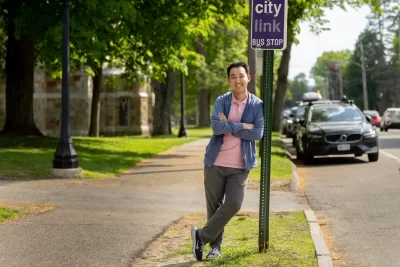
APPROVED, Alan Wang ’24 on College Street in front to Parker Hall where covered bus stop will be built on lawn behind him. 11/13/2023 16:25:54 Transportation for Bates awang3@bates.edu 5075817683 Student Better Bus Stop for Bates The MaineDOT is planning on implementing a commuter bus line between Lewiston and Portland. The bus line is set to terminate at Bates near Underhill Arena. However, the bus stop might not be pleasant and intuitive to use. Study from University of Minnesota show that bus stop amenities have a direct relationship with rider's perceived waiting time; having a bench can reduce the perceived waiting time by half compared to a stop without a bench. A well-equipped bus stop can entice more people to use it, thus reducing Bates' carbon footprint. "A bus shelter costs around $5,500. I want to apply for the full $2,000 grant to ultimately put this money back in the school's pocket, in the form of a well-designed bus shelter. This green fund can be a part of a larger funding package, I'm assuming that MaineDOT and the operator of this bus line will both pitch in to fund this shelter. The bus shelter should protect riders from weather elements, display proper signage and maps, equip with lighting and seating. MaineDOT also recommends installing bike racks and trash cans. The green grant can be used to achieve aspect(s) of the above objectives. " Increase comfort level when using public transportation. Reduce perceived waiting time. Encourage faculties and staff to commute using public transportation, thus reducing GHG emissions and free up parking spots.
A welcoming bus stop and bird-safe windows are among 2024 Green Grant initiatives

Friday, May 31, 2024 1:18 pm

This spring, three of four $2,000 Green Innovation Grants — totalling $8,000 — helped fund or start three new sustainability initiatives at Bates: a bus stop, bird-safe window treatment and recycling signs for residence-hall rooms.

Load more