A spotlight on the Bates studio-art faculty
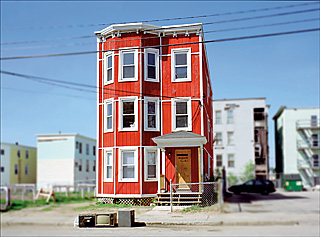
“Domicile I,” a large iris-print photograph by Elke Morris, was part of the “Domicile” series that transformed working-class urban areas into idealistic models.
An essential question: What is quality teaching? The answer resounds like a real estate agent’s “location” mantra: “experience, experience, experience.” And professors who dip their hands into the practical basins of their concentration bring still more depth and color into the classroom.
Bates professors offer this extra dimension to their students. In the Department of Art and Visual Culture, members of the studio art faculty shine as brightly in the Northeast’s art scene as they do in the Olin Arts Center studios. Olin itself provided proof of this extracurricular excellence during the summer, as Innovation and Opportunity: Bates College Faculty was the Museum of Art’s Bates Gallery exhibition last summer.
The work was as diverse as New England weather — and as complex. Paul Heroux’s intriguing stoneware vases, jars, and plates sat heavily in the space, coy like rain clouds pregnant with the cure for drought. The subtle vessels sneaked up on the viewer, then pounced with decoration that silently appeared, decoration that mimicked tidal grass ebbing easily with the current.
If Heroux’s jars were clouds, Penelope Jones’ patterned paintings became the sunsets of lusty romantics. Reminiscent of hand-illuminated Bibles, the lush colors drew in one’s gaze like perfect red lips. Curves against angles kept the viewer busy in an untamed waltz; occasionally the eyes tripped over a scratched area where Jones exposed the foundation of paintings long covered.
The show reminded me of a traditional martini with a twist of innovation, and one painting in particular exemplified this theme. “Sunset” by Robert Feintuch was a powerful look at a humble hero who transcends time. A knight gazed upon the changing atmosphere, wondering. Armor protected chest and head, but his lower body was left vulnerable, soft. The painting was half completed on Sept. 11, 2001, and the artist had no intention of connecting the two, but many viewers saw the image as a delicate narrative of the tragedy.
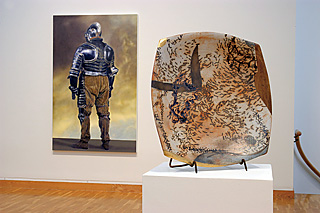
Robert Feintuch’s polymer emulson painting “Sunset” hangs behind “Squared Plate,” a piece of stoneware by Paul Heroux. Photo by Jay York.
Also gifted in creating narratives in their work are Jessica Gandolf, Joe Nicoletti, and art historian Erica Rand. Crisply rendered in oil, Gandolf’s old-time ball players imagined their past lives as quasi-Christ figures. Rand’s work, a collaboration with Elizabeth M. Stephens of the University of California–Santa Cruz swatted the borders between sex, love, and academia. With Renaissance poise and clarity, Nicoletti’s haunting self-portraits in oil questioned the moment yet to come, regardless of direction.
Mixing ideas and media like a baker does dough was how Pamela Johnson created her long copper-bordered standout piece, “One Two Three.” Sifting lucid dreaming with female identity, melting reality with the fairy tales of youth, she wondered if iconoclastic victims such as Snow White would have blossomed had Prince Charming not rescued them from their unkissed existence.
Elke Morris, winner of a Purchase Prize in the 2005 Portland Museum of Art Biennial, brought the viewer home with four images from her “Domicile” series. These large iris-print photographs transformed working-class urban areas into idealistic models, their selectively clean lines and sharp color detracting from decay and grunge. In her prizewinning piece, “Domicile I,” a landfill-bound TV and speaker set line the curb like children waiting for the school bus.
Maggie Knowles is a freelance writer who lives in Raymond, Maine.