Bates in the News
lAso see Bates People in the News for more news items.
It’s exciting when Bates lands high up in a prestigious college ranking or when a major news organization puts us front and center. But what may be more deeply gratifying is to see how often Bates is used in the press, almost casually, as an example of a desirable school.
In April, the University of Chicago campus paper Chicago Maroon ran a story about a local after-school squash program. Quoting the program director’s remark that squash skills can help students get into quality colleges, the writer gave one example — guess who? That same month, in White Plains, N.Y., The Journal News ran a piece offering advice on choosing a school. One of the two high school seniors quoted had been accepted by five schools, but was favoring Bates.
Such small mentions add up to a big mosaic of public awareness. Bates faculty play an important role in that process. Their expertise makes them the go-to folks for all manner of news organizations. In an article about the “gay cowboy” film Brokeback Mountain and its appeal to straight women, for instance, art historian Erica Rand was a resource for the Boston GLBT paper Bay Windows. “I think everybody has desires that are more complicated than people tend to imagine,” Rand told the paper.
Also during the winter, historian Steve Hochstadt played the lead role in a Jewish Telegraphic Agency piece about Jewish oral historians, while Science Daily mentioned anthropologist Bruce Bourque in describing a study of an ancient sea-migration route to the New World.
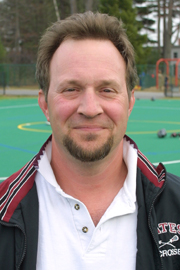
Of course, the media’s big boys are paying attention too. For the second time in recent months, Sports Illustrated looked to head men’s lacrosse coach Peter Lasagna for help with an article on the culture of that fast-growing sport — particularly its tradition of hard drinking. “I am learning that we are never done with this issue,” Lasagna said. The San Francisco Chronicle, meanwhile, talked to philosophy and religion professor John Strong for some authenticity in reviewing an exhibit of Buddhist relics.
And the really big boys, such as The New York Times and The Washington Post, come calling often enough. In April, Dean of Admissions Wylie Mitchell helped The Wall Street Journal with a piece about the shift to a buyers’ market in the admissions wars. (Mitchell and his Admissions colleague, associate dean Kristen Belka, also helped the Portland Press Herald with a story on “senioritis” at the high school level.)
And when there was another big outbreak of SAT news in the late winter and spring — faulty test scoring, and more and more schools dropping the SAT admissions requirement — the newshounds at the Times, the Post, and USA Today knew who to call: Vice President Bill Hiss ’66. Hiss not only led Bates to drop its SAT requirement 22 years ago and commissioned a 20-year study that shows the SAT’s lack of cred as a predictor of academic achievement, but he is unfailingly quotable — the cherry on every journalist’s sundae.