Ask Me Another
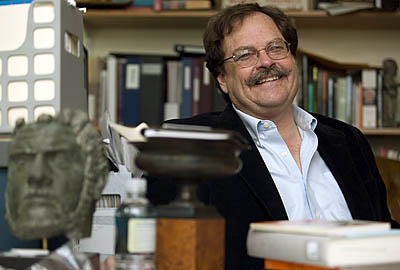
The scholarship of Michael Jones, the Christian A. Johnson Professor of Interdisciplinary Studies, includes The End of Roman Britain, first published in 1996.
Changing climate. Scarce food. Social upheaval. Not Africa in 2007, but Roman Britain in the fifth century when, according to Bates historian Michael Jones, abrupt climate change and famine helped open the door to Saxon invaders. A member of the faculty since 1982, Jones, whose scholarship intertwines history, archaeology, and geography, is the Christian A. Johnson Professor of Interdisciplinary Studies. He spoke with Bates Magazine Editor Jay Burns.
Your first major finding was that Roman Britain had many more people than originally thought.
Doing archaeology in Britain in the 1970s, I kept finding evidence of intensive settlement, in terms of both agriculture and cities. The conventional idea of a small British population easily displaced by the invading Anglo-Saxons just didn’t make sense. I made the case that the population wasn’t 200,000 but perhaps 3 or 4 million.
- Read more of the Michael Jones interview.
Why did people previously believe the population was so small?
No one wanted to find a large population. There’s a racial element. The old notion of a small, culturally unimportant Celtic world displaced by Anglo-Saxon invaders was deeply embedded in English historical thought.
You then used various evidence — ice cores, pollen, peat moss, tree rings — to support your idea that Britain’s climate got cooler and wetter around 450, and that led to famine.
Each source indicated rapid climate change. The realization that they occurred synchronously kicked me into the notion of an environmental crisis associated with the end of Roman Britain. Britain cooled, thus less grain could be grown. Famine struck, the Saxons invaded, and the Romans left. The population took a long time to recover.
Some say that the Dafur genocide is ultimately an environmental crisis due to the Sahara’s advance south.
The desert belts in Africa are an issue of real controversy because some ecological investigations suggest there are changes back and forth, not cumulative desertification. What I do think about is how long it’s been since we’ve had a war over resources, a war overtly over water, or an invasion by one country into another to secure food supplies. With global warming, we might face that prospect again.
With archaeologist Gerald Bigelow and geologist Mike Retelle, you’ve been to the Shetland Islands to research climate effects going back 2,500 years. How does that reflect interdisciplinary studies?
In summer 2005 we rented a house and cooked dinner together each evening. Eating the same meal, drinking the same whiskey, the communication was immediate. One comment — “Boy, we’d really like to know this” — often started a chain of thought in the other two investigators’ minds, about what each might do for the other two legs of the tripod.
Your favorite single malt scotch?
I’ll have to think long and hard on that. Well, no. It’s Linkwood.
You took Bates students to the Shetland site for a Short Term. How does your thinking about students change from going into the field with them?
You learn a lot about their lives — sometimes too much. As a Texan, I might say it’s like looking inside the enchilada! But I admire them. They are cheerful, adaptable, interested, and a delight to teach and work with.
In terms of your department’s own history, what’s the value of having emeriti like Ernest Muller and Jim Leamon ’55 living nearby and staying in contact?
Historians consider that “living memory” lasts up to three generations. Our department is entering the third generation: Ernie and Jim, then the historians they hired, like me, and now the younger historians. We have a living memory and a social memory; it’s a strong human quality.
What’s the standard they set?
The seriousness with which teaching is taken. You learn that teaching is fundamental to your life here, and everything else flows from that.
What’s some good reading in your field?
Roman Britain was a fascinating intersection of cultures — Celtic world, Roman world, Germanic world. A wonderful, well-grounded historical novel is The Eagle of the Ninth, by Rosemary Sutcliff. A more general and new look about what happened to the Roman Empire is The Fall of the Roman Empire: A New History of Rome and the Barbarians, by Peter Heather. Many will have heard of the book Collapse: How Societies Choose to Fail or Succeed, by Jared Diamond; he drives too hard to make a single explanation work for many different periods but does investigate environmental crisis. The Great Famine by William Chester Jordan looks at the dramatic famine during the 14th-century Little Ice Age.
But what about your book?!
The End of Roman Britain — it’s an extremely valuable paperback for not much money, and it’s at least occasionally available at Borders. I know because I visit the copy there!