The Nature of Reality
At Bates, Michael Golden ’91 took eight courses with Professor of Philosophy Mark Okrent, delving into metaphysics and the nature of reality, and learning how to evaluate ideas from different perspectives.
A decade or so after graduation, as the co-founder of @properties in Chicago, one of Inc. magazine’s 500 fastest-growing private companies in 2006, Golden employed those same habits of mind in his approach to the business of realty.
“What I applied to the real estate industry is what I learned at Bates: how to look at things differently,” Golden explains. And perhaps it takes a philosophy major like Golden — he’s actually a double major, including economics, with honors — to give real estate a different look and then apply a set of strategies that are, in fact, very common in business today.
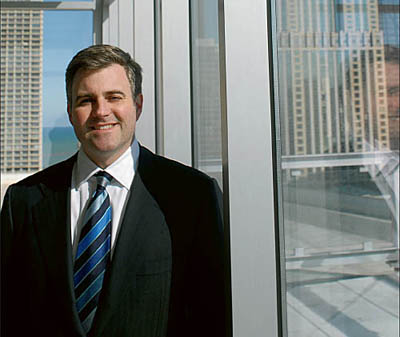
Michael Golden ’91 visits 30 West Oak, a Chicago property his company is now marketing. Photograph by Yvette Marie Dostoni.
Golden founded @properties seven years ago with a partner, Thaddeus Wong, and today the firm is the largest independent real estate brokerage in Chicago. In 2006, the firm cleared $40 million in revenue from $1.7 billion in sales. And notwithstanding all those mind-expanding courses with Okrent, Golden admits that the philosophy behind @properties is “not so different from that of a lot of successful companies in other industries.” He points to a recently published list of the best U.S. companies to work for. “They focus on their employees but expect great results,” he says. In that regard, “the real estate industry is inefficient. We are just trying to find a way to do it better.”
A product of Winchester, Mass., Golden wanted a small-school experience. “I wanted to get to know all the people around me,” he says. His years at Bates taught him how to treat others decently and with respect, and he learned how to form strong relationships in an atmosphere where honesty was stressed. “And integrity,” Golden adds, “important attributes that we stressed when we started our own company. I worked very hard [in college] on the curriculum, but it was in a very positive atmosphere. It was not about any one individual.” A 1988 “Question on the Quad” piece in The Bates Student shows Golden approving of the College’s decision to add sexual orientation to its nondiscrimination statement. “If you claim to be egalitarian, be egalitarian,” he said at the time.
Which, in a roundabout way, brings us to the culture of a traditional real estate brokerage. In Glengarry Glen Ross, when playwright David Mamet focused on real estate agents in a downtrodden Chicago office to tell a tale of desperation and isolation, the setting is hardly incidental. Real estate brokerages aren’t known for their team culture, the matching jackets notwithstanding.
Golden and Wong, though, decided to treat their sales agents in a more humane way, not just to be nice but to improve teamwork and sales production. Echoing what he found valuable about Bates, Golden says that a “business is not about any one individual deal, about any one individual commission. We’re trying to build relationships and friendships and foster a team environment in a business with traditionally no sense of team. This helps us establish and maintain a strong company culture — also rare in this business.”
Golden did human resources consulting before entering real estate. He met Wong at another real estate firm, and they both saw how their boss was “doing everything wrong.” Today, at their four offices in the heart of Chicago, they support their agents by providing everything from in-house business coaches to an array of social and team-building events — right up to renting out Wrigley Field for a company softball party. “When you find out what you have in common with each other and become friends, there is a reason to help each other, and a level of trust,” Golden says.
All this is part of the firm’s “trickle-up” marketing approach, in which
@properties hones the talents of its agents. “We willingly brand the individual, which naturally brands the company,” Golden says. “Most companies only brand the company, to the detriment of the agent.” Agents attend seminars (“to give agents goals and ideas, which the company helps implement”) and have access to a full-time coach experienced in Chicago real estate. Eleven full-time graphic designers assist agents with marketing materials and ad placements for their properties.
Then there’s what @properties doesn’t do, namely nickel-and-dime its agents. Traditional real estate brokerages make agents pay for everything from photocopies to advertising. For a $250 fee, an @properties agent gets a virtual tour of a property as well as print materials, plus listings on multiple pay Web sites. “And we input the listing on craigslist each week,” Golden says. “That all costs us way more than $250, but it ensures the agents get a quality product and it ensures us consistency in the market. Other offices charge this fee and you get nothing.”
Even as the real estate market in Chicago suffers a correction, if not a downright slump, Golden calls it a “great marketplace for us now.” His sales volume was up 31 percent in 2006 while the competition was down as much as 20 percent. From a half-dozen sales agents in 2000, the firm now employs 500 agents.
“I could be vain and say we are total innovators,” says Golden, who lives in the city with his wife, Kelly, and baby daughter. “But we are just taking practices that work in other industries and applying them to ours — along with a little common sense.” Just call it the Golden rule.
Bonnie McGrath is a writer and lawyer who lives in Chicago.