Samuel Huntington Public Service Award
The Samuel Huntington Public Service Award provides a $10,000 stipend for a graduating college senior to pursue one year of public service anywhere in the world. The award allows recipients to engage in a meaningful public service activity for one year before proceeding on to graduate school or a career.
The deadline to apply for the Samuel Huntington Public Service Award is February 15, 2010. Please click here for more information and to obtain an application.
At A Glance: Engaging Students with the Community
The Harward Center for Community Partnerships offers students the opportunity to engage with community partners through:
Community-Based Learning: Academically connected community-based work that includes courses, research, thesis, and independent study;
Fellowships/Community Work-Study: Paid employment that includes work with non-profit agencies;
Volunteerism: Student-led community engagement activities that are not tied to a course and are unpaid. These are one-time, short-term or ongoing activities supported by the Student Volunteer Fellows.
Kudos
-
A plan by three Bates College students to offer Tanzanian street children a survival alternative to a pervasive sex-for-food trade has won a $10,000 award from the 100 Projects for Peace program.
- Read more...
Faculty Profile

-
In April 2007, Lee Abrahamsen was one of three Maine college educators to receive the consortium's Donald Harward Faculty Award for Service-Learning Excellence (named for Bates President Emeritus Harward).
- Read more...
National Recognition
-
The Carnegie Foundation for the Advancement of Teaching recently selected Bates College for its new Community Engagement Classification, created to recognize colleges and universities that have institutionalized community engagement in their endeavors.
- Read more...
What We Stand For
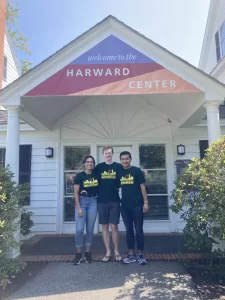
The Harward Center for Community Partnerships leads Bates’ efforts in community-based education. Our mission is to integrate civic engagement into the College’s educational work, undertaking programs that meet community needs, promote active citizenship in a diverse democracy, and enhance the Bates education. We are committed to mutuality and dialogue, believing that we can do with our partners what none of us could do alone. Such collaboration, we believe, enriches not only civic and community life but also liberal education.
Some History
The Harward Center was created in 2002 to honor then-retiring President Don Harward. It rests on the College’s founding legacy of abolitionism, egalitarianism, and inclusion; Bates was one of the first U.S. colleges to admit women and African-American students. President Harward translated that legacy into a commitment to community-engaged education, launching a Center for Service-Learning in the mid-1990s. The Harward Center is fortunate to inherit strong existing programs not only in community-based learning, but also community volunteerism and environmental stewardship.
Core Values
As we build upon these traditions of social responsibility and community engagement, the Center has developed a vision of our work grounded in three core values. We believe that the College and its educational mission have enormous gifts to bring to community life and democratic citizenship—and the responsibility to exercise them. We believe that civic and community engagement will enrich Bates’ educational work and institutional practices, making us better teachers, learners, and scholars. And finally we believe that these twin values depend on a commitment to collaboration and dialogue with our community partners.
Key Goals
These core beliefs are expressed in six key goals, co-equal and interlaced, that shape this first phase of our new Center:
First, we aim to promote mutual understanding, respect, and partnership between Bates and our communities by engaging the college’s academic resources and mission in the enrichment of civic and community life. We understand that both the College and our community partners bring both resources and needs to the table, and that communities themselves have diverse stakeholders and sometimes conflicting interests. The Center aims to do work that fosters both civic and educational capacities.
Second, we aim to encourage Bates students to explore the theory and practice of liberal education as a public good, through both curricular and co-curricular activities. We seek to weave community engagement across the curriculum, with intellectually rigorous models of teaching, learning, research, and culture-making. We also seek to offer students robust opportunities for community-based learning and leadership development, promoting integrative learning that nurtures the civic dimensions of students’ academic, personal, and professional lives.
Third, we aim to nurture a climate of faculty engagement, where faculty can flourish both as teachers and scholars and as partners and agents in public life. We believe that public work is an important medium of excellence for teaching, scholarship, and artistic creation. We aim not only to support such engagement materially and intellectually, but also to overcome the institutional and professional barriers that faculty often confront in linking academic work and civic commitments.
Fourth, we aim to foster Bates’ institutional commitment to civic and social responsibility. Working with other offices across the campus, we are committed to supporting Bates’ institutional commitments to such issues as diversity, environmental stewardship, and the welcoming of the larger community to campus events and facilities.
Fifth, we aim to nuture Bates’ role in the national movement for civic engagement. Bates has been a visible contributor to the movement, and the founding of the Harward Center renews our commitment to work with colleagues nationally to extend and deepen our practices of academic civic engagement and our understanding of the role of academic engagement in democratic citizenship.
Sixth, we aim to create a Center for Community Partnerships that embodies and acts on the values it advocates. We envision the Center as many things: an office sponsoring a vibrant array of programs, a hub of activity in which community and campus stakeholders come together, an advocate for democratic values and best practices, a place of conversation and imagination. We imagine ourselves as creating a culture, through regular communication, a supportive environment, deep inquiry, and participatory processes. We aim to create a center that is at once bold and responsible, playful and thoughtful, full of joy and full of meetings.
Two Final Questions: Where We Work and What Words We Use
We understand our “communities” to stretch across many places and publics. We have a particular commitment to our local communities, and the lion’s share of our work is in Lewiston-Auburn. At the same time, we actively support projects and partnerships on a regional, state-wide, national, and international scale, including the integration of community-based learning into Bates’ extensive study-abroad program. We also view ourselves as part of a growing movement for civic engagement in U.S. higher education, and we actively participate in national efforts and discussions within that movement.
Here and elsewhere we intentionally incorporate different ways of describing our work and our values. We use “civic,” “public,” and “community” in different contexts, as we do “engagement” and “involvement;” we often use the term “community-based” learning and research as umbrella terms for a range of pedagogies. Our intent is to harness the energies and values of these different concepts, not to fix, once and for all, specific meanings and rules of engagement. Indeed, part of what we stand for is constantly revisiting how to think, talk, and write about what we stand for.