Brand Width
John Hassan ’82, senior deputy editor at ESPN.com, looks like a genial bulldog, short and solid and earnest. When I pose a hypothetical question about the future generation of sports consumers, he swivels a picture of his 5-year-old son, Max, toward me. I give the requisite, “Aw, cute,” and he says with a barely perceptible playfulness, “Damn right he is.”
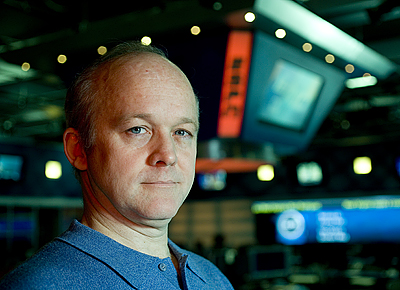
John Hassan ’82 pauses during a busy day at ESPN’s campus in Bristol, Conn., where 27 satellite dishes take in more than 40,000 feeds per year. Photograph by Phyllis Graber Jensen.
Blowups of ESPN The Magazine covers hang around Hassan’s office on the 64-acre ESPN campus in Bristol, Conn. On one wall, a Ramones poster shares space with a black-and-white photograph of Carl Yastrzemski waving goodbye to the Fenway faithful. During our conversation, Hassan’s bright blue eyes frequently dart to SportsCenter playing silently over my shoulder. He is usefully restless, quick, and sharp — you know it’s his job not to miss anything. Hired by ESPN The Magazine a decade ago as a senior editor, Hassan emigrated off the masthead in 2005 to his current job helping to integrate ESPN’s content across print, Web, and broadcast outlets. Whether you call it integrated marketing or convergence journalism, two industry buzz phrases, Hassan’s work has one goal: “to extend the brand across all of these platforms so each medium reinforces the others.”
In seeking this synergy, ESPN has the same personalities — “brands on their own,” Hassan says — appear in those various outlets. For example, in the magazine and online, the ESPN Radio show Mike & Mike has a presence, thanks to Hassan. Then there’s the “Greatest Highlight” project. “Through an ESPN.com poll, SportsCenter viewers voted for the greatest sports highlight of all time,” he explains. “We coordinated the polls and brackets for a countdown on TV and ESPN.com.”
Hassan is the kind of all-around sports enthusiast you might find editing a sports almanac (which he once did). Growing up in Holyoke, Mass., his favorite athletes came from both the Boston sports world and, importantly, beyond. The Yankees’ Don Mattingly, for example, “showed me that hating the other team was just stupid,” explains Hassan. “I loved Don Mattingly. Everything that I found out about him, I liked. It just made no sense to me to hate him and his team.” Hassan has carried the sentiment forward. “At ESPN, we cheer for good stories.”
With a Bates degree in English — his senior thesis was on the lyrics of the Beatles — Hassan began his journey through the publishing business, initially on the advertising side. He worked at Yankee Magazine after classmate J.D. Hale ’82, scion of longtime editor Judson Hale Sr. and now the company’s publisher, gave him a call about a residency program. Then, at the acclaimed but short-lived New England Monthly, he sold advertising for founding editor Dan Okrent.
“I was taught how to sell ads, and taught how to sell,” Hassan says. “It’s a tremendous skill that I thank the Lord I was given, because the rest of your life you’re selling yourself or your idea.”
Sensing I wasn’t sold, he rephrased it. “You need to know how to transfer your enthusiasm for something over to other people. It’s an invaluable skill. Everyone can say they’re above it, but everybody does it.”
In the early 1990s, Hassan again worked for Okrent as marketing director for Okrent’s invention, Rotisserie baseball, a job that evaporated as Rotisserie was overtaken by generic fantasy baseball. (Hassan jokes that his biggest accomplishment was getting The New York Times to capitalize “R” in Rotisserie.)
A lot of freelance hustling ensued — like writing album liner notes for Columbia records and projects for People and Esquire — as Hassan tried to catch up in the editorial world. “That was a good time for me,” he says. “I found out what I was made of, I found out what I was willing to do. I was infused with the attitude of always trying to find the best way to spend my time.”
A phone call from classmate Jeff Melvin ’82, an executive at Information Please Sports Almanac publisher Inso Corp., led to Hassan’s editing the almanac just as ESPN was branding the publication. In the “most beautiful piece of timing,” ESPN announced plans to start a magazine just as Hassan completed the 1998 book. He quickly got an interview for a job at the magazine.
“The day of the interview, we got five boxes of the new almanac. So I go down to Manhattan and I push the almanac across the desk to John Papanek,” the former Sports Illustrated managing editor who helped launch ESPN The Magazine. Hassan pushes a copy across the desk to me like he did almost 10 years ago.
Hassan’s job change in 2005 reflects today’s different media environment. When ESPN The Magazine was launched in 1998, one major goal — besides starting a sports magazine — was to connect the magazine back to the network. “We had to remember that people would expect this magazine to reflect what they liked about those four letters,” says Hassan.
Ten years later, that mission has many more fronts. “People expect to get their ESPN, be it scores, highlights or analysis, from their TV, computer, magazine, radio, cell phone, BlackBerry, and iPod Touch,” he says. “Not to mention from the screen facing you in the back seat of a New York City taxi.”
By Joshua Friedman
Joshua Friedman is a freelance writer living in Newton, Mass.