Composition One-on-One
“You can do the greatest research,” says neuroscience major Erin Bond ’09, “but if you can’t explain your findings effectively, it means basically nothing.” Writing is essential to explaining, and Bond is one of a corps of student writing tutors supporting the College’s effort to enhance, consolidate, and draw attention to the teaching of writing.
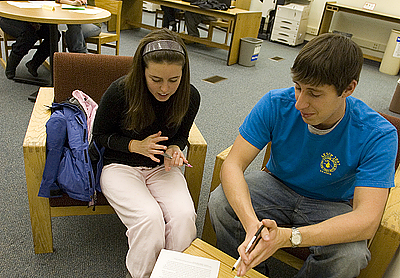
In Ladd Library’s Peer Writing Center, tutor Jon Blanchard ’08 of Tewksbury, Mass., works with Alie Schwartz ’08 of Charlotte, N.C. She’s writing a classics honors thesis (“Omens: The Undiscovered Voice of the Common Roman”) and sought advice on how to make her writing “understandable and clear to the everyday reader.” Photograph by Phyllis Graber Jensen.
Along with a stronger drive toward interdisciplinarity and stiffer requirements in science-related disciplines, this renewed emphasis on writing is central to the general education requirements implemented last fall — just as writing is central to the academic enterprise.
“I’m not sure how universally we’ve communicated to students explicitly that writing is a value and a goal of a Bates education. And now we’re making that very explicit,” explains Associate Professor of Mathematics Bonnie Shulman, who co-chaired the creation of the new gen-ed requirements and now co-chairs the First-Year Seminar and Writing Committee with philosopher Susan Stark.
As Bates began the four-year transition to the new requirements last fall, resources committed to that fundamental shift included the students in the Peer Writing Project. This semester, 16 peer writing assistants have evening shifts in Ladd Library, staffing a drop-in center for students seeking guidance. Another 11, meanwhile, are serving on the front lines as tutors attached to specific courses. (Two assistants are filling both roles.)
The peer-writing initiative has succeeded in ways both predictable and surprising. “It’s a low-stakes encounter for a student to drop in at Ladd and just chat for half an hour about a paper. It’s convenient, it’s accessible, and the evening hours are wonderful,” says Peer Writing Project coordinator Joanne Fennessey Cole ’77.
More than anything, Cole says, peer tutoring works for the simple reason that students speak a common language. “The social piece looms large,” she explains. As approachable as Bates faculty strive to be, some students will always be more comfortable with each other than with authority figures. In addition, says Cole, “Student tutors really do bring a special insight to the conversation because they have so recently wrestled with all these writing issues themselves.”
Faculty with peer writing assistants attached to first-year seminars last autumn could use them to support the classes’ writing as they saw fit. Some tutors worked alongside professors in the classroom, as well as one-on-one with students. Helen Regan, of the education faculty, says that she regarded her PWP assistant, Leigh Warner ’10, “as a colleague.”
“It’s really hard to measure, but I think that the improvement that I saw with several students would have been less without Leigh’s help, because there was just more coaching available,” Regan says. The Ladd writing center, meanwhile, is in a large room near the periodicals area. It’s open from 7 until 11 p.m. Sunday through Thursday — prime time for students grappling with writing issues.
Through readings assigned during the summer of 2007 and in group sessions early last semester, Cole trained the tutors to deal with everything from fine grammatical points to the overall organization and flow of a text — structural issues that proved to be among clients’ more common concerns.
| Writing Done Right
Peer writing tutors emphasize what program coordinator Joanne Fennessey Cole ’77 calls “first-order concerns that distinguish strong academic writing and that can be carried from one assignment to the next”: • A strong, clear focus • Awareness of audience and purpose • A structure appropriate for the purpose and effective for the reader • Voice and commitment to the subject • Development of ideas and effective use of evidence • Clarity of expression |
One of the writing lessons that the College is emphasizing is the importance of revision. “Bates students typically start a paper only a few days before it’s due, finish it the night before, read through it once for spelling and grammar, and then turn it in,” says Ladd tutor Jon Blanchard ’08. “One of our aims is to alter this culture of completing assignments at the last minute without a formal revision process.”
During his shifts at Ladd, reports tutor Owen Harris ’08, “I was surprised by the variety of questions. Some people came with just an outline — or not even an outline — just looking for help brainstorming and coming up with a place to start. Others came with papers that had already been corrected by the professor, but they were being allowed to revise, and needed help deciphering the professor’s comments. “And there was pretty much everything in between.” Including pure moral support. “We’re finding that one of the tutors’ most important roles is to reassure students,” says Cole. “Some students come to Bates uncertain about the expectations of college-level writing, and the writing assistants are here to say, ‘You’re doing fine. Be confident.’”
The tutors see themselves as guides or mentors, not hard-boiled copyeditors. The tutoring approach is inquisitive and supportive, not critical. Emma White, a student in a first-year chemistry seminar taught by Paula Schlax, consulted twice with tutor Bond. “Erin had me read my paper out loud and answer her questions about what messages I meant to convey to the reader,” White says. “This really helped — it showed me the differences between what I wanted to say and what I wrote. I can look more critically at my own writing.”
Tutor Regina Tavani ’10 was attached to a first-year seminar in English. “I really tried to establish myself as a kind of gentle guide rather than as a strong force in how the students improved their papers,” she says. “The program taught us that we should seek to improve not only the paper, but much more importantly, the writer.”