Environmental Geochemistry Laboratory
Located in the Earth and Climate Sciences Department in Carnegie Science Hall, the college’s Environmental Geochemistry Laboratory hosts a suite of instrumentation used for teaching and research in the broad field of Environmental Geochemistry.
The instrumentation includes the following:
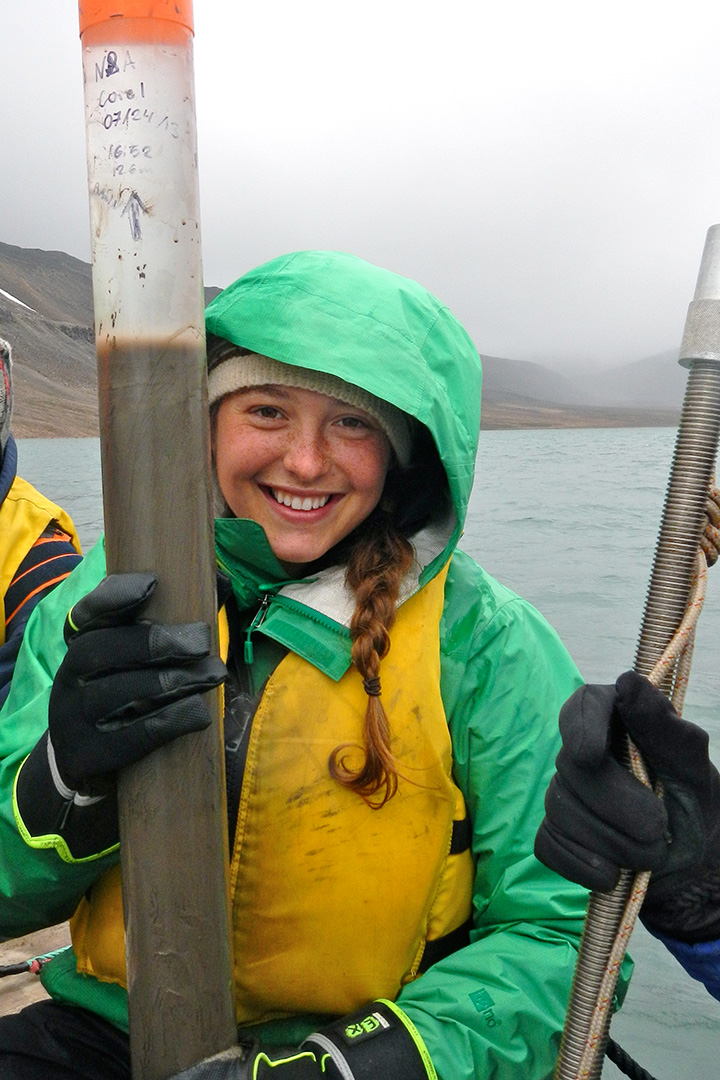
Ali Balter ’14 displays a sediment core sample she collected from Lake Lennoré, an Arctic lake in Svalbar, Norway. She did the lab analysis of the core in the college’s Environmental Geochemistry Laboratory. (Photograph by Greg de Wet ’11)
- Stable isotope ratio mass spectrometer (IRMS) interfaced to an elemental analyzer (EA) and a gas chromatograph (GC) via a combustion interface; EA/GC-C-IRMS
- Gas chromatograph with a flame ionization detector; GC-FID
- Inductively coupled plasma optical emission spectrometer; ICP-OES
- Organic geochemistry sample preparation equipment
The laboratory is designed for organic and inorganic chemical analyses of geological and biological materials (i.e., sediments, fossils, soils, plants, waters, animals).
Organic projects entail measuring the stable carbon and nitrogen isotope composition of organic material (bulk organics and specific biomolecules) preserved in geological samples to better understand nutrient cycling and environmental change through time.
Inorganic projects entail measuring elemental concentrations in environmental samples to help understand contaminant transport through the Earth system.
In classes, students use the EA/GC-C-IRMS to investigate changes in carbon cycling (GEO 340) and food web dynamics (BIO 270) in a Maine salt marsh. Students use the ICP-OES to investigate copper, zinc and lead concentrations in plants, soils and waters at an acid mine drainage site (GEO 240), lead concentrations in house paint (ES 203) and soil lead uptake by plants (CHEM 107B).
Recent faculty and senior thesis research projects include stable isotope and lipid biomarker concentrations of sediment cores to reconstruct paleoenvironments in NE Siberia, Australia, and coastal Maine, and paleodiets of extinct marine animals in coastal Maine.
EGL Equipment sign out form found here – Please fill out the attached google form when signing out EGL equipment or sensors.
Questions or comments regarding the use of this facility should be directed to Professor Beverly Johnson (bjohnso3@bates.edu).