Paul Savello '66
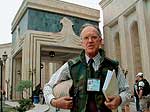
In the Green Zone
By H. Jay Burns
When Paul Savello ’66 has a cross-town business meeting, he dons a flak jacket and Kevlar helmet and climbs aboard an armored Humvee mounted with a .50-caliber machine gun. As he goes over his notes, the soldiers aboard keep alert for snipers and IEDs, the improvised explosive devices hidden in everything from Pepsi cans to dog carcasses.
A civilian food safety and technology expert contracted by the U.S. Department of Defense, Savello advises the Iraqi Ministry of Science and Technology in Baghdad. He works in the former Republican Palace inside the Green Zone, the 4-square-mile home of the Coalition Provisional Authority.
Recently, Savello ventured outside the Green Zone to MoST headquarters, where he delivered a major seminar for 100 or so top Iraqi scientists, experts with advanced degrees from some of the best universities in the world.
The subject of his seminar? “How to write a successful research grant proposal,” Savello says with a sigh.
For 15 years, Iraq’s scientific community has been isolated and under Saddam Hussein’s thumb. “They never wrote grant proposals because they were told what to research,” says Savello. Now, their attempts are “so open-ended as to be what we call ‘fishing trips.'”
Such are the fundamental challenges facing Savello and others who advise MoST, a 10,000-member ministry. “The pace of things is remarkably slow,” says Savello, a former consultant to Uruguay president Jorge Batlle. “A hundred times slower than in Latin America, and that’s already too slow.”
Among other projects, Savello has been helping MoST reactivate the country’s regulatory systems for food and water safety. “Pictures are worth a thousand words, and I’ve got a zillion pictures of slaughterhouses that slaughter animals on the floor, let the blood drain into a stream out back, and use ditch water to wash the floor.”
But for every problem in Iraq, there’s a bigger one needing more attention. “You can’t rush into a regulatory system,” he says, “because Iraq needs general security, then it needs food security — people getting enough to eat — before it needs food safety.”
Savello is also helping the Iraqi agriculture ministry restore the country’s date palms, extensively destroyed in the 1990s. “It’s important, considering the date used to be Iraq’s major agricultural export, and that the date palm is the country’s national symbol,” he says.
Since arriving in Baghdad in February, Savello has worked 11-hour days and seven-day weeks, the norm for people working in the former palace. “I’ve taken six hours off since February,” he admits.
Talking to Bates on a cell phone, Savello stands at the back of the palace overlooking a huge swimming pool. Asked if working inside the palace is any different from, say, working in Cleveland, he says, “No. At this point, the palace is just a just a gigantic building with lots and lots and lots of offices.”
Well, there are those pesky rockets occasionally lobbed into the Green Zone from somewhere outside the massive walls of reinforced, blast-proof concrete. “They can land close, a couple hundred yards,” he says. “But the Green Zone is so big, and they’re so random.” On Easter morning, for example, Savello’s early rising had nothing to do with sunrise services. “The rockets started at around 4:45 and were hitting somewhat close to the trailer park I’m in. They kept going off, so I got up and went to breakfast in the palace.” Like the way Britons got used to buzz bombs in World War II, Savello says “we don’t even jump” at the rockets any more.
A former Peace Corps worker in Uruguay after Bates, Savello also taught and researched at Utah State for 12 years. He ticks off other food and environmental problems facing Iraq but says just refurbishing MoST’s science facilities, destroyed during and after the war, would be nice.
“If we could tomorrow get $1 million of analytical equipment — chicken feed compared to what is being spent hourly here — it would be a huge thing,” he says.