Bates Matters
CALLED TO THE TABLE — Conversations about food remind us that a liberal education prepares the whole human being for life
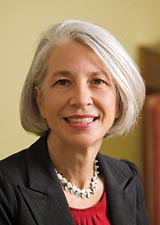
By Elaine Tuttle Hansen
This year’s theme for reflection and action — Nourishing Body and Mind: Bates Contemplates Food — celebrates two fortuitous circumstances. The first is the opening of our new dining Commons, an inviting space that reflects our students’ unswerving desire to dine as a single community. The second is a $2.5 million gift to the endowment to support the additional purchase of more local, organic, and natural food here on campus.
This anonymous gift from a Bates alum — perhaps the first, and certainly the largest, of its kind to a U.S. college — builds on our strengths and recognizes the additional costs of certain sustainable practices. Before the gift, about 22 percent of our food already came from local farmers and vendors; now we are able to purchase about 28 percent from these sources. Up to 84 percent of the food we don’t use re-enters the food cycle: to a food bank, into compost or to a recycling center, or as “waste” to a local pig farmer to be consumed as food by another species. We have never outsourced our food operations, and for many years staff members have been strong supporters of our environmental and communal ethos.
The purpose of Bates Contemplates Food is to call attention to ongoing programs as well as special events that teach us to ask questions about food. Where does it come from? How is it sourced and prepared at Bates? What is our role in the larger food system in which we are all embedded? Why are sustainable, healthy food cultures so important and so endangered, and what is the relationship between how we eat and how we think? Seeking answers often means confronting how little we know about complex and confounding issues ranging from dependence on petroleum and diet-related diseases in the U.S. to threats like species extinction and global hunger. But by feeding body and mind together, we may learn to make better choices in the face of complexity.
| True, students wanted a bigger and brighter and better Commons, but their ideas focused on a better space for one and all. |
In presenting Bates Contemplates Food to the College audience at Convocation this fall, I juxtaposed two stories, one fictional and one factual. The first story, about two meals the narrator eats on her visit to the fictional university of Oxbridge, is taken from the opening chapter of Virginia Woolf’s A Room of One’s Own, where Woolf introduces her argument about the relationship among money, space, and creative thought.
The luncheon meal at one of the men’s colleges is a glorious feast: “partridges…with all their retinue of sauces and salads” and “potatoes, thin as coins but not so hard….sprouts, foliated as rosebuds but more succulent.” Consumed slowly and satisfyingly, the sumptuous meal has the effect of lighting a “profound, subtle and subterranean glow which is the rich yellow flame of rational intercourse.”
The meager evening meal, by contrast, is taken at Fernham, the neighboring women’s college recently founded on a small endowment to promote the radical idea of higher education for women. This meal of stringy beef and prunes dampens the spirit, leaving Woolf to
her unexceptionable conclusion: “One cannot think well, love well, sleep well, if one has not dined well.”
The second story that I told at Convocation was about Bates dining itself. While the spirit of communal Bates dining has always been strong and willing — notwithstanding the historical reality that Bates women of my generation were the very first to be allowed to eat in the same dining hall with men — the physical space of Bates dining, Chase Hall’s Commons, grew less adequate to our dining needs over the years.
In planning to correct that situation, our architects initially advanced the au courant idea of “distributed dining” — multiple facilities spread around the campus, with food courts and fast-food franchises. To their surprise, Bates students promptly vetoed the idea and insisted on dining as a committee of the whole. True, they wanted a bigger and brighter and better Commons, but their ideas focused on a better space for one and all. And so we built a place where cooks and servers could excel in their work, and where students would be called to the table to eat nourishing food with good friends and great ideas.
Both the new Commons building and our sustainable dining practices are now more visibly than ever at the heart of our educational vision, reminding us that a liberal education prepares a whole human being for life. Today, in the high-speed, high-tech, competitive, and distracting world where we eat too much and too fast and too often alone, it’s critical to ensure that respectful and ethical human interaction is still at the core at Bates College.