The Department of Chemistry and Biochemistry focuses on teaching, learning, and scholarship within chemistry and intersecting disciplines.
Students will develop an understanding of the foundational theories of chemistry, apply these theories to the practice of reasoning from evidence, and learn to appreciate the role of science in society.
Contact Us
Thomas Pinette, Academic Administrative Assistant
45 Campus Avenue
Bonney Science Center Phone: 207-755-5928
tpinette@bates.edu
What You Will Learn
To develop and apply the foundational theories of chemistry and biochemistry
How to analyze experimental approaches and data analysis from scientific literature in order to understand how we gain new knowledge
To communicate with both scientific audiences and the general population, both orally and through written work
How to examine scientific work through the lens of society and populations with variable amounts of power and privilege
To conduct original research in a capstone course or a research lab
To understand science as a human activity practiced by a collaborative and diverse community
Life After Bates
Many majors go on to earn graduate degrees in chemistry, biochemistry, engineering, molecular biology, or microbiology. Students are well-prepared for professional post-graduate, health-related study in medical school, nursing school, veterinary school, dental school, and public health. Recent grads work in fields related to healthcare, consulting, pharmaceutical research and development, biotech, materials, and energy, among others.
91%
of 2020-2024 science and math graduates are employed and/or attending graduate school
” Looking back, I felt exceptionally well-prepared for medical school and my subsequent career in surgery following my degree in Biological Chemistry from Bates. Throughout my education, I was challenged academically in a manner that made me think critically and required a deep understanding of the subject matter well-beyond simple memorization. These skills were invaluable as I made my way through the rigorous curriculum of medical school. My education at Bates was capped by my honors thesis, which I performed under the mentorship of Paula Schlax. I still consider my thesis experience, from study design and lab work through a presentation in Washington, DC and manuscript preparation, the start of my career as an academic surgeon.”
— Nicholas Swerdlow
Selected Places of Employment/Service
Massachusetts General Hospital
Boston Children’s Hospital
Dana-Farber Cancer Institute
Broad Institute of MIT and Harvard
Brigham and Women’s Hospital
Mass General Brigham
Pfizer
MIT Koch Institute for Integrative Cancer Research
Beth Israel Deaconess Medical Center
Eurofins
Selected Graduate Schools
MIT
Columbia University
Johns Hopkins University
Stanford University
Duke University
Yale University
Northwestern University
University of Cambridge
Harvard University
Cornell University
They are jumping for joy.
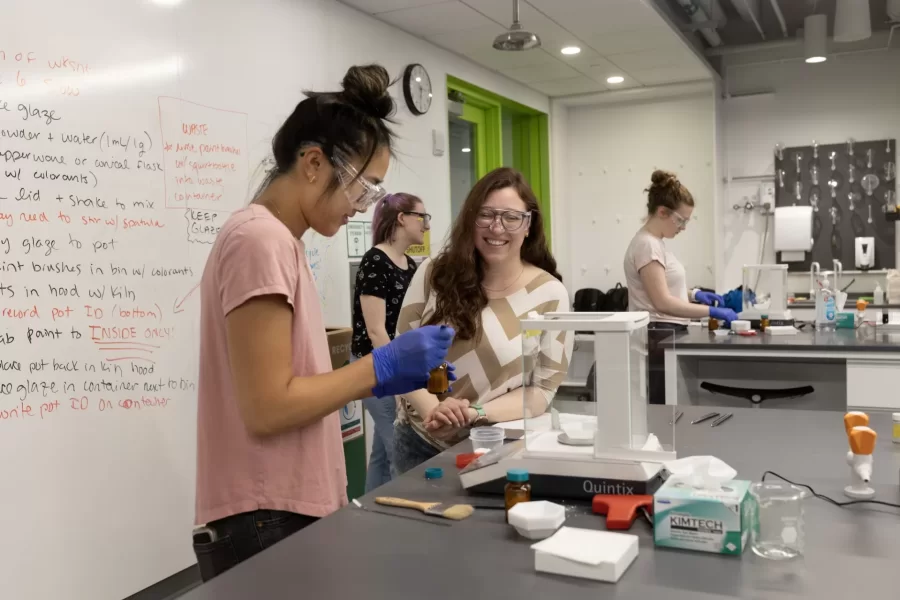
Women’s varsity rowing teammates Oli Seline ’24 (left) of Delaware, Ohio, and Olivia Dekker ’24 of Bethesda, Md., high five it at the conclusion of their last-ever Bates lab in Bonney 360.
The teammates are students in Assistant Professor of Biochemistry Geneva Laurita’s Short Term course, “Chemistry and the Arts.”
Seline is a biochemistry major with a GEC in “Visible Ideas,” while Dekker is a biochemistry major with a minor in art and visual culture.
The course explores the connection between chemistry and various topics in the arts and arts-related fields. The students learn about the chemistry behind these topics, exploring the literature behind various artistic practices, and applying hands-on techniques in the laboratory involved in various art processes
This year, Laurita asked students to focus on the origins of color, different crafts, print making, jewelry making, dyeing, and art conservation.
Laurita is the recipient of a major National Science Foundation grant of $581,984. The NSF CAREER award, considered to be one of the foundation’s most prestigious awards for faculty members who are just beginning their teaching and research careers, is based on both her scientific research in solid state materials and how she brings undergraduates into that vital area of scientific exploration.
3:18
What the particular lab was about…the lab handout.
Kate Baumler, intern for Geneva’s NSF grant, wearing, black shirt
Benji Richards, ’27, wearing tan shirt
Finian Gunny ’27, gray pullover and blond hair
Charlotte Maffie ’25 with pink tie dyed and hair in bun
Sister Alice Maffie ’27 in t-shirt and pony tail
Nina Greeley ’24 with hair in bun and pink t-shirt
Riley Lund ’26 in gray sweatshirt
Jahan Baker-Wainwright ’25 in green golf
Rohini Kandasamy ’27 in dark tan Life is cool t-shirt and low bun
Chemistry and the Arts S28, the origin of different crafts, print making, jewelry making, dyeing and art soncserv
It’s quintessential Bates as the college community shows the power of love in supporting students and their academic achievements at Mount David Summit.
Friday, April 5, 2024 in Pettengill Hall.
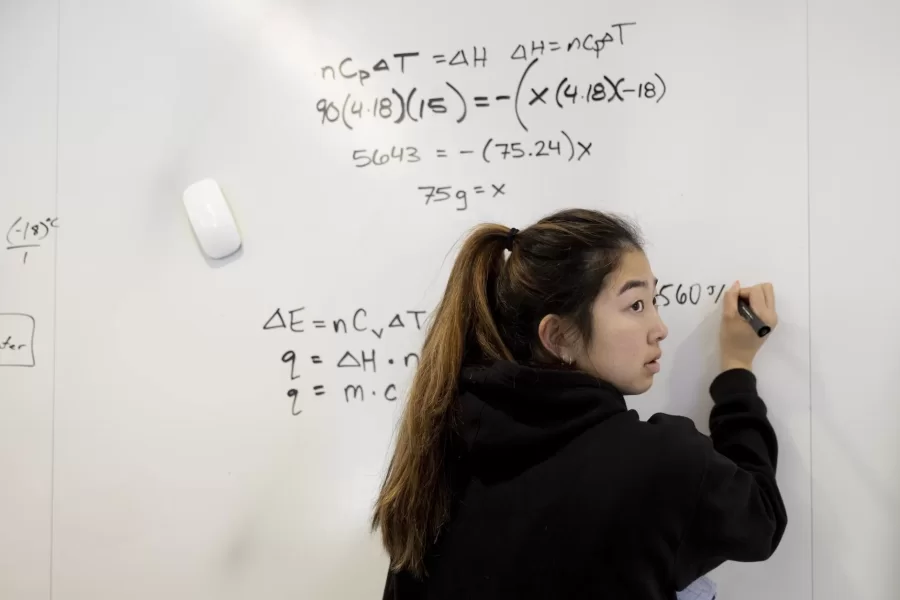
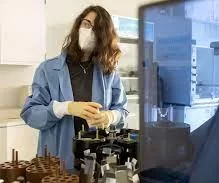
Assistant Professor of Chemistry Geneva Laurita teaches CHEM 108A – Chemical Reactivity/Lab on Monday, Jan. 30, 2023.
A continuation of CHEM 107A. Major topics include thermodynamics, kinetics, equilibrium, acid/base behavior, and electrochemistry. Laboratory: three hours per week.
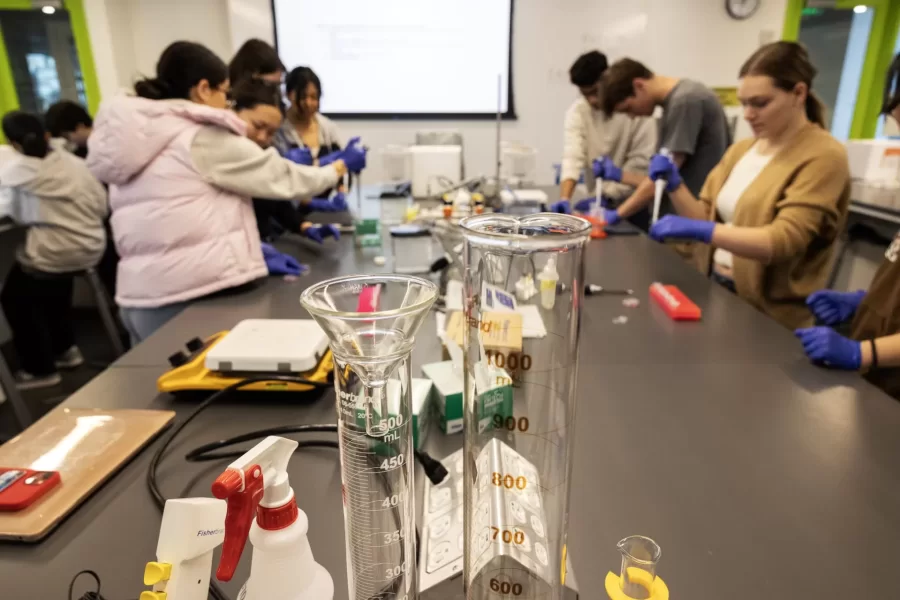
Moments from Lab-Based Biological Inquiry Cellular Neuroscience taught by Martin Kruse, associate professor of biology and neuroscience, in Bonney Science Center Room 370 on January 25, 2024. (Theophil Syslo | Bates College)
They are jumping for joy.
Women’s varsity rowing teammates Oli Seline ’24 (left) of Delaware, Ohio, and Olivia Dekker ’24 of Bethesda, Md., high five it at the conclusion of their last-ever Bates lab in Bonney 360.
The teammates are students in Assistant Professor of Biochemistry Geneva Laurita’s Short Term course, “Chemistry and the Arts.”
Seline is a biochemistry major with a GEC in “Visible Ideas,” while Dekker is a biochemistry major with a minor in art and visual culture.
The course explores the connection between chemistry and various topics in the arts and arts-related fields. The students learn about the chemistry behind these topics, exploring the literature behind various artistic practices, and applying hands-on techniques in the laboratory involved in various art processes
This year, Laurita asked students to focus on the origins of color, different crafts, print making, jewelry making, dyeing, and art conservation.
Laurita is the recipient of a major National Science Foundation grant of $581,984. The NSF CAREER award, considered to be one of the foundation’s most prestigious awards for faculty members who are just beginning their teaching and research careers, is based on both her scientific research in solid state materials and how she brings undergraduates into that vital area of scientific exploration.
3:18
What the particular lab was about…the lab handout.
Kate Baumler, intern for Geneva’s NSF grant, wearing, black shirt
Benji Richards, ’27, wearing tan shirt
Finian Gunny ’27, gray pullover and blond hair
Charlotte Maffie ’25 with pink tie dyed and hair in bun
Sister Alice Maffie ’27 in t-shirt and pony tail
Nina Greeley ’24 with hair in bun and pink t-shirt
Riley Lund ’26 in gray sweatshirt
Jahan Baker-Wainwright ’25 in green golf
Rohini Kandasamy ’27 in dark tan Life is cool t-shirt and low bun
Chemistry and the Arts S28, the origin of different crafts, print making, jewelry making, dyeing and art soncserv
They are jumping for joy.
Women’s varsity rowing teammates Oli Seline ’24 (left) of Delaware, Ohio, and Olivia Dekker ’24 of Bethesda, Md., high five it at the conclusion of their last-ever Bates lab in Bonney 360.
The teammates are students in Assistant Professor of Biochemistry Geneva Laurita’s Short Term course, “Chemistry and the Arts.”
Seline is a biochemistry major with a GEC in “Visible Ideas,” while Dekker is a biochemistry major with a minor in art and visual culture.
The course explores the connection between chemistry and various topics in the arts and arts-related fields. The students learn about the chemistry behind these topics, exploring the literature behind various artistic practices, and applying hands-on techniques in the laboratory involved in various art processes
This year, Laurita asked students to focus on the origins of color, different crafts, print making, jewelry making, dyeing, and art conservation.
Laurita is the recipient of a major National Science Foundation grant of $581,984. The NSF CAREER award, considered to be one of the foundation’s most prestigious awards for faculty members who are just beginning their teaching and research careers, is based on both her scientific research in solid state materials and how she brings undergraduates into that vital area of scientific exploration.
3:18
What the particular lab was about…the lab handout.
Kate Baumler, intern for Geneva’s NSF grant, wearing, black shirt
Benji Richards, ’27, wearing tan shirt
Finian Gunny ’27, gray pullover and blond hair
Charlotte Maffie ’25 with pink tie dyed and hair in bun
Sister Alice Maffie ’27 in t-shirt and pony tail
Nina Greeley ’24 with hair in bun and pink t-shirt
Riley Lund ’26 in gray sweatshirt
Jahan Baker-Wainwright ’25 in green golf
Rohini Kandasamy ’27 in dark tan Life is cool t-shirt and low bun
Chemistry and the Arts S28, the origin of different crafts, print making, jewelry making, dyeing and art soncserv
Campus scenes from Oct. 11, 2024.
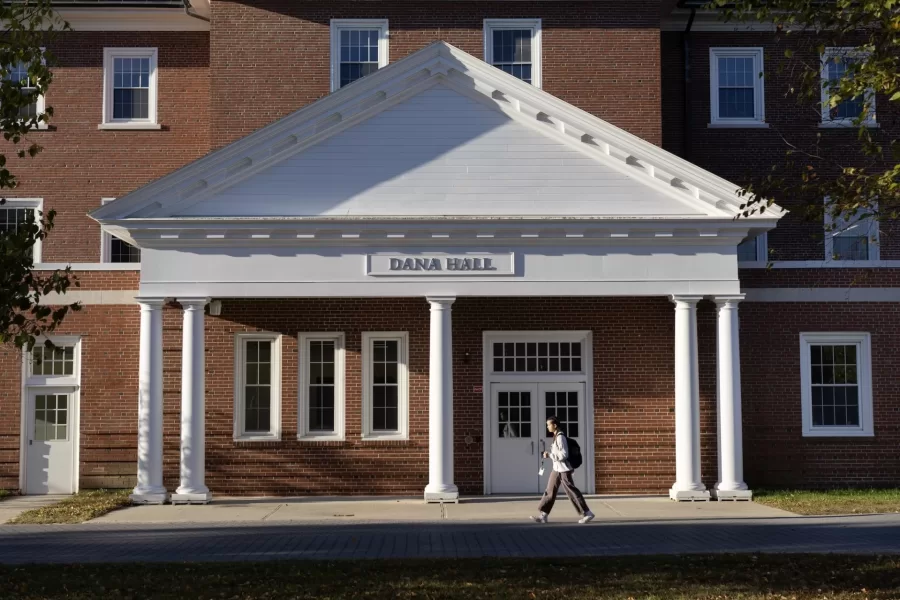
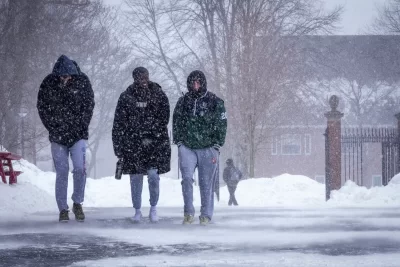
Students pass by Dana Chemistry on Alumni Walk.
They are jumping for joy.
Women’s varsity rowing teammates Oli Seline ’24 (left) of Delaware, Ohio, and Olivia Dekker ’24 of Bethesda, Md., high five it at the conclusion of their last-ever Bates lab in Bonney 360.
The teammates are students in Assistant Professor of Biochemistry Geneva Laurita’s Short Term course, “Chemistry and the Arts.”
Seline is a biochemistry major with a GEC in “Visible Ideas,” while Dekker is a biochemistry major with a minor in art and visual culture.
The course explores the connection between chemistry and various topics in the arts and arts-related fields. The students learn about the chemistry behind these topics, exploring the literature behind various artistic practices, and applying hands-on techniques in the laboratory involved in various art processes
This year, Laurita asked students to focus on the origins of color, different crafts, print making, jewelry making, dyeing, and art conservation.
Laurita is the recipient of a major National Science Foundation grant of $581,984. The NSF CAREER award, considered to be one of the foundation’s most prestigious awards for faculty members who are just beginning their teaching and research careers, is based on both her scientific research in solid state materials and how she brings undergraduates into that vital area of scientific exploration.
3:18
What the particular lab was about…the lab handout.
Kate Baumler, intern for Geneva’s NSF grant, wearing, black shirt
Benji Richards, ’27, wearing tan shirt
Finian Gunny ’27, gray pullover and blond hair
Charlotte Maffie ’25 with pink tie dyed and hair in bun
Sister Alice Maffie ’27 in t-shirt and pony tail
Nina Greeley ’24 with hair in bun and pink t-shirt
Riley Lund ’26 in gray sweatshirt
Jahan Baker-Wainwright ’25 in green golf
Rohini Kandasamy ’27 in dark tan Life is cool t-shirt and low bun
Chemistry and the Arts S28, the origin of different crafts, print making, jewelry making, dyeing and art soncserv
Why Study Chemistry and Biochemistry at Bates?
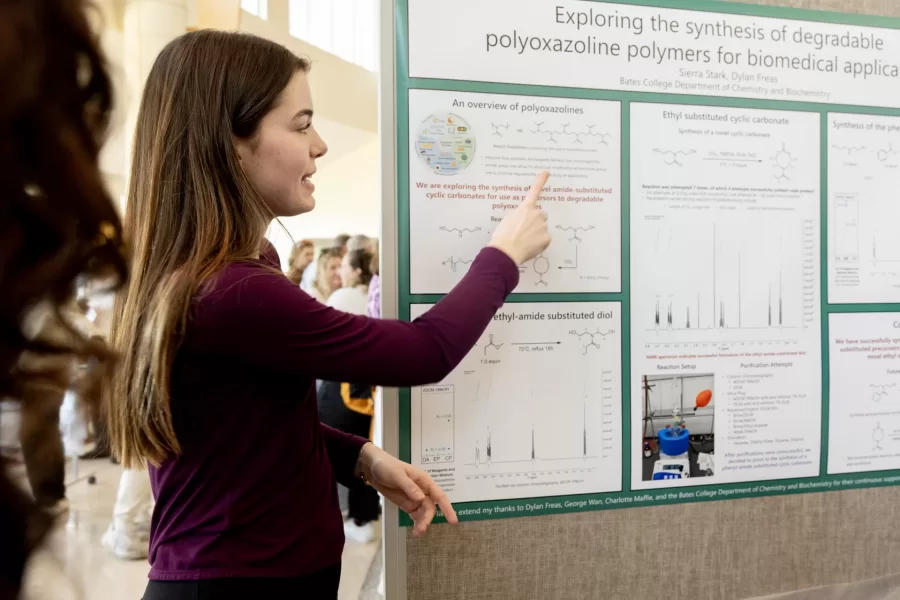
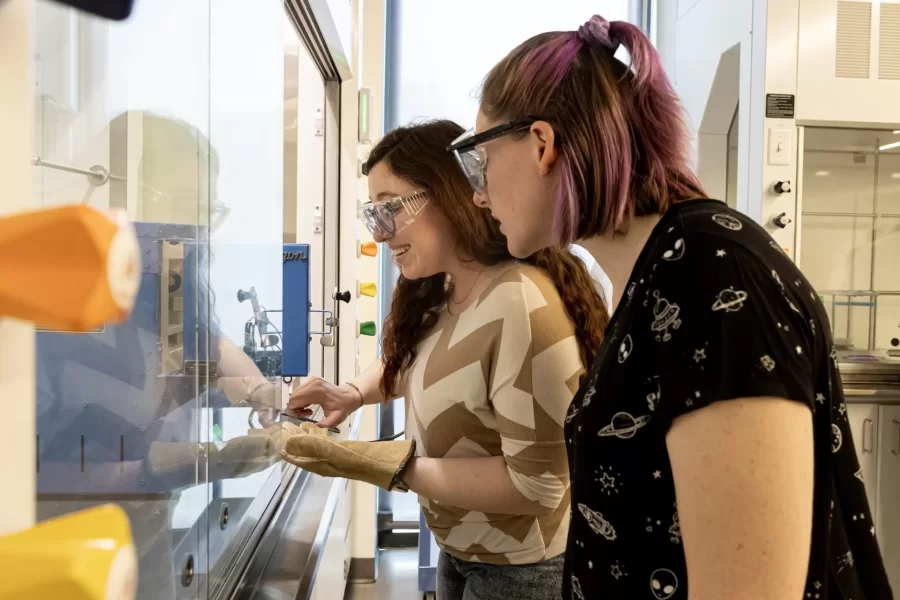
Our classes emphasize active learning both in the classroom and the laboratory, offering a variety of hands-on learning opportunities. Students and faculty work closely together to conduct scholarly work through real-time experimentation in instructional and research labs. The department supports collaboration of faculty and students across disciplines and endeavors to create a supportive, inclusive environment for all members of the Bates community interested in chemistry and related fields.
Featured Courses
Meet the Faculty
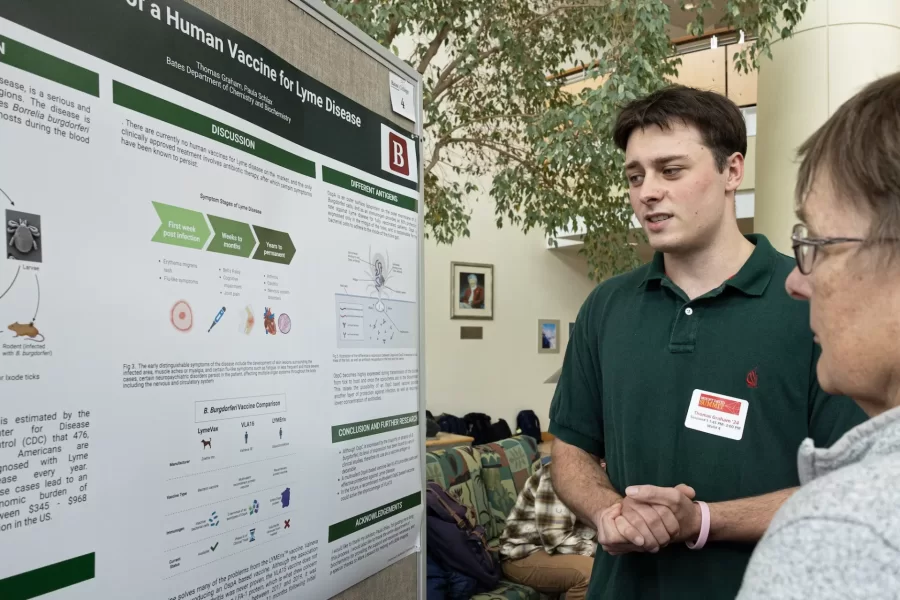
Faculty members have expertise in all areas of chemistry, including analytical, biochemistry, computational, inorganic, organic, and physical chemistry, and every faculty member is active in research in their respective fields. Some have received grants from NIH, while others collaborate with researchers at major universities to break new scientific ground. Faculty present their work at national meetings and specialty conferences and regularly co-author with students on publications in nationally renowned journals.
In the Student Center for Belonging and Community, first-generation Bates students mentor their younger peers, providing guidance on everything from academics to internships to social life.
Bates is embarking on a $45 million project to update two key athletic facilities and construct a new fitness and well-being center. A gift of $10 million from Jon W. Brayshaw ’90, P’25 and Jocelyn Stoddard Brayshaw ’88, P’25 has brought the college a vital step closer to construction. The new facility will be named the Stoddard Fitness and Well-Being Center.
February on campus saw sports successes, several large snowfalls, and our annual Winter Carnival — a week of events celebrating the joys of the chilly season.