The Program in Digital and Computational Studies allows students to explore society’s relationship with digital technology.
With courses in artificial intelligence, machine learning, data science, and beyond, DCS is geared toward accessible knowledge that can be applied across multiple disciplines. All seniors majoring in DCS participate in a closely mentored capstone project, where they get the chance to work with a local partner to research, design, and build a solution for a real-world problem affecting people in their community.
To develop proficiency in fundamental aspects of algorithmic thinking, software development, and data science
How to use critical theory to identify ethical and social issues and structures of inequality in computing and digital spaces
How to engage in professional practices that encourage collaboration, transparency, and equitable access
How to build, design, analyze, and critique digital tools and algorithms
How to communicate complex ideas both orally and in writing, appropriate to the audience
To interrogate the assumptions of the digital world
Life After Bates
The digital and computational science major is a strong foundation for a successful career across a wide variety of fields, including software development, AI engineering, and data analysis. The skills and knowledge gained from this degree are also transferrable to fields as far ranging as art and education to politics, government, and education.
91%
of 2020-2024 science and math graduates are employed and/or attending graduate school
Selected Graduate Schools
Bentley University McCallum Graduate School of Business
Boston College Carroll School of Management
Boston University
Brown University
Columbia University
Public History in the Digital Age
Public history takes place beyond history classrooms and academic contexts. Traditionally, it has been found in museums, walking tours, and performances, and has told the stories of people with social and political privilege. Increasingly, however, public history has come to focus on a greater range of voices, and takes place in a wider range of forms: on websites, graphic novels, interactive sensory experiences, social media, and other digital spaces. In this community-engaged course, students learn to see public history “in the wild,” engage with primary sources, and present those sources and historical interpretation to the public in digital form. Students with interests in history and public engagement are encouraged to enroll in this course.
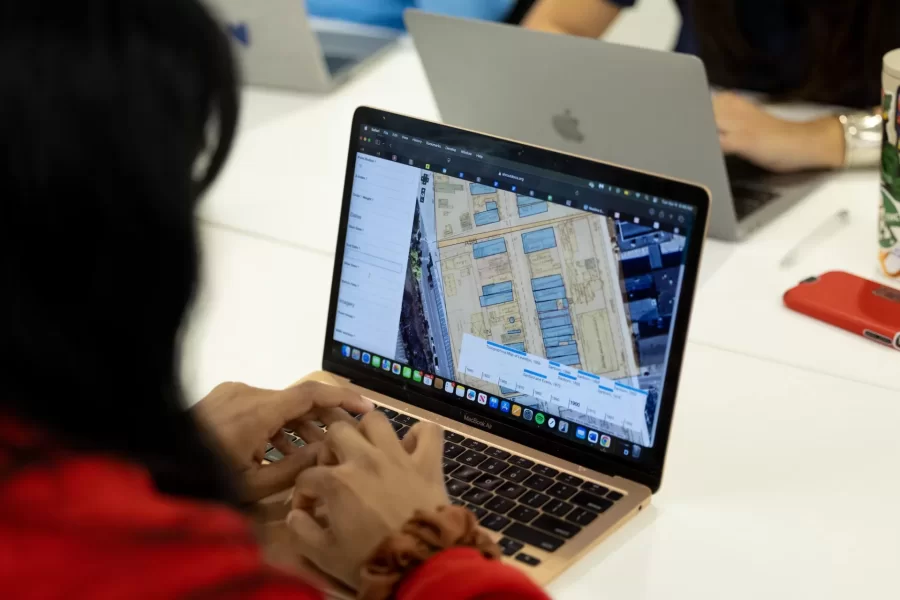
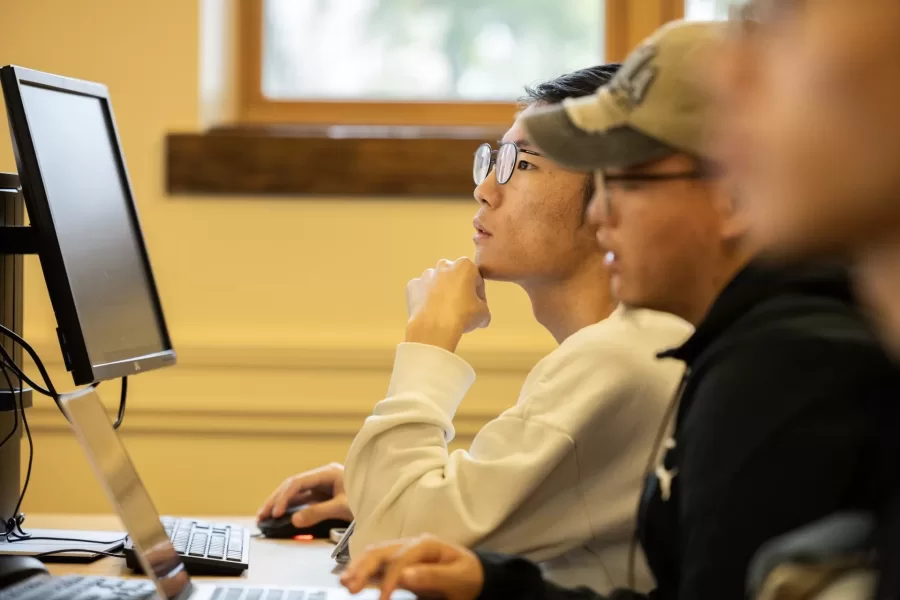
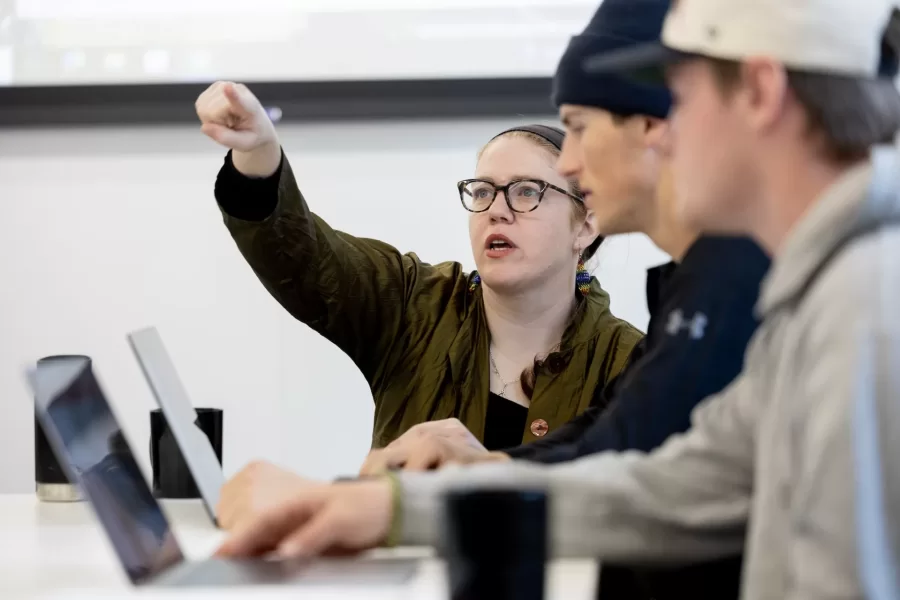
Students and Associate Professor of Digital and Computational Studies Anelise Shrout meet in Bonney 160 at 8 a.m. on April 8 to review their projects before working on creating a topographical map of Lewiston’s Lisbon Street from 1850-1940. There will be three individuals per decade in Lisbon Street Lisbon buildings. Each student is assigned to research and profile on individual.
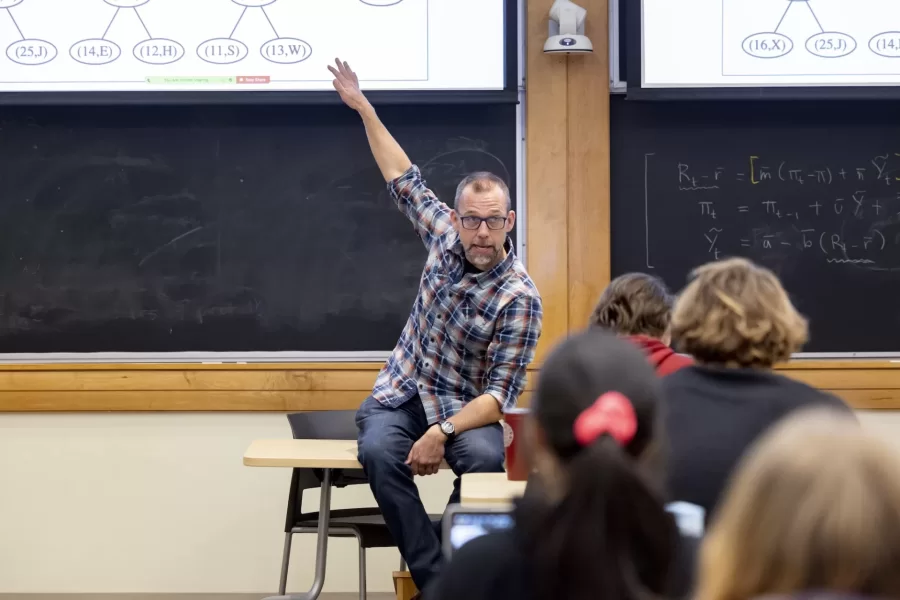
Colony Family Professor of Digital and Computational Studies Barry Lawson teaches DCS 229 – Data Structures and Algorithms in Pettengill G65.
This course provides an introduction to common data structures and selected algorithms for solving more complex problems. Topics covered include concrete data types (arrays and linked structures); abstract data types (including stacks, queues, trees, and maps); an introduction to fundamental algorithms including sorting, graph-search algorithms (breadth-first search, depth-first search), and greedy algorithms; and basic algorithm analysis (big-Oh). The course focuses on applying data structures and algorithms for problem solving, rather than on data-structure implementation details and formal analysis.
Public History in the Digital Age
Public history takes place beyond history classrooms and academic contexts. Traditionally, it has been found in museums, walking tours, and performances, and has told the stories of people with social and political privilege. Increasingly, however, public history has come to focus on a greater range of voices, and takes place in a wider range of forms: on websites, graphic novels, interactive sensory experiences, social media, and other digital spaces. In this community-engaged course, students learn to see public history “in the wild,” engage with primary sources, and present those sources and historical interpretation to the public in digital form. Students with interests in history and public engagement are encouraged to enroll in this course.
Students and Associate Professor of Digital and Computational Studies Anelise Shrout meet in Bonney 160 at 8 a.m. on April 8 to review their projects before working on creating a topographical map of Lewiston’s Lisbon Street from 1850-1940. There will be three individuals per decade in Lisbon Street Lisbon buildings. Each student is assigned to research and profile on individual.
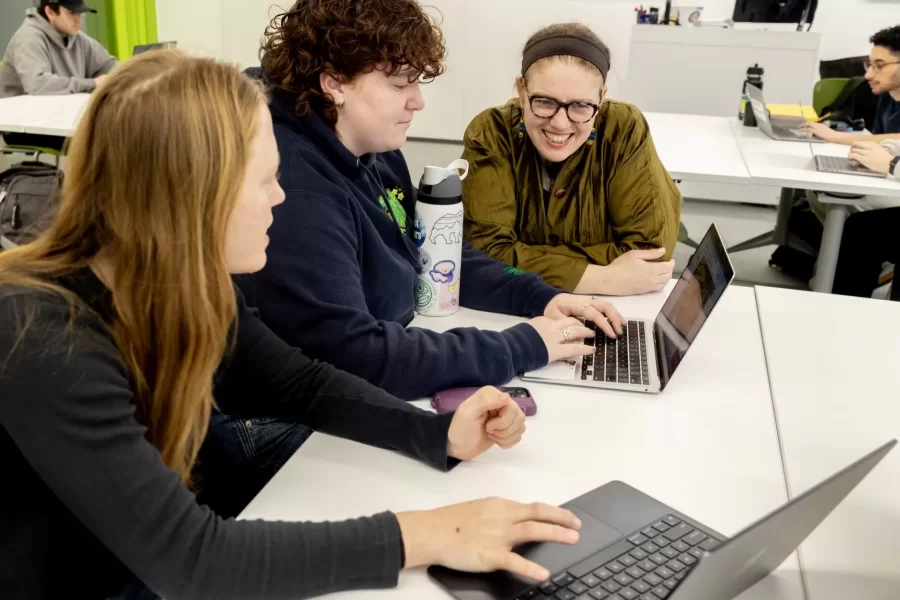
Associate Professor of Digital and Computational Studies Carrie Diaz Eaton teaches MATH 316 – PIC Math: Community Engaged Data Science in Roger Williams 413 on Oct. 4, 2023.
This PIC Math (Preparation for Industrial Careers in Mathematical Sciences) course is intended for students with a strong interest in industrial applications of mathematics and computation. Students work in teams on a research problem identified by a community partner from business, industry, or government. Students develop their mathematical and programming skills as well as skills and traits valued by employers of STEM professionals, such as teamwork, effective communication, independent thinking, problem solving, and final products. Prerequisite(s): MATH 205 and 206.
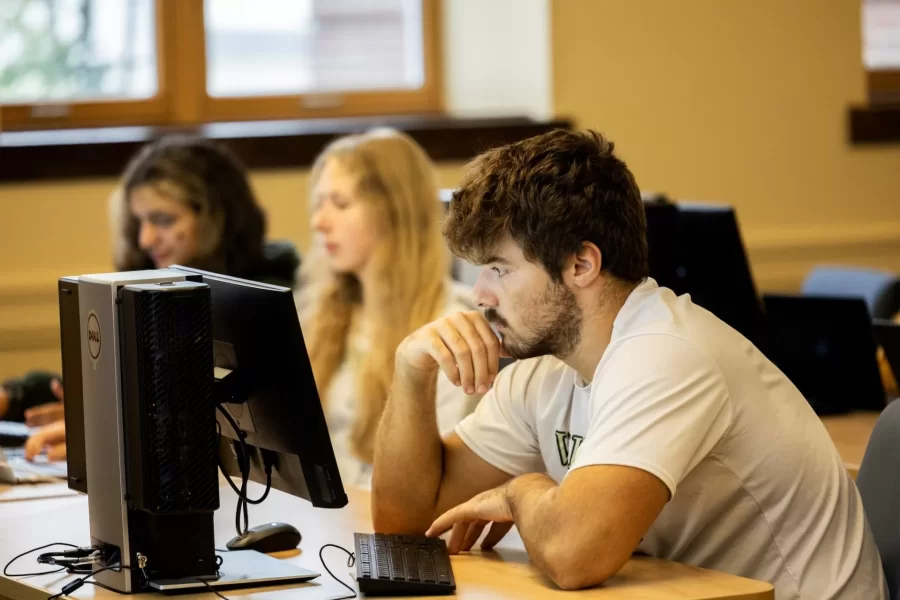
In an adjacent RW lounge, a group meets with its DCS community partner Jacqueline Crucet, Neighborhood Development Planner, on Zoom to discuss insights into housing data for the City of Lewiston.
In frame #690. From left, Jacob Gordon ’24, Cameron Frary ’24, Spencer Obiero ’25, and Elvira Keira Ishimwe ’25.
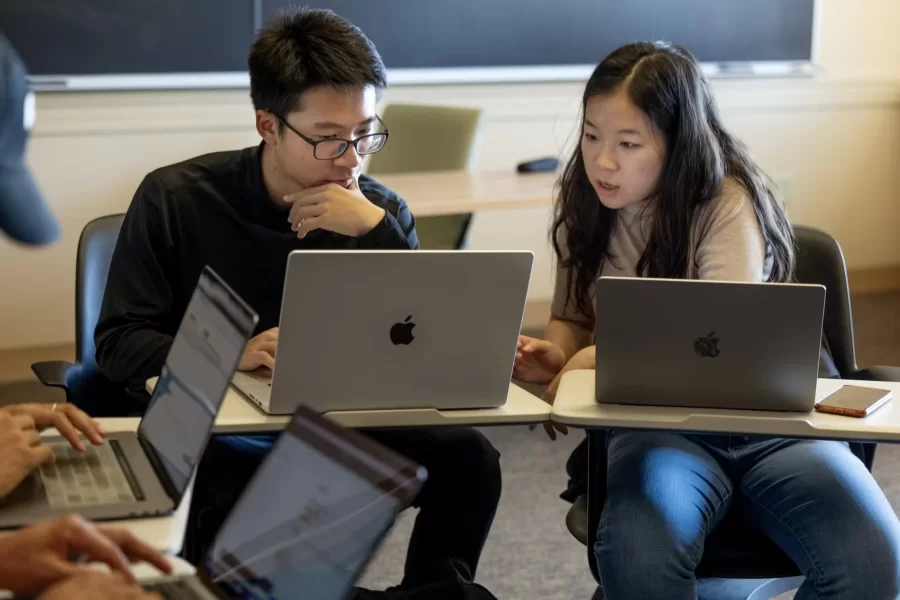
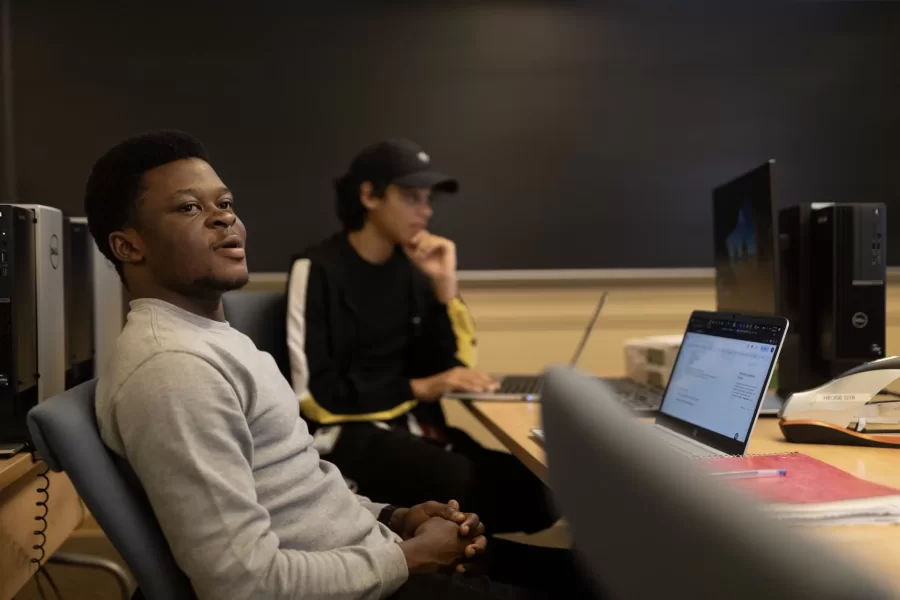
Visiting Assistant Professor of Digital and Computational Studies Chris Agbonkhese teaches DCS 109 – Intro to Computer Science for Software Development” in Hedge G18 on Oct. 4, 2023.
This course is an introduction to computational thinking and problem solving via an introduction to computer programming, designed for students interested in broadly applying computing and software solutions across a range of disciplines. It considers computing as a discipline of study, exploring the representation and manipulation of data, fundamental algorithms, efficiency, and limits of computing. Students learn fundamentals of computer programming using Python, including basic data structures, flow control structures, functions, recursion, elementary object-oriented programming, and file I/O, as well as discussion of higher-level concepts including abstraction, modularity, reuse, testing, and debugging. By implementing programs in contexts such as image processing, voting algorithms, DNA sequence analysis, and simple games, students develop an understanding of computational problem solving and gain experience in broadly applicable software development skills.
One of the topics presented and discussed was “recall: for loop and if-statements.”
Visiting Assistant Professor of Digital and Computational Studies Chris Agbonkhese teaches DCS 109 – Intro to Computer Science for Software Development” in Hedge G18 on Oct. 4, 2023.
This course is an introduction to computational thinking and problem solving via an introduction to computer programming, designed for students interested in broadly applying computing and software solutions across a range of disciplines. It considers computing as a discipline of study, exploring the representation and manipulation of data, fundamental algorithms, efficiency, and limits of computing. Students learn fundamentals of computer programming using Python, including basic data structures, flow control structures, functions, recursion, elementary object-oriented programming, and file I/O, as well as discussion of higher-level concepts including abstraction, modularity, reuse, testing, and debugging. By implementing programs in contexts such as image processing, voting algorithms, DNA sequence analysis, and simple games, students develop an understanding of computational problem solving and gain experience in broadly applicable software development skills.
One of the topics presented and discussed was “recall: for loop and if-statements.”
Visiting Assistant Professor of Digital and Computational Studies Chris Agbonkhese teaches DCS 109 – Intro to Computer Science for Software Development” in Hedge G18 on Oct. 4, 2023.
This course is an introduction to computational thinking and problem solving via an introduction to computer programming, designed for students interested in broadly applying computing and software solutions across a range of disciplines. It considers computing as a discipline of study, exploring the representation and manipulation of data, fundamental algorithms, efficiency, and limits of computing. Students learn fundamentals of computer programming using Python, including basic data structures, flow control structures, functions, recursion, elementary object-oriented programming, and file I/O, as well as discussion of higher-level concepts including abstraction, modularity, reuse, testing, and debugging. By implementing programs in contexts such as image processing, voting algorithms, DNA sequence analysis, and simple games, students develop an understanding of computational problem solving and gain experience in broadly applicable software development skills.
One of the topics presented and discussed was “recall: for loop and if-statements.”
Public History in the Digital Age
Public history takes place beyond history classrooms and academic contexts. Traditionally, it has been found in museums, walking tours, and performances, and has told the stories of people with social and political privilege. Increasingly, however, public history has come to focus on a greater range of voices, and takes place in a wider range of forms: on websites, graphic novels, interactive sensory experiences, social media, and other digital spaces. In this community-engaged course, students learn to see public history “in the wild,” engage with primary sources, and present those sources and historical interpretation to the public in digital form. Students with interests in history and public engagement are encouraged to enroll in this course.
Students and Associate Professor of Digital and Computational Studies Anelise Shrout meet in Bonney 160 at 8 a.m. on April 8 to review their projects before working on creating a topographical map of Lewiston’s Lisbon Street from 1850-1940. There will be three individuals per decade in Lisbon Street Lisbon buildings. Each student is assigned to research and profile on individual.
Why Study Digital and Computational Studies at Bates?
Digital and computational studies is a hands-on major that turns students into problem solvers, whether they’re working on using computers to solve human problems or breaking down complex tasks so that a computer can understand. Faculty advisors work closely with students throughout their study, and many faculty members offer employment opportunities for students to further develop their skills as teaching or research assistants.
Featured Courses
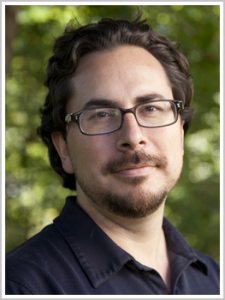
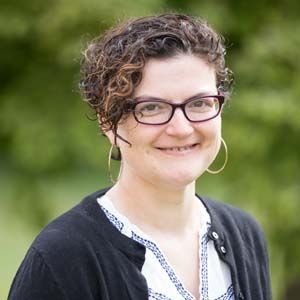
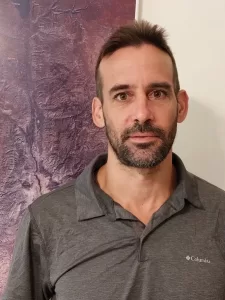
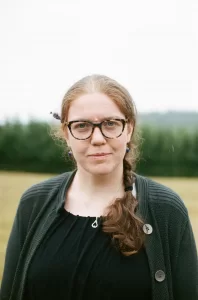
Meet the Faculty
Faculty in digital and computational studies lead the way in cutting-edge research across the field. They have been trained or have held research positions at prestigious institutions such as Cornell University, Brown University, and the University of Chicago, as well as at NASA, Google, and Amazon. Their research has been published in renowned journals, and faculty members are leaders in their scholarly communities, regularly gaining national awards. In addition, their work has been covered by news outlets such as Science, Nature, NPR, and The Washington Post.
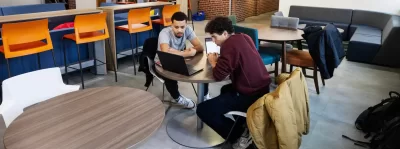
In the Student Center for Belonging and Community, first-generation Bates students mentor their younger peers, providing guidance on everything from academics to internships to social life.
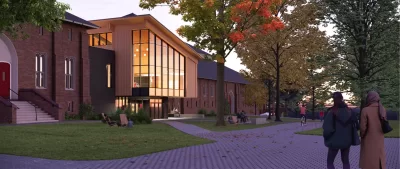
Bates is embarking on a $45 million project to update two key athletic facilities and construct a new fitness and well-being center. A gift of $10 million from Jon W. Brayshaw ’90, P’25 and Jocelyn Stoddard Brayshaw ’88, P’25 has brought the college a vital step closer to construction. The new facility will be named the Stoddard Fitness and Well-Being Center.
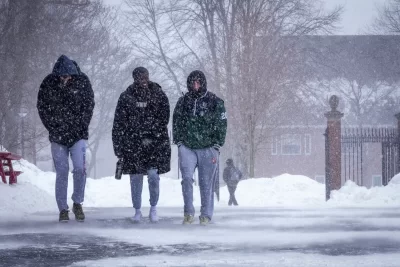
February on campus saw sports successes, several large snowfalls, and our annual Winter Carnival — a week of events celebrating the joys of the chilly season.