






Hispanic Studies at Bates

The Department of Hispanic Studies responds to the cultural richness and diversity of the Spanish-speaking world and to the obligations and opportunities of a globalized world.

Students develop strong, practical proficiency in Spanish – which is spoken by over 500 million people worldwide — and build the skills and knowledge needed to engage critically with a broad range of culture produced by Latin America, Spain, and Latino communities in the U.S. From introductory language courses to senior seminars taught exclusively in Spanish, the major cultivates students’ capacity for creative and intellectual expression.

Contact Us

Indya Childs, Academic Administrative Assistant
9 Andrews Road
Roger Williams Hall
Phone: 1- 207-786-8293 ichilds@bates.edu

What You Will Learn

garnet iconography with open book, globe, and desktop computer
How to navigate cultural spaces across the Spanish-speaking world with strong language proficiency
garnet iconography with books on a shelf, globe, and circuit
To critically analyze literature, film, media, and visual arts from Latin America, Spain, and U.S. Latino communities
garnet iconography with people, academic building, and stack of books
How to engage in diverse theoretical approaches and research methods in the humanities
garnet iconography with academic building, stack of papers with pen, and trifold map with marker
To synthesize study-abroad experiences with on-campus coursework
garnet iconography with presentation slide, speech bubbles, and people
To communicate with confidence as readers, writers, discussants, and researchers in Spanish
garnet iconography with chat bubble and people
How to engage with the wider community through film screenings, Q&A sessions, and presentations connected to coursework

Life After Bates

Hispanic studies graduates from Bates have gone on to careers in sectors as varied as public health, education, finance, and environmental policy — fields where the ability to navigate a globalized, multilingual world is an increasingly important asset.

90%

of 2020-2024 humanities graduates are employed and/or attending graduate school

  • Wesleyan University
2pm | All These Sons
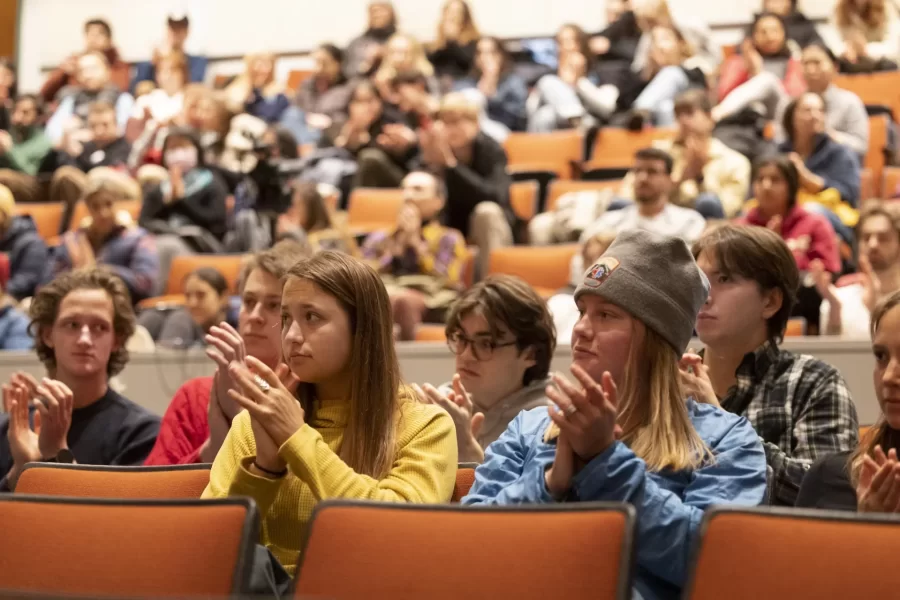
Screening and discussion. Chicago’s West and South sides are infamous for their high murder rates. In this documentary directed by Bing Liu and Joshua Altman, Marshall Hatch Jr. ’10 and Billy Moore (who served 20 years in prison for murder) create healing spaces for young men to reimagine themselves, find redemption, and embrace causes worth fighting for. Hatch, the subject of a cover story by Bates Magazine in 2021, will introduce the film. (2021; 88 min.) Sponsored by the Program in American Studies, Department of Anthropology, Department of Hispanic Studies, and Department of Rhetoric, Film, and Screen Studies.
Location: Olin Concert Hall

2pm | All These Sons Screening and discussion. Chicago’s West and South sides are infamous for their high murder rates. In this documentary directed by Bing Liu and Joshua Altman, Marshall Hatch Jr. ’10 and Billy Moore (who served 20 years in prison for murder) create healing spaces for young men to reimagine themselves, find redemption, and embrace causes worth fighting for. Hatch, the subject of a cover story by Bates Magazine in 2021, will introduce the film. (2021; 88 min.) Sponsored by the Program in American Studies, Department of Anthropology, Department of Hispanic Studies, and Department of Rhetoric, Film, and Screen Studies. Location: Olin Concert Hall

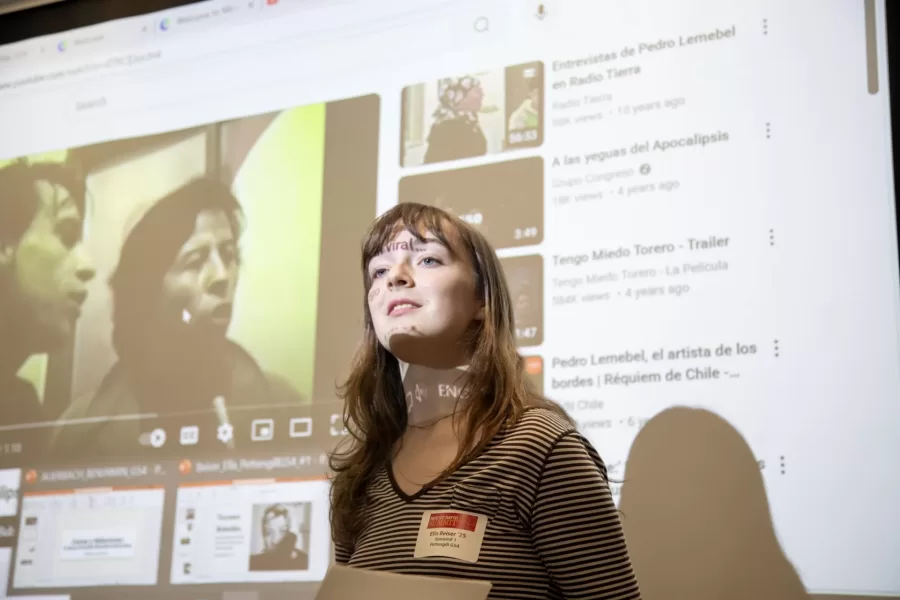
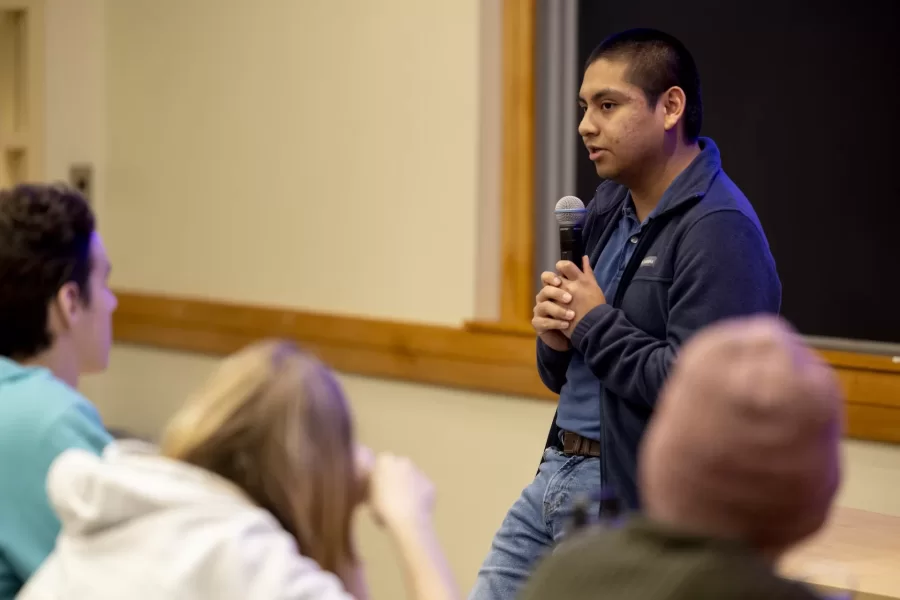
Ella Beiser '25 presents her Hispanic Studies thesis on the work of queer Chilean activist Pedro Lemebel during the Hispanic Studies Panel.

Ella Beiser ’25 presents her Hispanic Studies thesis on the work of queer Chilean activist Pedro Lemebel during the Hispanic Studies Panel.

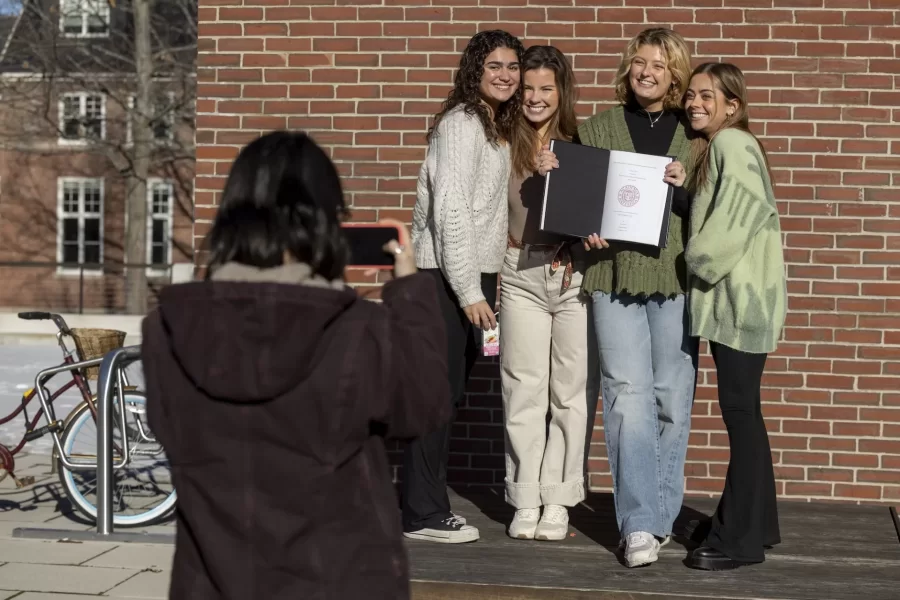
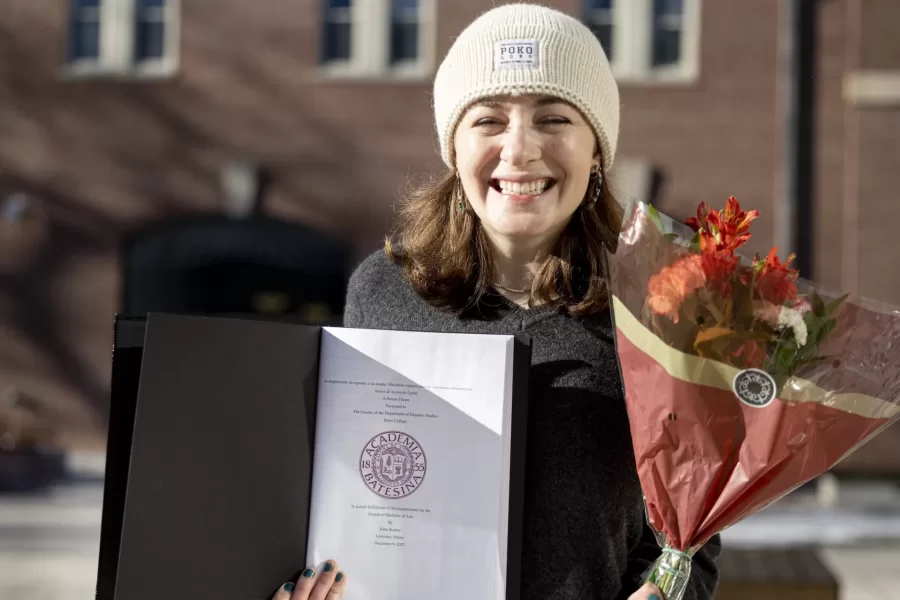
Ilana Rosker ’23 of Lexington,Mass.,(hat), a major in Hispanic Studies, and Emma Pike ’23 of York, Maine, a major in Hispanic studies, bind their theses in the company of friends on the Library Terrace on Dec. 13, 2022.

Rosker wrote on “La imagination, la rapture y la magia: Hacienda espacio para la conciencia alternativa a traves de la poesia Latin X.”

Pike wrote on “Llimpia bus propoios Platos!: explorando masculinidad hegemonica en Jane the Virgin.”

Ilana Rosker ’23 of Lexington,Mass.,(hat), a major in Hispanic Studies, and Emma Pike ’23 of York, Maine, a major in Hispanic studies, bind their theses in the company of friends on the Library Terrace on Dec. 13, 2022. Rosker wrote on “La imagination, la rapture y la magia: Hacienda espacio para la conciencia alternativa a traves de la poesia Latin X.” Pike wrote on “Llimpia bus propoios Platos!: explorando masculinidad hegemonica en Jane the Virgin.”

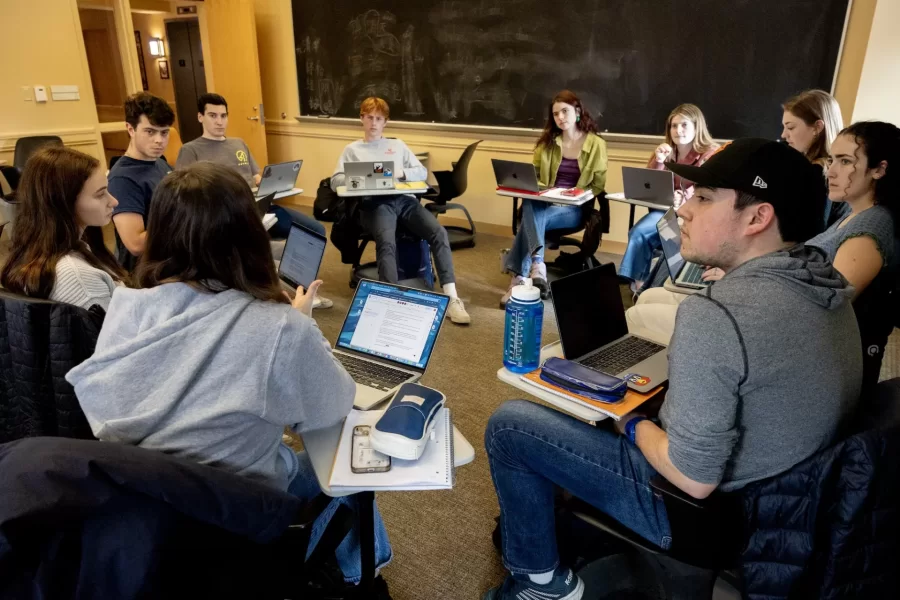
Students in Associate Professor of Hispanic Studies Stephanie Pridgeon’s “Screening Citizenship: Jewish Latin American Film” class prepare for two upcoming presentations they will make at the upcoming
Maine Jewish Film Festival, both in Portland and Bates. One film is called “Torah Tropical” (see below) and the other, made in Argentina and Austria, is called “The Klezmer Project).

Pridgeon says:

This coming Tuesday, March 4 at 7 PM in Olin, we will be screening the beautiful documentary “Torah Tropical” followed by a Q + A with producer Heidi Paster (parent of a current Bates student) led by students from my Jewish Latin American film seminar. The documentary follows the story of a family in Cali, Colombia, who converts to Judaism and attempts to immigrate to Israel. Please join us if you're interested and please also consider passing along the information to your students, colleagues, and friends if they might also be interested (entry is free for Bates staff, faculty, and students!)


This course considers films from throughout Latin America made by Jewish directors. Students learn the history of Latin American film production as well as terms and skills necessary for audiovisual analysis. The course examines the ways in which film is used as a vehicle to explore and represent issues of identity, belonging, immigration, and assimilation that have long characterized Jewish experiences in Latin America. Moreover, the course focuses on filmmakers’ engagement with key social and political issues within their respective countries as well as on a regional or global scale. Taught in Spanish. Recommended background: HISP 228. Prerequisite(s): HISP 210 or 211.

Students in Associate Professor of Hispanic Studies Stephanie Pridgeon’s “Screening Citizenship: Jewish Latin American Film” class prepare for two upcoming presentations they will make at the upcoming Maine Jewish Film Festival, both in Portland and Bates. One film is called “Torah Tropical” (see below) and the other, made in Argentina and Austria, is called “The Klezmer Project). Pridgeon says: This coming Tuesday, March 4 at 7 PM in Olin, we will be screening the beautiful documentary “Torah Tropical” followed by a Q + A with producer Heidi Paster (parent of a current Bates student) led by students from my Jewish Latin American film seminar. The documentary follows the story of a family in Cali, Colombia, who converts to Judaism and attempts to immigrate to Israel. Please join us if you’re interested and please also consider passing along the information to your students, colleagues, and friends if they might also be interested (entry is free for Bates staff, faculty, and students!) This course considers films from throughout Latin America made by Jewish directors. Students learn the history of Latin American film production as well as terms and skills necessary for audiovisual analysis. The course examines the ways in which film is used as a vehicle to explore and represent issues of identity, belonging, immigration, and assimilation that have long characterized Jewish experiences in Latin America. Moreover, the course focuses on filmmakers’ engagement with key social and political issues within their respective countries as well as on a regional or global scale. Taught in Spanish. Recommended background: HISP 228. Prerequisite(s): HISP 210 or 211.

Students in Associate Professor of Hispanic Studies Stephanie Pridgeon’s “Screening Citizenship: Jewish Latin American Film” class prepare for two upcoming presentations they will make at the upcoming
Maine Jewish Film Festival, both in Portland and Bates. One film is called “Torah Tropical” (see below) and the other, made in Argentina and Austria, is called “The Klezmer Project).

Pridgeon says:

This coming Tuesday, March 4 at 7 PM in Olin, we will be screening the beautiful documentary “Torah Tropical” followed by a Q + A with producer Heidi Paster (parent of a current Bates student) led by students from my Jewish Latin American film seminar. The documentary follows the story of a family in Cali, Colombia, who converts to Judaism and attempts to immigrate to Israel. Please join us if you're interested and please also consider passing along the information to your students, colleagues, and friends if they might also be interested (entry is free for Bates staff, faculty, and students!)


This course considers films from throughout Latin America made by Jewish directors. Students learn the history of Latin American film production as well as terms and skills necessary for audiovisual analysis. The course examines the ways in which film is used as a vehicle to explore and represent issues of identity, belonging, immigration, and assimilation that have long characterized Jewish experiences in Latin America. Moreover, the course focuses on filmmakers’ engagement with key social and political issues within their respective countries as well as on a regional or global scale. Taught in Spanish. Recommended background: HISP 228. Prerequisite(s): HISP 210 or 211.

Students in Associate Professor of Hispanic Studies Stephanie Pridgeon’s “Screening Citizenship: Jewish Latin American Film” class prepare for two upcoming presentations they will make at the upcoming Maine Jewish Film Festival, both in Portland and Bates. One film is called “Torah Tropical” (see below) and the other, made in Argentina and Austria, is called “The Klezmer Project). Pridgeon says: This coming Tuesday, March 4 at 7 PM in Olin, we will be screening the beautiful documentary “Torah Tropical” followed by a Q + A with producer Heidi Paster (parent of a current Bates student) led by students from my Jewish Latin American film seminar. The documentary follows the story of a family in Cali, Colombia, who converts to Judaism and attempts to immigrate to Israel. Please join us if you’re interested and please also consider passing along the information to your students, colleagues, and friends if they might also be interested (entry is free for Bates staff, faculty, and students!) This course considers films from throughout Latin America made by Jewish directors. Students learn the history of Latin American film production as well as terms and skills necessary for audiovisual analysis. The course examines the ways in which film is used as a vehicle to explore and represent issues of identity, belonging, immigration, and assimilation that have long characterized Jewish experiences in Latin America. Moreover, the course focuses on filmmakers’ engagement with key social and political issues within their respective countries as well as on a regional or global scale. Taught in Spanish. Recommended background: HISP 228. Prerequisite(s): HISP 210 or 211.

2pm | All These Sons
Screening and discussion. Chicago’s West and South sides are infamous for their high murder rates. In this documentary directed by Bing Liu and Joshua Altman, Marshall Hatch Jr. ’10 and Billy Moore (who served 20 years in prison for murder) create healing spaces for young men to reimagine themselves, find redemption, and embrace causes worth fighting for. Hatch, the subject of a cover story by Bates Magazine in 2021, will introduce the film. (2021; 88 min.) Sponsored by the Program in American Studies, Department of Anthropology, Department of Hispanic Studies, and Department of Rhetoric, Film, and Screen Studies.
Location: Olin Concert Hall

2pm | All These Sons Screening and discussion. Chicago’s West and South sides are infamous for their high murder rates. In this documentary directed by Bing Liu and Joshua Altman, Marshall Hatch Jr. ’10 and Billy Moore (who served 20 years in prison for murder) create healing spaces for young men to reimagine themselves, find redemption, and embrace causes worth fighting for. Hatch, the subject of a cover story by Bates Magazine in 2021, will introduce the film. (2021; 88 min.) Sponsored by the Program in American Studies, Department of Anthropology, Department of Hispanic Studies, and Department of Rhetoric, Film, and Screen Studies. Location: Olin Concert Hall

The Right to Live with One’s Parents vs U.S. Immigration Policy of Family Separation
Screening and discussion. U.S. immigration policies enforce family separation. Several million U.S. citizen children have at least one undocumented parent and are part of mixed-status families. Even though they are entitled to the same rights and freedoms as all Americans, many of these children are growing up with the constant fear of separation from their parents. The workshop features a showing of Abrazos (Embraces), a film by Guatemalan director Luis Argueta, about the experience of 14 U.S. citizen children, sons and daughters of unauthorized immigrants in this country, who travel from Minnesota to Guatemala to meet their grandparents, and in some cases, their siblings, for the first time. Luis Argueta will answer questions at the end. Led by: Baltasar Fra-Molinero, Professor of Hispanic Studies.
Location: Pettengill G65 |

The Right to Live with One’s Parents vs U.S. Immigration Policy of Family Separation Screening and discussion. U.S. immigration policies enforce family separation. Several million U.S. citizen children have at least one undocumented parent and are part of mixed-status families. Even though they are entitled to the same rights and freedoms as all Americans, many of these children are growing up with the constant fear of separation from their parents. The workshop features a showing of Abrazos (Embraces), a film by Guatemalan director Luis Argueta, about the experience of 14 U.S. citizen children, sons and daughters of unauthorized immigrants in this country, who travel from Minnesota to Guatemala to meet their grandparents, and in some cases, their siblings, for the first time. Luis Argueta will answer questions at the end. Led by: Baltasar Fra-Molinero, Professor of Hispanic Studies. Location: Pettengill G65 |

Ilana Rosker ’23 of Lexington,Mass.,(hat), a major in Hispanic Studies, and Emma Pike ’23 of York, Maine, a major in Hispanic studies, bind their theses in the company of friends on the Library Terrace on Dec. 13, 2022.

Rosker wrote on “La imagination, la rapture y la magia: Hacienda espacio para la conciencia alternativa a traves de la poesia Latin X.”

Pike wrote on “Llimpia bus propoios Platos!: explorando masculinidad hegemonica en Jane the Virgin.”

Ilana Rosker ’23 of Lexington,Mass.,(hat), a major in Hispanic Studies, and Emma Pike ’23 of York, Maine, a major in Hispanic studies, bind their theses in the company of friends on the Library Terrace on Dec. 13, 2022. Rosker wrote on “La imagination, la rapture y la magia: Hacienda espacio para la conciencia alternativa a traves de la poesia Latin X.” Pike wrote on “Llimpia bus propoios Platos!: explorando masculinidad hegemonica en Jane the Virgin.”

Hispanic studies at Bates is for students who want to engage with one of the world’s most widely spoken languages and the rich, diverse cultures it connects, from Latin America to Europe to the United States. The department’s specialized seminars explore wide-ranging topics rooted in faculty members’ eminent research, and students take an active role in creating knowledge. Study abroad is strongly encouraged and deeply integrated into the curriculum, with courses upon return designed to continue building on what was learned abroad.

Featured Courses

Photo of Claudia Aburto Guzmán

Claudia Aburto Guzmán

Associate Professor of Hispanic Studies

Photo of Baltasar Fra-Molinero

Baltasar Fra-Molinero

Professor of Hispanic Studies

Photo of David R. George Jr.

David R. George Jr.

Senior Lecturer in Hispanic Studies

Photo of Cristina Morales Segura

Cristina Morales Segura

Visiting Assistant Professor of Hispanic Studies

Photo of Stephanie M. Pridgeon

Stephanie M. Pridgeon

Associate Professor of Hispanic Studies

News & Events

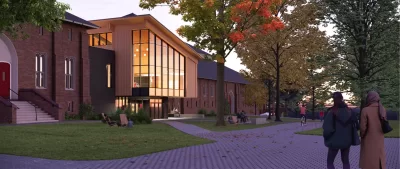
Bates announces Stoddard Fitness and Well-Being Center and athletics facilities upgrades
March 5, 2026

Bates announces Stoddard Fitness and Well-Being Center and at…

Bates is embarking on a $45 million project to update two key athletic facilities and construct a new fitness and well-being center. A gift of $10 million from Jon W. Brayshaw ’90, P’25 and Jocelyn Stoddard Brayshaw ’88, P’25 has brought the college a vital step closer to construction. The new facility will be named the Stoddard Fitness and Well-Being Center. 

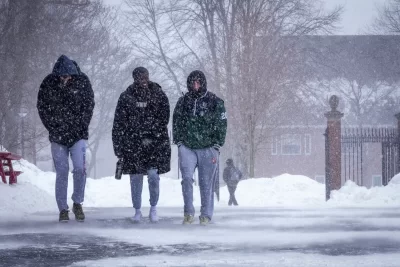
Over the woodlands brown and bare, over the harvest-fields forsaken, silent, and soft, and slow descends the snow. — Longfellow Back on campus after the February freak storm, Bates feels suspended between motion and stillness; cars crunch in half-melted tracks, boots drip by radiators, flights and plans still catching up somewhere in the clouds. Some of us are here, some are delayed, and the quiet holds space for both. It’s a strange return; rushed arrivals, late-night drives, weather maps open on our phones, yet the air itself feels calm, like the world pressed pause just long enough for us to notice it. The paradox is real; chaos in the forecast, steadiness on the quad. Snow does that. It softens edges, lowers voices, makes even a campus full of movement feel like it’s breathing slowly.
March 5, 2026

February at Bates

February on campus saw sports successes, several large snowfalls, and our annual Winter Carnival — a week of events celebrating the joys of the chilly season.