Neuroscience at Bates

The Bates Program in Neuroscience’s curriculum is built around active, learning-by-doing experiences.

The program trains students to draw on perspectives from physiology, psychology, biology, and quantitative approaches to consider topics such as molecular and cellular mechanisms, neural circuits, computation, and behavior. Students develop skills through laboratory courses and research practice, and the major culminates with a senior capstone or thesis that emphasizes rigorous, independent inquiry.

Contact Us

Thomas Pinette
Academic Administrative Assistant
Bonney Science Center
Phone: 207-755-5928 tpinette@bates.edu

What You Will Learn

garnet iconography with magnifying glass, desktop computer, and circles
How to design and conduct neuroscience research by collecting, analyzing, and interpreting data
garnet iconography with chat bubbles, presentation slides, and clipboard with pen
To communicate the principles of neuroscience clearly in writing, presentations, and visuals for different audiences
garnet iconography with stack of books, globe, and magnifying glass
How to evaluate evidence and scientific claims with methodological and ethical rigor, paying special attention to societal impact
garnet iconography with beaker, open notebook, and circuit
How to translate neuroscience into real-world domains including health, technology, education, and policy
garnet iconography with people, globe, and molecule
To present and share research with the campus community and at regional and national scientific meetings
garnet iconography with people and brain
To build a broad understanding of the connection between the brain and behavior, starting at the molecular level

Life After Bates

Students graduate as thoughtful and responsible consumers and producers of neuroscientific knowledge, providing a versatile foundation for careers in healthcare, research, biotechnology, and academia. Graduates frequently pursue roles as physicians, neuroscientists, research technicians, and counselors, or work in specialized areas like pharmaceutical sales, science writing, and AI-driven interface development.

91%

of 2020-2024 science and math graduates are employed and/or attending graduate school

  • Massachusetts Institute of Technology
  • University of Oxford
  • Stanford University
  • University of Pennsylvania
  • Columbia University
  • Johns Hopkins University
  • Duke University
  • University of California, San Francisco
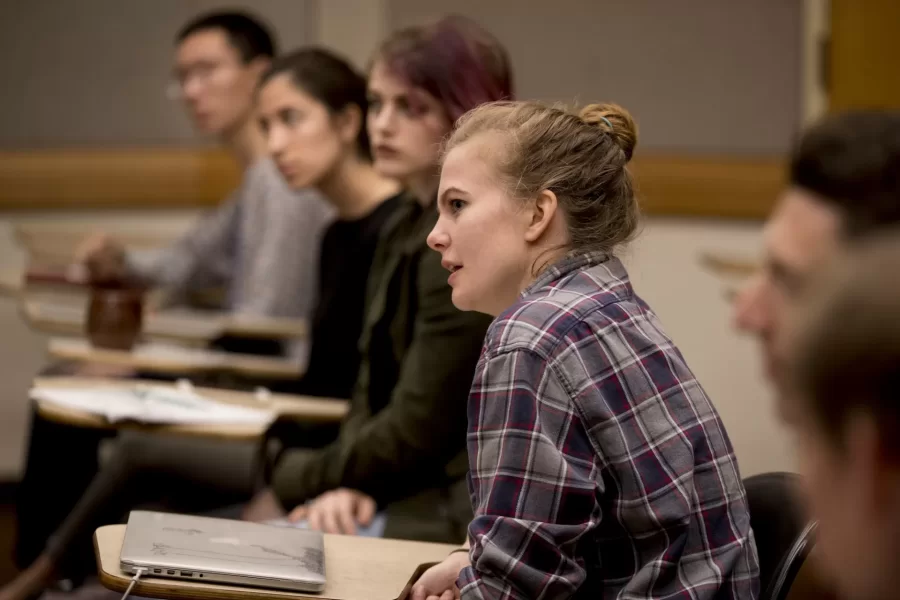
Laura Ligouri, teaching Neuroscience, Ethics, and Society in Pettengill G21

NRSC S20 - Neuroscience, Ethics, and Society
As our ability to measure, predict, and manipulate brain function progresses, so too does our need to grapple with the societal consequences of neuroscientific discovery. This course invites critical examination of the ethics surrounding real-world neuroscience applications in private and public sectors. With topics that include psychopharmacology and cognitive liberty, neuroimaging for lie detection, weaponization of neurotechnology, and neuroprivacy in an era of data mining, students engage two overarching questions: How does the practice of neuroscience simultaneously mirror and mold social attitudes and policy-making agendas? What does it mean to be a responsible consumer and/or producer of neuroscientific knowledge? Prerequisite(s): NRSC 130, NS/PH 117, NS/PY 160, or PSYC 215. Not open to students who have received credit for NRSC 208. 

“A neuroscience course that looks at how we conceive of the ethics and societal implications of neurobiological research. There’s lots of different ways of taking a look at that from neuro technology and whether something’s safe to apply or not to neuroscience in the criminal justice system. So this week was all about looking at neuroscience in kind of an international context, specifically clinical, around trauma and PTSD. There’s so much neurobiological research around trauma and PTSD, we know a lot about the brain and trauma, and so how can we conceive of that research in cross-cultural context where it’s really tough to translate. It’s really tough to apply, it’s really tough to ethically interact. So how can we think about this with a broader lens when most of the research has been done with western communities?


So we had three speakers – and she goes to get their names – 
Decca Deluc, a clinician from Somalia, treasurer of the Somali Community Center of Maine, and co-founder of Cr
Laura Ligouri, teaching Neuroscience, Ethics, and Society in Pettengill G21 NRSC S20 – Neuroscience, Ethics, and Society As our ability to measure, predict, and manipulate brain function progresses, so too does our need to grapple with the societal consequences of neuroscientific discovery. This course invites critical examination of the ethics surrounding real-world neuroscience applications in private and public sectors. With topics that include psychopharmacology and cognitive liberty, neuroimaging for lie detection, weaponization of neurotechnology, and neuroprivacy in an era of data mining, students engage two overarching questions: How does the practice of neuroscience simultaneously mirror and mold social attitudes and policy-making agendas? What does it mean to be a responsible consumer and/or producer of neuroscientific knowledge? Prerequisite(s): NRSC 130, NS/PH 117, NS/PY 160, or PSYC 215. Not open to students who have received credit for NRSC 208.  “A neuroscience course that looks at how we conceive of the ethics and societal implications of neurobiological research. There’s lots of different ways of taking a look at that from neuro technology and whether something’s safe to apply or not to neuroscience in the criminal justice system. So this week was all about looking at neuroscience in kind of an international context, specifically clinical, around trauma and PTSD. There’s so much neurobiological research around trauma and PTSD, we know a lot about the brain and trauma, and so how can we conceive of that research in cross-cultural context where it’s really tough to translate. It’s really tough to apply, it’s really tough to ethically interact. So how can we think about this with a broader lens when most of the research has been done with western communities? So we had three speakers – and she goes to get their names – Decca Deluc, a clinician from Somalia, treasurer of the Somali Community Center of Maine, and co-founder of Cr
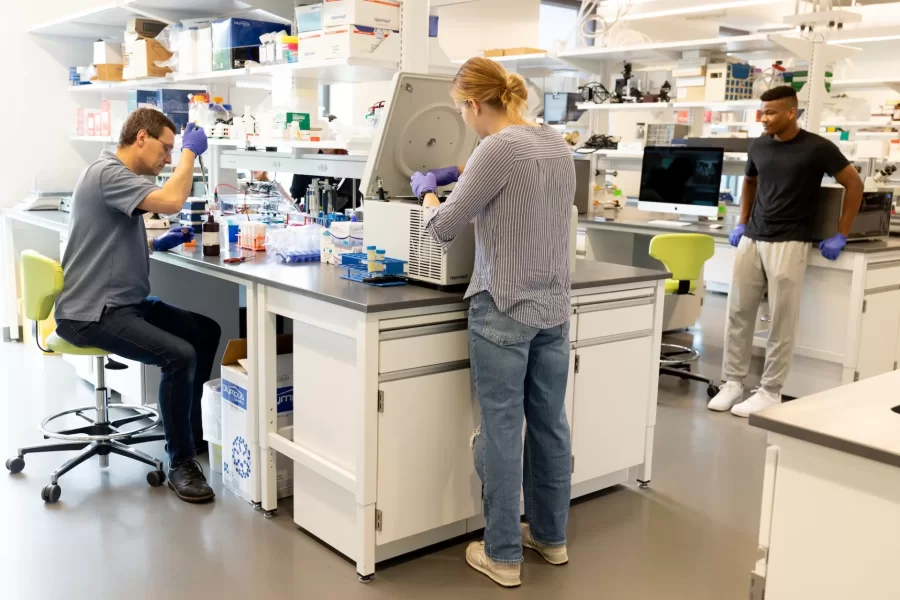
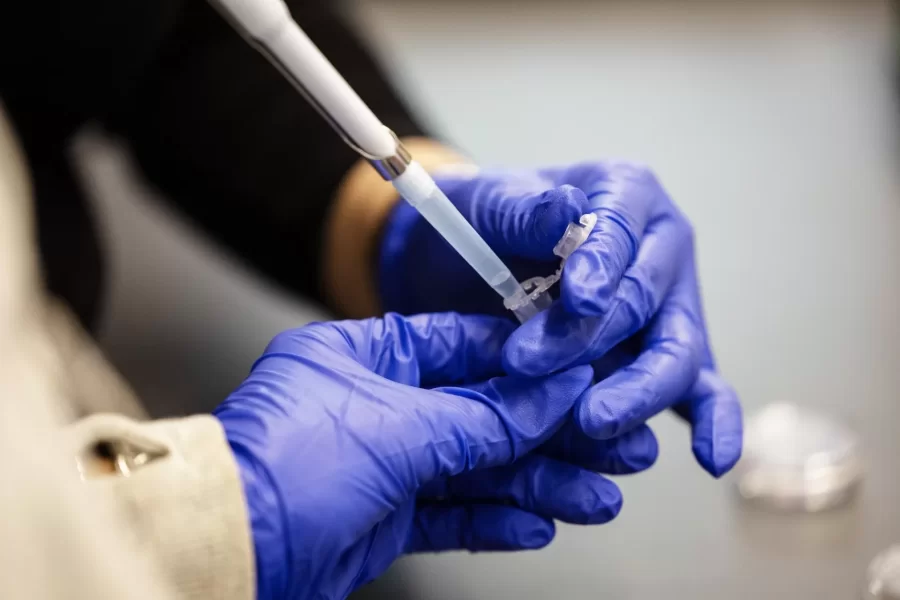
Moments from Lab-Based Biological Inquiry Cellular Neuroscience taught by Martin Kruse, associate professor of biology and neuroscience, in Bonney Science Center Room 370 on January 25, 2024. (Theophil Syslo | Bates College)

Moments from Lab-Based Biological Inquiry Cellular Neuroscience taught by Martin Kruse, associate professor of biology and neuroscience, in Bonney Science Center Room 370 on January 25, 2024. (Theophil Syslo | Bates College)

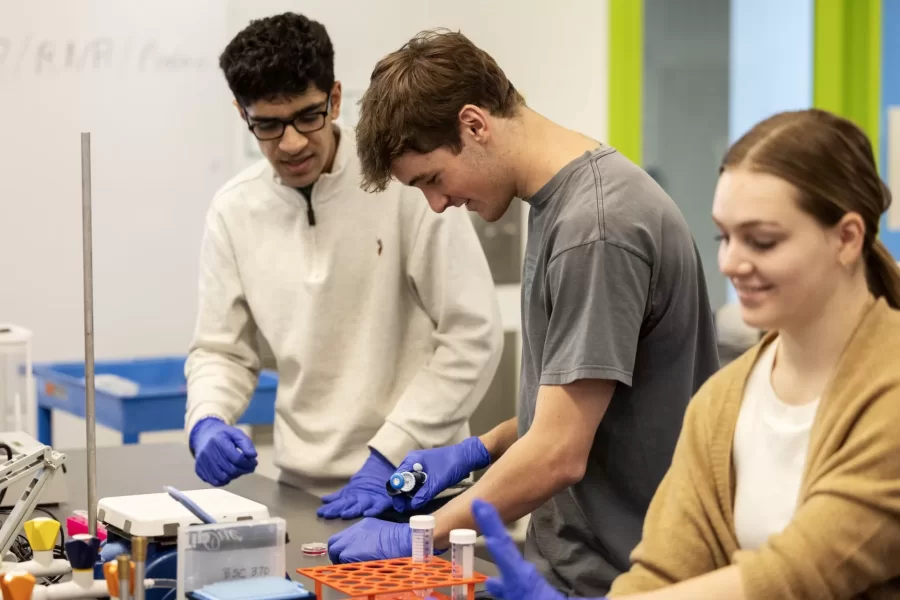
Zain Ali ‘27 of Lebanon, Ohio, left, Tim Johnson ‘27 of Brewster, Mass., center, and Cate Fleming ‘27 of Brookline, Mass.,during Lab-Based Biological Inquiry Cellular Neuroscience taught by Martin Kruse, associate professor of biology and neuroscience, in Bonney Science Center Room 370 on January 25, 2024. (Theophil Syslo | Bates College)

Zain Ali ‘27 of Lebanon, Ohio, left, Tim Johnson ‘27 of Brewster, Mass., center, and Cate Fleming ‘27 of Brookline, Mass.,during Lab-Based Biological Inquiry Cellular Neuroscience taught by Martin Kruse, associate professor of biology and neuroscience, in Bonney Science Center Room 370 on January 25, 2024. (Theophil Syslo | Bates College)

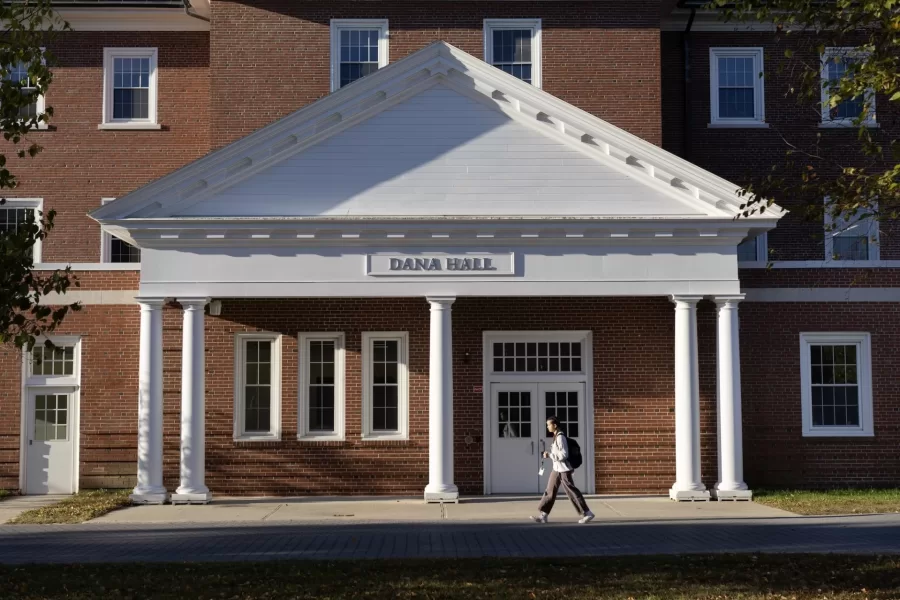
Campus scenes from Oct. 11, 2024.


Students pass by Dana Chemistry on Alumni Walk.

Campus scenes from Oct. 11, 2024. Students pass by Dana Chemistry on Alumni Walk.

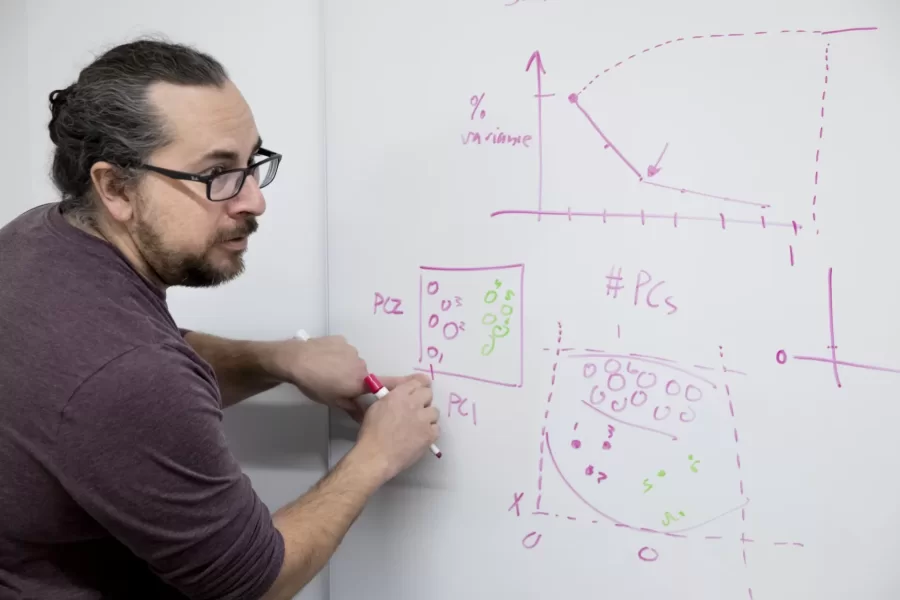
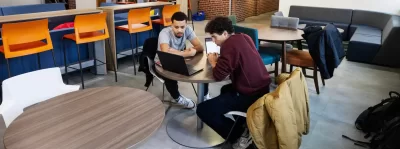
Associate Professor of Neuroscience Jason Castro meets with two of his thesis students in Bonney 283.

John Loftus ’22 of Palo Alto, Calif., a double major in neuroscience and art and visual culture (studio art), and Juliet Bockhorst ’22 of Westwood, Mass., a neuroscience major.

Associate Professor of Neuroscience Jason Castro meets with two of his thesis students in Bonney 283. John Loftus ’22 of Palo Alto, Calif., a double major in neuroscience and art and visual culture (studio art), and Juliet Bockhorst ’22 of Westwood, Mass., a neuroscience major.

Students choose neuroscience at Bates for mentored, high-touch scientific practice. We provide close faculty guidance as students learn to design studies, work with data, and communicate their findings. Students graduate prepared to think critically about the nervous system, conduct and communicate original research, and integrate scientific understanding with ethical and societal perspectives. We offer a truly hands-on approach to neuroscience; students in our program routinely participate in active research programs and mentored projects with our faculty.

Featured Courses

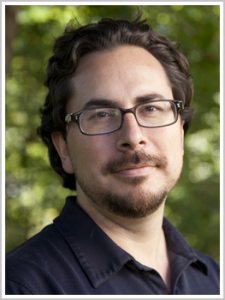
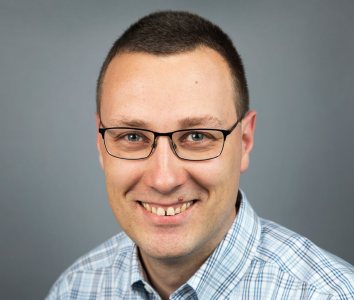
Photo of Jason B. Castro

Jason B. Castro

Associate Professor of Neuroscience

Photo of Justin C. Hulbert

Justin C. Hulbert

Associate Professor of Neuroscience

Photo of Olivia A. Kim

Olivia A. Kim

Assistant Professor of Neuroscience

Photo of Martin Kruse

Martin Kruse

Associate Professor of Biology and Neuroscience

Photo of Mollie B. Woodworth

Mollie B. Woodworth

Assistant Professor of Neuroscience

News & Events

Bates announces Stoddard Fitness and Well-Being Center and athletics facilities upgrades
March 5, 2026

Bates announces Stoddard Fitness and Well-Being Center and at…

Bates is embarking on a $45 million project to update two key athletic facilities and construct a new fitness and well-being center. A gift of $10 million from Jon W. Brayshaw ’90, P’25 and Jocelyn Stoddard Brayshaw ’88, P’25 has brought the college a vital step closer to construction. The new facility will be named the Stoddard Fitness and Well-Being Center. 

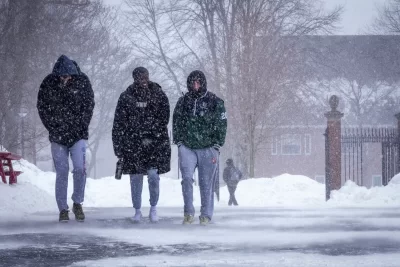
Over the woodlands brown and bare, over the harvest-fields forsaken, silent, and soft, and slow descends the snow. — Longfellow Back on campus after the February freak storm, Bates feels suspended between motion and stillness; cars crunch in half-melted tracks, boots drip by radiators, flights and plans still catching up somewhere in the clouds. Some of us are here, some are delayed, and the quiet holds space for both. It’s a strange return; rushed arrivals, late-night drives, weather maps open on our phones, yet the air itself feels calm, like the world pressed pause just long enough for us to notice it. The paradox is real; chaos in the forecast, steadiness on the quad. Snow does that. It softens edges, lowers voices, makes even a campus full of movement feel like it’s breathing slowly.
March 5, 2026

February at Bates

February on campus saw sports successes, several large snowfalls, and our annual Winter Carnival — a week of events celebrating the joys of the chilly season.