Mónica Quiñones-Frías
Assistant Professor of Biology
About
Inquiring About Research Opportunities
If you’re interested in doing research in my lab, fill out this form.
Education
2010 – 2014 B.S. in Molecular and Cellular Biology
2014 – 2020 Ph.D, in Biology; Massachusetts Institute of Technology
2020 – present Postdoctoral fellow; Brandeis University
Research Interests
In neurons, the ER extends deep into dendrites, axons, and synapses, where it adopts diverse structures and forms specialized contacts with other organelles, like endosomes. Studies suggest the ER is involved in neurite outgrowth, neurotransmission, and synaptic plasticity; however, the cell biology of the neuronal ER remains under-investigated. These gaps are crucial because mutations in genes that shape the ER can lead to neurodegenerative diseases, such as Hereditary Spastic Paraplegia (HSP). The importance of understanding synaptic ER function is further highlighted by the fact that HSP disease progression originates at upper motor neuron synapses. Altered ER function is also linked to other neurological diseases, such as Alzheimer’s Disease, making my research relevant to a range of neurological conditions.
Using the Drosophila larval neuromuscular junction (NMJ) as a model synapse, my lab will explore three aspects of ER biology in healthy and diseased neurons: the relationship between ER structure and function, ER structural dynamics, and local regulation of synaptic ER function. These research areas encompass fundamental questions that undergraduates can access experimentally, while maintaining high relevance to human neurodegenerative diseases. Through this work, students will grow as independent researchers by learning to dissect complex biological pathways using genetic approaches, including RNAi and CRISPR-based screens.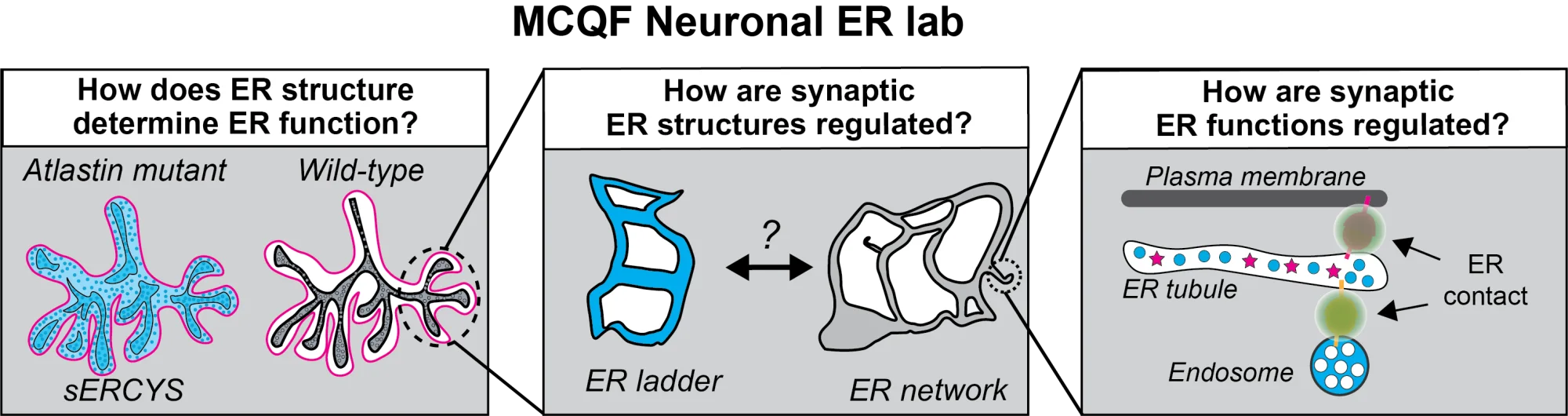
Publications
-
Quiñones-Frías, Mónica C., Dina M. Ocken*, and Avital Rodal. 2025. “Disruption of Synaptic Endoplasmic Reticulum Luminal Protein Containment in Drosophila Atlastin Mutants.” Preprint, bioRxiv, February 15. https://doi.org/10.1101/2023.09.01.555994.
*undergraduate researcher - Quiñones-Frías, Mónica C., and J. Troy Littleton. 2021. “Function of Drosophila Synaptotagmins in Membrane Trafficking at Synapses.” Cellular and Molecular Life Sciences 78 (9): 4335–64. https://doi.org/10.1007/s00018-021-03788-9.
- Guan, Zhuo, Monica C. Quiñones-Frías, Yulia Akbergenova, and J. Troy Littleton. 2020. “Drosophila Synaptotagmin 7 Negatively Regulates Synaptic Vesicle Release and Replenishment in a Dosage-Dependent Manner.” eLife 9 (April): e55443. https://doi.org/10.7554/eLife.55443.
Expertise
Current Courses
Fall Semester 2026
Lab-Based Biological Inquiry: The Cell Biology of Neurons
This is a course-based research experience in the biological sciences. Students build research skills through open-ended, authentic experimentation or observations of the natural world. Students gain practice reading scientific literature, formulating and testing hypotheses, analyzing data, interpre…
Winter Semester 2027
Senior Thesis
Permission of the department and the thesis advisor are required. Students register for BIO 458 in the winter semester. Majors writing an honors thesis register for both BIO 457 and 458.
Collaborative Thesis in Cell Biology
Laboratory, field, or library study of a current research topic in experimental ecology. A topic is selected with reference to the research interests of the instructor. Prerequisite(s): BIO 202, 204, and 206.