For the past 11 days, Ladd Library has played the role of first host to a deceptively simple exhibition touring various state cultural institutions. Starting on Sept. 21, three pages of the Maine State Constitution were on display in a glass box on the first floor of Ladd.
What made these particular pages, which only represent about 15 percent of the full State Constitution, worthy of a traveling exhibit? They had recently been printed by a Maine company, Wolfe Editions, using entirely old-fashioned means: vellum (an animal skin), a 19th century hand press, and cold-set ink. But what made them special is they contained words that hadn’t seen the light of day —at least in a printed copy of the State Constitution — for 150 years.
Language contained within Article X, including some related to the land rights of the Wabanaki Nations, disappeared from the last printed version of the State Constitution in 1876. In theory, foundational laws detailed in three sections of Article X hadn’t changed. But as Associate Professor of History Joseph Hall put it in an explanatory talk at Ladd on Sept. 24, the description of them had been “painted over in an invisible ink, erased but still in existence.”
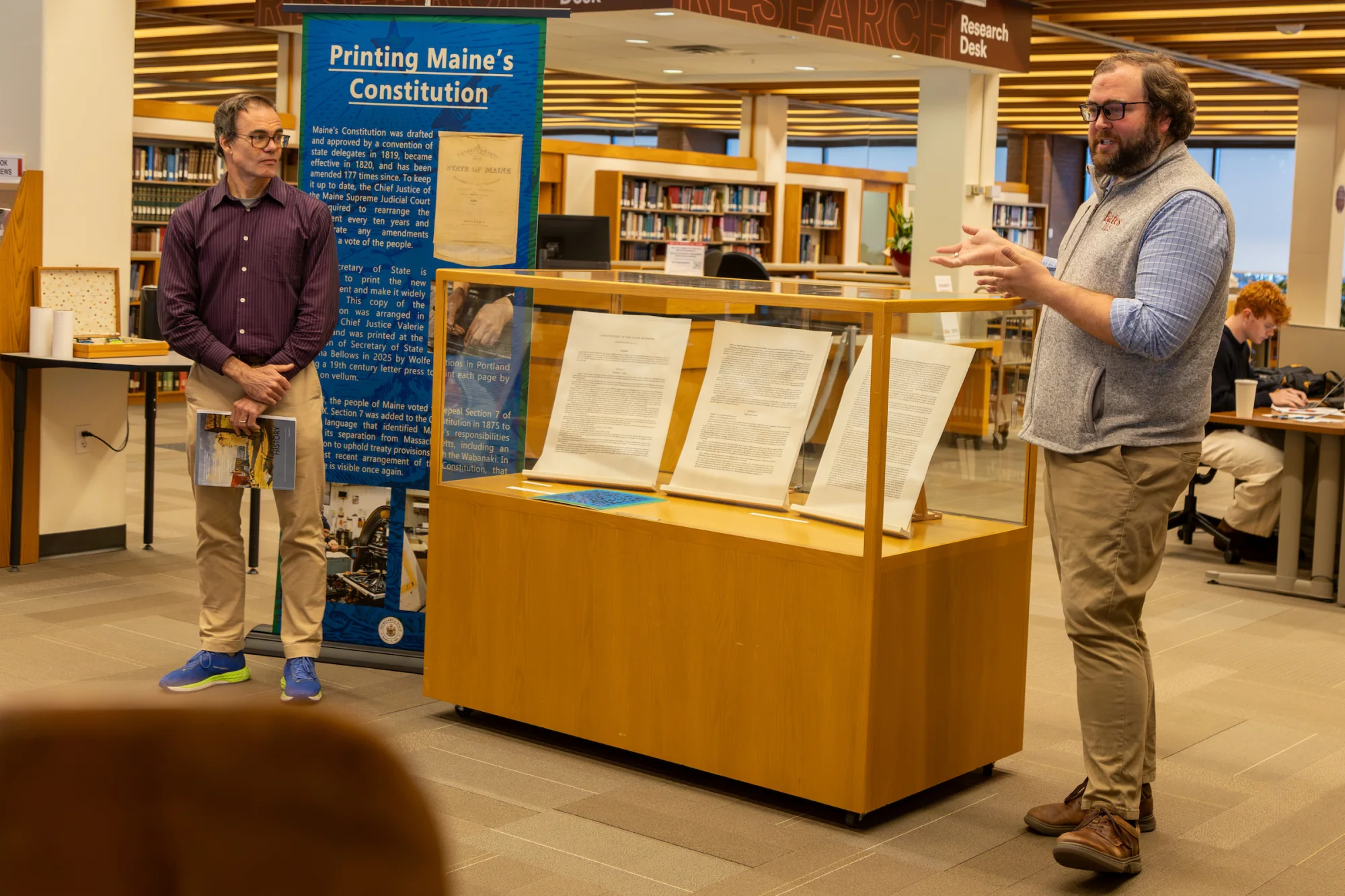
The exact reasons have been lost to history, but in recent years the deliberate omission has been carefully examined by historians, discussed by tribal leaders, and speculated on broadly. In 2023, Secretary of State Shenna Bellows led a movement to rectify the omission through a constitutional amendment. Maine voters weighed in on Question 6: should the formerly redacted words be restored? It won by 73 percent and the display at Ladd represented the material results of that vote. The words were there, written in cold-set ink.
The Maine State Archives had reached out to Sam Howes, a former employee of the state archives, now a reference and digital initiatives archivist at the Edmund S. Muskie Archives and Special Collections Library, about hosting the display this summer. Howes asked Hall, who teaches Native American history among other topics, to give some context for the exhibit.
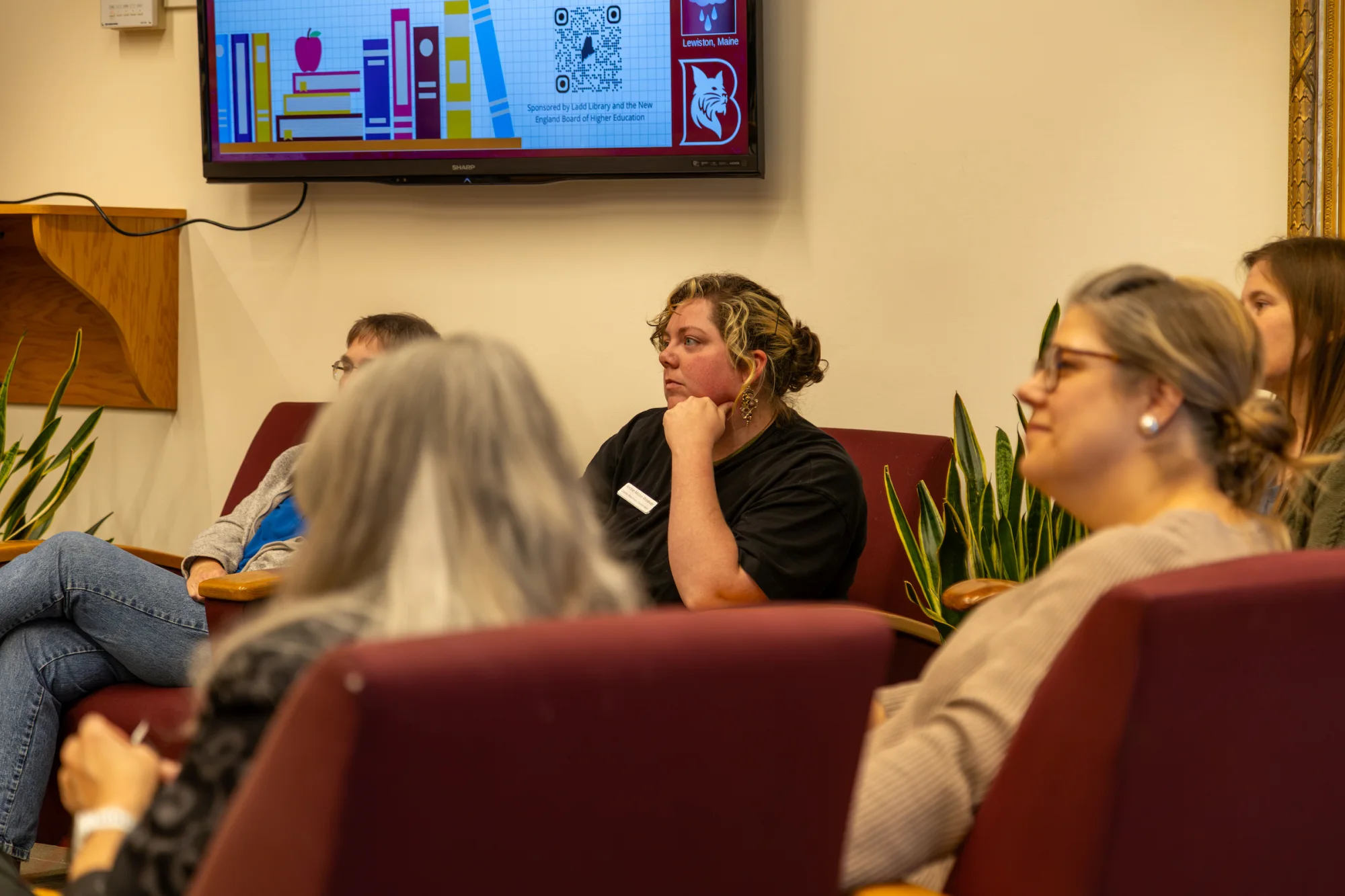
At the beginning of his talk, Hall asked the assembled group of students, faculty, and staff why — and whether — the printed document mattered. “Why do we care about these kinds of things?” he said. “We can get it on the internet. We don’t need to see this.”
Then he began building the case for its visibility.
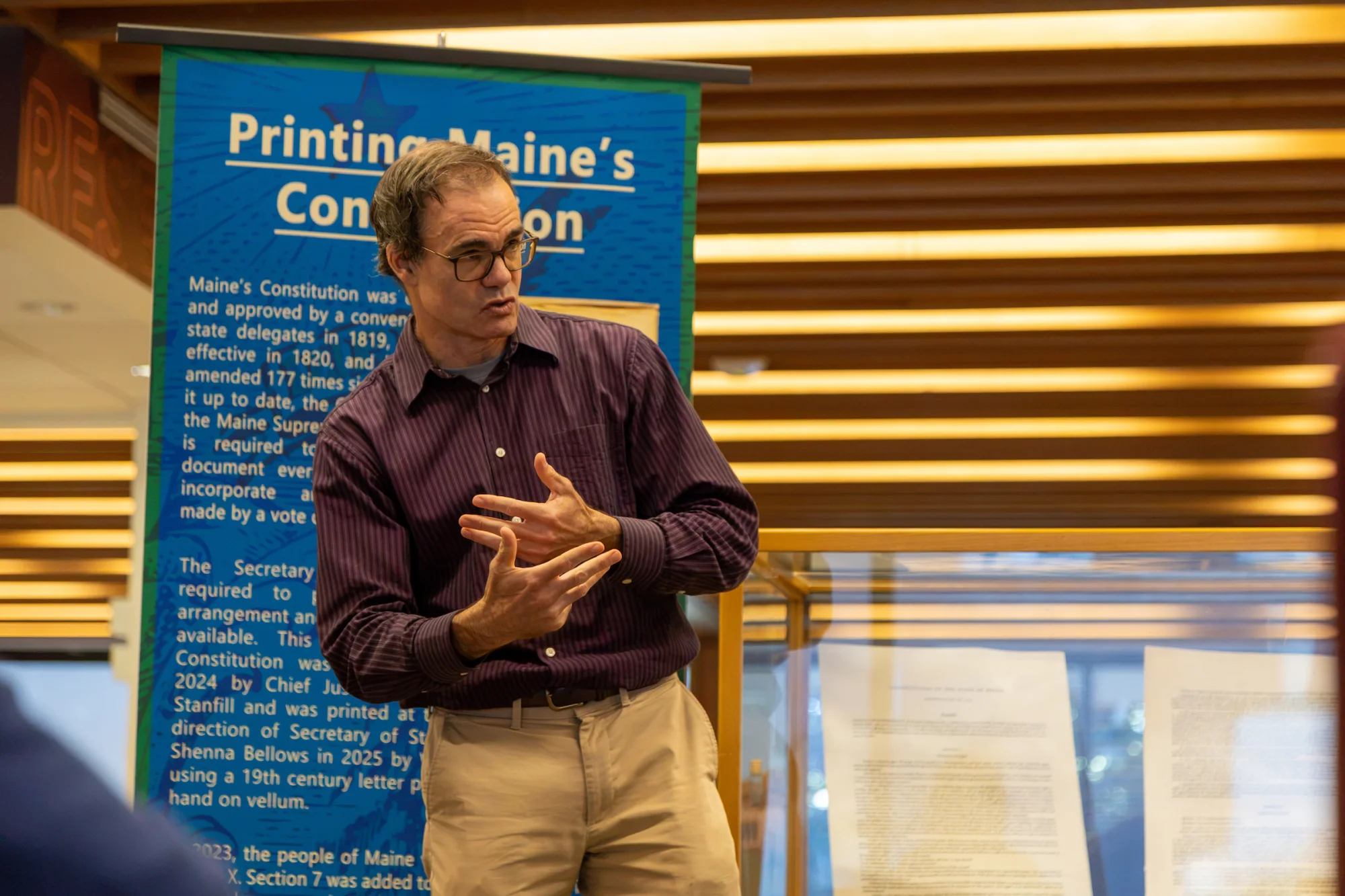
Redacted since 1876, these missing words had been in the earliest draft of the State Constitution in 1819, under Article X. Within Article X, Section 5 specifically described what the former District of Maine had to do to become independent from the Commonwealth of Massachusetts in 1820. Included in those rules was this provision:
The new State shall, as soon as the necessary arrangements can be made for that purpose, assume and perform all the duties and obligations of this Commonwealth towards the Indians within said district of Maine, whether the same arise from treaties, or otherwise; and for this purpose shall obtain the assent of said Indians, and their release to this Commonwealth of claims and stipulations arising under the treaty at present existing between the said Commonwealth and said Indians.
As Hall helped the assembled group get their heads around a complicated puzzle that spans three centuries, he held a copy of historian Catherine M. Burns’ 2021 scholarly work “‘It May Be Questionable:’ Granger v. Avery and the Redaction of Article X, Section 5 from the Maine Constitution.” Originally printed in Maine History, Burns’ article won the 2022 James Phinney Baxter Award. It likely led directly to the 2026 printing of the State Constitution, only the third time the document has ever been printed. (While Burns’ award-winning article is not available online, much of her findings are included in a piece she curated for the Maine Historical Society.)
“I wanted to bring it in part because basically you’re going to get the five-minute version of this very interesting essay,” Hall said. Burns, he said, found no document that explained the decision agreed to by voters in 1875 to redact the information in the 1876 printed constitution. But she did find “a number of interesting circumstantial pieces that suggest why,” he added.
“There’s no, if you will, smoking gun that proves that the state was saying, ‘We need to hide this section so that the Passamaquoddies don’t sue us for this land or for the loss of this land,’” Hall said.
But the Maine Supreme Judicial Court had heard a legal case in 1874 that seemed highly relevant. Joseph Granger v. Peter Avery was about a dispute between the Passamaquoddy and a lawyer from Calais named Joseph Granger, who believed he owned Grass Island in the St. Croix River. Peter Avery, a white Indian agent for the Passamaquoddy, had harvested hay on the island and authorized others to do so.
Granger’s claim was supported by a 1794 deed. But the tribe had a treaty with Massachusetts dating to the same year that established Grass Island and 14 other islands in the St. Croix were theirs. Granger won, and the Passamaquoddy lost, both the ownership of the island and their rights to harvest hay there. There was no restitution.
What Burns found in her research was that Granger had a friend and junior partner named Frederick Pike, also from Calais. In 1875, Pike was on the constitutional commission tasked with cleaning up the document in 1875. Pike, Hall said, “then makes the suggestion among all the things that might get cleaned up in the constitution ‘what if we also just take out Section 5?’” The decision was made to redact it instead, adding in language that it would still be enforced “with the same effect as if contained in said printed copies.”
Vice President for Information and Library Services Patricia Schoknecht asked Hall why Maine didn’t propose an amendment to entirely get rid of Article X in 1875.
The state couldn’t do that, Hall explained. “Because Massachusetts would have to agree to it.” The Maine Constitution mandates Massachusetts’ consent to annul or alter the Articles of Separation. That would include any changes in tribal relations in the state of Maine.
“I don‘t think Massachusetts was a hotbed of native sovereignty or something like that in 1875, because they’d already done their best to erase the Wampanoags and the Nipmuc and the other Native nations residing in Massachusetts,” Hall said. “But the idea that you now have to ask some other state?” As Hall suggests, there would perhaps be, 60 years into statehood, some resentment of the former “owner” of Maine getting to weigh in on future policy. To make it worse, Hall points out, there would also be “a real sort of paper trail.”
With this display of the amended and unredacted State Constitution, leaving Bates on Oct. 1 and headed next to the Turner Historical Museum, the paper trail is that much more visible.