Art in the Balance
Going global. Staying local. Can Mark Bessire, director of the Bates College Museum of Art, do both?
by Doug Hubley
Say it loud: We’re an academic museum and proud!
All right, not a rallying cry for the ages. Still, it’s a sentiment that Mark Bessire would endorse. To the public, says the new director of the Bates College Museum of Art, “there’s a certain amount of baggage to the notion of an ‘academic museum’: a dry, tired, insulated museum. But I actually think we need to reclaim the term ‘academic museum’ as a notion of progressivity.”
A Portlander who started at Bates a year ago, Bessire means “progressive” in the literal sense, and sees the museum’s first 2004 exhibition as a perfect example.
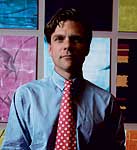
Director Mark Bessire strives to perfect the Museum of Art's local-global vision.
Documenting China: Contemporary Photography and Social Change gave Bates students a window on the world, revealing an ancient nation in the post-industrial throes of globalism and urbanization. Moreover, the exhibit arose from close collaboration with Bates faculty and bolstered existing curriculum, thanks in part to the teaching residency of curator Gu Zheng. And it anticipated a growing interest in contemporary Chinese art.
All that plus knockout photography now in the museum collection.
“If we did Documenting China two years from now, we would be following major shows in New York and at other museums,” says Bessire, who inherited the exhibition from staffers Bill Low and Anthony Shostak, who kept the museum on course between directors.
“Because we’re doing it first, we are actually meeting our mission in a really excellent way.”
Meeting our mission in an excellent way! That’s Bessire in a nutshell: a youthful 40-year-old, the son of a professional fund-raiser and someone who gets serious results through a deceptively buoyant, forward-in-all-directions energy.
Perhaps you heard about eRacism, a career retrospective by Bates’ own William Pope.L. Bessire curated the show for the Maine College of Art’s Institute of Contemporary Art, which he directed before coming to Bates. Yes, it was Pope.L’s own provocative art that garnered national press, but it was Bessire who got the exhibit together, sent it across country, and edited the gorgeous, award-winning catalog published by MIT Press.
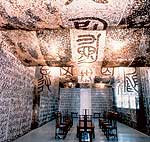
China Monument: temple of heaven by Wenda Gu.
That show illustrates the freedom academic museums enjoy thanks to institutional underwriting. “The more-public environment now is just so dependent on ticket sales,” Bessire says. “There certainly is a conversation among museum professionals about, how far does one go in leading the public or following the public? How far does one go to serious scholarship or to entertainment?”
“We are still interested in raising money, we are still interested in acquiring objects, we want as many people as possible to come into the museum,” he says, “but we just have a wider selection of variables by which we gauge our success.” Those variables include how museum programs mesh with the curriculum and what kind of art scholarship they engender.
So while Maine’s big public museums geared up for another summer of angling for middlebrow dollars, along came Bates with Wenda Gu, a Chinese artist who explores issues of cultural and racial convergence through “monuments” created from, among other elements, invented language and human hair (supposedly from 1 million heads).
While still at his previous post at ICA, Bessire, with counterparts in Texas and Missouri, curated Gu’s touring exhibition From Middle Kingdom to Biological Millennium. This summer the two institutions are jointly hosting the show. (Bessire has another Maine College of Art connection: His wife, Aimée Bessire, teaches art history there and Short Term courses at Bates.)
Bessire sees Gu’s work, like Documenting China, as artistic nutrition for growing minds. The artist traffics in themes abounding on today’s campus: the cultural effects of globalization, the power of the diasporic voice, the ascendancy of conceptual art. (More on the Web: www.bates.edu/x45913.xml) At the same time, Bessire knows well that the Bates museum must steward another tradition that may be antithetical, in its retrospection and even insularity, to what Gu or Documenting China represent.
The museum was founded to preserve a significant collection of Marsden Hartley drawings and other materials pertaining to this seminal American modernist, who was born in Lewiston and did much of his important work in Maine. More broadly, the museum’s holdings are rich in Maine art, and under predecessor Genetta McLean was known for thoughtful shows by eminent Mainers. (Although McLean’s exhibits also included a show by Xu Bing, another contemporary Chinese artist, in 2000.)
“We are going to stay keenly aware of where we started with Hartley,” Bessire says, and a small show from the Hartley collection is up this summer. Longer-term goals include the acquisition of a Hartley painting (not cheap) and perhaps more feasibly, a major traveling exhibition placing Hartley in his art-historical context, with Maine-linked contemporaries like Carl Sprinchorn, Berenice Abbott, and John Marin.
This summer’s third concurrent exhibition seems to sum up the artistic alchemy that Bessire seeks to perfect. The theme is recently acquired photographs — and the artists come from distant Africa, far-off China, and that mysterious settlement known as Portland, Maine.
In short, Bessire is practicing what he calls a “local-global vision,” and he believes that students need exposure to both the micro and the macro views. The trick is harmonizing the two — and it’s a trickier trick if you’re not interested in the middlebrow.
“It’s trying to find a balance,” Bessire says, “and it’s hard.”