Physics and Astronomy at Bates

The Physics and Astronomy department focuses on the study of space, time, matter, and energy.

Introductory courses provide students with the fundamentals of the subject, an introduction to the logic and philosophy of science, and insight into the understanding and applications of contemporary physics and astrophysics. Advanced courses allow students to delve deeper into each topic, from quantum theory to thermal physics. Majors will conduct and complete an independent project through participation in the senior thesis.

Contact Us

Sylvia Deschaine
Academic Administrative Assistant and Carnegie Science Hall Coordinator
Phone: 207-786-6490 sdescha2@bates.edu

What You Will Learn

clipboard, pen, chat bubbles, and network icons in garnet
To appreciate the workings of the natural world through qualitative and quantitative description, analysis, and understanding

pen, stack of paper, light bulb, and gear icons in garnet
To build problem-solving skills and the capability for analytical thinking
person, circular network, map, and marker icons in garnet
How to appreciate the intuitive and creative elements of physics
academic building, brain, paper, and pencil icons in garnet
To foster constructive skepticism in order to ask substantive questions about the natural world

books on a shelf and chat bubble icons in garnet
The real-world role of physics as a foundational part of our technology-driven society

magnifying glass, notebook, and academic building icons in garnet
How to demonstrate knowledge through both oral and written communications to a diverse audience
Life After Bates

Physics and Astronomy majors at Bates go on to successful careers across a wide range of fields, including science and technology, information technology, and financial services. In addition, graduates often pursue post-graduate studies at prestigious universities such as Princeton, Harvard, and Virginia Tech, exploring subjects as diverse as electrical engineering, geophysics, medical physics, and more.

91%

of 2020-2024 Science & Math graduates are employed and/or attending graduate school

  • Harvard University
  • University of Oxford
  • Columbia University
  • Dartmouth College
  • Cornell University
  • University of Pennsylvania
  • Brown University
  • University of Michigan
All kids agree; the moon looks WAY better up close!
.
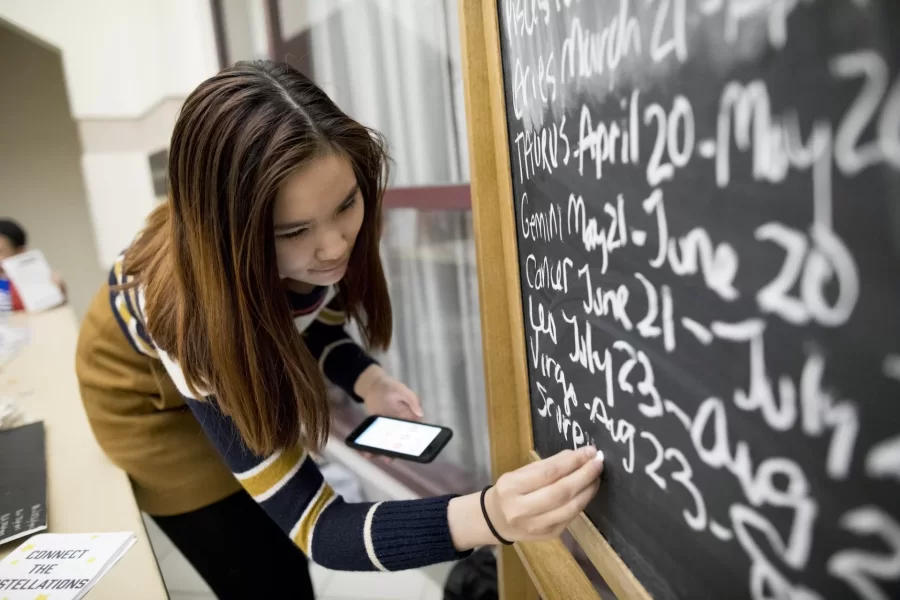
Emily Morse '17 (blue jeans) and Laura Nguyen '19 with Connect the Constellations.

Isla Shea, 6, of East Auburn School, uses a Carnegie telescope with 2,000x eye strength to view the moon as Evan Goldberg '19 looks on during last night's Bates Astronomy Extravaganza co-hosted by the Harward Center for Community Partnerships and the Bates College Physics and Astronomy Department.
.
Students in Astronomy 106, taught by Assistant Professor of Phyiscs Aleks Diamond-Stanic, ran hands on activities and planetarium shows to introduce children to black holes, galaxies, moons, planets, and more. Bates provided a fun night of getting kids excited about science.

All kids agree; the moon looks WAY better up close! . Emily Morse ’17 (blue jeans) and Laura Nguyen ’19 with Connect the Constellations. Isla Shea, 6, of East Auburn School, uses a Carnegie telescope with 2,000x eye strength to view the moon as Evan Goldberg ’19 looks on during last night’s Bates Astronomy Extravaganza co-hosted by the Harward Center for Community Partnerships and the Bates College Physics and Astronomy Department. . Students in Astronomy 106, taught by Assistant Professor of Phyiscs Aleks Diamond-Stanic, ran hands on activities and planetarium shows to introduce children to black holes, galaxies, moons, planets, and more. Bates provided a fun night of getting kids excited about science.

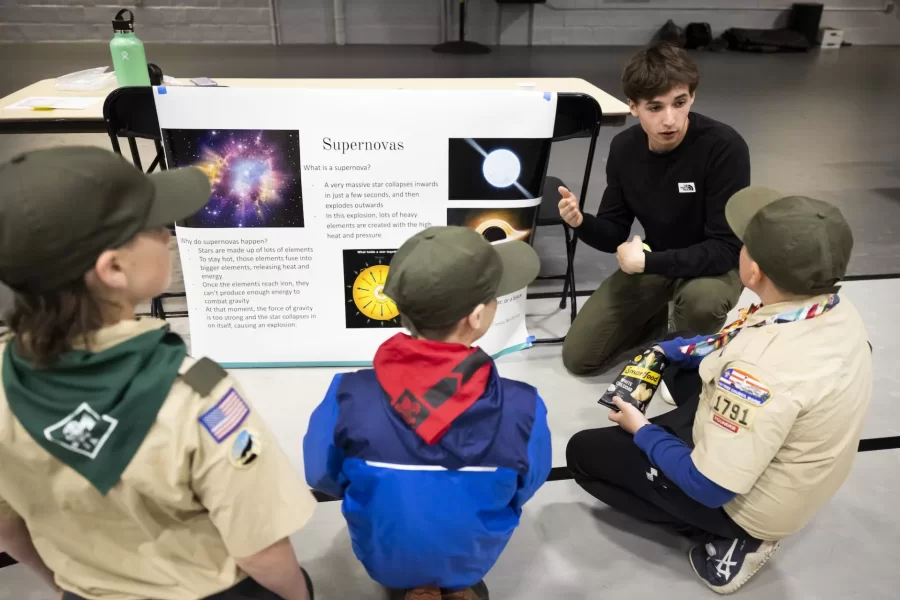
Students from Associate Professor of Physics Aleks Diamond-Stanic’s Intro to Astronomy course held 20 interactive learning activities on topics including constellations, seasons, moon phases, planets and stars, gravity, telescopes, supernova explosions, and black holes. 

Caption info for Community Astronomy Night

Mark Diamond-Stanic, 7, of Lewiston jumping

Adam Joseph ’25 of Bloomfield, Conn., and Naomi Lynch ’25 of Farmingdale, Maine, at the rocket jumping station, seeing who can make the rocket go highest: the amount of force is related to how fat the rocket launches and how high it goes. It’s about how gravity works.

Bates students jumping at this station: Zach Van Dusen in blue jacket, Sydney Schuster in purple bandana, Talia Skaistis in black and yellow, and Julia Neumann in green.

Dexter Demers, 9, of Minot with Julia Johnson, Emmy Pike at Poster, Delaney Nwachukwu ‘24
The Electromagnetic Spectrum

Hannah, 8, with brothers David, 6, and Evan, 4 (mother is Michelle Richards of Lewiston)

Afonso, 5, of Lewison. His father is Afonso Ngola (afonsongola@hotmail.com). With sister Rebeca, 18

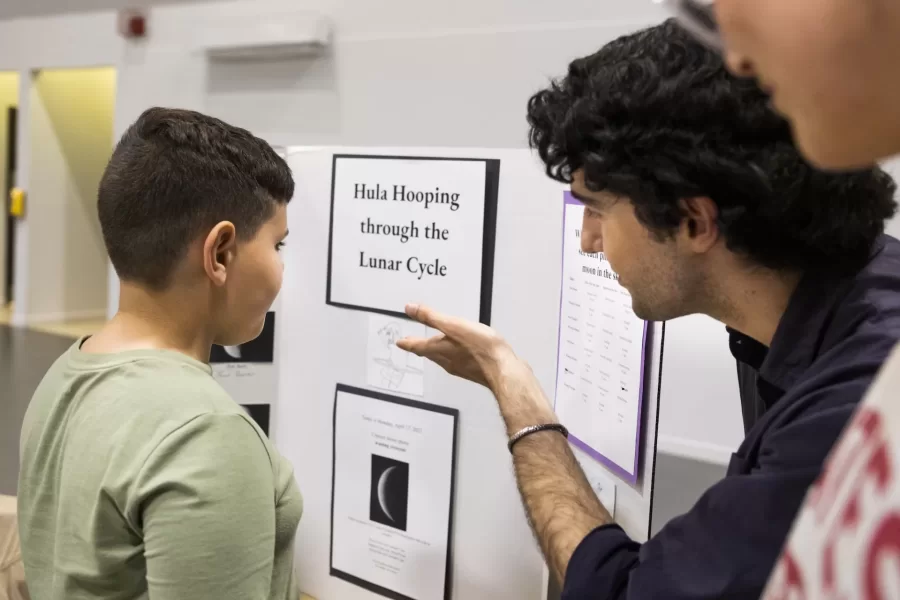
Teddy Rocque, 7, at moon phases station with Sadie Coleman ’25 and Serena McGrane 

Intro to Astronomy, Maddox, 8, of Lewiston

Hula hooping
Daphne Valen ’23 in sweatshirt
Evan Antonakes ’23 amd Lincoln Rybeck ‘25

Boy Scout master Dan Poirier (615-9952) of Troop 1791 in Auburn
Chad, 11, right; Wyatt, 11, center, and Calvin, 11 left

Students from Associate Professor of Physics Aleks Diamond-Stanic’s Intro to Astronomy course held 20 interactive learning activities on topics including constellations, seasons, moon phases, planets and stars, gravity, telescopes, supernova explosions, and black holes. Caption info for Community Astronomy Night Mark Diamond-Stanic, 7, of Lewiston jumping Adam Joseph ’25 of Bloomfield, Conn., and Naomi Lynch ’25 of Farmingdale, Maine, at the rocket jumping station, seeing who can make the rocket go highest: the amount of force is related to how fat the rocket launches and how high it goes. It’s about how gravity works. Bates students jumping at this station: Zach Van Dusen in blue jacket, Sydney Schuster in purple bandana, Talia Skaistis in black and yellow, and Julia Neumann in green. Dexter Demers, 9, of Minot with Julia Johnson, Emmy Pike at Poster, Delaney Nwachukwu ‘24 The Electromagnetic Spectrum Hannah, 8, with brothers David, 6, and Evan, 4 (mother is Michelle Richards of Lewiston) Afonso, 5, of Lewison. His father is Afonso Ngola (afonsongola@hotmail.com). With sister Rebeca, 18 Teddy Rocque, 7, at moon phases station with Sadie Coleman ’25 and Serena McGrane Intro to Astronomy, Maddox, 8, of Lewiston Hula hooping Daphne Valen ’23 in sweatshirt Evan Antonakes ’23 amd Lincoln Rybeck ‘25 Boy Scout master Dan Poirier (615-9952) of Troop 1791 in Auburn Chad, 11, right; Wyatt, 11, center, and Calvin, 11 left

The Mount David Summit 2023 __________

Alecks Diamond-Stanic, Physics, and Brandon Villalta Lopez '25, Kerry O'Brien Award

The Mount David Summit 2023 __________ Alecks Diamond-Stanic, Physics, and Brandon Villalta Lopez ’25, Kerry O’Brien Award

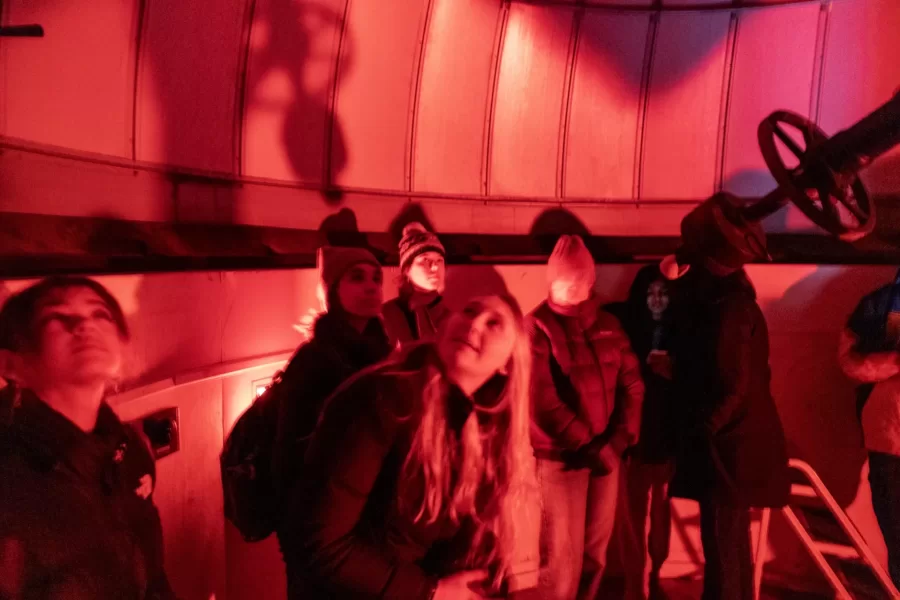
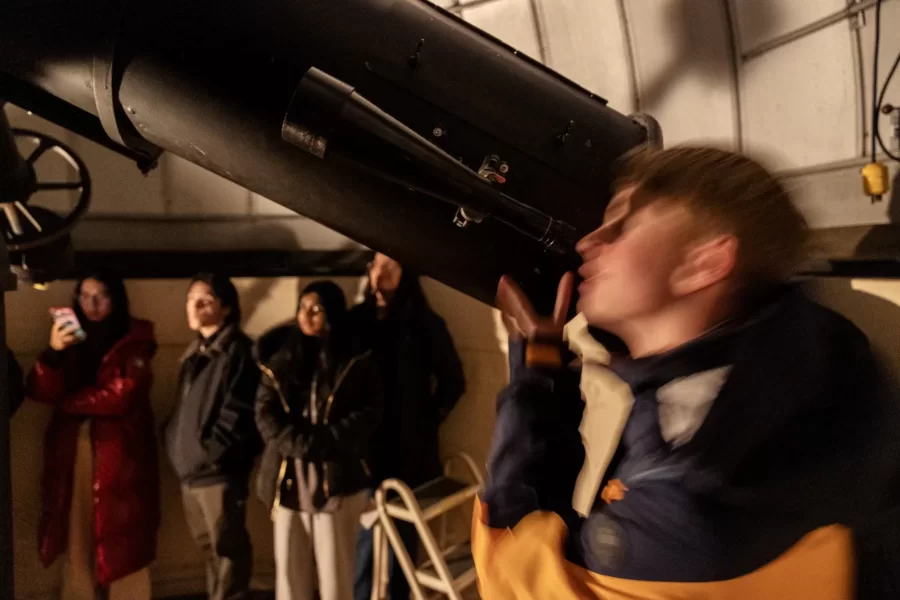
Evan Boxer-Cook ’26, of Scarborough, Maine, leads the Bates Astronomy Club from Carnegie 321 to the Stephens observatory, located on the roof of Carnegie, on January 15, 2025. (Theophil Syslo | Bates College)

Evan Boxer-Cook ’26, of Scarborough, Maine, leads the Bates Astronomy Club from Carnegie 321 to the Stephens observatory, located on the roof of Carnegie, on January 15, 2025. (Theophil Syslo | Bates College)

Evan Boxer-Cook ’26, of Scarborough, Maine, leads the Bates Astronomy Club from Carnegie 321 to the Stephens observatory, located on the roof of Carnegie, on January 15, 2025. (Theophil Syslo | Bates College)

Evan Boxer-Cook ’26, of Scarborough, Maine, leads the Bates Astronomy Club from Carnegie 321 to the Stephens observatory, located on the roof of Carnegie, on January 15, 2025. (Theophil Syslo | Bates College)

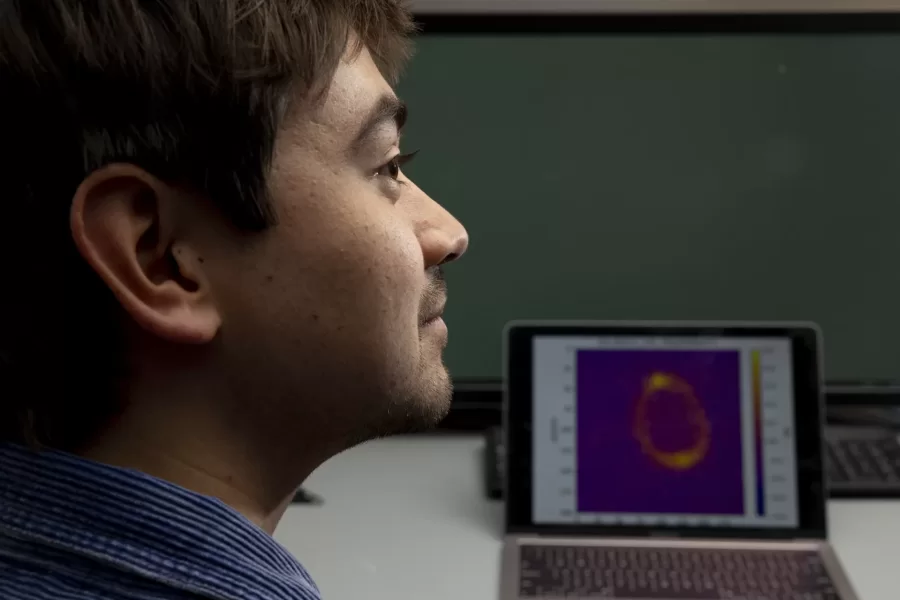
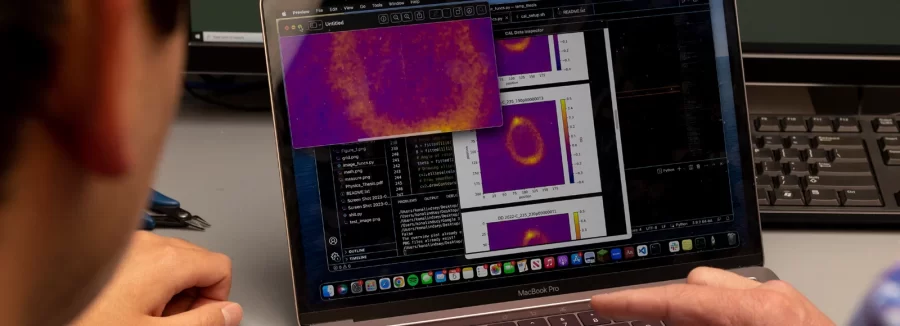
Professor of Physics Nathan Lundblad has received an award from NASA. He is collaborating with several students on the research and is shown here in his Carnegie Science Lab (Carnegie 146) with two of those students, Kona Lindsey ’23 of Colorado Springs, Colo., and Elias Veilleux ’23 (I gray shirt with glasses) of Orono, Maine

Kona is shown with his laptop that display research images. Kona writes: “The image seen on my laptop is from an experiment run in the Cold Atom Lab on the International Space Station (ISS). It shows an ultracold gas bubble composed of rubidium atoms. The ring that is visible indicates that the atoms are occupying a shell, or bubble structure. You can see that the inside of the ring has few atoms, meaning the structure is truly hollow.”

Professor of Physics Nathan Lundblad has received an award from NASA. He is collaborating with several students on the research and is shown here in his Carnegie Science Lab (Carnegie 146) with two of those students, Kona Lindsey ’23 of Colorado Springs, Colo., and Elias Veilleux ’23 (I gray shirt with glasses) of Orono, Maine Kona is shown with his laptop that display research images. Kona writes: “The image seen on my laptop is from an experiment run in the Cold Atom Lab on the International Space Station (ISS). It shows an ultracold gas bubble composed of rubidium atoms. The ring that is visible indicates that the atoms are occupying a shell, or bubble structure. You can see that the inside of the ring has few atoms, meaning the structure is truly hollow.”

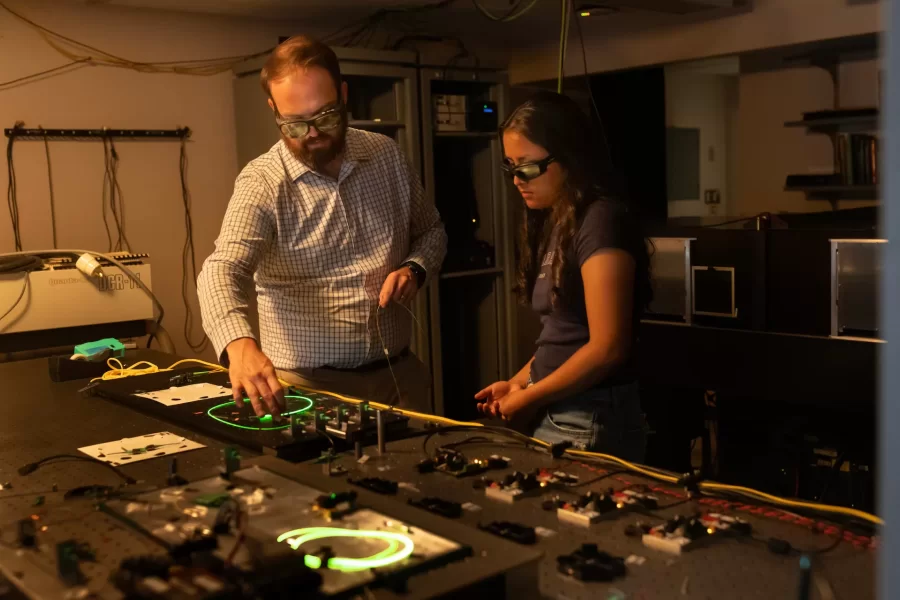
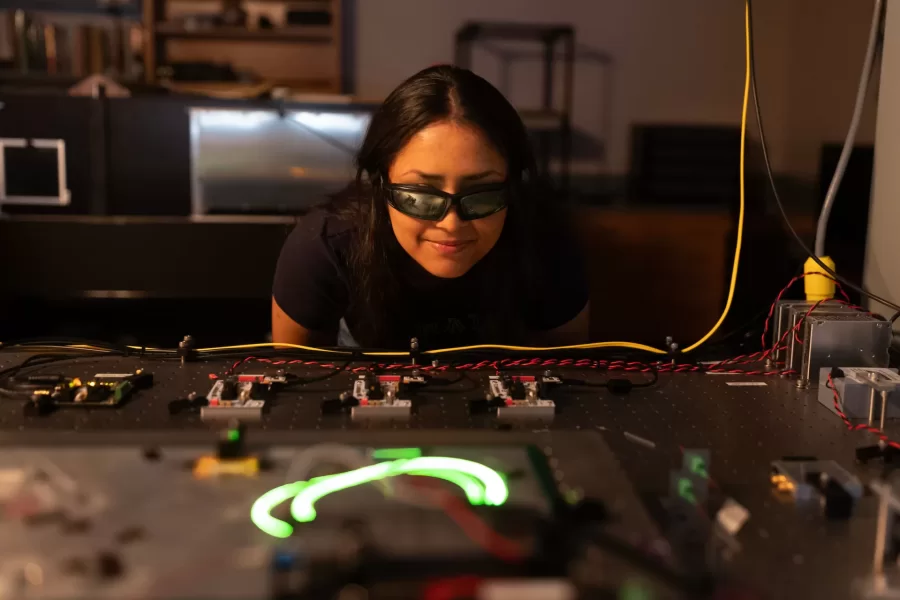
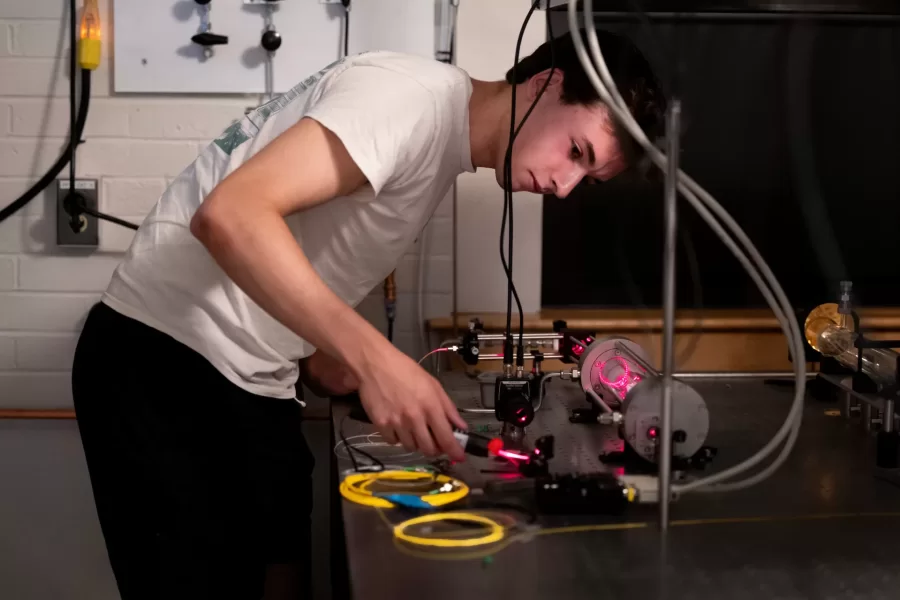
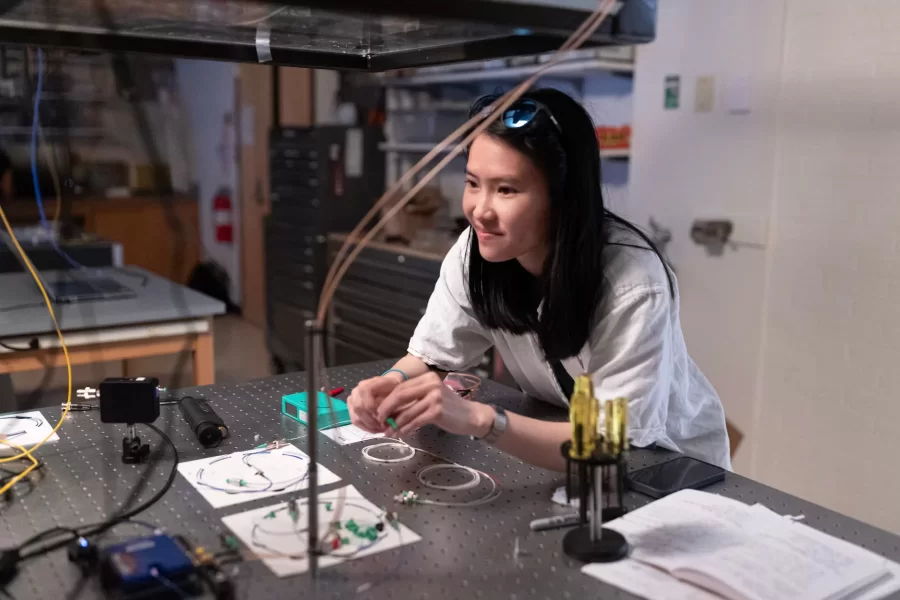
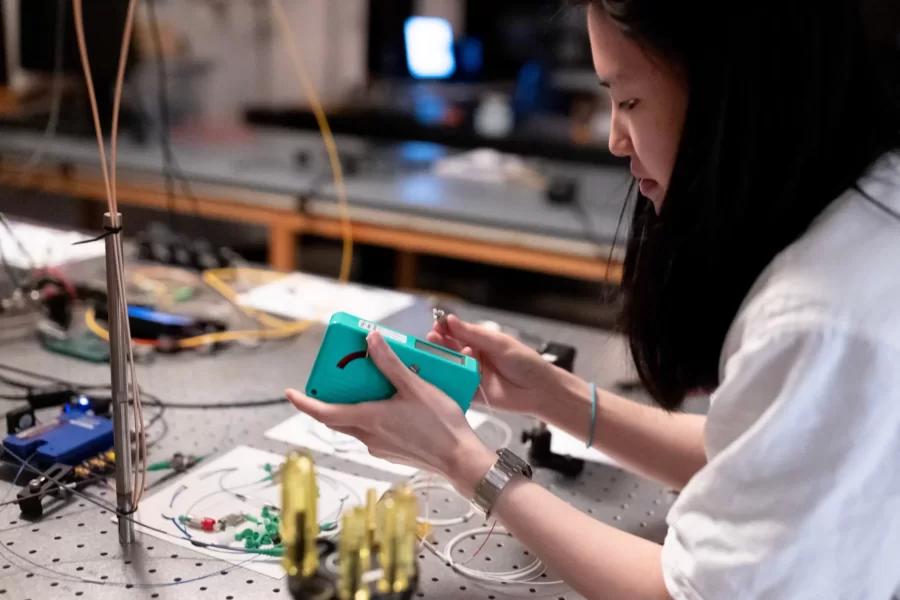
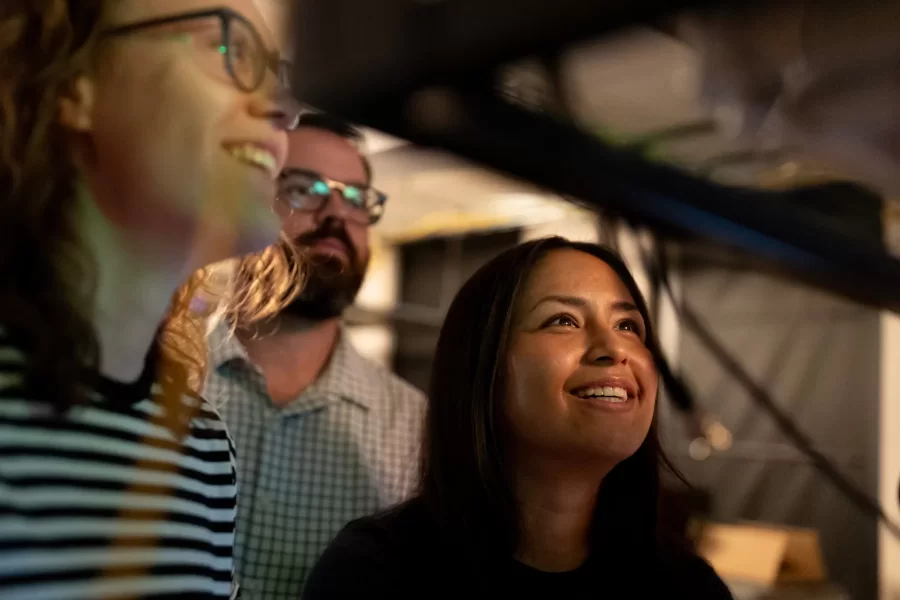
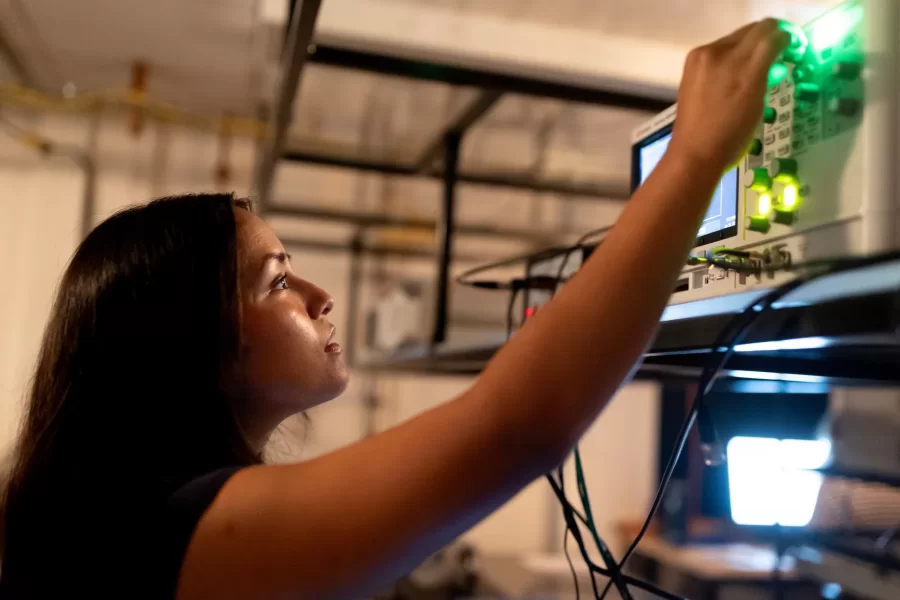
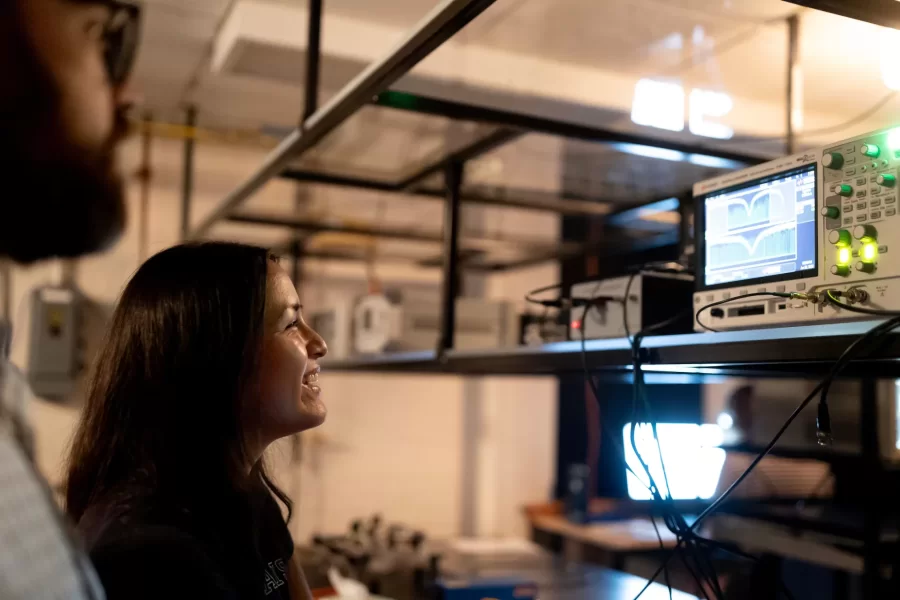
Assistant Professor of Physics Ryan Cole works with students in his Carnegie Science 156 lab on June 20, 2025. There is a secondary lab pictured in some of the photos that he and Paloma visited wearing goggles, where they used a laser to measure light frequencies. 

“Every once in a while, science makes sense,” he said at one point to the students.


“Paloma is building an instrument to study very precisely sunlight and specifically the spectrum of sunlight for applications ultimately in exoplanets (planets orbiting other stars)  detection and characterization.

And then this table, which is Carson, Quinn, and Audrey (and Andrew Liu who is not here today) They are measuring how atmospheric gases like methane — specifically green house gases — interact with light to ultimately help us measure those things better in the atmosphere.

Students photographed:

Audrey Schane ’25, physics major, who is working as a research assistant with Cole this summer,
Shown at the computer (striped t-shirt), where she is looking at a gas sample where she’s building something to control gas temperatures, with a vaccuum on the bottom. 

Paloma Rodriguez ’26, a physics major (black t-shirt)

Carson Moellering ’26, physics major, looking at how methane absorbs light in different conditions (light reflecting back and forth in mirrors (white t-shirt)

Qwynn Kobertz ’26, double major in physics and studio art, using a DSR laser exploring how to use this laser in a methane detecting app. (sunglasses on head) Here are two quick links that may help with some context for what we're doing in the lab.

My research website: https://sites.google.com/bates.edu/colelab/research-areas?authuser=0

NIST Article on optical frequency combs: https://www.nist.gov/topics/physics/optical-frequency-combs

Assistant Professor of Physics Ryan Cole works with students in his Carnegie Science 156 lab on June 20, 2025. There is a secondary lab pictured in some of the photos that he and Paloma visited wearing goggles, where they used a laser to measure light frequencies. “Every once in a while, science makes sense,” he said at one point to the students. “Paloma is building an instrument to study very precisely sunlight and specifically the spectrum of sunlight for applications ultimately in exoplanets (planets orbiting other stars) detection and characterization. And then this table, which is Carson, Quinn, and Audrey (and Andrew Liu who is not here today) They are measuring how atmospheric gases like methane — specifically green house gases — interact with light to ultimately help us measure those things better in the atmosphere. Students photographed: Audrey Schane ’25, physics major, who is working as a research assistant with Cole this summer, Shown at the computer (striped t-shirt), where she is looking at a gas sample where she’s building something to control gas temperatures, with a vaccuum on the bottom. Paloma Rodriguez ’26, a physics major (black t-shirt) Carson Moellering ’26, physics major, looking at how methane absorbs light in different conditions (light reflecting back and forth in mirrors (white t-shirt) Qwynn Kobertz ’26, double major in physics and studio art, using a DSR laser exploring how to use this laser in a methane detecting app. (sunglasses on head) Here are two quick links that may help with some context for what we’re doing in the lab. My research website: https://sites.google.com/bates.edu/colelab/research-areas?authuser=0 NIST Article on optical frequency combs: https://www.nist.gov/topics/physics/optical-frequency-combs

Assistant Professor of Physics Ryan Cole works with students in his Carnegie Science 156 lab on June 20, 2025. There is a secondary lab pictured in some of the photos that he and Paloma visited wearing goggles, where they used a laser to measure light frequencies. 

“Every once in a while, science makes sense,” he said at one point to the students.


“Paloma is building an instrument to study very precisely sunlight and specifically the spectrum of sunlight for applications ultimately in exoplanets (planets orbiting other stars)  detection and characterization.

And then this table, which is Carson, Quinn, and Audrey (and Andrew Liu who is not here today) They are measuring how atmospheric gases like methane — specifically green house gases — interact with light to ultimately help us measure those things better in the atmosphere.

Students photographed:

Audrey Schane ’25, physics major, who is working as a research assistant with Cole this summer,
Shown at the computer (striped t-shirt), where she is looking at a gas sample where she’s building something to control gas temperatures, with a vaccuum on the bottom. 

Paloma Rodriguez ’26, a physics major (black t-shirt)

Carson Moellering ’26, physics major, looking at how methane absorbs light in different conditions (light reflecting back and forth in mirrors (white t-shirt)

Qwynn Kobertz ’26, double major in physics and studio art, using a DSR laser exploring how to use this laser in a methane detecting app. (sunglasses on head) Here are two quick links that may help with some context for what we're doing in the lab.

My research website: https://sites.google.com/bates.edu/colelab/research-areas?authuser=0

NIST Article on optical frequency combs: https://www.nist.gov/topics/physics/optical-frequency-combs

Assistant Professor of Physics Ryan Cole works with students in his Carnegie Science 156 lab on June 20, 2025. There is a secondary lab pictured in some of the photos that he and Paloma visited wearing goggles, where they used a laser to measure light frequencies. “Every once in a while, science makes sense,” he said at one point to the students. “Paloma is building an instrument to study very precisely sunlight and specifically the spectrum of sunlight for applications ultimately in exoplanets (planets orbiting other stars) detection and characterization. And then this table, which is Carson, Quinn, and Audrey (and Andrew Liu who is not here today) They are measuring how atmospheric gases like methane — specifically green house gases — interact with light to ultimately help us measure those things better in the atmosphere. Students photographed: Audrey Schane ’25, physics major, who is working as a research assistant with Cole this summer, Shown at the computer (striped t-shirt), where she is looking at a gas sample where she’s building something to control gas temperatures, with a vaccuum on the bottom. Paloma Rodriguez ’26, a physics major (black t-shirt) Carson Moellering ’26, physics major, looking at how methane absorbs light in different conditions (light reflecting back and forth in mirrors (white t-shirt) Qwynn Kobertz ’26, double major in physics and studio art, using a DSR laser exploring how to use this laser in a methane detecting app. (sunglasses on head) Here are two quick links that may help with some context for what we’re doing in the lab. My research website: https://sites.google.com/bates.edu/colelab/research-areas?authuser=0 NIST Article on optical frequency combs: https://www.nist.gov/topics/physics/optical-frequency-combs

Assistant Professor of Physics Ryan Cole works with students in his Carnegie Science 156 lab on June 20, 2025. There is a secondary lab pictured in some of the photos that he and Paloma visited wearing goggles, where they used a laser to measure light frequencies. 

“Every once in a while, science makes sense,” he said at one point to the students.


“Paloma is building an instrument to study very precisely sunlight and specifically the spectrum of sunlight for applications ultimately in exoplanets (planets orbiting other stars)  detection and characterization.

And then this table, which is Carson, Quinn, and Audrey (and Andrew Liu who is not here today) They are measuring how atmospheric gases like methane — specifically green house gases — interact with light to ultimately help us measure those things better in the atmosphere.

Students photographed:

Audrey Schane ’25, physics major, who is working as a research assistant with Cole this summer,
Shown at the computer (striped t-shirt), where she is looking at a gas sample where she’s building something to control gas temperatures, with a vaccuum on the bottom. 

Paloma Rodriguez ’26, a physics major (black t-shirt)

Carson Moellering ’26, physics major, looking at how methane absorbs light in different conditions (light reflecting back and forth in mirrors (white t-shirt)

Qwynn Kobertz ’26, double major in physics and studio art, using a DSR laser exploring how to use this laser in a methane detecting app. (sunglasses on head) Here are two quick links that may help with some context for what we're doing in the lab.

My research website: https://sites.google.com/bates.edu/colelab/research-areas?authuser=0

NIST Article on optical frequency combs: https://www.nist.gov/topics/physics/optical-frequency-combs

Assistant Professor of Physics Ryan Cole works with students in his Carnegie Science 156 lab on June 20, 2025. There is a secondary lab pictured in some of the photos that he and Paloma visited wearing goggles, where they used a laser to measure light frequencies. “Every once in a while, science makes sense,” he said at one point to the students. “Paloma is building an instrument to study very precisely sunlight and specifically the spectrum of sunlight for applications ultimately in exoplanets (planets orbiting other stars) detection and characterization. And then this table, which is Carson, Quinn, and Audrey (and Andrew Liu who is not here today) They are measuring how atmospheric gases like methane — specifically green house gases — interact with light to ultimately help us measure those things better in the atmosphere. Students photographed: Audrey Schane ’25, physics major, who is working as a research assistant with Cole this summer, Shown at the computer (striped t-shirt), where she is looking at a gas sample where she’s building something to control gas temperatures, with a vaccuum on the bottom. Paloma Rodriguez ’26, a physics major (black t-shirt) Carson Moellering ’26, physics major, looking at how methane absorbs light in different conditions (light reflecting back and forth in mirrors (white t-shirt) Qwynn Kobertz ’26, double major in physics and studio art, using a DSR laser exploring how to use this laser in a methane detecting app. (sunglasses on head) Here are two quick links that may help with some context for what we’re doing in the lab. My research website: https://sites.google.com/bates.edu/colelab/research-areas?authuser=0 NIST Article on optical frequency combs: https://www.nist.gov/topics/physics/optical-frequency-combs

Assistant Professor of Physics Ryan Cole works with students in his Carnegie Science 156 lab on June 20, 2025. There is a secondary lab pictured in some of the photos that he and Paloma visited wearing goggles, where they used a laser to measure light frequencies. 

“Every once in a while, science makes sense,” he said at one point to the students.


“Paloma is building an instrument to study very precisely sunlight and specifically the spectrum of sunlight for applications ultimately in exoplanets (planets orbiting other stars)  detection and characterization.

And then this table, which is Carson, Quinn, and Audrey (and Andrew Liu who is not here today) They are measuring how atmospheric gases like methane — specifically green house gases — interact with light to ultimately help us measure those things better in the atmosphere.

Students photographed:

Audrey Schane ’25, physics major, who is working as a research assistant with Cole this summer,
Shown at the computer (striped t-shirt), where she is looking at a gas sample where she’s building something to control gas temperatures, with a vaccuum on the bottom. 

Paloma Rodriguez ’26, a physics major (black t-shirt)

Carson Moellering ’26, physics major, looking at how methane absorbs light in different conditions (light reflecting back and forth in mirrors (white t-shirt)

Qwynn Kobertz ’26, double major in physics and studio art, using a DSR laser exploring how to use this laser in a methane detecting app. (sunglasses on head) Here are two quick links that may help with some context for what we're doing in the lab.

My research website: https://sites.google.com/bates.edu/colelab/research-areas?authuser=0

NIST Article on optical frequency combs: https://www.nist.gov/topics/physics/optical-frequency-combs

Assistant Professor of Physics Ryan Cole works with students in his Carnegie Science 156 lab on June 20, 2025. There is a secondary lab pictured in some of the photos that he and Paloma visited wearing goggles, where they used a laser to measure light frequencies. “Every once in a while, science makes sense,” he said at one point to the students. “Paloma is building an instrument to study very precisely sunlight and specifically the spectrum of sunlight for applications ultimately in exoplanets (planets orbiting other stars) detection and characterization. And then this table, which is Carson, Quinn, and Audrey (and Andrew Liu who is not here today) They are measuring how atmospheric gases like methane — specifically green house gases — interact with light to ultimately help us measure those things better in the atmosphere. Students photographed: Audrey Schane ’25, physics major, who is working as a research assistant with Cole this summer, Shown at the computer (striped t-shirt), where she is looking at a gas sample where she’s building something to control gas temperatures, with a vaccuum on the bottom. Paloma Rodriguez ’26, a physics major (black t-shirt) Carson Moellering ’26, physics major, looking at how methane absorbs light in different conditions (light reflecting back and forth in mirrors (white t-shirt) Qwynn Kobertz ’26, double major in physics and studio art, using a DSR laser exploring how to use this laser in a methane detecting app. (sunglasses on head) Here are two quick links that may help with some context for what we’re doing in the lab. My research website: https://sites.google.com/bates.edu/colelab/research-areas?authuser=0 NIST Article on optical frequency combs: https://www.nist.gov/topics/physics/optical-frequency-combs

Assistant Professor of Physics Ryan Cole works with students in his Carnegie Science 156 lab on June 20, 2025. There is a secondary lab pictured in some of the photos that he and Paloma visited wearing goggles, where they used a laser to measure light frequencies. 

“Every once in a while, science makes sense,” he said at one point to the students.


“Paloma is building an instrument to study very precisely sunlight and specifically the spectrum of sunlight for applications ultimately in exoplanets (planets orbiting other stars)  detection and characterization.

And then this table, which is Carson, Quinn, and Audrey (and Andrew Liu who is not here today) They are measuring how atmospheric gases like methane — specifically green house gases — interact with light to ultimately help us measure those things better in the atmosphere.

Students photographed:

Audrey Schane ’25, physics major, who is working as a research assistant with Cole this summer,
Shown at the computer (striped t-shirt), where she is looking at a gas sample where she’s building something to control gas temperatures, with a vaccuum on the bottom. 

Paloma Rodriguez ’26, a physics major (black t-shirt)

Carson Moellering ’26, physics major, looking at how methane absorbs light in different conditions (light reflecting back and forth in mirrors (white t-shirt)

Qwynn Kobertz ’26, double major in physics and studio art, using a DSR laser exploring how to use this laser in a methane detecting app. (sunglasses on head) Here are two quick links that may help with some context for what we're doing in the lab.

My research website: https://sites.google.com/bates.edu/colelab/research-areas?authuser=0

NIST Article on optical frequency combs: https://www.nist.gov/topics/physics/optical-frequency-combs

Assistant Professor of Physics Ryan Cole works with students in his Carnegie Science 156 lab on June 20, 2025. There is a secondary lab pictured in some of the photos that he and Paloma visited wearing goggles, where they used a laser to measure light frequencies. “Every once in a while, science makes sense,” he said at one point to the students. “Paloma is building an instrument to study very precisely sunlight and specifically the spectrum of sunlight for applications ultimately in exoplanets (planets orbiting other stars) detection and characterization. And then this table, which is Carson, Quinn, and Audrey (and Andrew Liu who is not here today) They are measuring how atmospheric gases like methane — specifically green house gases — interact with light to ultimately help us measure those things better in the atmosphere. Students photographed: Audrey Schane ’25, physics major, who is working as a research assistant with Cole this summer, Shown at the computer (striped t-shirt), where she is looking at a gas sample where she’s building something to control gas temperatures, with a vaccuum on the bottom. Paloma Rodriguez ’26, a physics major (black t-shirt) Carson Moellering ’26, physics major, looking at how methane absorbs light in different conditions (light reflecting back and forth in mirrors (white t-shirt) Qwynn Kobertz ’26, double major in physics and studio art, using a DSR laser exploring how to use this laser in a methane detecting app. (sunglasses on head) Here are two quick links that may help with some context for what we’re doing in the lab. My research website: https://sites.google.com/bates.edu/colelab/research-areas?authuser=0 NIST Article on optical frequency combs: https://www.nist.gov/topics/physics/optical-frequency-combs

Assistant Professor of Physics Ryan Cole works with students in his Carnegie Science 156 lab on June 20, 2025. There is a secondary lab pictured in some of the photos that he and Paloma visited wearing goggles, where they used a laser to measure light frequencies. 

“Every once in a while, science makes sense,” he said at one point to the students.


“Paloma is building an instrument to study very precisely sunlight and specifically the spectrum of sunlight for applications ultimately in exoplanets (planets orbiting other stars)  detection and characterization.

And then this table, which is Carson, Quinn, and Audrey (and Andrew Liu who is not here today) They are measuring how atmospheric gases like methane — specifically green house gases — interact with light to ultimately help us measure those things better in the atmosphere.

Students photographed:

Audrey Schane ’25, physics major, who is working as a research assistant with Cole this summer,
Shown at the computer (striped t-shirt), where she is looking at a gas sample where she’s building something to control gas temperatures, with a vaccuum on the bottom. 

Paloma Rodriguez ’26, a physics major (black t-shirt)

Carson Moellering ’26, physics major, looking at how methane absorbs light in different conditions (light reflecting back and forth in mirrors (white t-shirt)

Qwynn Kobertz ’26, double major in physics and studio art, using a DSR laser exploring how to use this laser in a methane detecting app. (sunglasses on head) Here are two quick links that may help with some context for what we're doing in the lab.

My research website: https://sites.google.com/bates.edu/colelab/research-areas?authuser=0

NIST Article on optical frequency combs: https://www.nist.gov/topics/physics/optical-frequency-combs

Assistant Professor of Physics Ryan Cole works with students in his Carnegie Science 156 lab on June 20, 2025. There is a secondary lab pictured in some of the photos that he and Paloma visited wearing goggles, where they used a laser to measure light frequencies. “Every once in a while, science makes sense,” he said at one point to the students. “Paloma is building an instrument to study very precisely sunlight and specifically the spectrum of sunlight for applications ultimately in exoplanets (planets orbiting other stars) detection and characterization. And then this table, which is Carson, Quinn, and Audrey (and Andrew Liu who is not here today) They are measuring how atmospheric gases like methane — specifically green house gases — interact with light to ultimately help us measure those things better in the atmosphere. Students photographed: Audrey Schane ’25, physics major, who is working as a research assistant with Cole this summer, Shown at the computer (striped t-shirt), where she is looking at a gas sample where she’s building something to control gas temperatures, with a vaccuum on the bottom. Paloma Rodriguez ’26, a physics major (black t-shirt) Carson Moellering ’26, physics major, looking at how methane absorbs light in different conditions (light reflecting back and forth in mirrors (white t-shirt) Qwynn Kobertz ’26, double major in physics and studio art, using a DSR laser exploring how to use this laser in a methane detecting app. (sunglasses on head) Here are two quick links that may help with some context for what we’re doing in the lab. My research website: https://sites.google.com/bates.edu/colelab/research-areas?authuser=0 NIST Article on optical frequency combs: https://www.nist.gov/topics/physics/optical-frequency-combs

Assistant Professor of Physics Ryan Cole works with students in his Carnegie Science 156 lab on June 20, 2025. There is a secondary lab pictured in some of the photos that he and Paloma visited wearing goggles, where they used a laser to measure light frequencies. 

“Every once in a while, science makes sense,” he said at one point to the students.


“Paloma is building an instrument to study very precisely sunlight and specifically the spectrum of sunlight for applications ultimately in exoplanets (planets orbiting other stars)  detection and characterization.

And then this table, which is Carson, Quinn, and Audrey (and Andrew Liu who is not here today) They are measuring how atmospheric gases like methane — specifically green house gases — interact with light to ultimately help us measure those things better in the atmosphere.

Students photographed:

Audrey Schane ’25, physics major, who is working as a research assistant with Cole this summer,
Shown at the computer (striped t-shirt), where she is looking at a gas sample where she’s building something to control gas temperatures, with a vaccuum on the bottom. 

Paloma Rodriguez ’26, a physics major (black t-shirt)

Carson Moellering ’26, physics major, looking at how methane absorbs light in different conditions (light reflecting back and forth in mirrors (white t-shirt)

Qwynn Kobertz ’26, double major in physics and studio art, using a DSR laser exploring how to use this laser in a methane detecting app. (sunglasses on head) Here are two quick links that may help with some context for what we're doing in the lab.

My research website: https://sites.google.com/bates.edu/colelab/research-areas?authuser=0

NIST Article on optical frequency combs: https://www.nist.gov/topics/physics/optical-frequency-combs

Assistant Professor of Physics Ryan Cole works with students in his Carnegie Science 156 lab on June 20, 2025. There is a secondary lab pictured in some of the photos that he and Paloma visited wearing goggles, where they used a laser to measure light frequencies. “Every once in a while, science makes sense,” he said at one point to the students. “Paloma is building an instrument to study very precisely sunlight and specifically the spectrum of sunlight for applications ultimately in exoplanets (planets orbiting other stars) detection and characterization. And then this table, which is Carson, Quinn, and Audrey (and Andrew Liu who is not here today) They are measuring how atmospheric gases like methane — specifically green house gases — interact with light to ultimately help us measure those things better in the atmosphere. Students photographed: Audrey Schane ’25, physics major, who is working as a research assistant with Cole this summer, Shown at the computer (striped t-shirt), where she is looking at a gas sample where she’s building something to control gas temperatures, with a vaccuum on the bottom. Paloma Rodriguez ’26, a physics major (black t-shirt) Carson Moellering ’26, physics major, looking at how methane absorbs light in different conditions (light reflecting back and forth in mirrors (white t-shirt) Qwynn Kobertz ’26, double major in physics and studio art, using a DSR laser exploring how to use this laser in a methane detecting app. (sunglasses on head) Here are two quick links that may help with some context for what we’re doing in the lab. My research website: https://sites.google.com/bates.edu/colelab/research-areas?authuser=0 NIST Article on optical frequency combs: https://www.nist.gov/topics/physics/optical-frequency-combs

Assistant Professor of Physics Ryan Cole works with students in his Carnegie Science 156 lab on June 20, 2025. There is a secondary lab pictured in some of the photos that he and Paloma visited wearing goggles, where they used a laser to measure light frequencies. 

“Every once in a while, science makes sense,” he said at one point to the students.


“Paloma is building an instrument to study very precisely sunlight and specifically the spectrum of sunlight for applications ultimately in exoplanets (planets orbiting other stars)  detection and characterization.

And then this table, which is Carson, Quinn, and Audrey (and Andrew Liu who is not here today) They are measuring how atmospheric gases like methane — specifically green house gases — interact with light to ultimately help us measure those things better in the atmosphere.

Students photographed:

Audrey Schane ’25, physics major, who is working as a research assistant with Cole this summer,
Shown at the computer (striped t-shirt), where she is looking at a gas sample where she’s building something to control gas temperatures, with a vaccuum on the bottom. 

Paloma Rodriguez ’26, a physics major (black t-shirt)

Carson Moellering ’26, physics major, looking at how methane absorbs light in different conditions (light reflecting back and forth in mirrors (white t-shirt)

Qwynn Kobertz ’26, double major in physics and studio art, using a DSR laser exploring how to use this laser in a methane detecting app. (sunglasses on head) Here are two quick links that may help with some context for what we're doing in the lab.

My research website: https://sites.google.com/bates.edu/colelab/research-areas?authuser=0

NIST Article on optical frequency combs: https://www.nist.gov/topics/physics/optical-frequency-combs

Assistant Professor of Physics Ryan Cole works with students in his Carnegie Science 156 lab on June 20, 2025. There is a secondary lab pictured in some of the photos that he and Paloma visited wearing goggles, where they used a laser to measure light frequencies. “Every once in a while, science makes sense,” he said at one point to the students. “Paloma is building an instrument to study very precisely sunlight and specifically the spectrum of sunlight for applications ultimately in exoplanets (planets orbiting other stars) detection and characterization. And then this table, which is Carson, Quinn, and Audrey (and Andrew Liu who is not here today) They are measuring how atmospheric gases like methane — specifically green house gases — interact with light to ultimately help us measure those things better in the atmosphere. Students photographed: Audrey Schane ’25, physics major, who is working as a research assistant with Cole this summer, Shown at the computer (striped t-shirt), where she is looking at a gas sample where she’s building something to control gas temperatures, with a vaccuum on the bottom. Paloma Rodriguez ’26, a physics major (black t-shirt) Carson Moellering ’26, physics major, looking at how methane absorbs light in different conditions (light reflecting back and forth in mirrors (white t-shirt) Qwynn Kobertz ’26, double major in physics and studio art, using a DSR laser exploring how to use this laser in a methane detecting app. (sunglasses on head) Here are two quick links that may help with some context for what we’re doing in the lab. My research website: https://sites.google.com/bates.edu/colelab/research-areas?authuser=0 NIST Article on optical frequency combs: https://www.nist.gov/topics/physics/optical-frequency-combs

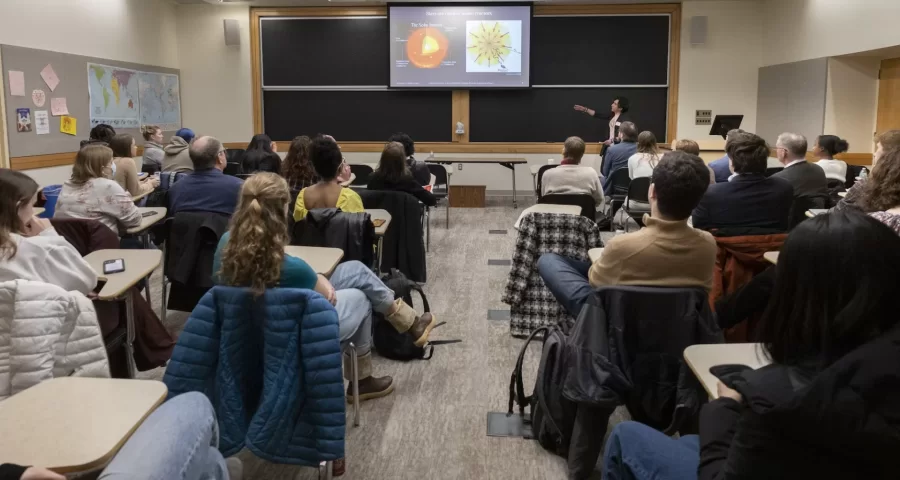
Physics and Astronomy at Bates is a hands-on major that allows students to directly investigate and influence science. Students take their scientific knowledge and curiosity out of the classroom and into the laboratory, where they’re able to directly contribute to scientific advancements hand-in-hand with their professors. In addition, the department regularly hosts visiting speakers and holds events for students, faculty, and staff, and the campus features both a machine shop and a 25-seat planetarium.

Featured Courses

Photo of Casey E. Berger

Casey E. Berger

Assistant Professor of Physics

Photo of Ryan K. Cole

Ryan K. Cole

Assistant Professor of Physics

Photo of Sarah A. Conley

Sarah A. Conley

Assistant Professor of Physics

Photo of Aleksandar M. Diamond-Stanic

Aleksandar M. Diamond-Stanic

Associate Professor of Physics

Photo of Wesley C. Gillis

Wesley C. Gillis

Assistant Professor of Physics

Photo of Nathan E. Lundblad

Nathan E. Lundblad

Professor of Physics

Photo of Rebecca C. Payne

Rebecca C. Payne

Assistant Professor of Earth and Climate Sciences and Physics

News & Events

Bates announces Stoddard Fitness and Well-Being Center and athletics facilities upgrades
March 5, 2026

Bates announces Stoddard Fitness and Well-Being Center and at…

Bates is embarking on a $45 million project to update two key athletic facilities and construct a new fitness and well-being center. A gift of $10 million from Jon W. Brayshaw ’90, P’25 and Jocelyn Stoddard Brayshaw ’88, P’25 has brought the college a vital step closer to construction. The new facility will be named the Stoddard Fitness and Well-Being Center. 

Over the woodlands brown and bare, over the harvest-fields forsaken, silent, and soft, and slow descends the snow. — Longfellow Back on campus after the February freak storm, Bates feels suspended between motion and stillness; cars crunch in half-melted tracks, boots drip by radiators, flights and plans still catching up somewhere in the clouds. Some of us are here, some are delayed, and the quiet holds space for both. It’s a strange return; rushed arrivals, late-night drives, weather maps open on our phones, yet the air itself feels calm, like the world pressed pause just long enough for us to notice it. The paradox is real; chaos in the forecast, steadiness on the quad. Snow does that. It softens edges, lowers voices, makes even a campus full of movement feel like it’s breathing slowly.
March 5, 2026

February at Bates

February on campus saw sports successes, several large snowfalls, and our annual Winter Carnival — a week of events celebrating the joys of the chilly season.