
Religious studies is a discipline that explores the spiritual and religious practices of individuals and cultures around the world.
The Department of Religious Studies offers powerful opportunities for developing a student’s ability to analyze, communicate, collaborate, and continue to learn over the course of a lifetime. Students work closely with faculty to design their program of study, and all students in the major take classes across introductory, intermediate, and advanced levels, providing them with a wide breadth of knowledge on the topic.
To gain breadth and depth in the understanding of a variety of religious traditions and practices
To apply both theoretical and methodological approaches to the study of religion
How to develop language, insights, and frameworks for understanding individual experiences
To communicate and act on the deepest sense of meaning and purpose
How to analyze the ways in which ideologies and institutions shape and animate the world
How to develop critical thinking skills
Life After Bates
Students leave the religious studies department with a deep cultural understanding and analytical skills that help them excel in a variety of fields, including medicine, law, business, the arts, teaching, social work, nonprofit administration, and beyond. Recent graduates have gone on to successful careers as research fellows, financial managers, and more.
90%
of 2020-2024 humanities graduates are employed and/or attending graduate school
“Religious studies taught me that … you can have faith and question it at the same time. The community engagement projects I worked on as part of my courses were so meaningful that I knew I had to have a service component to my work post-Bates.”
— Phoebe Uricchio ’10
Selected Places of Employment/Service
Fulbright
HubSpot
Spears & Imes LLP
Mary McDowell Friends School
FoodCorps
Tenacity
Zoldak Agency
Maine Democrats
Budge
Hebron Academy
Selected Graduate Schools
Harvard Divinity School
Duke University School of Law
Harvard University
Boston College
Princeton University
Harvard University Kennedy School of Government
Columbia University
Georgetown University
Johns Hopkins University
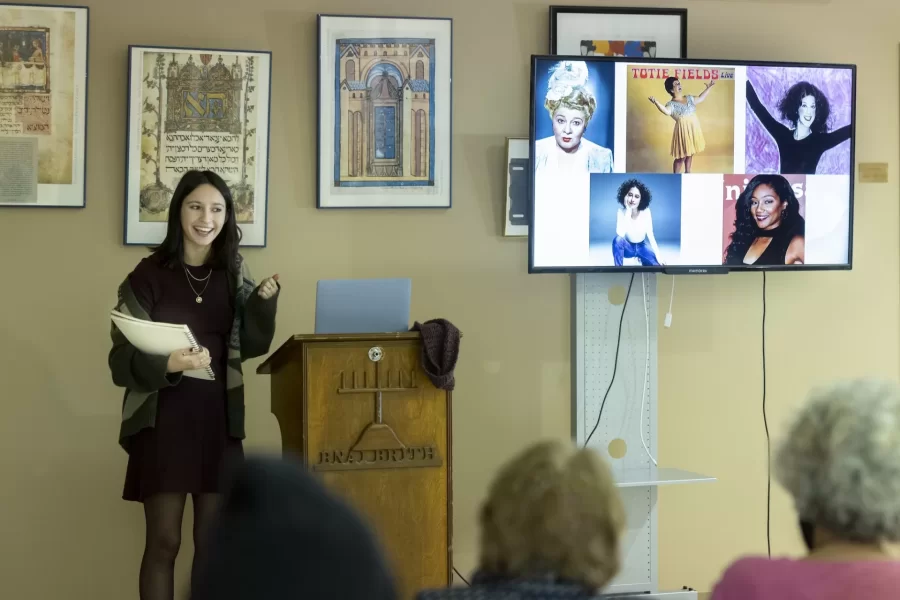
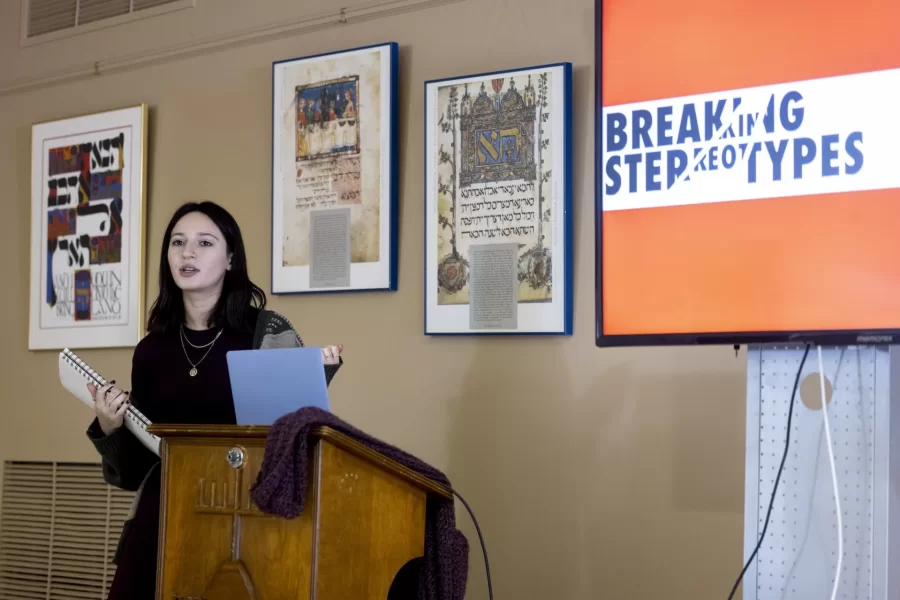
Frances White of ’23 New York City presents her religious studies senior thesis, “Women With Chutzpah.” to members of Temple Shalom Synagogue-Center in Auburn after a brunch on Sunday, Feb. 12, 2023.
“I just knew I wanted to work on something that was going to be funny and enjoyable and also kind of empowering and important to myself.”
— Frances White ’23 of New York City
Champagne and Coca-Cola sprayed in unison as a group of White’s friends gathered outside Ladd Library on Monday, Dec. 12, 2022, to watch White and her friend, Fenna Oliphant-Linden ’26 of Bethesda, Md., bind White’s thesis in religious studies, titled “Women with Chutzpah.”
“Women with Chutzpah” is about “the subversive means of Jewish humor for Jewish women specifically,” says White, who looked at five female Jewish comedians for her research: Sophie Tucker, Toby Fields, Gilda Radner, Ilana Glazer, and Tiffany Haddish.
“It was a way for me to just take what I love doing, which is making people laugh and using coping mechanisms of humor, and then seeing how that works in scholarly discourse.” White’s thesis adviser is Professor of Religious Studies Cynthia Baker.
White is also minoring in Africana, and her studies around the concept of race helped inform the focus of her thesis.
“A big part of my thesis was looking at how making fun of identity and humor is different if it’s your identity, rather than someone else’s.” It’s one thing when Jewish women themselves reclaim their pride in a Jewish body, White said, “but when other people are saying or using these stereotypes, it holds a very different impact.”
“How do we as Jewish women talk about ourselves and then use that as empowering, while also acknowledging we know what the anti-Semitic discourses are.”
Frances White of ’23 New York City presents her religious studies senior thesis, “Women With Chutzpah.” to members of Temple Shalom Synagogue-Center in Auburn after a brunch on Sunday, Feb. 12, 2023.
“I just knew I wanted to work on something that was going to be funny and enjoyable and also kind of empowering and important to myself.”
— Frances White ’23 of New York City
Champagne and Coca-Cola sprayed in unison as a group of White’s friends gathered outside Ladd Library on Monday, Dec. 12, 2022, to watch White and her friend, Fenna Oliphant-Linden ’26 of Bethesda, Md., bind White’s thesis in religious studies, titled “Women with Chutzpah.”
“Women with Chutzpah” is about “the subversive means of Jewish humor for Jewish women specifically,” says White, who looked at five female Jewish comedians for her research: Sophie Tucker, Toby Fields, Gilda Radner, Ilana Glazer, and Tiffany Haddish.
“It was a way for me to just take what I love doing, which is making people laugh and using coping mechanisms of humor, and then seeing how that works in scholarly discourse.” White’s thesis adviser is Professor of Religious Studies Cynthia Baker.
White is also minoring in Africana, and her studies around the concept of race helped inform the focus of her thesis.
“A big part of my thesis was looking at how making fun of identity and humor is different if it’s your identity, rather than someone else’s.” It’s one thing when Jewish women themselves reclaim their pride in a Jewish body, White said, “but when other people are saying or using these stereotypes, it holds a very different impact.”
“How do we as Jewish women talk about ourselves and then use that as empowering, while also acknowledging we know what the anti-Semitic discourses are.”
Eroticism and the Divine: a comparative look
at the Song of Songs and the Gita Govinda
A feminist talk about eroticism and religion titled “Gardens of Oppression: In Search of Her Delight,” to be delivered by Khushi Choudhary, Bates Class of 2023, who is a candidate for a Master of Theological Studies degree at the Harvard Divinity School.
Written under the direction of Professor of Religious Studies Cynthia Baker, Choudhary’s 2023 honors thesis explores the place of eroticism in religion.
Talk given on April 8, 2024, in her class
CMS 235 – Introduction to the Hebrew Bible
What is the Hebrew Bible (Christianity’s Old Testament and Judaism’s Tanakh)? This course centers perspectives of BIPOC biblical scholars who employ a range of scholarly tools and methods for exploring the content and genres of major books of the Hebrew Bible – including Genesis, Exodus, Leviticus, Numbers, Deuteronomy, Joshua, Judges, Samuel, and Kings-with brief forays into selected Prophets and Wisdom literature. Topics include theories about the composition and sociopolitical contexts of the writings, the events and ideas they narrate, and the use of scripture in sustaining and contesting modern social practices, especially those related to colonization, cultural violence, and race/gender disparities.
“Eroticism has no place in religion. Or so I’ve heard,” Choudhary wrote in her thesis abstract. Yet, the Song of Songs and the Gita Govinda, among other texts, complicate the separation of eros/kama and God and “invite speculation about the place of desire and passion in human-divine relationships.”
“These texts have lured me on with scandalous glimpses of mutuality, equality, even sexuality as defining elements of sacred eros,” she says. “More than that, each features an unapologetically assertive female protagonist in active pursuit of the divine object of her desire. Can God really be sought and enjoyed by women like me? Not without some challenges.”
Using
Why Study Religious Studies at Bates?
Religion is everywhere, from cosmic life-and-death questions to the halls of power, and our program gives students the opportunity to examine religion and spirituality from every angle. We cross-list with a greater variety of departments and programs than any other department at Bates, allowing students to intersect with multiple fields, including the humanities, social sciences, neuroscience, and art, providing them with a truly integrated liberal arts experience. Study abroad is strongly encouraged, giving students a fresh, hands-on look at how religious and spiritual practices function in other countries.
Featured Courses
Meet the Faculty
The faculty, made up of scholars, thinkers, and writers with expertise across a diverse group of topics, works on an individual level with students to shape a program of study geared toward their interests and passions. Professors include experts in Qur’an and early Islamic history, nationalism in the formative periods of Judaism and Christianity, and the history of Tibetan and Chinese Buddhism.
In the Student Center for Belonging and Community, first-generation Bates students mentor their younger peers, providing guidance on everything from academics to internships to social life.
Bates is embarking on a $45 million project to update two key athletic facilities and construct a new fitness and well-being center. A gift of $10 million from Jon W. Brayshaw ’90, P’25 and Jocelyn Stoddard Brayshaw ’88, P’25 has brought the college a vital step closer to construction. The new facility will be named the Stoddard Fitness and Well-Being Center.
February on campus saw sports successes, several large snowfalls, and our annual Winter Carnival — a week of events celebrating the joys of the chilly season.