
Slideshow: Mao Jacket sculpture arrives in style on Alumni Walk
Following its autumn-long appearance on Park Avenue in Manhattan, a 10-foot eponymous Mao jacket was installed on Bates’ own busy thoroughfare, Alumni Walk, on Dec. 5.
On loan to Bates for a year, the approximately 4-ton metal sculpture, formally named Legacy Mantle (Mao Jacket), is by contemporary Chinese Artist Sui Jianguo.
Mark Bessire, director of the Bates College Museum of Art, says that he first spied the sculpture in Beijing as he was organizing the museum’s Stairway to Heaven exhibition. He wanted Sui’s piece in that exhibition, but shipping the sculpture from China to Lewiston would’ve busted his budget.

Professor of History Dennis Grafflin touches the rough, rusty metal surface.

Professor of Mathematics Chip Ross, exiting Pettengill Hall, looks askance at Mao Jacket.

Director of the Museum of Art Mark Bessire says that he first saw the sculpture in Beijing, outside artist Sui Jianguo’s studio.

Standing together in front of the sculpture, history professor Dennis Grafflin and Anthony Shostak, the museum’s education coordinator, provide a sense of the jacket’s size.

The sculpture apparently has the power to stop Alumni Walk traffic, as biker Rusty Milholland ’10 of Freeport pauses to take a good look.
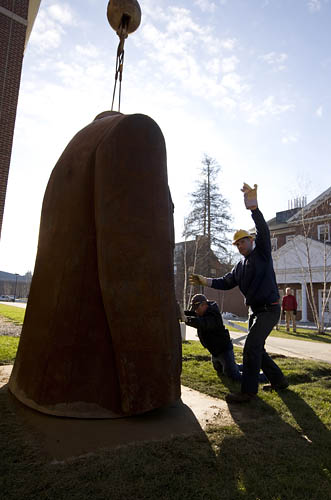
Workers help guide the sculpture to its installation spot across from Dana Chemistry.
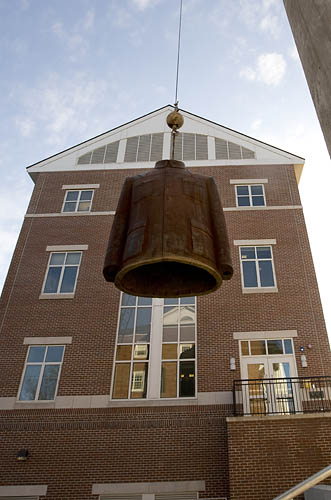
The sculpture passes by the north end of Pettengill Hall.
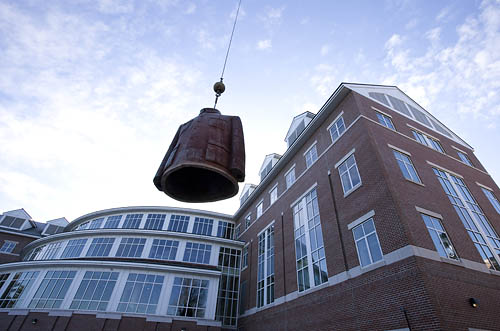
After the crane is repositioned closer to Alumni Walk, the sculpture is hoisted again.
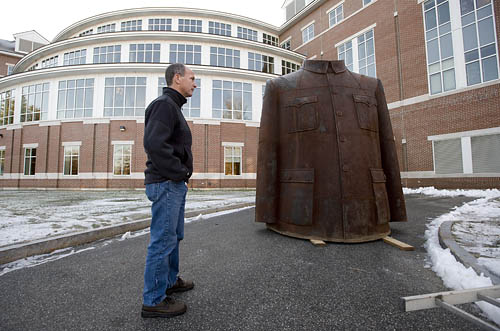
Bill Low, assistant curator at the Museum of Art, examines the jacket as the crane is repositioned for the second and final move.

Jason Patterson ’02, assistant dean of admissions, takes in the scene.
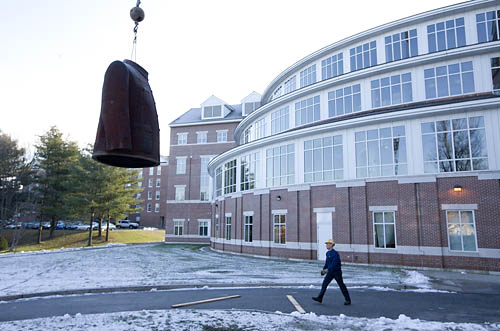
The sculpture descends to the ground behind Pettengill.

Frank Toth, trucker for J. Supor & Son, poses with Mao Jacket after delivering the sculpture to the parking lot behind Lane Hall. He said he was initially unsure if the jacket was indicative of Mao or Stalin.
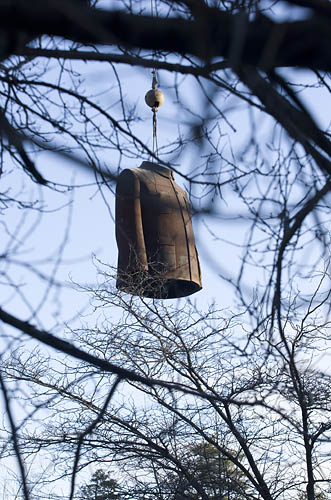
Thanks to the 150-foot crane, the jacket seems to float across the blue sky.
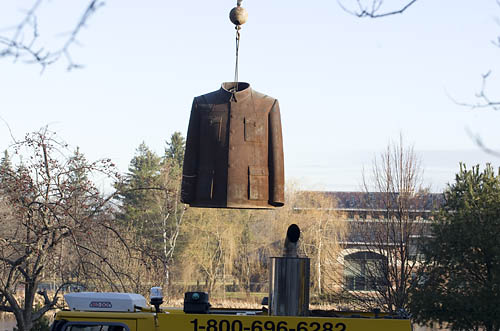
The crane maneuvers the jacket from the trailer behind Lane Hall to a staging spot behind Pettengill Hall.
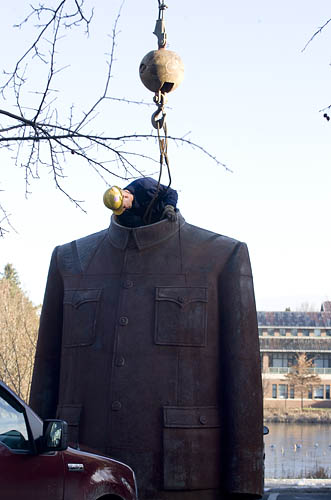
Leo Castonguay, of Cote Crane and Rigging, reaches into the collar to attach the hook to the sculpture.
Photographs by Phyllis Graber Jensen
Instead, the jacket initially came to the U.S. as part of Art and China’s Revolution, an exhibition by the Asia Society and the New York City Department of Parks and Recreation.
From Sept. 7 through mid-November, the suit sat on the Park Avenue median at 70th Street.
According to Melissa Chiu, museum director at the Asia Society, “the iconic Mao jacket symbolizes Mao’s legacy and may be viewed as both nostalgic and critical, mirroring the views of the artist and many Chinese of his generation.”
Given the Bates Museum of Art’s reputation for championing contemporary Chinese art (other recent major exhibitions include Documenting China and From Middle Kingdom to Biological Millennium by Wenda Gu), Bessire says he “immediately” approached the Bates Committee on Public Art about bringing Mao Jacket to campus.
From that point, the sculpture’s path to Bates was guided by the College’s Public Art Policy (see page 7 for “temporary installations”).
Bessire hopes the work will “continue the conversation about Chinese history and the expanding influence of China and Chinese culture,” noting that Mao Jacket is an “extraordinary opportunity for Bates to have one of the iconic symbols of Chinese contemporary art by one of the most influential artists in the world today.”
The huge icon of Communist rule looked like some strange bell as it dangled in the air between Lane and Pettengill halls. “Surreal,” said Bessire.
The scuplture arrived early Wednesday morning on a flatbed trailer hauled by a Peterbilt tractor. In two stages, a 120-ton Grove all-terrain crane hoisted the piece from the parking lot behind Lane Hall up to Alumni Walk.
At one point, the huge icon of Communist rule looked like some strange bell as it dangled in the air between Lane and Pettengill halls against the vivid blue sky. “Surreal,” said Bessire.
The sculpture sits outside Pettengill Hall, across from Dana Chemistry.
Afterwards, Bessire relaxed on a bench next to the jacket and talked with people about the sculpture. “I got many responses,” he says. “Some loved it, some were confused and some did not like it. But everybody was certainly thinking about what is public art and what role it has on the Bates campus.”
In the coming weeks, Bessire will offer a lecture about the sculpture and about public art at Bates.