From inside of her dorm room, Grace Thomas ’26 of Bethesda, Md., heard a clinking outside of her door. She peeked into the hallway to find a trash bag dumped on her doorstep. A fragrance drifted up from the bag, which was full of empty metal cans.
They were exactly what she needed.
For months, Thomas and Annie Robinson ’26 of Atlanta, Ga., had been campaigning friends — and friends of friends — across campus for their leftover cans and metal bottle caps. This latest delivery comprised leftovers from a birthday party for a friend’s boyfriend’s football teammate.
After meticulously washing out each can in an Olin Arts Center sink, Robinson and Thomas combined the cans with several other kinds of waste to form their winning design for the 20th annual Trashion Show, held on Nov. 19 in Alumni Gymnasium. The show takes place annually after Dining, Conferences, and Campus Events’ Harvest Dinner, a fall-themed meal in Commons open to the public and featuring live music and horse-drawn carriage rides across campus.
Trashion invites Bates students, faculty, and staff to construct runway pieces out of trash with the goal of bringing awareness to the amount of waste produced on a college campus — even one that prides itself on having achieved a carbon neutral standard of sustainability in 2019, when Bates was only one of seven colleges in the country to have achieved that standard.
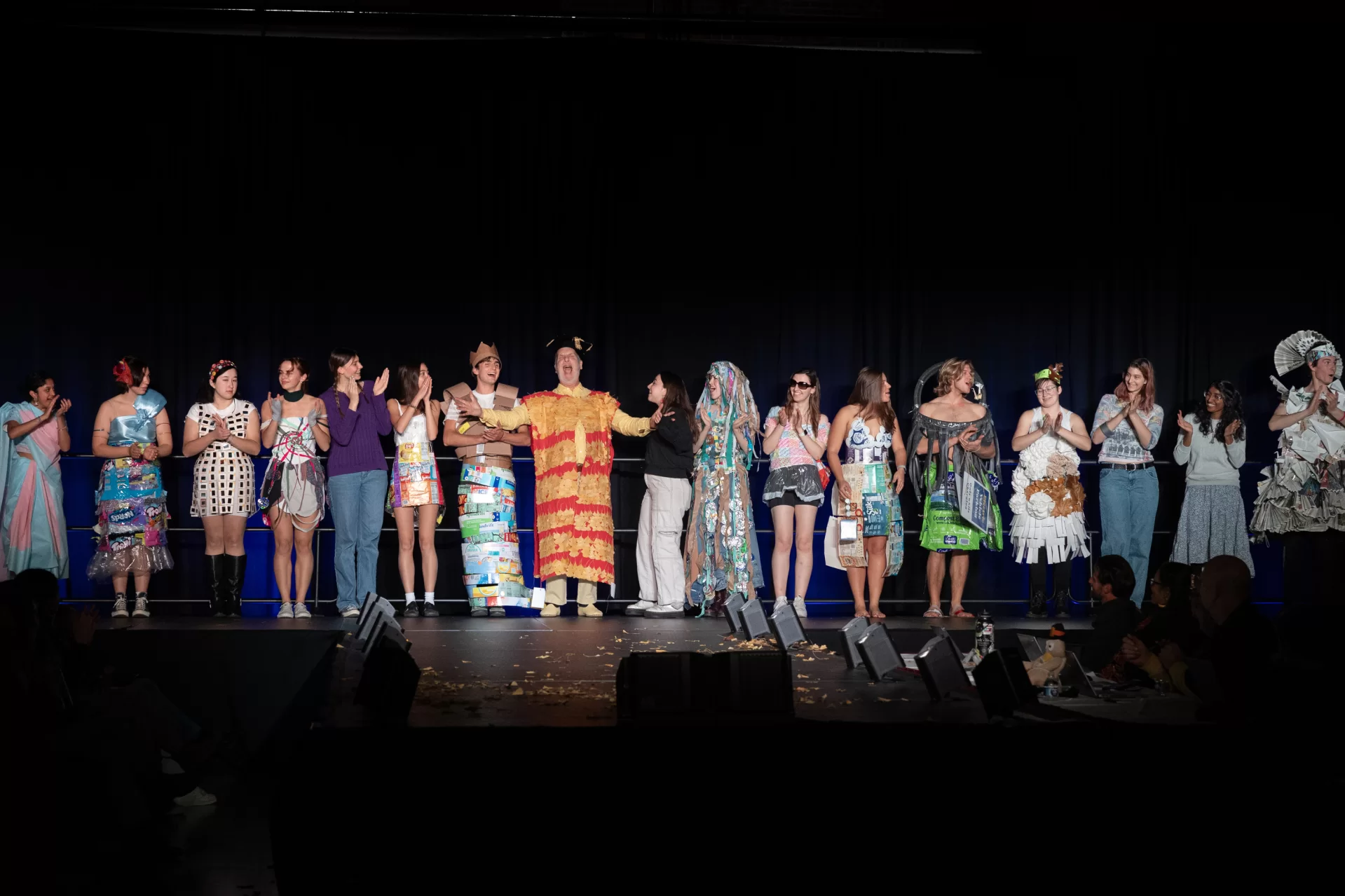
The Bates student EcoReps organize the show. All designers provide a brief description of and backstory for their pieces, which student emcees read aloud to the audience during the show. A panel of judges — this year made up of Associate Director of Culinary & Retail Operations and Executive Chef Michael Staffenski, Associate Professor of German Jakub Kazecki, Campus Safety Supervisor Mark Cayer, Assistant Professor of Environmental Studies Christine Martinez, and Associate Dean for International Student Programs James Reese from Global Education — generate some light competition among entrants.
Thomas and Robinson went into the event as defending champions, having won last year with a ballgown made of rolled-up paper from academic readings, co-designed by both students and modeled by Thomas.
“Now there’s expectations for ourselves,” Thomas said two days before the competition, as the two were crushing cans and cutting strips of cardboard for this year’s design. “The pressure is on.”
The designers started thinking about this year’s entry the day after last year’s Trashion Show. They wanted to make something completely different from last year’s ballgown, which was monochromatic and chic, so they spent hours scrolling Pinterest and sketching possible designs. Thomas suggested incorporating metal bottle caps, and the outline of the outfit formed around that medium.
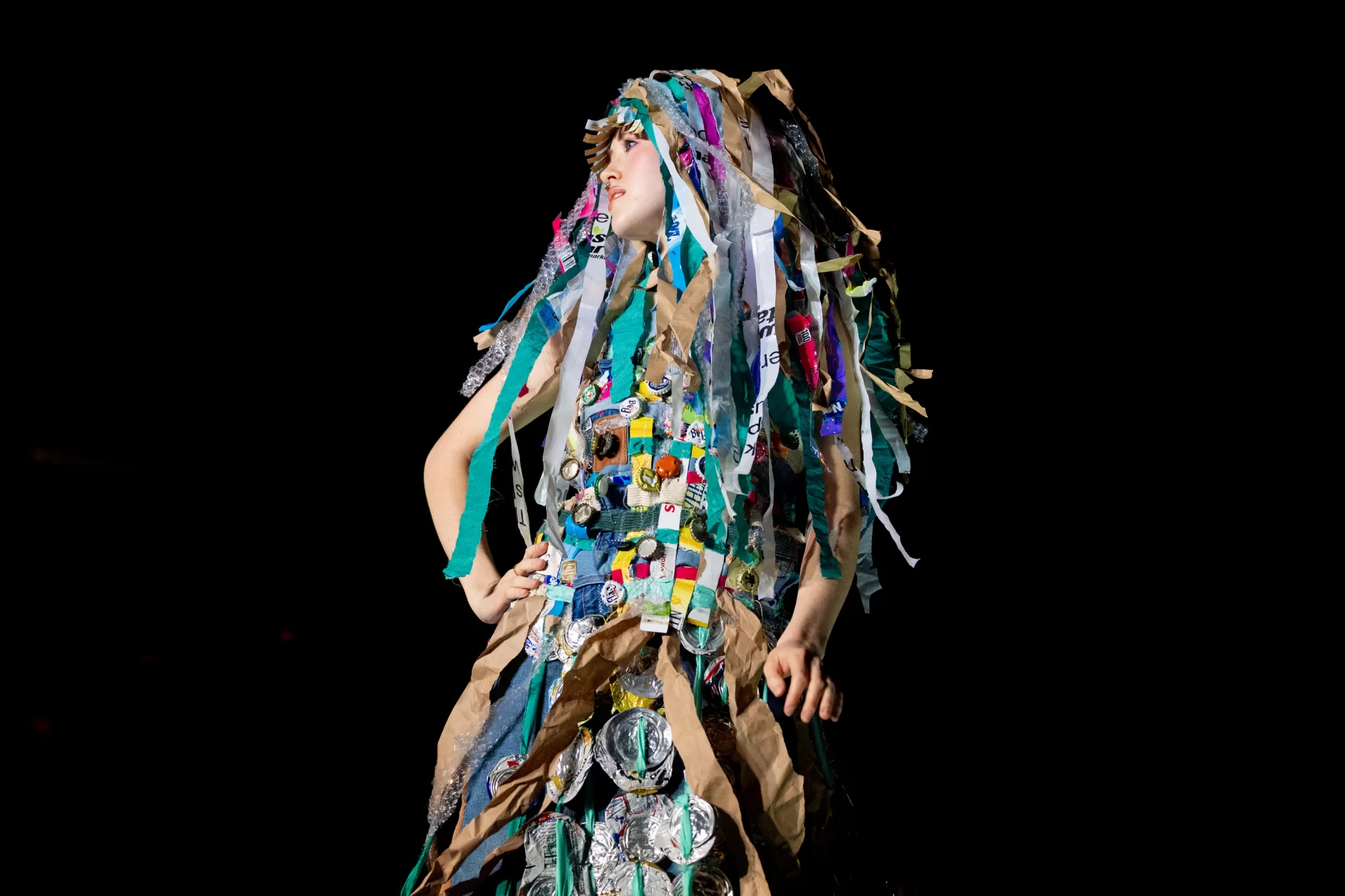
The final design featured a denim skirt made of old blue jeans, overlaid with ribbons of paper and strips of turquoise hammock fabric strung through about one hundred crushed cans, all held up by a belt also made from the hammock. The top was made from multicolor cardboard, plastic, and fabric woven together and adorned with bottle caps. They completed the look with a wig made from strips of cardboard and hammock fabric and a necklace of bottle caps. The plan was that Thomas would model, but they made Robinson a pair of matching bottle cap earrings to wear backstage.
Each material tells the story of a relationship: a friend’s torn jeans in the skirt, fabric pulled from another friend’s ripped hammock that hung outside Page Hall their freshman year, cans from the football team, and more.
“We’ve had so many people’s trash and help,” Robinson said. “I’ll get texts like, ‘Oh, do you still need bottle caps from people?’ I don’t remember talking to them about this, but they’re happy to help.”
Many of the bottle caps came from a surprising secret stash. Robinson was visiting a craft-loving friend who lives in Turner Hall and happened to ask if she had any spare caps sitting around. The friend pointed Robinson to the crevice between the heater and the wall, where a collection of bottle caps had apparently been growing for years. Previous occupants had created the cache, Robinson’s friend said, for no apparent reason except amusement.
“What is this pile for, if not for Trashion?” Robinson thought to herself. She grabbed chopsticks and scissors to get into the space, which was too small for her hand, and dug out every bottle cap.
Thomas and Robinson constructed their design in Olin Arts Center’s room 321, the same number, coincidentally, as the duo’s freshman year dorm room in Parker Hall. As new Batesies, they bonded over making arts and crafts and had a shared wall between their beds that they decorated with art and ephemera from “anything that happened together,” Robinson said.
When Robinson, who is a double major in economics and gender and sexuality studies, learned about the Trashion Show, she knew that she and Thomas, a studio art major, would make a great team.
This year, even though they’re both swamped with thesis projects, they still made time to meet in Olin to craft, their miscellaneous cardboard and fabric scraps spread out across the studio floor as they transformed trash into Bates couture.
“Do I look like a little kid playing dress up?” Thomas asked as she tried on the cardboard base she had constructed for the wig. She was engineering a way to create bangs that would hold their shape and not fall in her face. She landed on little strips of cardboard that curled upward so that she could safely see the Trashion stage.
“Visibility is crucial,” Thomas said.
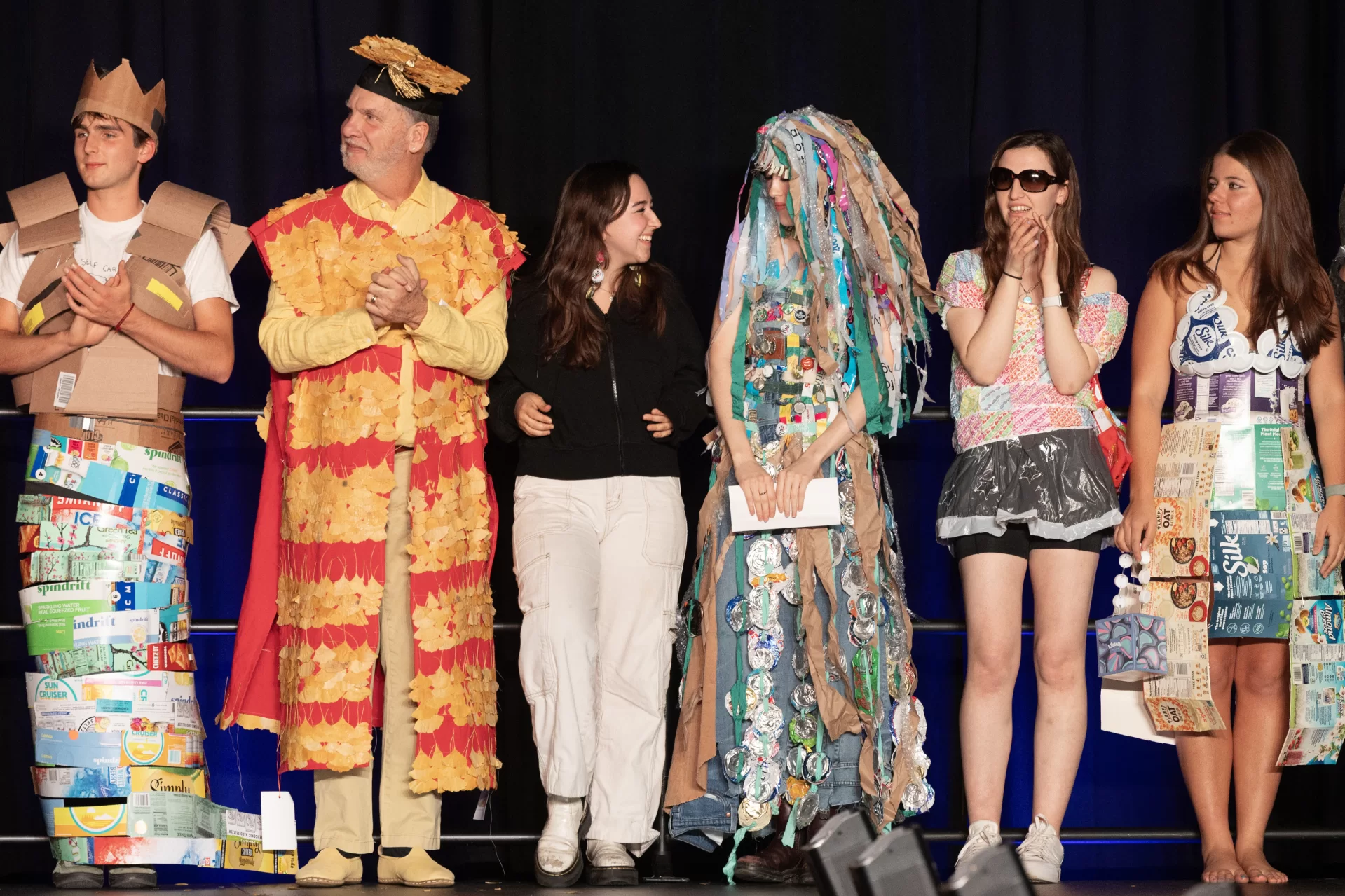
Two days later, against the backdrop of colorful lights, Thomas modeled the outfit to a cheering crowd of Trashion attendees. The clink of the dozens of cans adorning her skirt complemented the music played by student DJ Djibril Diaw ’27 of Mount Hernon, Mass. For the second year in a row, Thomas and Robinson won first place for their design, earning a $75 gift card to Forage Market in Lewiston.
Students from Professor of French and Francophone Studies Kirk Read’s first-year seminar “Family Stories” earned third place honors at the Trashion Show for their design featuring paper birds, fans, snowflakes, and airplanes, constructed with recycled paper from paper mills in central Maine and modeled by Finn Merrick ’29 of Easton, Md.
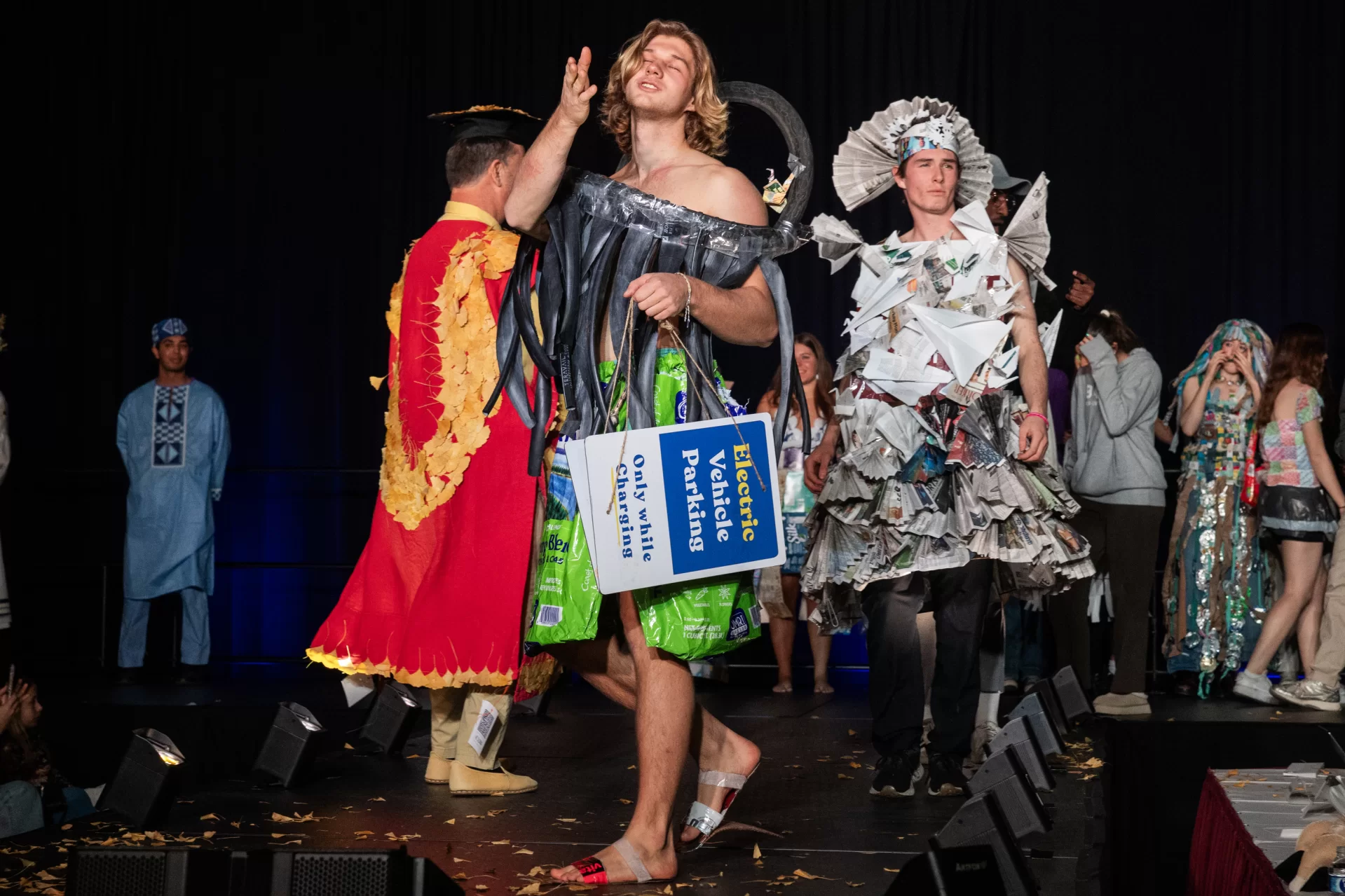
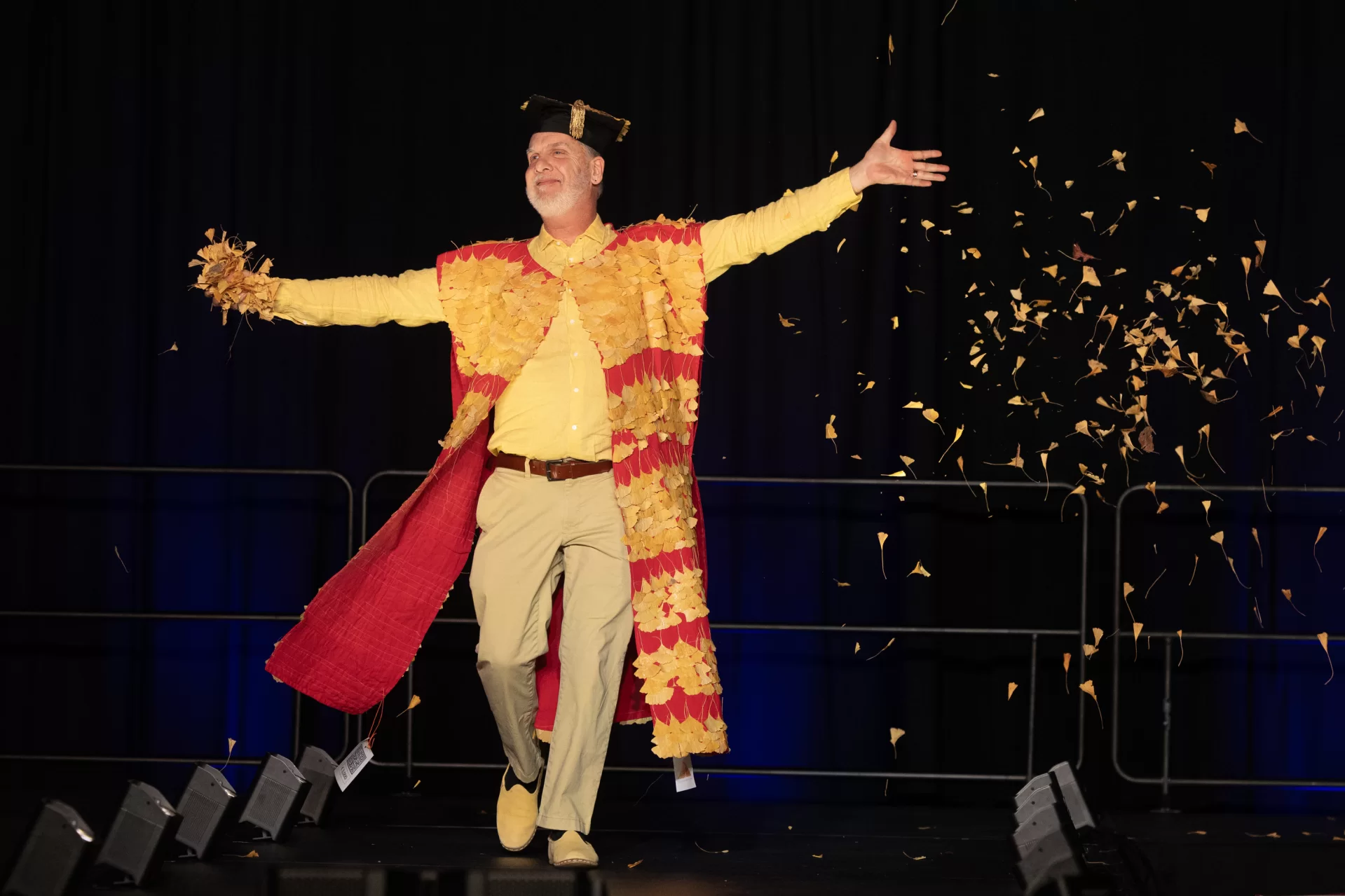
In second place was Read himself, who modeled an academic gown made from an antique table cloth and adorned with fallen yellow leaves from the beloved ginkgo tree outside of Carnegie Science Hall. Read and his longtime partner in Trashion creations, Kerry O’Brien, retired assistant dean in the Dean of the Faculty office, co-designed the piece. As he walked, Read threw ginkgo leaves into the air and around the runway.
Among the other elaborate designs was another leafy piece by seniors Elle Stogel, Caroline Mayer, Vyshu Viju, and Ellie Millard, and modeled by Millard. That dress was constructed from shredded paper, tissues, and real maple leaves. The designers aimed to draw awareness to key environmental issues in Maine, including recycling bottles and cans, but most crucial to the dress itself, the ways in which climate change is already threatening the state’s maple sugar industry.
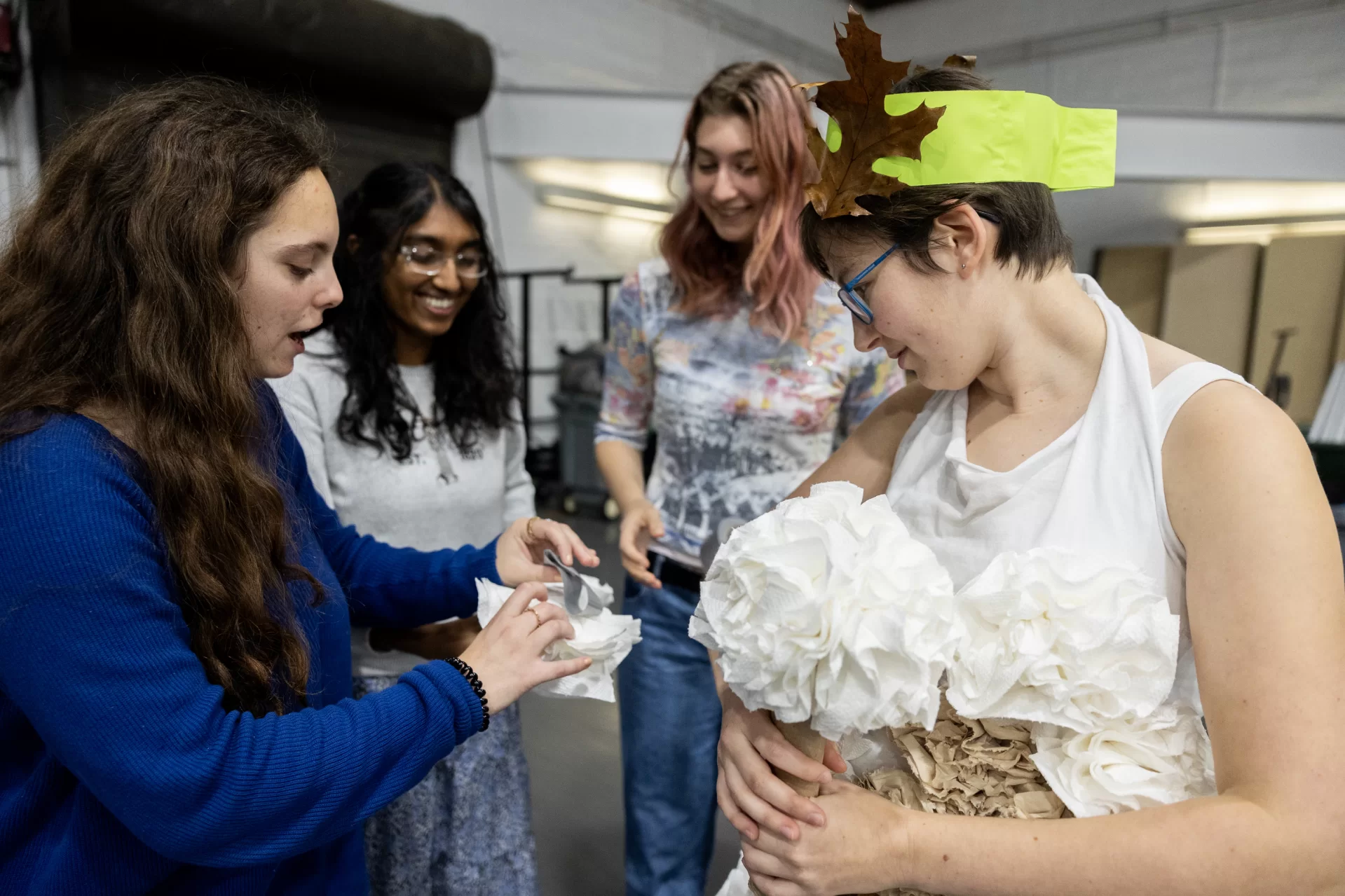
“We knew that this is something big that’s going on in Maine right now, and we wanted to advertise it,” Millard said.
After most of the audience had left, ginkgo leaves from Read’s costume lingered on the stage. They fit in nicely with the autumn decor around Alumni Gym, including a fall-themed photo backdrop behind pumpkins and a stationary four-wheeler — where a few students sat to watch the show — and tables laden with desserts like Baked Alaska and red velvet cupcakes.
Gazing across the ginkgo leaves after the show, Robinson reflected on her final fall at Bates.
“It’s fall confetti,” Robinson said. “It’s a great final celebration of the last time I’m going to see that ginkgo tree outside of Carnegie.”
Additional student designers and models comprised:
- Mary Parker ’27, Hazel Krinsky ’27, Arnav Panigrahi ’27, and Surta Shah ’28, who modeled pieces crafted from surgical blue wrap by Partners for World Health
- Shay Campolongo ’26, who designed and modeled a skirt and shirt made with over 200 film slides
- Campbell MacDonald ’27 who modeled and designed a cardboard suit
- Ava Teleki ’29 who modeled and designed an outfit from yogurt and milk containers
- Alessandra Williams ’29, who co-designed and modeled the Bates Environmental Coalition’s design made from a Halloween costume and candy wrappers
- Sophia Lebeau Toung ’28, who modeled an outfit fashioned from candy and snack wrappers, co-designed with Ella Albright ’28
- Daisy O’Dwyer ’26, who modeled and designed an outfit featuring a shirt of Dum Dum lollipop wrappers and a skirt from a trash bag
- Mikayla Ferguson ’28, who designed and modeled a dress from scraps of old t-shirts
- Erik Lindholm ’27, who modeled and co-designed an outfit by the Bates EcoReps, made of materials including compost bags, newspapers, and a bike tube
Watch the full Trashion video below: