L’dor v’dor in Hebrew or “from generation to generation” in English refers to the responsibility of passing down history and values.
That’s what happened when Associate Professor of Hispanic Studies Stephanie Pridgeon brought award-winning director Sandi DuBowski to Bates to screen his critically acclaimed 2024 documentary Sabbath Queen and meet with students in several classes.
Pridgeon’s research and teaching expertise are on Jewish and Latin American film, where she often focuses on issues of gender and sexuality. When she was a freshman in college, 22 years ago, she saw Trembling Before G-d, DuBowski’s 2001 groundbreaking documentary about gay and lesbian Orthodox Jews trying to reconcile their religion and sexual identities and was fascinated by it. That film, Pridgeon says, “stuck with me all these years.”
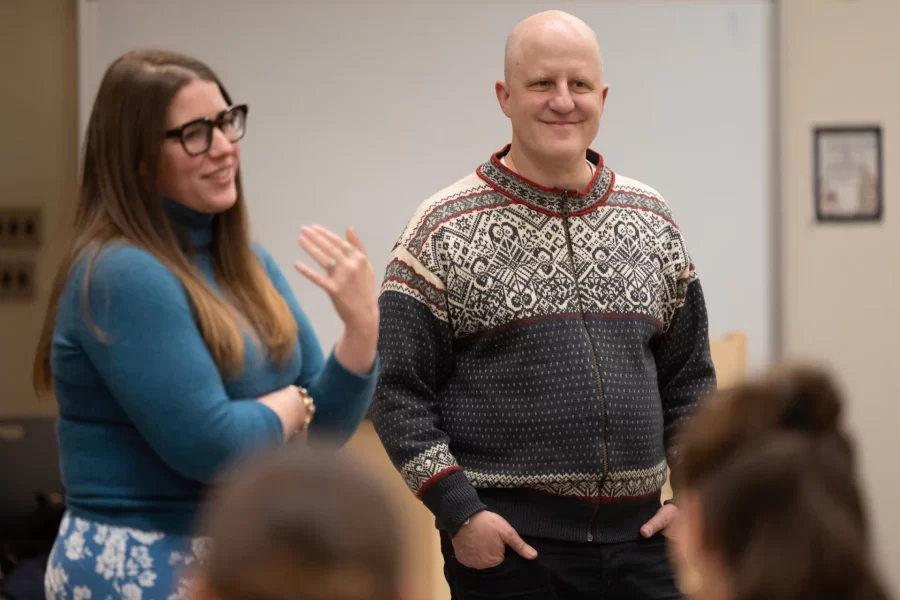
When she saw Sabbath Queen last year she realized it was thematically something of a follow up to Trembling Before G-d. When DuBowski visited Maine to screen the film at SPACE Gallery in Portland last May, Pridgeon had an opportunity to be his interviewer for a Q&A with the audience. That’s when she got the idea to invite DuBowski to Bates, to give her students a chance to see his work and discuss it with him.
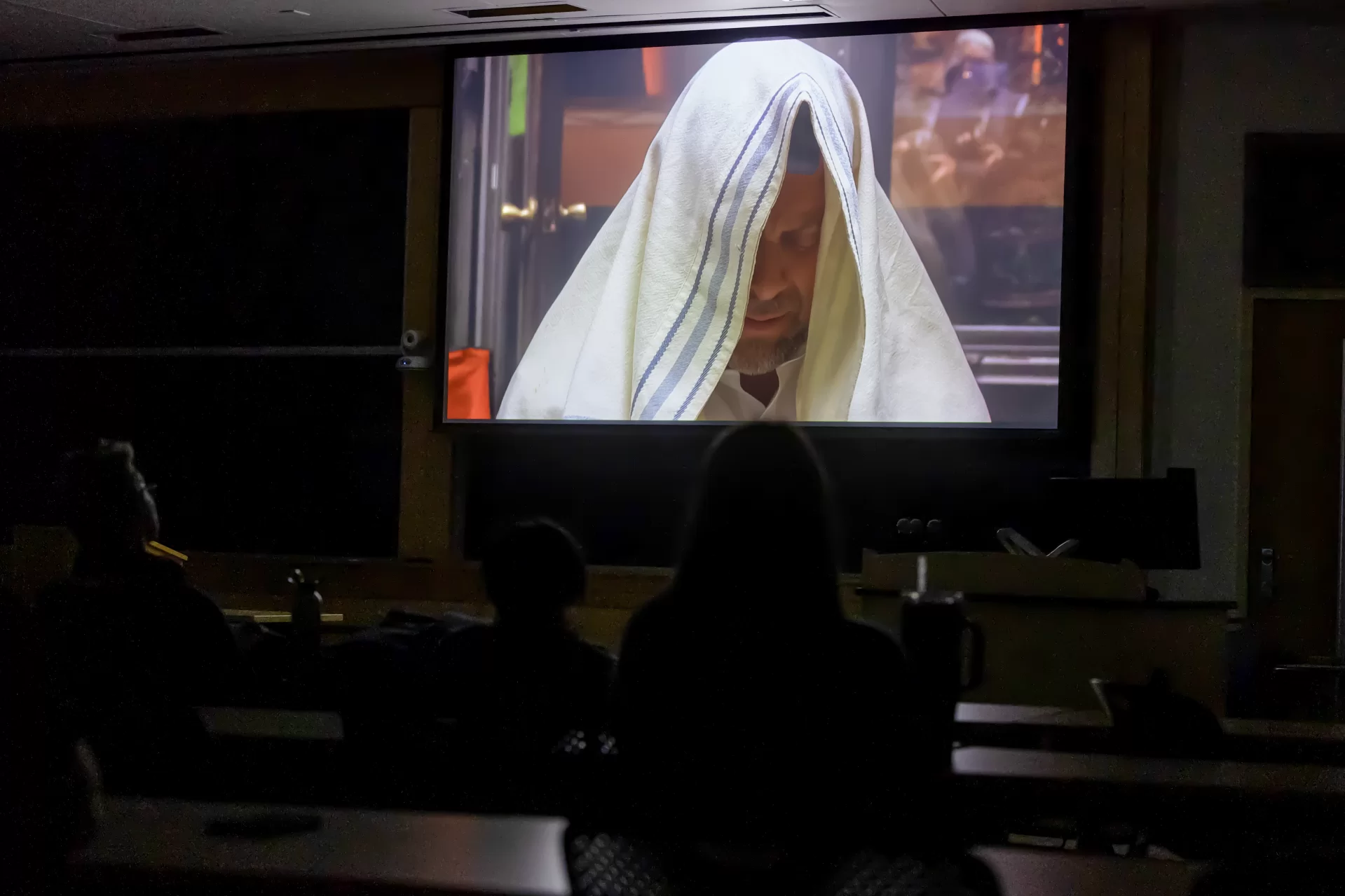
The feature documentary was filmed over 21 years. It follows Rabbi Amichai Lau-Lavie on an epic journey. He’s the dynastic heir of 38 generations of Orthodox rabbis. Two of his relatives, a first cousin and an uncle, were elected Chief Rabbis of Israel and served lengthy terms in these powerful positions. Arguably, his destiny was linked to the traditional, and as the film shows, he was torn between embracing that destiny and rejecting it.
Over those 21 years of being filmed by DuBowski , Lau-Lavie becomes a drag-queen rebel, a queer bio-dad and the founder of Lab/Shul—an everybody-friendly, God-optional, artist-driven, pop-up experimental congregation. The New York Times reviewer called Sabbath Queen a “fascinating look at the act of questioning yourself and your family, your surroundings and your decisions.”
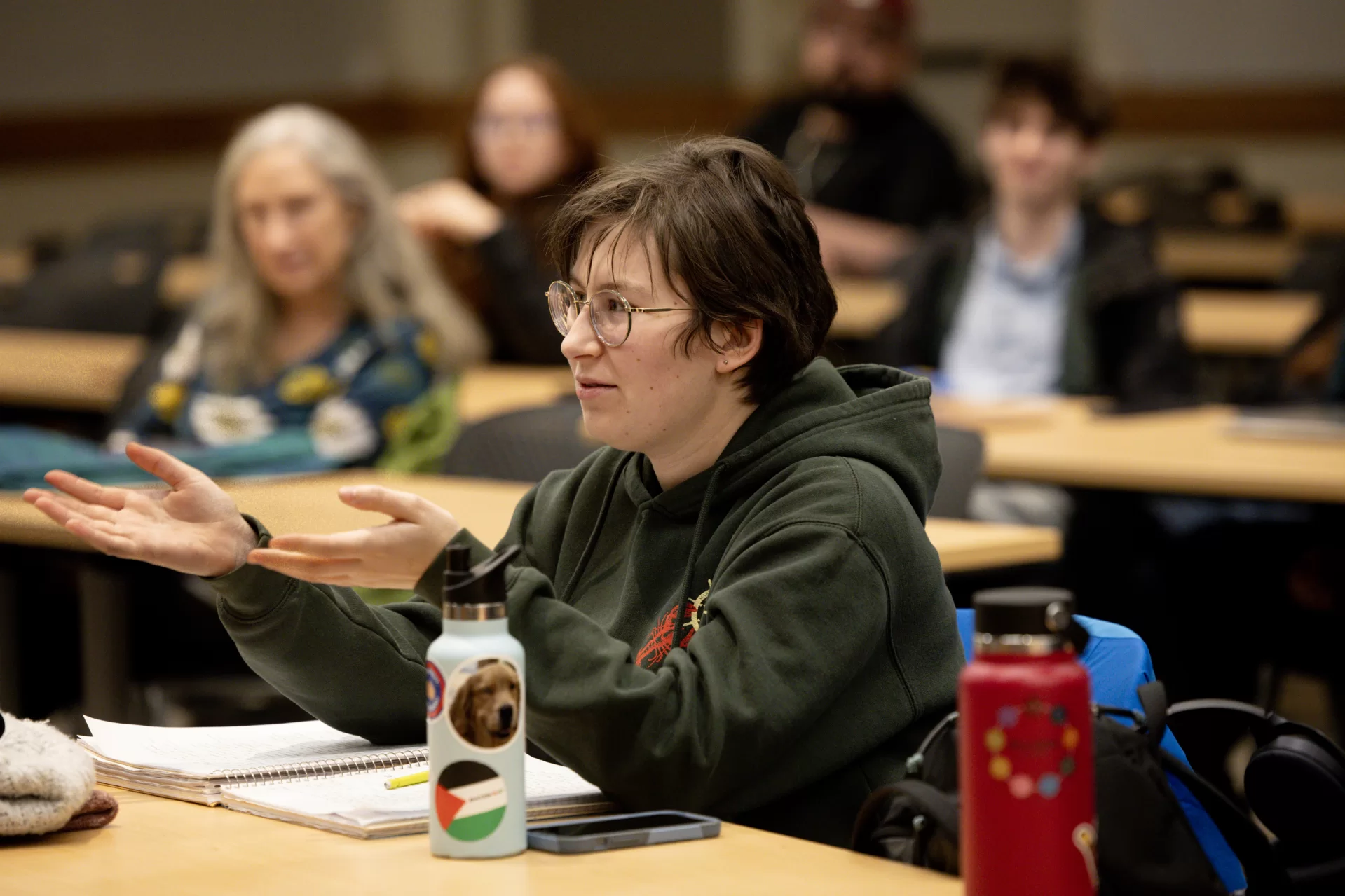
DuBowski’s work struck a chord with Pridgeon’s student, Ellie Millard ’26 of Harrison, N.Y., a double major in environmental studies and Hispanic studies who is taking Pridgeon’s Jewish Latin American film class. “The film is incredibly interesting,” Millard says. “Because it is the first time that I am seeing anyone from an Orthodox Jewish background coming out and being openly vulnerable about their sexuality and gender expression in media.”
Millard credits Pridgeon with “allowing students to experience a diverse range of media.”
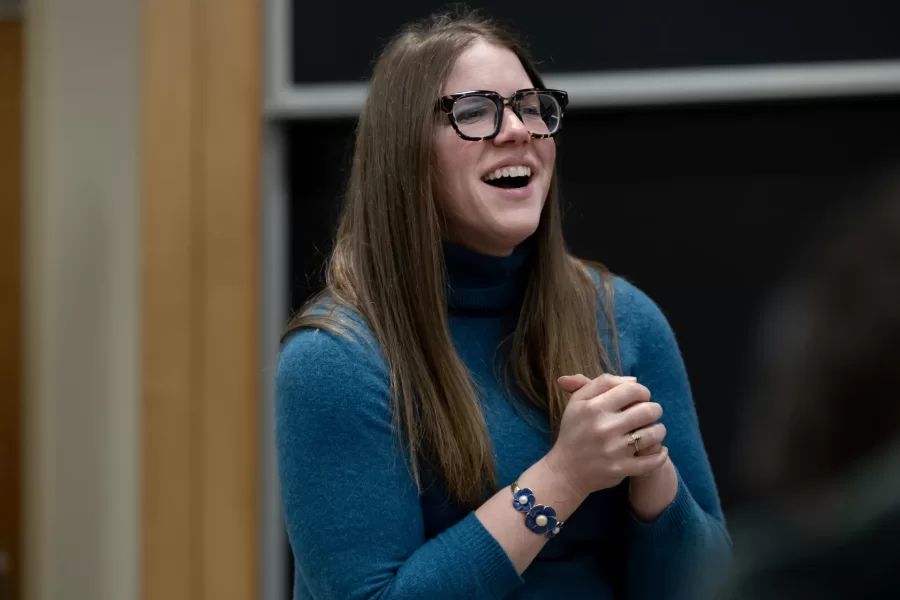
The gratitude goes both ways. “Being able to bring Sabbath Queen to campus and discuss it and Sandi’s other films with my students has been really just a huge privilege for me,” Pridgeon says. “It felt like a really beautiful kind of full-circle moment.”
Generation to generation.
DuBowski’s visit was co-sponsored by the Office of Equity and Inclusion, Hispanic studies, religious studies, SPARQ, Multifaith Chaplaincy, gender and sexuality studies, humanities division, and interdisciplinary studies division.
Categories BatesNews