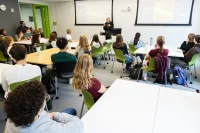
Bates has once again been recognized for achievements in sustainability in the 2026 Sustainable Campus Index, produced annually by the Association for the Advancement of Sustainability in Higher Education (AASHE).

The index highlights colleges and universities that are leading the way in sustainable practices, both through overall impact and in specific areas of development. Bates ranked fourth among baccalaureate institutions for overall top performance in sustainability and, for the 10th consecutive year, earned a Gold rating for sustainability.

“Bates College being ranked as one of the top sustainability schools in the nation is akin to our Bates basketball team making it to the Final Four,” said Tom Twist, Bates assistant director of sustainability. “It’s a great validation of all the deliberate, cross-departmental work that Bates folks have sustained for decades.” 
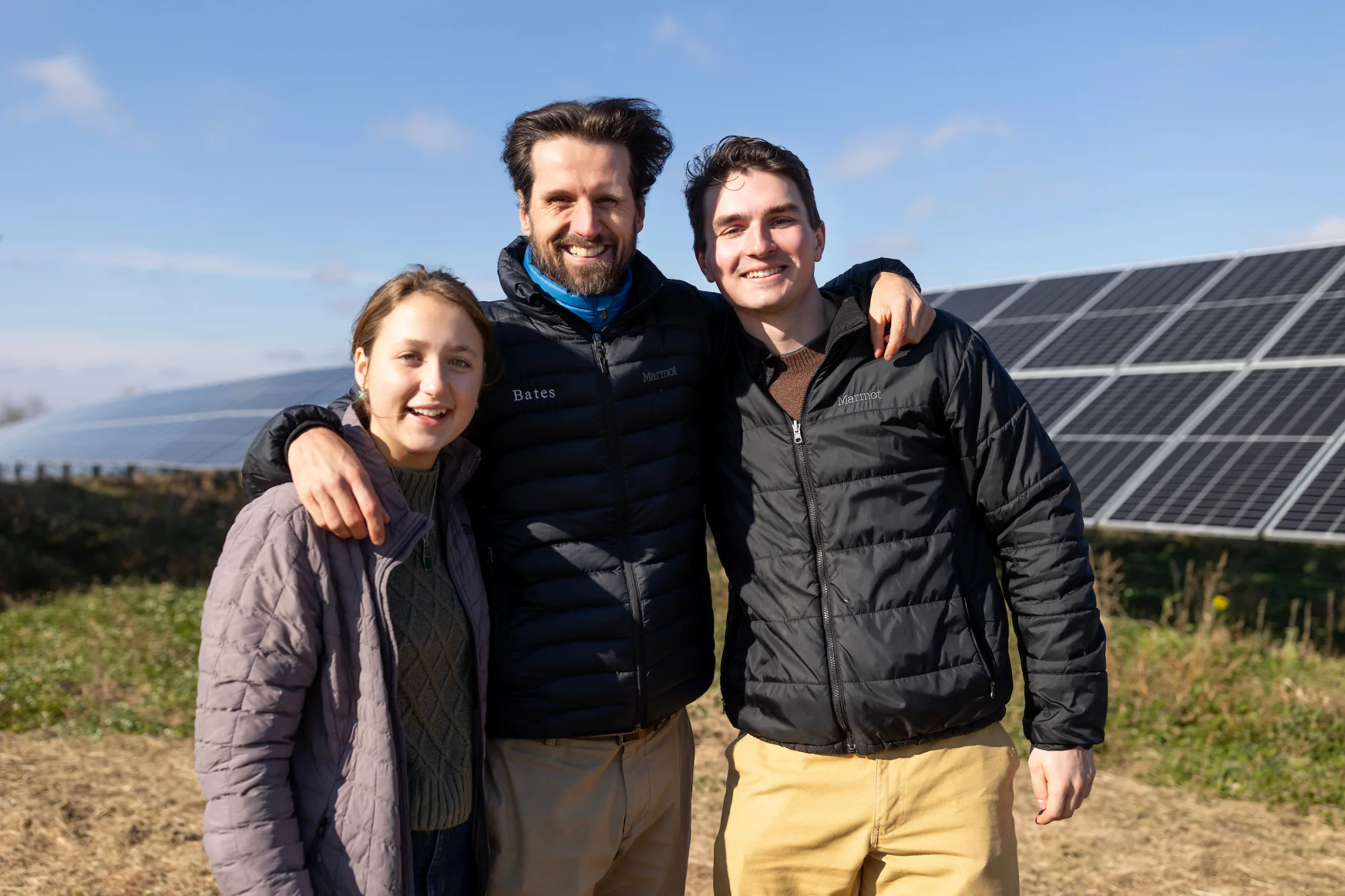
A visit on Nov. 15, 2023 to the Bates solar array (farm).

The location is 327 Eaton Mtn. Road in Skowhegan. I’ll make sure to have a sign/ReVision logo close to the road!


“The loose agenda is to greet everyone over coffee and some light breakfast goodies, then take a tour. After the tour we’ll ask a few folks for interviews on video. I’d be grateful for your help identifying who the Bates’ team members that could best answer the questions: Why is a transition to renewable energy important to Bates? What has it been like working with ReVision Energy?

 
From the ReVision Energy team, we will have: Brian Byrne (project manager), Phil Coupe (co-founder), Holly Noyes (land acquisition), Joey Freeman (photographer), Tina Meserve (Commercial Sales), and myself. The landowner, Jim Henshaw, will also be joining us.”

Jason Hehlo, energy manager, Facilities

Holly ‘10 Noyes

Jfreeman@revisionenergy.com

Izzy Larson 2025
Martin Carriere 2024

Members Energy solution group Bates eco reps


Caitlin Brooke (She/Her) | Employee-Owner | Partnership & Community Engagement Director
ReVision Energy, a Certified B Corp

Geoff Swift
Tom Twist
Jay Phillips
Bates Assistant Director of Sustainability Tom Twist, at center, visits the college’s solar array in Skowhegan, Maine, with then-student EcoReps Izzy Larson ’25 (left) and Martin Carriere ’25. (Phyllis Graber Jensen/Bates College)

All rankings in the Sustainable Campus Index use the Sustainability Tracking, Assessment & Rating System 2.2 (STARS), a framework implemented by hundreds of institutions to measure, report, and improve their sustainability performance. 

Bates’ sustainability data “really looks at every aspect of campus — from the percentage of sustainability classes we teach, to our carbon footprint, to our endowment, to student culture,” Twist said. “So it’s not hyperbole to say that we are being ranked on the sustainability of every department at Bates.” 

Since first reporting its sustainability data with STARS in 2017, Bates has been included among the top 10 baccalaureate institutions four times and been recognized specifically for top performance in the Air & Climate and Energy categories. 
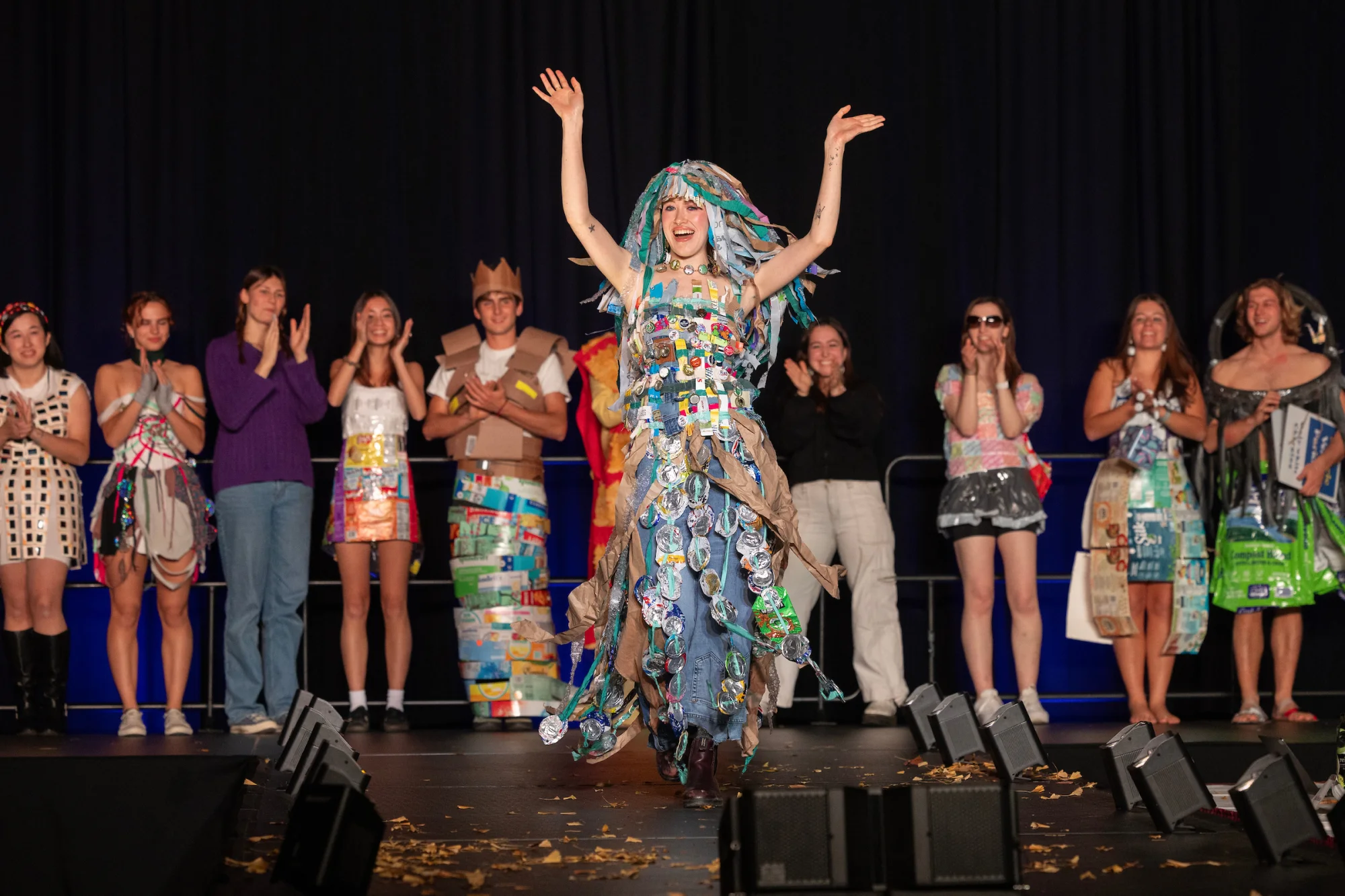
The Annual Harvest Dinner held in Commons, followed by horse rides around campus, a dessert part and the Annual Trashion Show in the Gray Athletic Building.

Where friends, fashion, fun, and sustainability all collide. Welcome to the Bates Trashion Show 2025, held in the Gray Athletic Building on Wednesday, Nov. 19.

All participants were winners!

Singled out for recognition were, in first place, seniors Annie Robinson and Grace Thomas (the model), who designed the dress together; Professor of French and Francophone studies Kirk Read in second place; and in third place, a team of students in Read’s first-year seminar “Family Stories.”
Among the college’s sustainability traditions is the annual Trashion Show, which invites students, faculty, and staff to design outfits from waste. At front is Grace Thomas ’26, modeling 2025’s winning design that she created with Annie Robinson ’26. (Phyllis Graber Jensen/Bates College)

In 2019, Bates became carbon neutral, then one of only seven higher education institutions to have reached that milestone. Among Bates’ innovative sustainability initiatives are its EcoReps program, through which students work to promote environmentally responsible behavior on campus; its expansive solar array in Skowhegan, Maine, which accounts for about 75 percent of the college’s energy and generates significant savings on energy costs; and its Commons dining program that diverts 80 percent of its waste and utilizes produce grown in the on-campus, student-run garden.

“My hope is that we’ll use this momentum to keep innovating, keep reducing our environmental footprint, and keep training our environmental leaders of the future,” Twist said. 
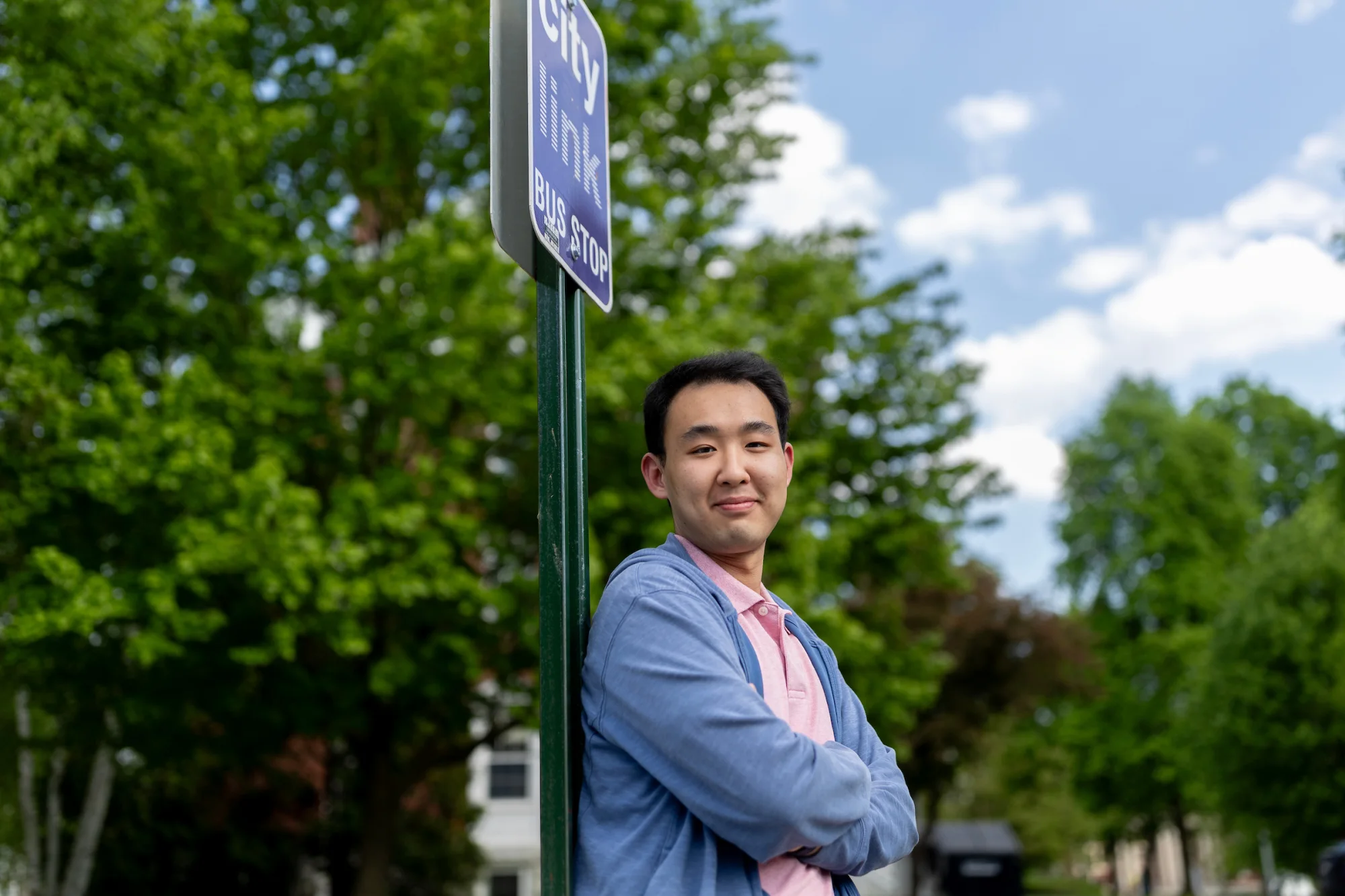
APPROVED, Alan Wang ’24 on College Street in front to Parker Hall where covered bus stop will be built on lawn behind him.								
11/13/2023 16:25:54	Transportation for Bates	awang3@bates.edu	5075817683	Student
	
Better Bus Stop for Bates
	
The MaineDOT is planning on implementing a commuter bus line between Lewiston and Portland. The bus line is set to terminate at Bates near Underhill Arena. However, the bus stop might not be pleasant and intuitive to use. Study from University of Minnesota show that bus stop amenities have a direct relationship with rider's perceived waiting time; having a bench can reduce the perceived waiting time by half compared to a stop without a bench. A well-equipped bus stop can entice more people to use it, thus reducing Bates' carbon footprint.	"A bus shelter costs around $5,500. I want to apply for the full $2,000 grant to ultimately put this money back in the school's pocket, in the form of a well-designed bus shelter. This green fund can be a part of a larger funding package, I'm assuming that MaineDOT and the operator of this bus line will both pitch in to fund this shelter. 

The bus shelter should protect riders from weather elements, display proper signage and maps, equip with lighting and seating. MaineDOT also recommends installing bike racks and trash cans. The green grant can be used to achieve aspect(s) of the above objectives. "	Increase comfort level when using public transportation. Reduce perceived waiting time. Encourage faculties and staff to commute using public transportation, thus reducing GHG emissions and free up parking spots.
Bates’ innovative Green Grants program provides funding for faculty, staff, and students to complete sustainability projects on campus. Alan Wang ’24 earned a Green Grant for his proposal to create clear and welcoming signage for a bus stop on campus, which would become the stop for the LAP commuter bus that connects Lewiston, Auburn, and Portland. (Phyllis Graber Jensen/Bates College)

Bates’ next major sustainability goal, as outlined in the college’s Sustainability Roadmap, is to become climate positive, meaning the college will remove more carbon dioxide from the atmosphere than it emits, by 2030. Sustainability considerations play a major role in all campus construction, and Bates’ forthcoming Stoddard Center for Fitness and Well-Being, slated to open fall 2027, will be representative of the college’s sustainability innovations. Fitted with solar panels, the building’s energy use intensity — a measurement of energy used per square foot — will be about 75 percent lower than other campus buildings.

Categories BatesNews