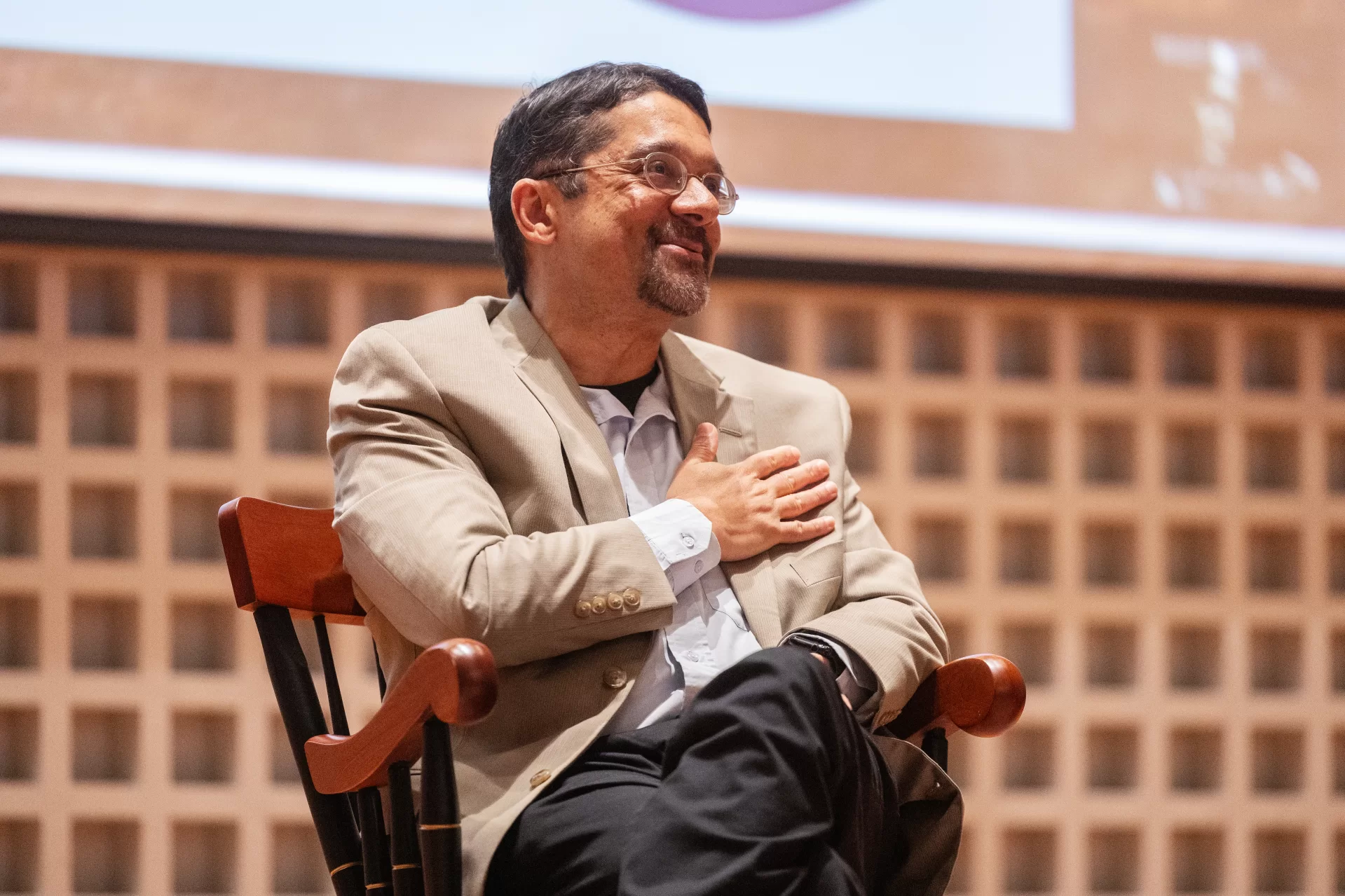
How can we connect when we find ourselves locked in disagreement? How can we engage in dialogue if we come from different perspectives? These are among the questions that Shankar Vedantam asked when he was the speaker during the second installment of the new program Bates Open Network on Dialogue. Vedantam, journalist, author, and host of the Hidden Brain podcast, had visited Bates before in 2023 when he was a recipient of a Doctor of Letters honorary degree.
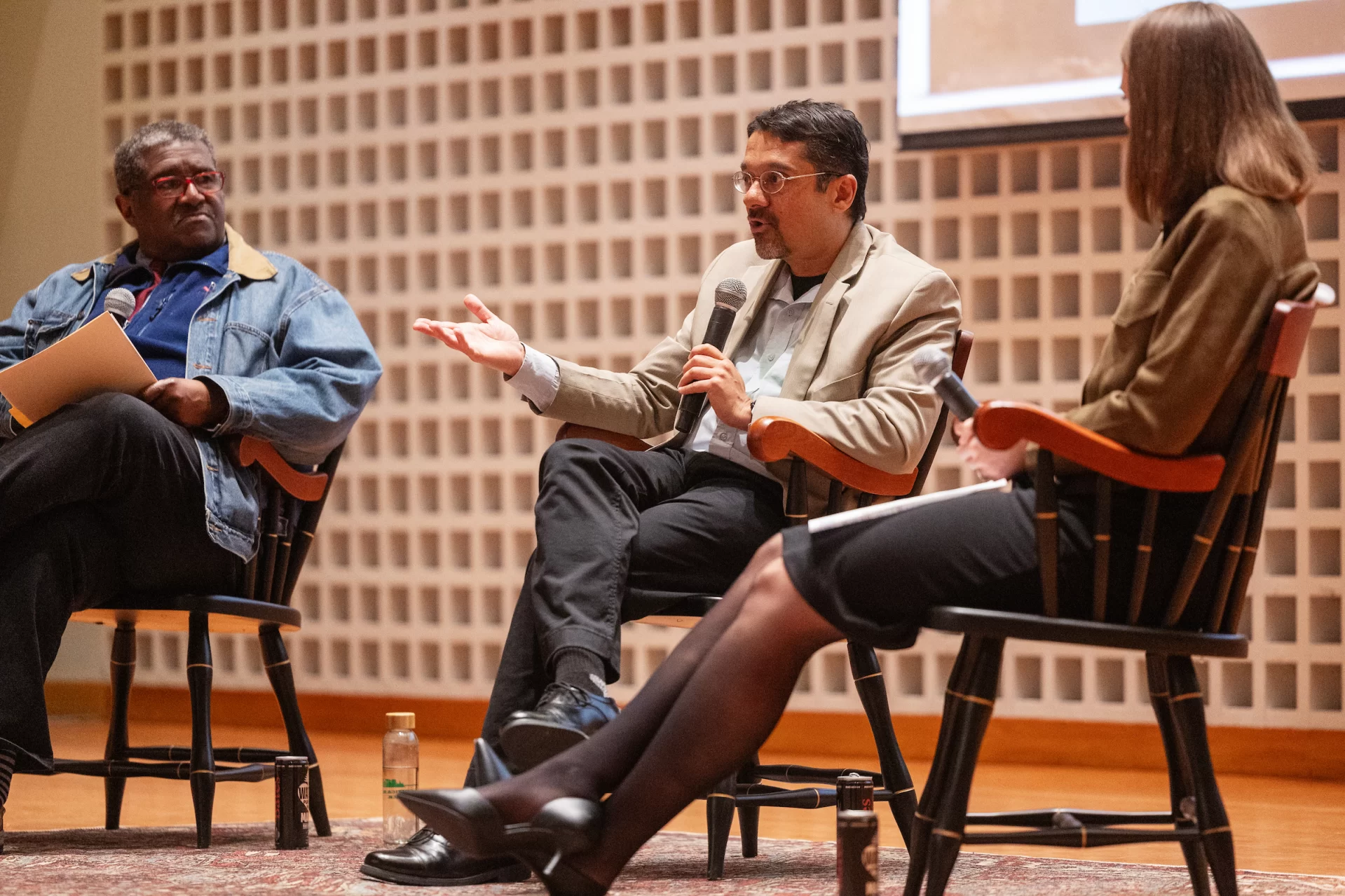
Facilitated by Charles Nero, Benjamin E. Mays ’20 Distinguished Professor of Rhetoric, Film, and Screen Studies, and Elena Maker Castro, assistant professor of psychology, the conversation built upon Vedantam’s focus on human behavior from a behavioral and psychological perspective. In his podcast and in his talk on April 2 in Olin Arts Center, Vedantam emphasized the ways that our brains work, pointing out that most anger has its basis in fear.
“It’s a useful thing to keep in mind,” Vedantam said, “because I think so often when we have conflict, it’s very easy to see ourselves in a position of vulnerability. And it’s very difficult for us to acknowledge that our opponents might be coming at a discussion from a place of fear, from a place of vulnerability.”
Vedantam moved beyond understanding and framing toward action, when Nero asked him for strategies to call upon in difficult conversations across differences.
“One technique that is useful is to start with saying, ‘This is actually what I’m afraid of,’” Vedantam said. “And you will find that if you actually are able to articulate what it is that you’re afraid of, the thing that you are worried about is something that the other person can relate to.”
According to Vedantam, we communicate across differences constantly, and often manage it well. But when it comes to issues that we deem controversial, we have set up the wrong model. Most of us learn debate in high school, where the goal is to win — even if your assigned perspective doesn’t align with your values.
“There’s a difference between debate and dialogue,” Vedantam said.
This idea is at the very heart of Bates Open Network on Dialogue (BOND). Leana Amaez, vice president for equity and inclusion, described BOND as “a two-part program that promotes dialogue across differences, creating opportunities for meaningful discussions outside of the classroom, where students, staff, and faculty can discuss relevant, timely topics while building empathy, challenging assumptions, and deepening our understanding of one another.”
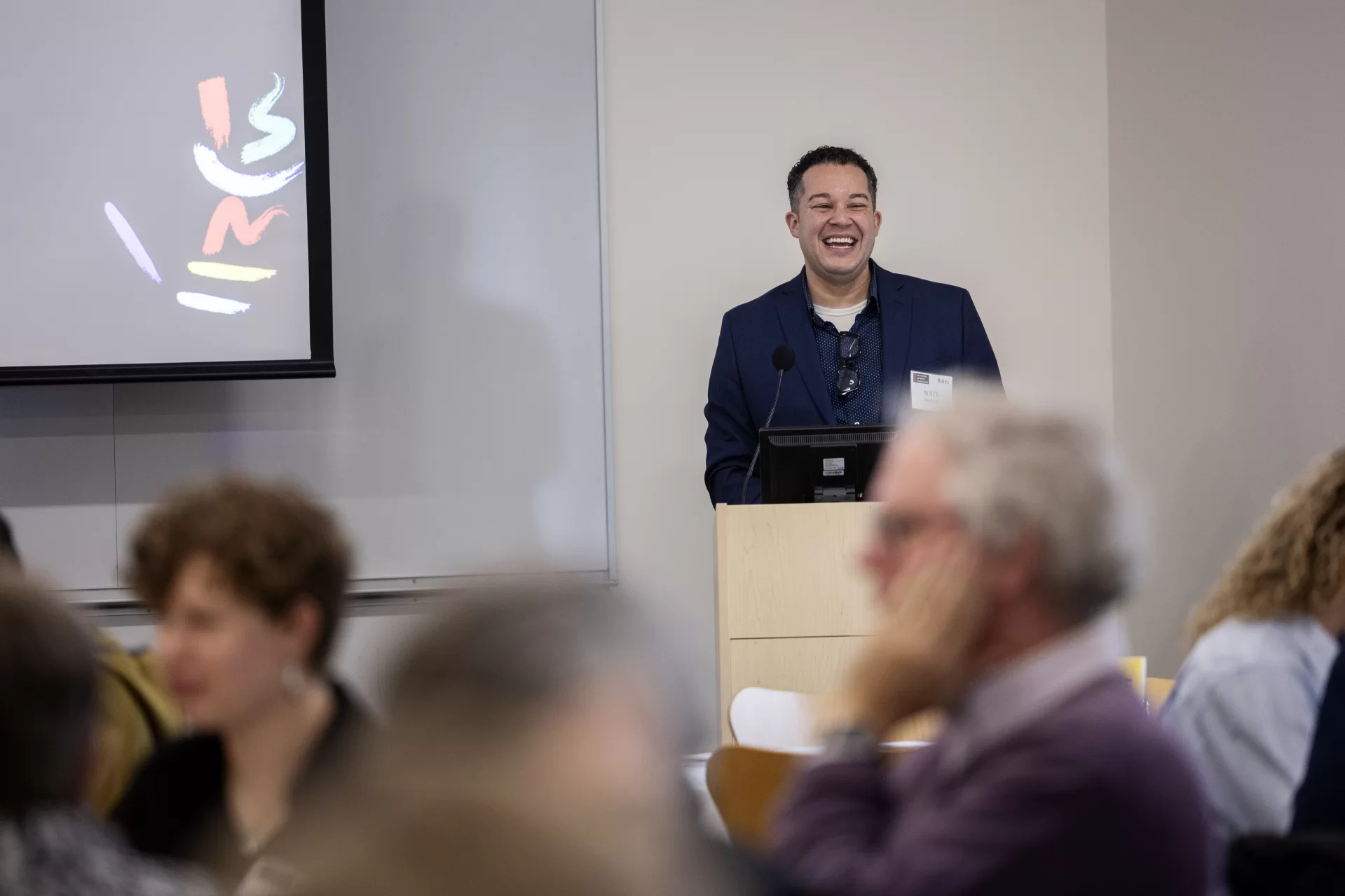
Following the discussion in Olin Arts Center, which included robust Q&A (where every question was posed by a Bates student), guests were invited to come together in Commons for a dinner and dialogue facilitated by Nate Menifield, equity and inclusion program manager.
A group composed of students, staff, faculty, and community members gathered to talk more about the ideas that Vedantam had stirred as he spoke about understanding “the complexity of how our minds work and the errors and the filters that are embedded inside our heads” as we strive toward dialogue. Menifield began by outlining the structure for the evening’s small group discussions, taking place at each table. Leading the groups through three brief rounds of discussion, Menifield framed the approach for each round from a new angle. Participants were encouraged to “take space and make space,” with attention to the engagement of everyone at the table. This awareness shifted some tendencies in how we interact and aimed to invite more voices into the conversation.
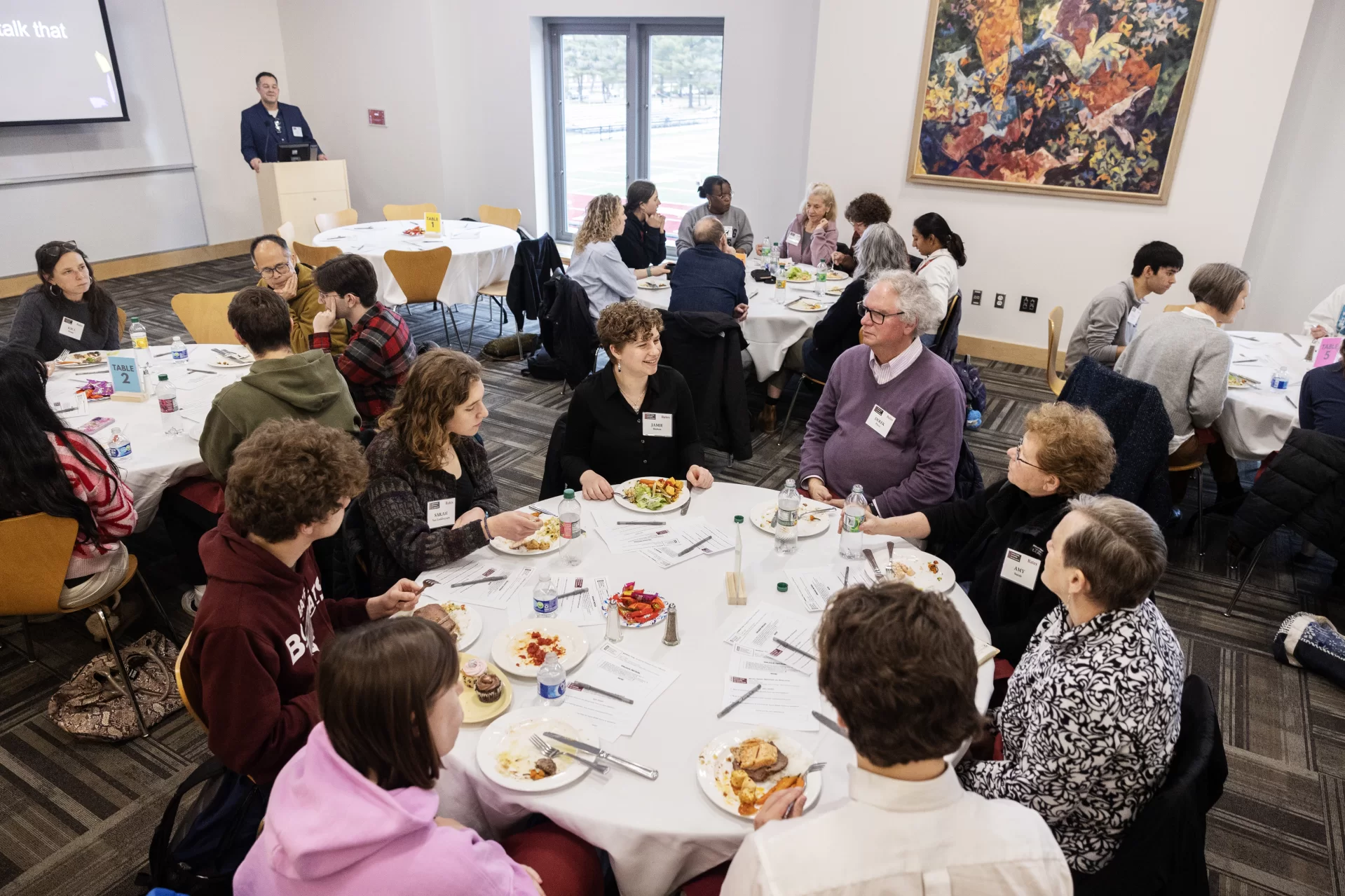
Kika Stump, assistant director of Institutional Research, Analysis & Planning, attended the talk and the dinner, drawn by “concepts of dialogue and community” at the heart of the BOND programming. At her table, Stump talked with three students, two community members and three other staff members, following Menifield’s guidance.
“As someone who often speaks and feels obligated to keep dialogue ‘going,’ it was welcome to have a practice that encouraged more voices to be heard and put time limits on my own,” Stump said.
One idea that came up at the dialogue following Vedantam’s talk was the tension between the optimism that dialogue can bring us together and a distrust in our potential to connect in such divided times. Consensus was not necessarily the goal of the BOND session; instead Menifield led the group to focus on empathizing with and deeply listening to other perspectives.
Colleges can play a critical role in connecting across differences, and programs like BOND offer a research-driven approach to a facilitated dialogue with the goal of expanding understanding.
“One of the great values of college is that you’re coming into contact with people who are different from you and you’re forming bonds with them,” Vedantam said. “And hopefully some of those bonds will persist as you go through your life, and you might become a Republican, they might become a Democrat, but down the road you’re remembering back to the time that you are freshman year roommates and you ask yourself, ‘Can that bond hold you together when you have these things pulling you apart?’”
Faculty Featured
Elena G. Maker Castro
Assistant Professor of Psychology
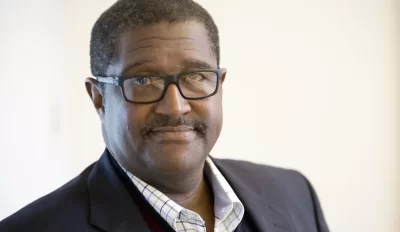
Charles I. Nero
Benjamin E. Mays '20 Distinguished Prof of Rhetoric, Film, and Screen Studies
Categories Academic Life BatesNews