With the breadth of Maine’s four seasons, Bates’ campus is ever-changing throughout the year.
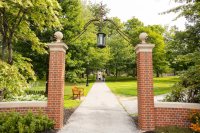
But, even in the most extreme weather, a few things always remain the same — such as the Adirondack chairs dotting the Historic Quad. They stay put through winter blizzards, under colorful fall foliage, and during summer heat, like reliable friends waiting for company.
For Mia Wetzel ’26 of Mashpee, Mass., those chairs evoke a feeling of community representative of her Bates experience. That’s why the biochemistry major, with a concentration in art and visual culture, chose to depict them in her design for this year’s ivy stone, which features two empty Adirondack chairs surrounded by a cascade of falling leaves.
“The fact that they’re empty, it’s like: There’s an open chair, you never know who you’re going to meet, what’s going to happen,” Wetzel said.
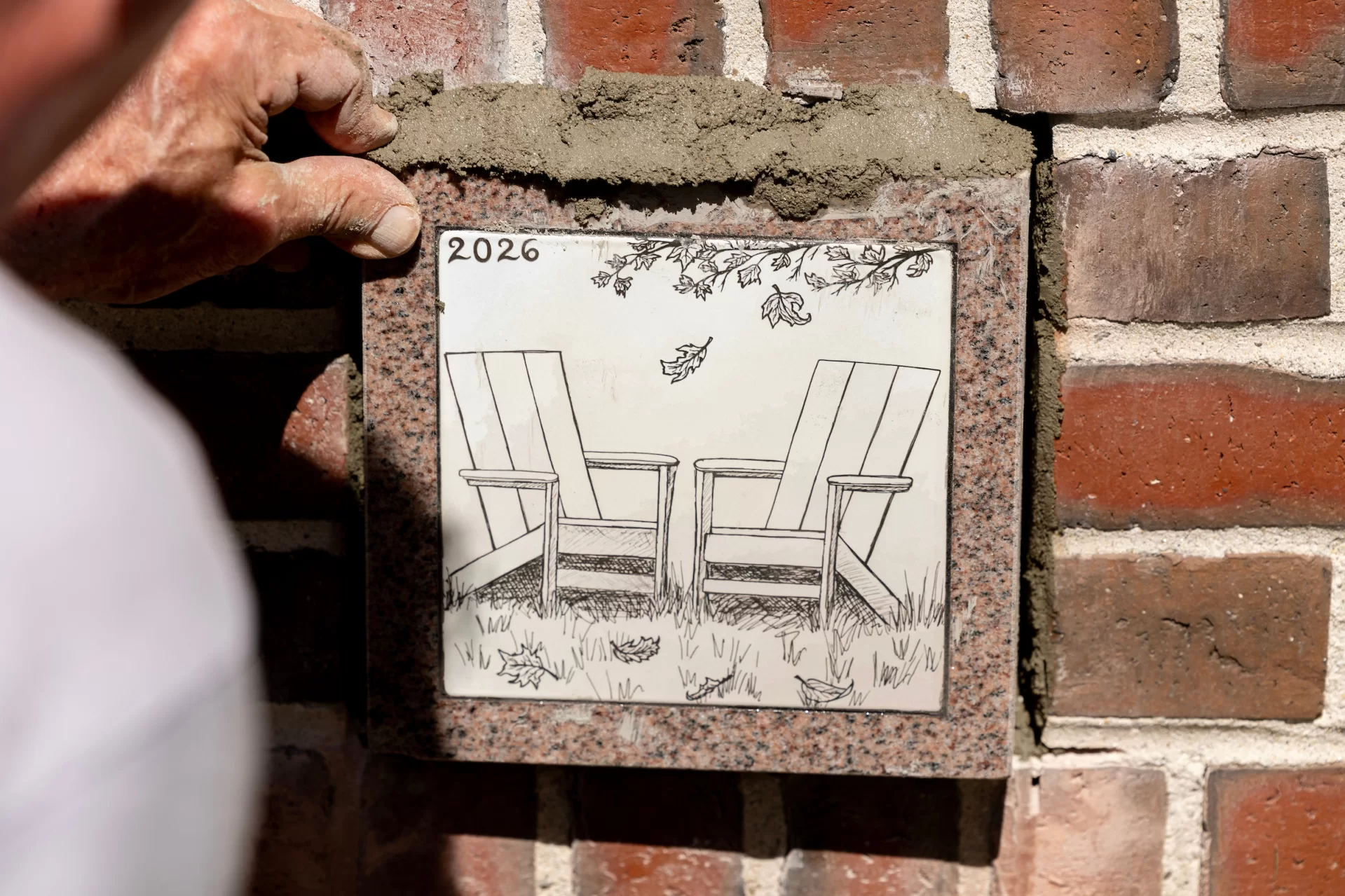
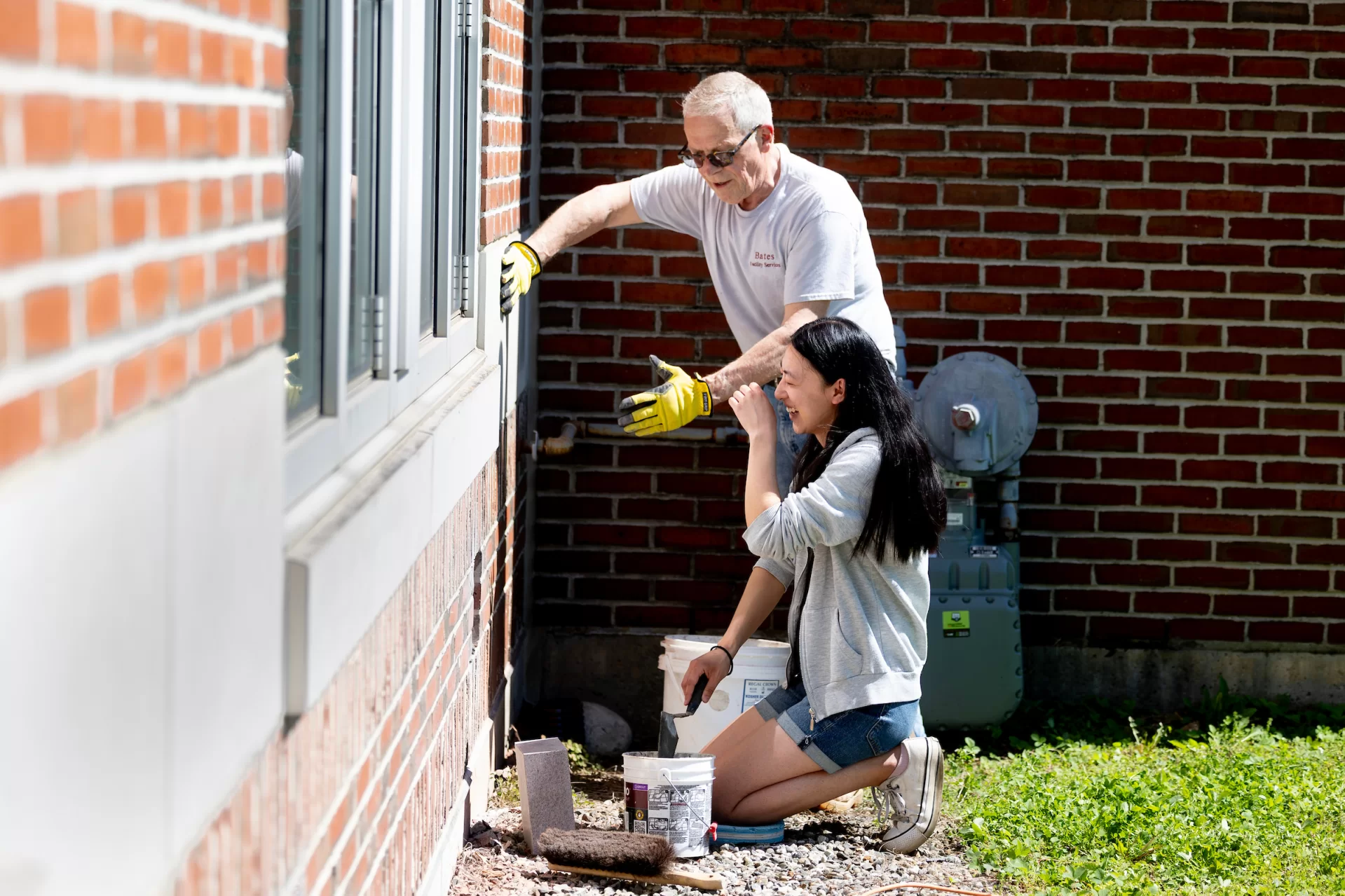
Since 1878, it’s been tradition for a graduating student to design a decorative stone to represent their class year. Any senior can submit an idea, and members of the senior class vote on the final design. On May 26, Wetzel’s stone joined the ranks of more than 130 stones dotting buildings around campus. In keeping with campus tradition, she helped Ron Tardif, a Bates Facility Services mason, install the stone on the southeast side of Pettengill Hall.
Though its design depicts an opportunity for new beginnings, the stone itself reflects not only the departure of the Class of 2026 but also the end of an era for Tardif, who has worked at Bates since 2016. He is retiring later this year, making Wetzel’s stone the last ivy stone he will install.
“I feel blessed to have this job,” Tardif said. “Bates is a generous employer. To be able to interact with the students is just one benefit. We have some really good kids here, and I enjoyed installing the ivy stones with them.”
For her design, Wetzel wanted to depict something that was personal but also specific to the Class of 2026. She remembered how, arriving at Bates in 2022, she realized that her class would be the first since the COVID-19 pandemic to have a fully in-person campus experience.
“That’s when everything started returning to normal,” Wetzel said. “I used that as my inspiration — the idea of connection, reconnection, after being isolated or socially distanced.”
The Adirondack chairs came to mind as a fitting symbol of on-campus community. Bates purchased the chairs in 2020 as a means to encourage socially distanced and safe ways to be together, so they have always been a feature of Wetzel’s Bates. She intentionally included two chairs in her design, representing the inherent connection in being a pair.
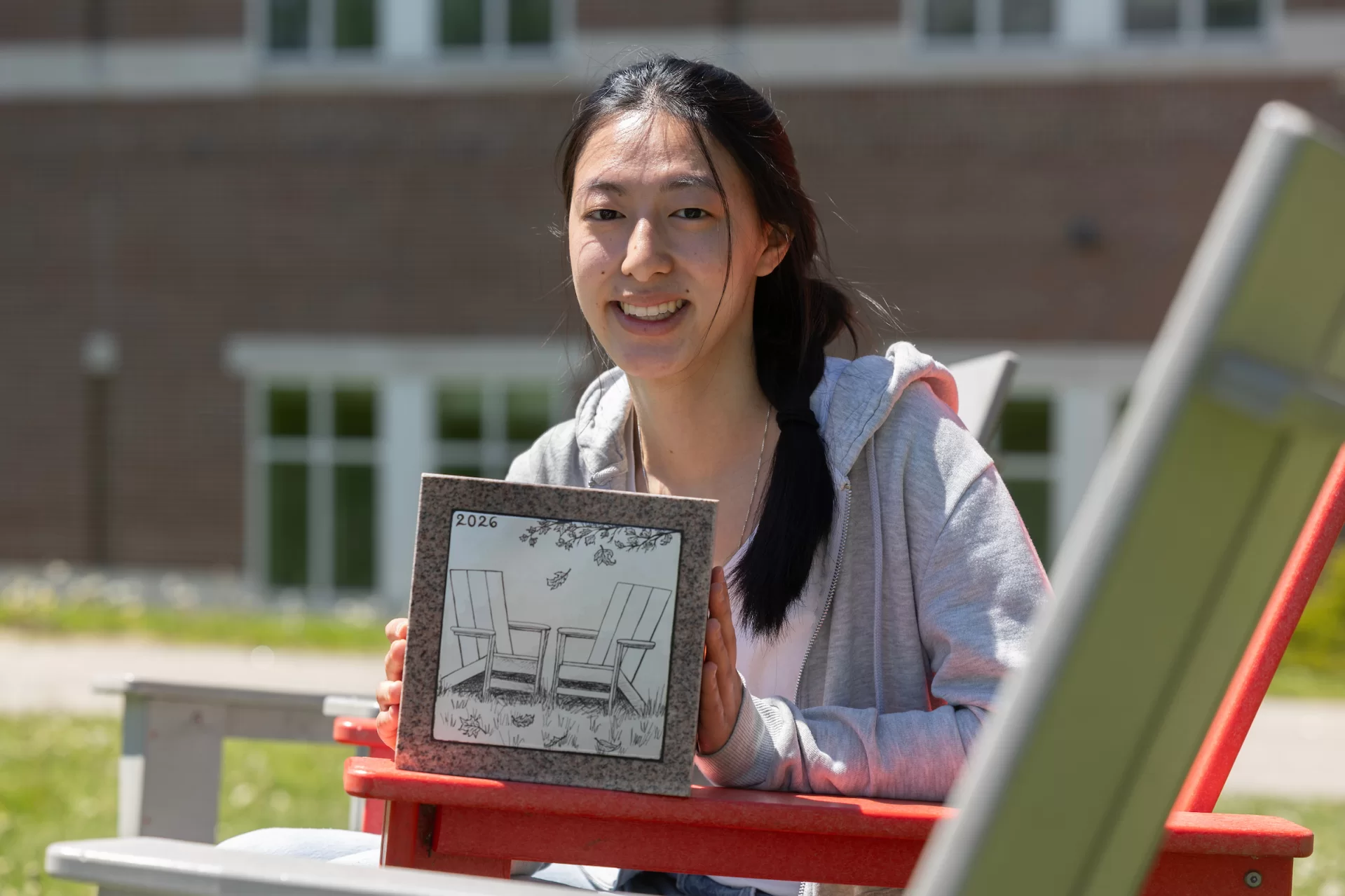
As for the personal side of the artwork, Wetzel arrived at Bates ready to slow down and form deep connections after moving twice during high school — from Zimbabwe to the U.S., then from the U.S. to Germany — for her dad’s work with the Foreign Service. The chairs, with their wide, inviting seats and spacious arms, reflect the relationships she created on campus, including with her professors, who she said have been incredibly supportive, and friends she met through academics and extracurricular activities. Wetzel was the president of the Asian Students Association for two years, a violinist with the Bates Orchestra, a Student Academic Support Center tutor, and, most recently, an emergency medical technician with Bates EMS.
“Sometimes the people you connect the most with are the people you least expected to,” Wetzel said. “That’s part of what drew me to Bates, knowing that there was a friendly atmosphere and that people can talk to whoever, and you might find a connection.”