|
|
||||||||||||
| Bates Now > |
|
Bates researchers count Lyme-disease ticks in Maine woods
Aug. 15, 2008
|
||||||
|
|
Students at Bates worked this summer with visiting biology professor Ronald Barry to collect and analyze data about ticks that carry Lyme disease. Two biology majors, senior Elizabeth Rogers of Mansfield, Mass., and junior Nelish Pradhan of Kathmandu, Nepal, worked with Barry. "Reports of black-legged ticks and Lyme disease are increasing in Maine, but we’re not sure of tick densities, tick burdens on small mammals and the proportion of tick larvae and nymphs that are actually infected with the Lyme disease bacterium in noncoastal Maine," said Barry. "These parameters are what we're trying to estimate." Hear more from professor Ron Barry The research was supported by a grant to Bates from the Howard Hughes Medical Institute.
Although the rates of tick infection with the Lyme bacterium will not be determined until later in the year, the threesome's preliminary results do suggest a burgeoning tick population in noncoastal regions of southwestern Maine. From June until early August, the trio trapped mice in woodland areas around Lewiston-Auburn, Casco and Standish. Previous research in Maine has been conducted in primarily coastal areas, where high tick abundance has been documented in areas of comparatively high human density. The Bates group is collaborating with the Vector-borne Disease Laboratory of the Maine Medical Center Research Institute to improve understanding of tick populations elsewhere in Maine. Hear more from professor Ron Barry Deer ticks, also known as black-legged ticks and by the Latin name of Ixodes scapularis, can feed on small mammals as larvae and nymphs. As larvae and especially nymphs, they can transmit Lyme disease to humans through bites in summer months. The larvae, which hatch from eggs in the spring, are about the size of the period at the end of a sentence and the nymphs, in the second year of the life cycle, are slightly larger. Adult ticks that have not fed measure about one-sixteenth of an inch across. Hear more from Nelish Pradhan Dog ticks, a different species that's larger and much easier to see, do not carry Lyme disease. "Folks who find ticks on their clothes or themselves, if they're seeing the ticks without squinting, probably have dog ticks on them -- probably not deer ticks," says Barry. "A dog tick also has white markings on its back, so that's how you can recognize it," Pradhan adds. Using live traps baited with peanut butter, the team caught small mammals and removed and collected all ticks in the field before releasing their hosts. In addition, they collected ticks from leaf litter and ground vegetation to estimate tick densities in the wooded habitats. Hear more from Beth Rogers Back at their Bates lab, they counted larvae and nymphs found at large and carried by the mammals, and are measuring the levels of the spirochete bacterium (Borrelia burgdorferi) that causes Lyme disease. Tick burdens of small mammals varied widely. "On one mouse we found 32 ticks, mostly around the eyes and cheeks," says Rogers. Ticks were dissected and their innards fixed onto microscope slides. The slides were then treated with a fluorescent antibody that binds to the spirochetes and glows under ultraviolet light. That response enables the team to count the bacteria when viewed with a microscope fitted with a UV light source. Hear more from Nelish Pradhan Barry's team has focused on a single mouse species, the white-footed mouse (Peromyscus leucopus) – the most abundant small rodent in the eastern United States and the most competent small mammal host for the Lyme disease spirochete. While the white-footed mouse may enter houses in the winter, it's not to be confused with the house mouse (Mus musculus). "It's important that people get acquainted with these things," says Barry. "You're not likely to get Lyme disease from a house mouse running around your garage." The threesome has taken care to avoid tick bites. In addition to wearing clothing that covers the extremities and is light-colored to show ticks that have They didn't pick up many ticks on their clothes, Rogers says, "which is reassuring. But it's also hard because, keep in mind, these ticks are the size of freckles." "Sometimes I'd think there's a tick climbing on me, but it was mostly just me being a little paranoid," she laughs. "I didn't find any ticks on me." "These guys are pretty tough," Barry adds about his students. The first phase of the field research was completed in early August, but Rogers, who is using the study as a basis for her senior thesis, will continue to sample study sites and their mouse populations through September. Pradhan took Barry’s spring 2008 course in mammalogy and is using the tick study to further clarify his interests in biology. The results of the study will be presented at Bates by Rogers and Pradhan. If funding becomes available, Rogers hopes to present her thesis research at the annual meeting of the American Society of Mammalogists next June in Fairbanks, Ala.
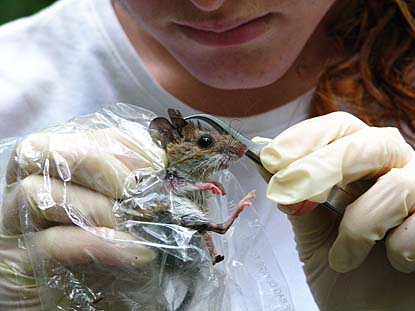
Rogers works with a mouse prior to setting it free. - Erin Bond '09 and Doug Hubley, Office of Communications and Media Relations |
|||||
| Feedback |