The Program in Environmental Studies prepares students with knowledge, skills, and ethical sensibilities needed to engage a broad range of local-to-global human-environment relationships.
Environmental studies is rooted in creating a more just, livable, and compassionate world for human and more-than-human flourishing at a time of radical climatic and environmental change. Courses in the natural sciences, social sciences, and humanities explore the cultural, political, scientific, creative, and ethical aspects of environmental questions. A social justice approach arms students with the knowledge and skills required to address today’s urgent social-ecological issues.
To examine, analyze, and understand the diverse resources of the natural world

To consider the scientific, technical, political, historical, cultural, and justice-oriented aspects of environmental issues

To use qualitative analysis software to build skills in ethnographic methods and thematic coding

To build focused knowledge and familiarity with methodological tools

To explore how environmental issues impact diverse populations through community-engaged coursework in urban, rural, and coastal settings

To design and pilot teaching materials for high school and college level students
Life After Bates
Our alumni explore diverse career paths ranging from ecologists and environmental lawyers to policymakers and National Park Service rangers. Recent graduates currently work in positions that include energy and green building consulting and land conservation.
91%
of 2020-2024 science and math graduates are employed and/or attending graduate school
“Being an Environmental Studies student at Bates helped me to broaden my thinking about how I approach research in work and in general…At Bates, I learned to defend my ideas among my peers, receive critical feedback, and adjust what I was doing, all of which were important for my master’s in chemical engineering. ”
— Lois St. Brice, ‘07
Selected Places of Employment/Service
U.S. Environmental Protection Agency
Pine Gate Renewables
Accenture
Environmental Resources Management
Ropes & Gray LLP
FB Environmental Associates
Triumvirate Environmental
EBI Consulting
Morningstar
Alexandria Real Estate Equities Inc.
Selected Graduate Schools
University of Oxford
University of Copenhagen
Yale University
University of Pennsylvania
Columbia University
Cornell University
University of Virginia School of Architecture
Boston University
Harvard University
American University Washington College of Law
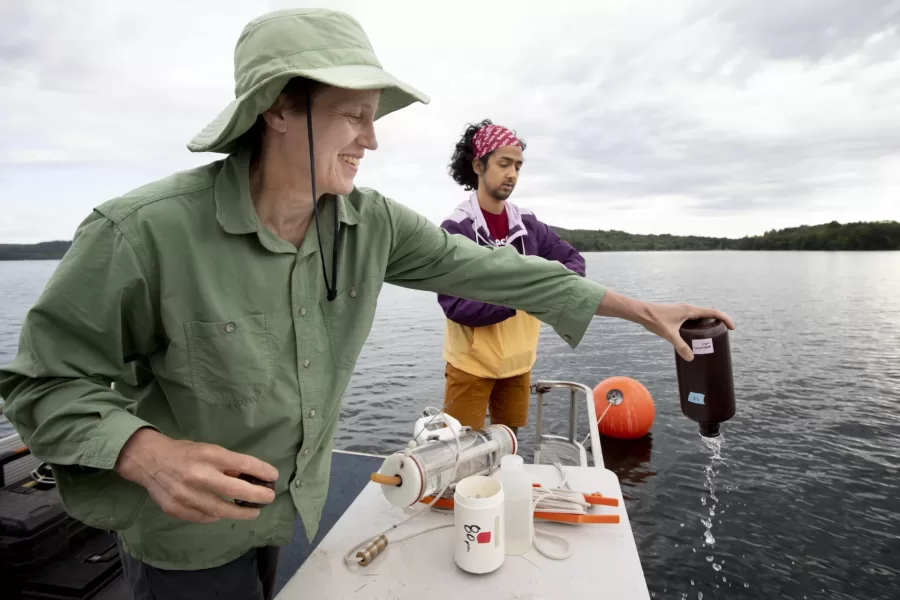
Supervised by Holly Ewing, Christian A. Johnson Professor of Interdisciplinary Studies, environmental studies major Christopher Castaneda ’20 takes water samples from Lake Auburn. He’s studying nutrients produced by algae and consumed by other organisms in the lake. Related to the impacts of algae blooms on water quality, the research supports community efforts to deliver unfiltered public water at the lowest price.
On the boat with
Water treatment manager and lab director Chris Curtis (in blue shirt) and Lindsay Bates and Dan Fortin, water quality technicians (Bruins sweatshirt)
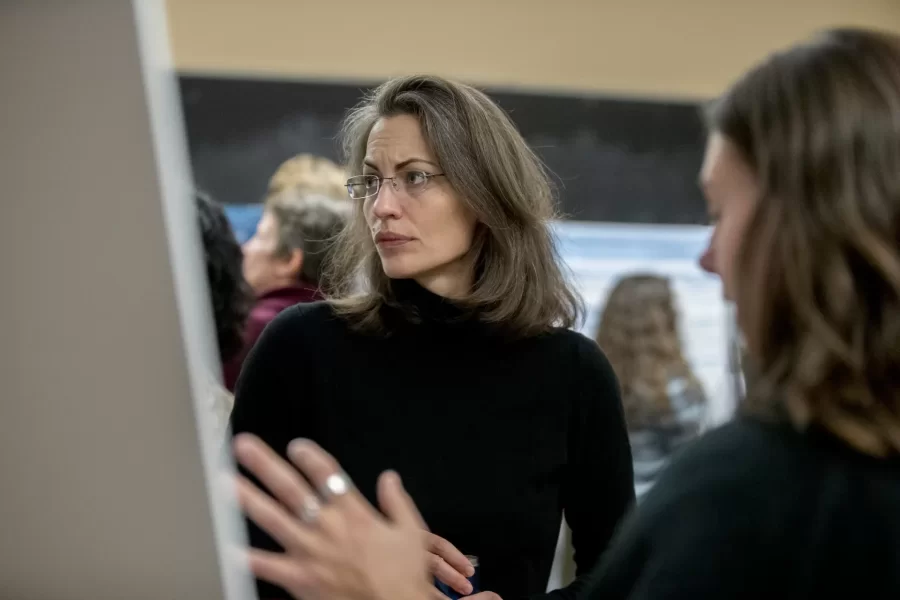
The environmental studies department holds a research poster session in Hedge Hall during the final week of classes. Jane Costlow attends.
Sonja K. Pieck
Associate Professor of Environmental Studies
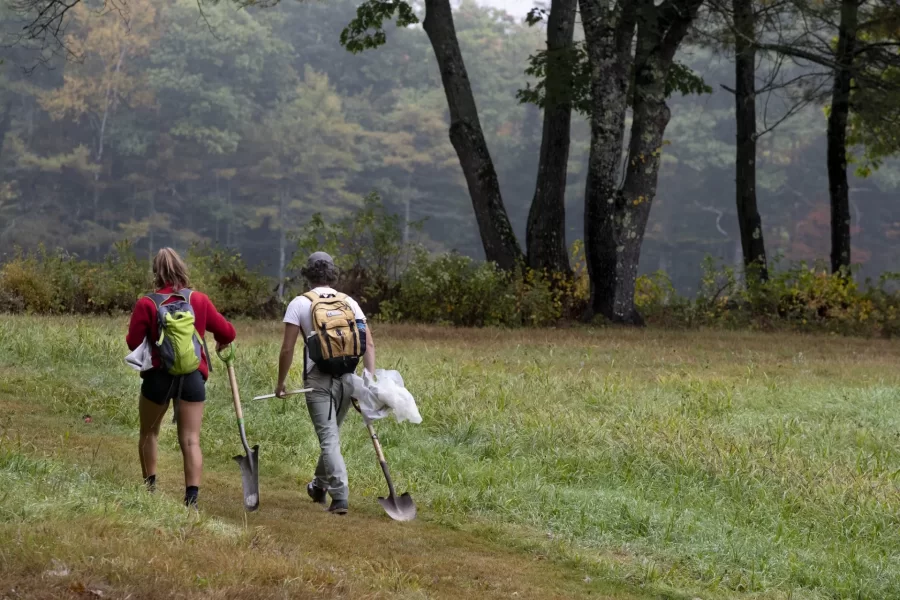
Zoe Knauss ’23 of Buffalo, N.Y., who will declare as an ES major, and ES major Sam Gilman ’22 of Mendham, N.J., , dig for soil in a field.
Prof of Environmental Studies and Christian A. Johnson Prof of Interdisc Studies Holly Ewing and Lecturer in Environmental Studies & Learning Associate in Environmental Studies Camille Parrish take students in the Soils/Lab course for a field trip to Pettengill Farm in Freeport, Maine. A nineteenth century salt-water farm on the estuary of the Harraseeket River, the farm is owned by Freeport Historical Society(FHS). It includes a saltbox house (ca. 1800) on 140 acres of fields, woods, antique apple orchards and salt marsh. Most interesting are the etchings (sgraffitti) found on the plaster walls in the upper chambers of ships, sea monsters, longboats and animals. The farmhouse remains without plumbing, central heat and electricity and is listed in the National Register of Historic Places. Mildred Pettengill was its last resident and lived in the house until 1970.
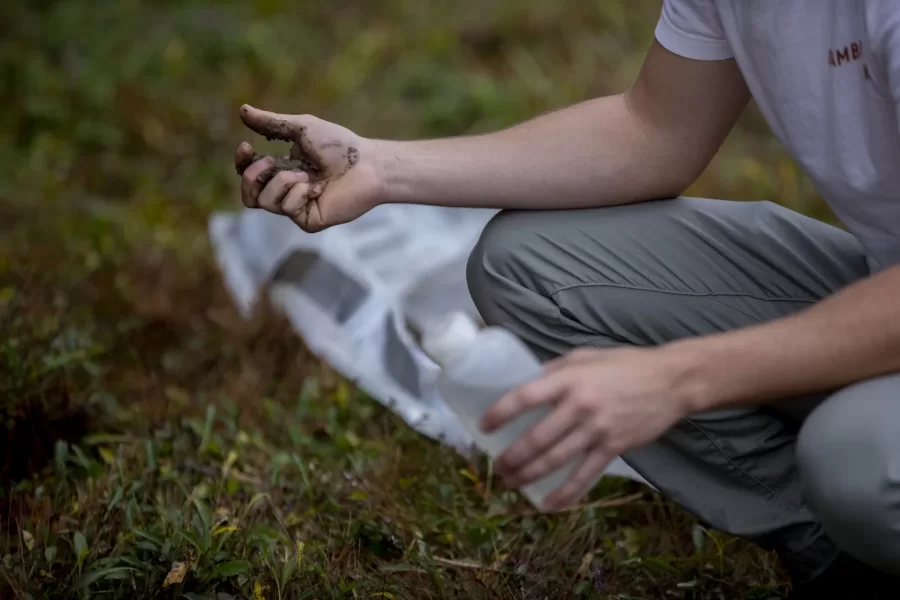
The students are digging up soil and making observations (soil profiles) before putting it back where it came from.
ENVR 310 – Soils/Lab
Depending on one’s point of view, soils are geological units, ecosystems, the foundation of plant life, a place for microbes to live, building material, or just dirt. This course takes a scientific perspective and explores the genesis of soils, their distribution and characteristics, and their interaction with plants. Field studies emphasize description of soils, inferences about soil formation, and placement within a landscape context. Labs investigate the chemistry of soils and their role in forestry and agriculture.
Zoe Knauss ’23 of Buffalo, N.Y., who will declare as an ES major, and ES major Sam Gilman ’22 of Mendham, N.J., , dig for soil in a field.
Prof of Environmental Studies and Christian A. Johnson Prof of Interdisc Studies Holly Ewing and Lecturer in Environmental Studies & Learning Associate in Environmental Studies Camille Parrish take students in the Soils/Lab course for a field trip to Pettengill Farm in Freeport, Maine. A nineteenth century salt-water farm on the estuary of the Harraseeket River, the farm is owned by Freeport Historical Society(FHS). It includes a saltbox house (ca. 1800) on 140 acres of fields, woods, antique apple orchards and salt marsh. Most interesting are the etchings (sgraffitti) found on the plaster walls in the upper chambers of ships, sea monsters, longboats and animals. The farmhouse remains without plumbing, central heat and electricity and is listed in the National Register of Historic Places. Mildred Pettengill was its last resident and lived in the house until 1970.
The students are digging up soil and making observations (soil profiles) before putting it back where it came from.
ENVR 310 – Soils/Lab
Depending on one’s point of view, soils are geological units, ecosystems, the foundation of plant life, a place for microbes to live, building material, or just dirt. This course takes a scientific perspective and explores the genesis of soils, their distribution and characteristics, and their interaction with plants. Field studies emphasize description of soils, inferences about soil formation, and placement within a landscape context. Labs investigate the chemistry of soils and their role in forestry and agriculture.
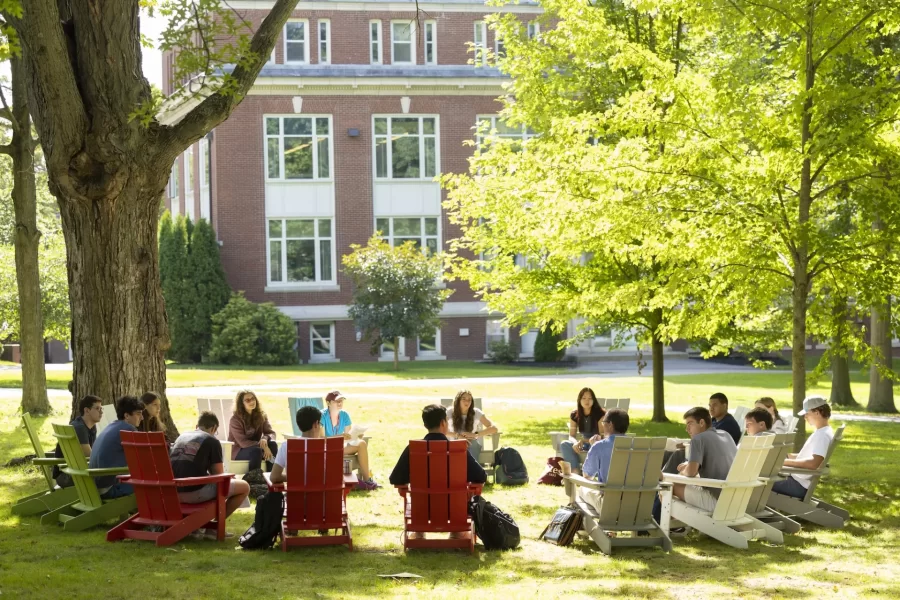
“It was a great day to be talking under the trees.”
— Associate Professor of History Joe Hall, describing the first meeting of his first-year seminar, “This Land is Whose Land?” on the Historic Quad.
The class, along with all other first-year seminars, met for the first time on Thursday morning, Sept. 1, 2022, as an opportunity for classmates to connect with each other and their instructor, who will also serve as their first-year advisor.
Swipe left for a few additional moments from yesterday’s first-year seminars, including:
“Beyond Nelson Mandela: Themes and Personalities in South African History,” taught by Assistant Professor of History Patrick Otim;
“Arts and Spirituality: Art Making and Aesthetic Experience as Conduits for Reflection and Connection,” taught by Lecturer in the Humanities and Multifaith Chaplain Brittany Longsdorf; and
“Reading Refugees and Migration in European Children’s Literature,” taught by Associate Professor of German Raluca Cernahoschi.
Supervised by Holly Ewing, Christian A. Johnson Professor of Interdisciplinary Studies, environmental studies major Christopher Castaneda ’20 takes water samples from Lake Auburn. He’s studying nutrients produced by algae and consumed by other organisms in the lake. Related to the impacts of algae blooms on water quality, the research supports community efforts to deliver unfiltered public water at the lowest price.
On the boat with
Water treatment manager and lab director Chris Curtis (in blue shirt) and Lindsay Bates and Dan Fortin, water quality technicians (Bruins sweatshirt)
Supervised by Holly Ewing, Christian A. Johnson Professor of Interdisciplinary Studies, environmental studies major Christopher Castaneda ’20 takes water samples from Lake Auburn. He’s studying nutrients produced by algae and consumed by other organisms in the lake. Related to the impacts of algae blooms on water quality, the research supports community efforts to deliver unfiltered public water at the lowest price.
On the boat with
Water treatment manager and lab director Chris Curtis (in blue shirt) and Lindsay Bates and Dan Fortin, water quality technicians (Bruins sweatshirt)
Why Study Environmental Studies at Bates?
As an environmental studies major at Bates, you will have access to small class sizes often assembled outside the conventional classroom setting. Environmental studies students can explore Maine’s diverse natural world through the Bates College Shortridge Coastal Center and the 600-acre Bates-Morse Mountain open air classroom, as well as through community-engaged coursework. Faculty research programs offer students the opportunity to take part in research assistantships, and each year, our students present scholarly work at prominent symposiums and regional and national conferences.
Featured Courses
Meet the Faculty
The Bates environmental studies department is a close-knit community of science professionals who are deeply engaged in exciting research programs at the intersection of ecological and human relationships. Recent and current projects have included the impacts of climate change on Caribbean coral reefs and Maine’s tidal shore, and community-engaged scholarship with African American communities in the Lower Mississippi River valley. They are widely published in books and such prestigious journals as Climate and Development, Cultural Geographies, and Development and Change.
In the Student Center for Belonging and Community, first-generation Bates students mentor their younger peers, providing guidance on everything from academics to internships to social life.
Bates is embarking on a $45 million project to update two key athletic facilities and construct a new fitness and well-being center. A gift of $10 million from Jon W. Brayshaw ’90, P’25 and Jocelyn Stoddard Brayshaw ’88, P’25 has brought the college a vital step closer to construction. The new facility will be named the Stoddard Fitness and Well-Being Center.
February on campus saw sports successes, several large snowfalls, and our annual Winter Carnival — a week of events celebrating the joys of the chilly season.