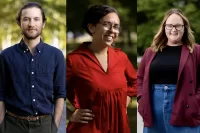
Bates has welcomed a large group of new faculty this year. Seventeen tenured or tenure-track professors joined the college during the 2025-2026 academic year. Bates News has been introducing them in groups over this semester. This fifth and final installment introduces you to the last of our new faculty hires at Bates this year.
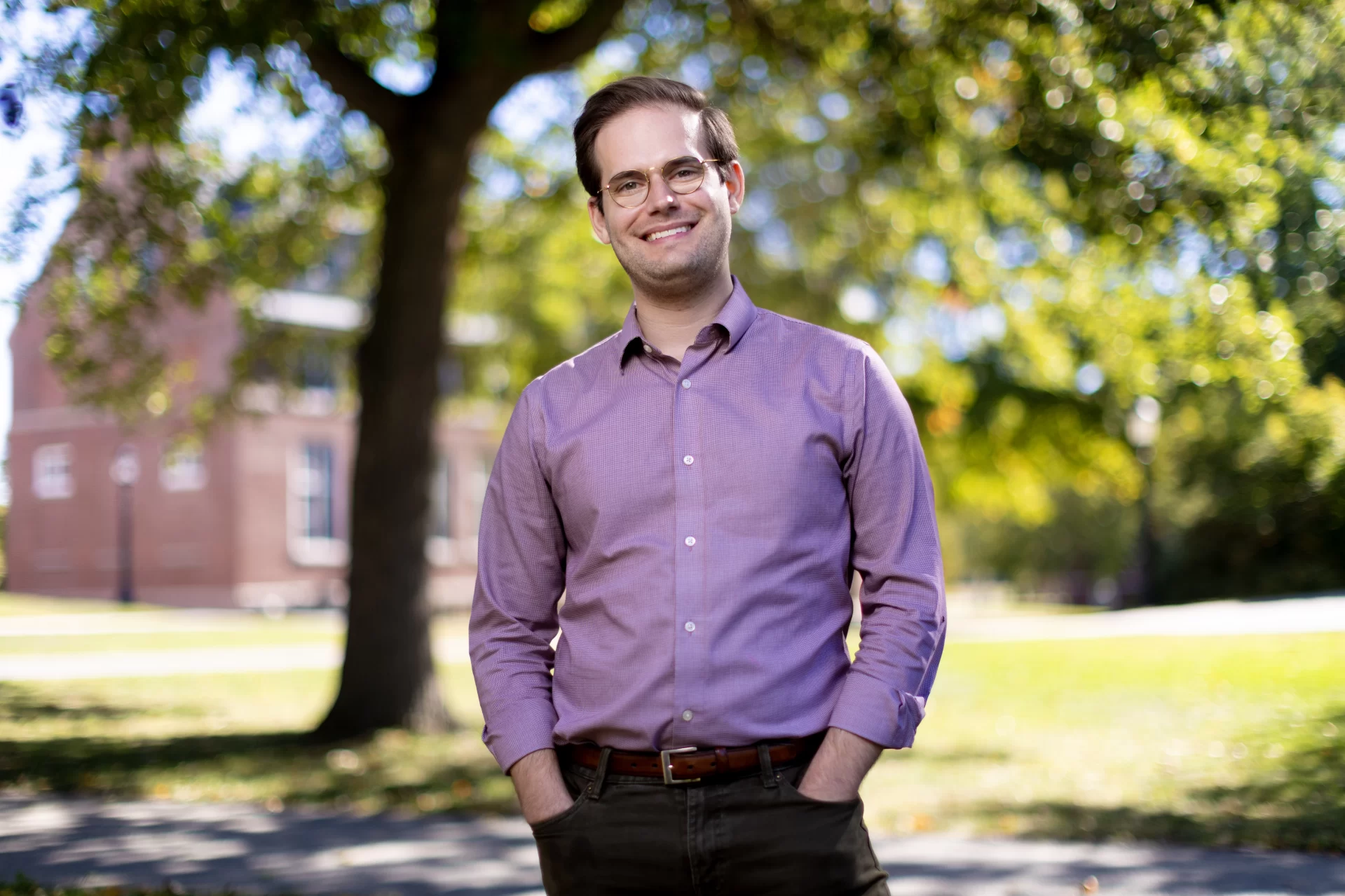
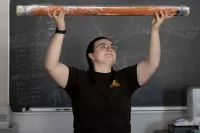
Wesley Gillis, assistant professor of physics
Focus of teaching and scholarship:
Collaboration is at the heart of both my teaching and my scholarship. In the classroom, I am focused on implementing team-based learning across the physics curriculum. This approach helps students build effective team dynamics, develop collaborative problem-solving skills, and engage deeply with complex, real-world problems through shared inquiry and discussion.
My research similarly centers on collaborative engagement within a large, international scientific community. As a member of the nEXO collaboration — comprising approximately 200 scientists worldwide — I contribute to the research and development of a next-generation, underground experiment designed to investigate the fundamental nature of the neutrino. Specifically, my lab studies the detection mechanisms, hardware design, and data analysis of vacuum ultraviolet light in liquid xenon. Together, our work aims to answer one of physics’ most profound questions: Is the neutrino its own antiparticle?
What is most exciting in your first year at Bates?
I was excited to play Dvorak’s 9th symphony, the New World Symphony, with the Bates College Orchestra in November.
What is your favorite part of teaching?
When a class full of teams has been given a challenging problem, the volume ramps from a dull rumble to a clamorous cacophony of engagement. This is when I know good learning is happening.
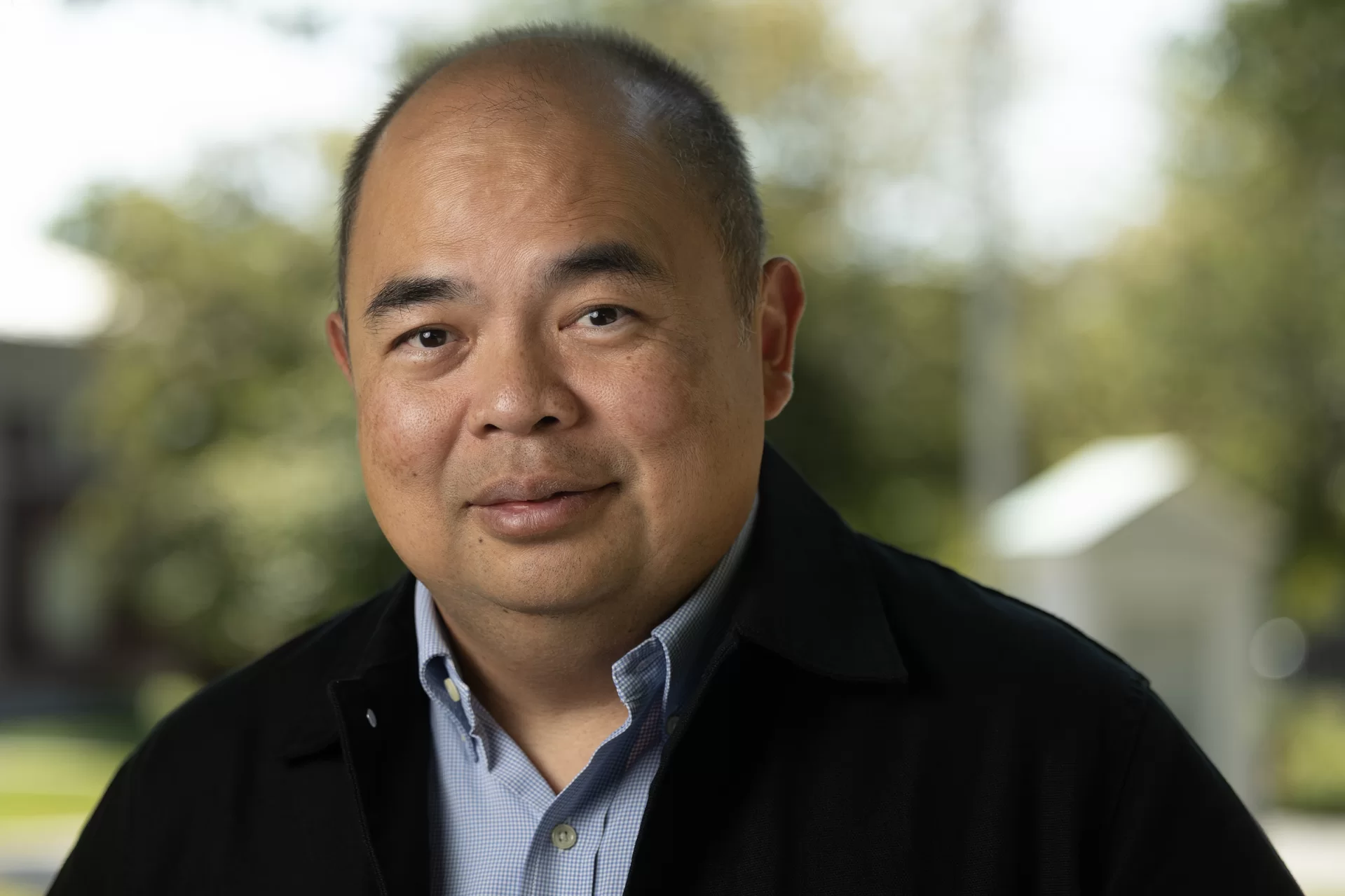
Eugene Choo, professor of economics
Focus of teaching and scholarship:
I specialize in empirical industrial organization and econometrics, with a research focus on marriage matching and the economics of household formation. My work combines structural modeling and econometric identification to study matching markets. Before joining Bates College, I taught econometrics, industrial organization, mathematical economics, and intermediate microeconomics.
What is most exciting in your first year at Bates?
I am excited about joining the vibrant liberal arts community and engaging with Bates students. I am also looking forward to exploring the beautiful state of Maine.
What is your favorite part of teaching?
My favorite part of teaching is watching students discover economics and how it is used to look at everyday life.
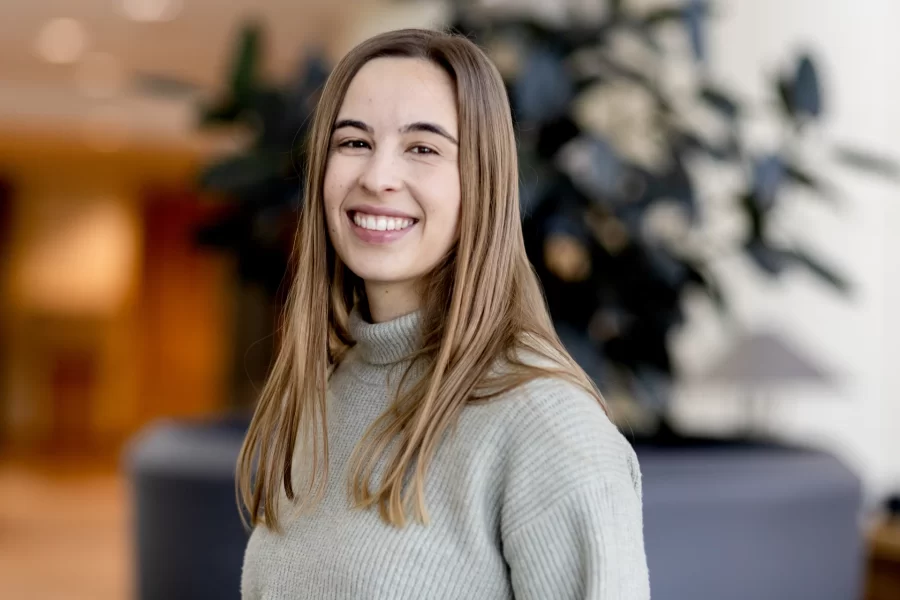
Charlotte Connop, assistant professor of earth and climate sciences
Focus of teaching and scholarship:
I’m a metamorphic petrologist and geochronologist. These are fancy words to say that I date the formation of (usually pretty old) metamorphic rocks and try to figure out how these rocks formed. These rocks can help us figure out the driving mechanisms behind processes that happen deep within the Earth that we are unable to directly observe. I’m especially interested in investigating processes that lead to the movement of elements within the Earth, including things like partial melting — where temperatures increase enough to melt rock, with the molten rock able to migrate through the Earth, leading to the transportation of material to a new location.
My teaching focuses reflect these research interests — in my classes, students learn about the rocks that make up our planet and the land we live on, and the different processes that formed and modified these rocks over time. Students learn how elements join together on the atomic scale to make minerals and how those minerals are combined in different proportions to produce different rocks. We focus on connecting these different rocks to tectonic environments to disentangle Earth processes that we are unable to observe ourselves.
What is most exciting in your first year at Bates?
I’m most excited about getting to know everyone in the Bates community! Whether it’s students in class, swinging by office hours or completing a senior thesis with me, or seeing my fellow faculty and staff around campus or in the Den grabbing lunch, everyone has been so welcoming so far. I’m looking forward to getting to know everyone more and becoming part of the Bates community.
What is your favorite part of teaching?
My favorite part of teaching is watching students pull together information from across the semester (and across their courses) to grapple with complex scientific questions. We think about a lot of different time and length scales in earth and climate sciences and to have students be able to think from the nano scale to the macro scale and beyond requires integrating a lot of different concepts, which can be hard to grapple with at times, but so rewarding when put together correctly.
Faculty Featured
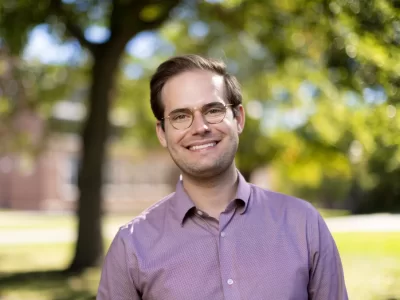
Wesley C. Gillis
Assistant Professor of Physics

Eugene S. Choo
Professor of Economics
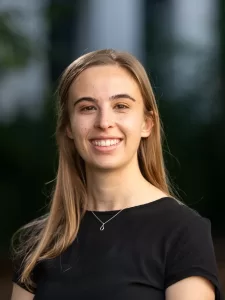
Charlotte H. Connop
Assistant Professor of Earth and Climate Sciences