Elena Maker Castro, assistant professor of psychology, and Michel Droge, visiting assistant professor of art and visual culture, have both earned Fulbright fellowships for the 2026-2027 academic year. They join a large group of 15 Bates students and one recent alumna who recently received Fulbright Student international exchange awards for 2026–2027.
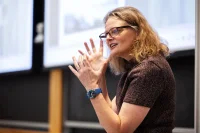
Elena Maker Castro will spend time at the Universidad Nacional Autónoma de Mexico in Mexico City, working with collaborators to explore adolescent and young adult sociopolitical development throughout Mexico City.

“Sociopolitical development is the way that young people develop critical social analysis of the systems and structures around us,” Maker Castro said. This theory of youth civic engagement further explores how young people “engage in action to challenge and transform inequitable systems.”
The Fulbright fellowship will enable Maker Castro to look at sociopolitical development beyond the US, helping to extend research in a field of study that tends to be rooted in our own national context.
“We need to move beyond that narrow context and think about what sociopolitical development looks like across different kinds of national cultural environments,” she said.
Her time in Mexico City will allow her to bring more cross-cultural research to her classes — most directly to her course “Youth Sociopolitical Development.” In courses like “Developmental Psychology” and “Educational Psychology,” Maker Castro works to draw in structural and cultural factors that impact development. For example, “religion, family values, experiences with violence, experiences with belonging and discrimination might inform how youth think and act against injustice and inequity,” she said.
“In psychology, we can risk thinking about the individual absent their context,” Maker Castro said. She anticipates that the support from Fulbright along with collaboration with students and faculty in Mexico City will energize her context-informed work when she returns to Bates.
Michel Droge received a joint Fulbright award in art and design to work in Greece and Iceland, where they will embark upon a project entitled “Light, Salt and Stone” in collaboration with marine scientists at the Hellenic Centre for Marine Research’s Institute of Oceanography in Greece and at the University of Akureyri in Iceland.
This project, which will culminate in exhibitions in both countries along with public programming, is an extension of Droge’s recent work, which has focused on the deep sea as inspiration for their paintings. Droge is familiar with making art as a result of collaboration with scientists, having worked as an artist depicting deep-sea research in collaboration with Beth Orcutt, vice president for research and senior research scientist at Bigelow Laboratory for Ocean Sciences in Boothbay, Maine.
“Over the past five years I’ve been doing deep-sea research and making work around that,” Droge said. “I’m now climbing out of the ocean onto the land. So the deep sea I looked at was more of an unconscious and the land is that liminal space.”
Droge’s work with scientists means that they are looking at the ocean both scientifically and metaphorically as they travel to two islands — Iceland and Greece — that are a part of the Mid-Atlantic Ridge.
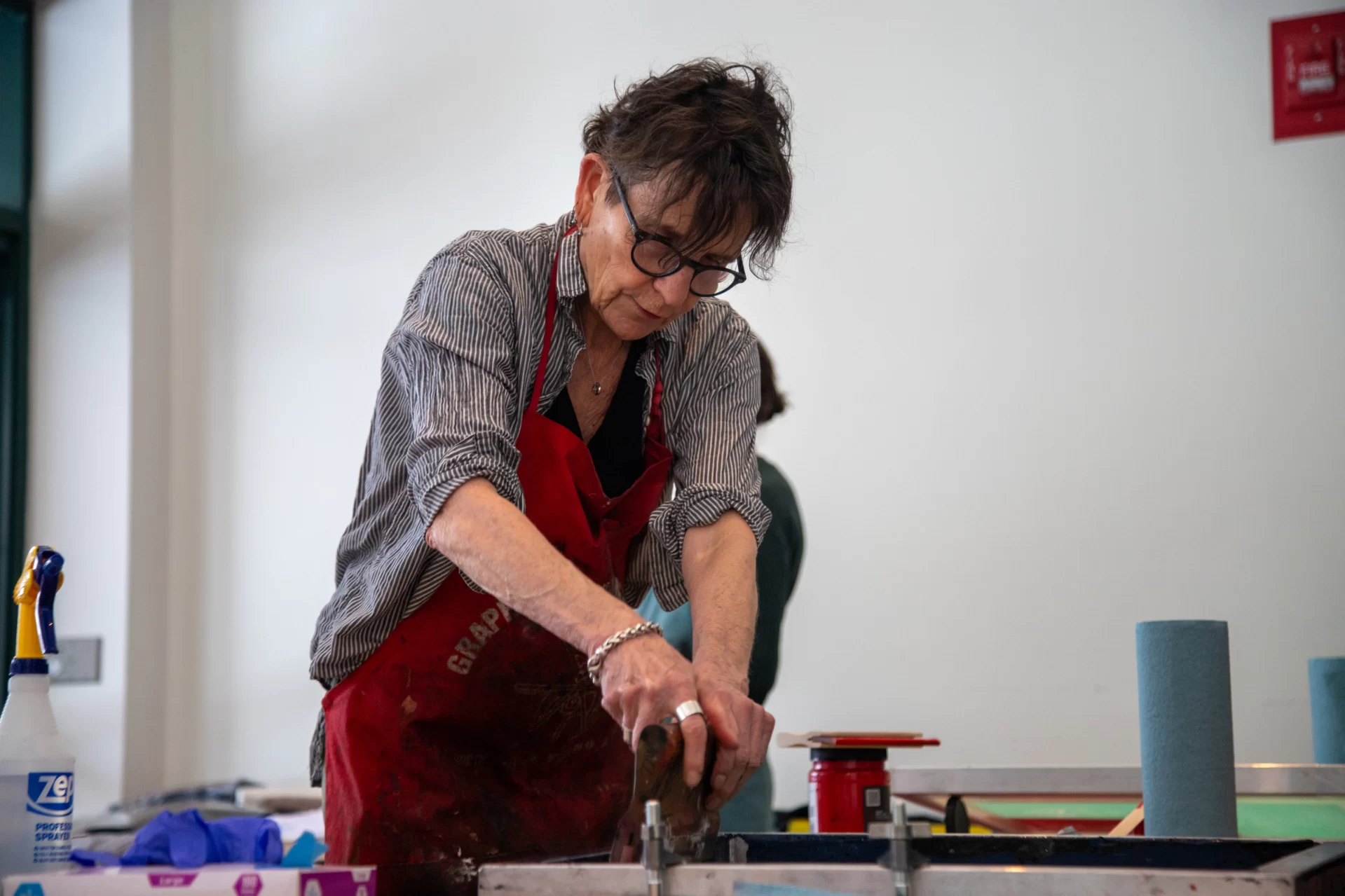
“Over the past five years I’ve been doing deep-sea research and making work around that,” Droge said. “I’m now climbing out of the ocean onto the land. When researching the deep sea, I thought a lot about the metaphor of the unconscious dream state mind. My newer work will be exploring tidal marshes and rivers and become a metaphor for the liminal space between the dream world and the tangible world, the unconscious realms and the conscious, the unseen becoming visible.”
Droge’s time working with scientists shows up not only in their painting, but impacts the ways that they approach the classroom and the curriculum. “To have time to really immerse myself in my research is such a gift, such an honor, and it’s such an important thing for both my practice, but also the rest of my teaching career.”
Faculty Featured

Michel Droge
Elena G. Maker Castro
Assistant Professor of Psychology
Categories BatesNews