Over the past year, Bates’ 11 graduating studio art and visual culture students have spent countless hours working in their own favored media, each creating intricate paintings, drawings, photography, or sculptures for their thesis projects.
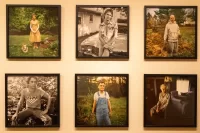
On April 17, they’ll step outside of their Olin Arts Center studios to share their work with the world as At the Table: Senior Thesis Exhibition 2026 opens at the Bates Museum of Art.
Creating the annual senior thesis exhibition is a big task, but one that brings students, faculty, and staff together in collaboration. The students write in-depth artist statements, sign contracts with the museum, and work with Visiting Assistant Professor of Art and Visual Culture and Lead Preparator at the museum Michel Droge to learn about framing and physically displaying their works.
“Art school students across the country are lucky if they get a week-long exhibition for their senior thesis work,” says Museum of Art Director Carrie Cushman. “A six-week exhibition in a professional museum is a truly remarkable opportunity for the students at Bates — an opportunity that they live up to with equal parts professionalism and ambition. For our part, hosting the show is a highlight of the year as a time when the community gathers together to celebrate and learn from our students.”
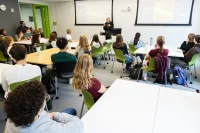
The process takes place across two semesters; the fall course, taught by Professor of Art and Visual Culture Cat Balco, focuses primarily on rigorous research into various artistic practices, idea development, and the first stages of physically creating the art. That research includes not only learning about specific materials but also exploring how these materials are represented across various sociopolitical and cultural contexts.
The winter course, taught by Associate Professor of Art and Visual Culture Carolina González Valencia says, is about synthesizing those ideas into exhibition-ready works.
“We as artists engage in research in many different ways,” González Valencia says.
The entire year-long process is intense, requiring students to leap from a place of boundless possibility and uncertainty to physical creation, with the willingness to redirect their paths when something isn’t working.
“I have a student this semester who is always asking, ‘But how do I know that this will work?’” González Valencia says. “I always tell her, ‘You never know,’ which is very scary, but very exciting. Seeing them struggle with the uncertainty is very beautiful because it’s in that uncertainty that they start finding themselves, finding their voice and trusting it to start building their ideas.”
The chance to display their work in a museum, which Bates offers its graduating studio art students each year, is a fantastic opportunity, González Valencia says.
“That’s something very, very beautiful — that the students get to experience what it’s like to actually put it out there and have people experience it and have their own meaning about it,” González Valencia says.
The students worked together to brainstorm the name of the exhibition, which conveys their belief that each artist, with their unique collection of work, deserves to have their ideas heard — to have a seat At the Table. The exhibition opens with a reception at the Bates Museum of Art on April 17 at 5 p.m. and will remain on display through May 30. Below, learn more about each student’s work, drawn from their artist statements.
Sam Bunar
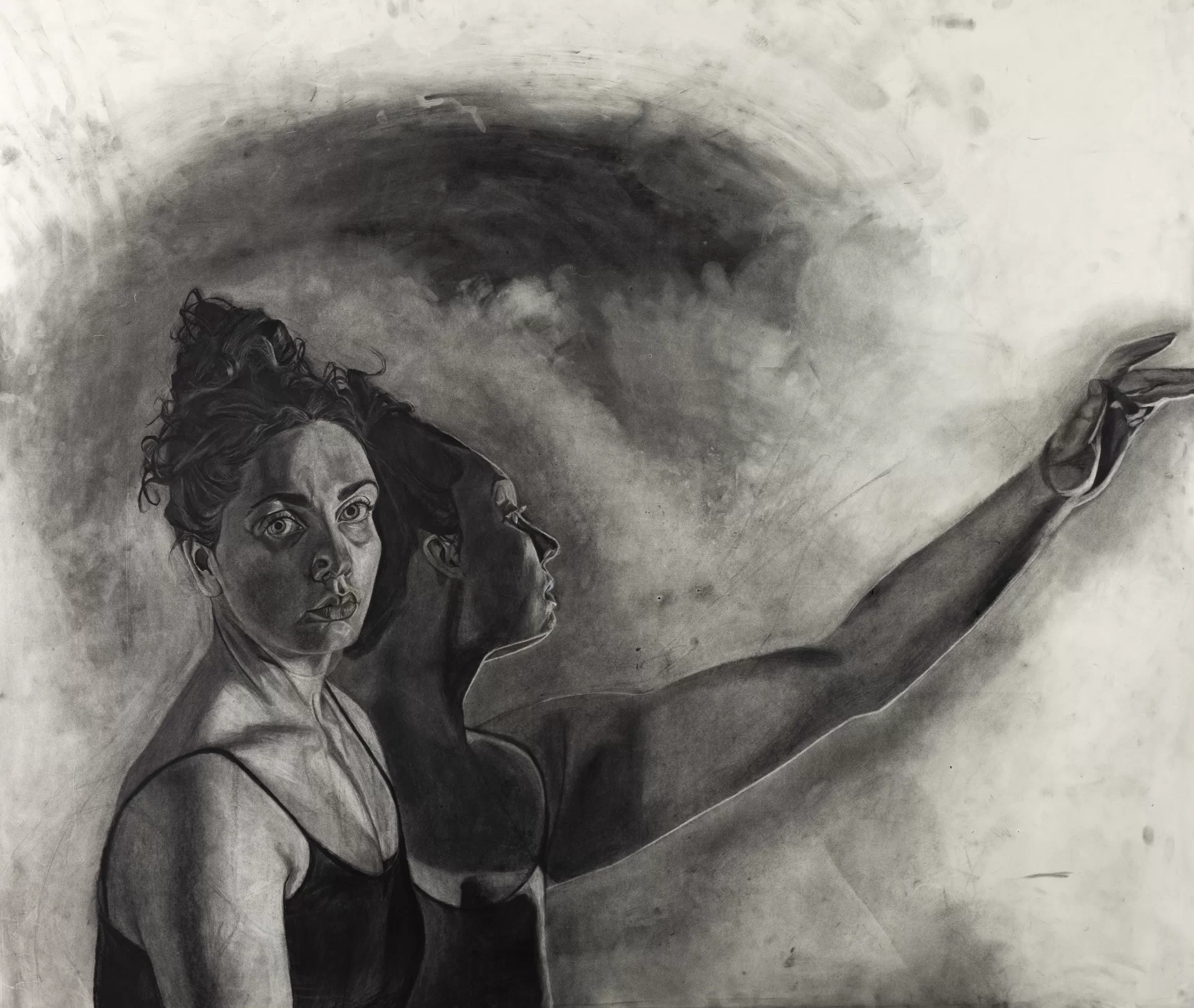
With her charcoal drawings, Sam Bunar of Harwich, Mass., explores the way that releasing control can lead to artistic expression. She interrogates the self and the cosmos, and how the two interact, with self-portraits portraying her reflected in a mirror, surrounded by cosmic patterns.
“I draw inspiration from the inherently complex and uncontrollable nature of the cosmos, inexplainable forces that humans may never completely understand, yet remain profoundly beautiful,” Bunar writes. “In their vastness, they remind us of the infinitesimal scale of our existence within the boundless universe.”
The loose quality of charcoal drawing reflects this idea of relinquishing control, which Bunar wrestled with in her personal life after a physical injury forced her to release her all-encompassing identity as a soccer player. A double major in art and visual culture and physics, Bunar’s scientific interests also inform her work.
“I tell a story about embracing chaos as I visualize an accent toward metaphysical weightlessness and serenity. It is a conscious state of liberation that allows for intrinsic growth, unhindered by the need to control every parameter and outcome in life. My individual pieces come together to model the cyclic nature of my obsession, perfectionism, and fear of the uncontrollable.”
Audrey Esteves
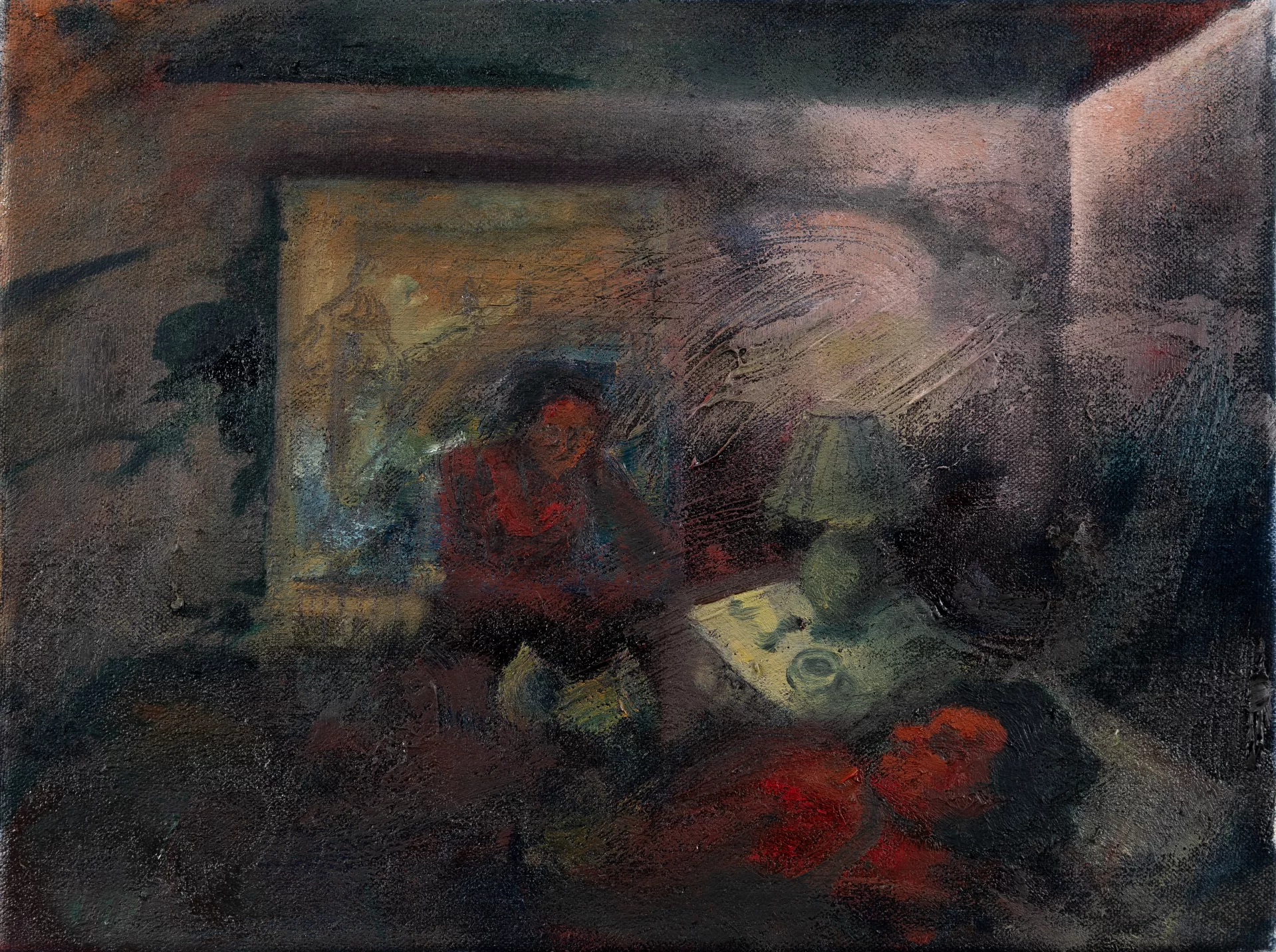
Audrey Esteves of Cranford, N.J., explores sleep — as a place of rest and warmth and also as a receptacle for exploring memory — through oil painting. She mixes wet and dry oil painting techniques to allow “figures and spaces to emerge” in layers of subtle, hazy definition.
“My body of work strives to imagine recurring moments of rest, wherein memory and meaning are distorted by darkness and lucidity,” Esteves writes. “I want to find warmth in what is unknown and unseen — in what happens when the light goes out.”
A double major in art and visual culture and American studies, Esteves looks to Expressionism and the Italian medieval and early Renaissance periods for inspiration about sleep’s eerie qualities and the narratives and images that the brain imagines in sleep.
“I employ repetition when painting these intimate moments of everyday life, skewing the perspective of sleeping figures, their bedrooms and their objects. This process helps me to answer the questions my body and brain have about what happens in the dark — both within dreams, and the liminal moments between sleep and consciousness.”
Jeremy Felton
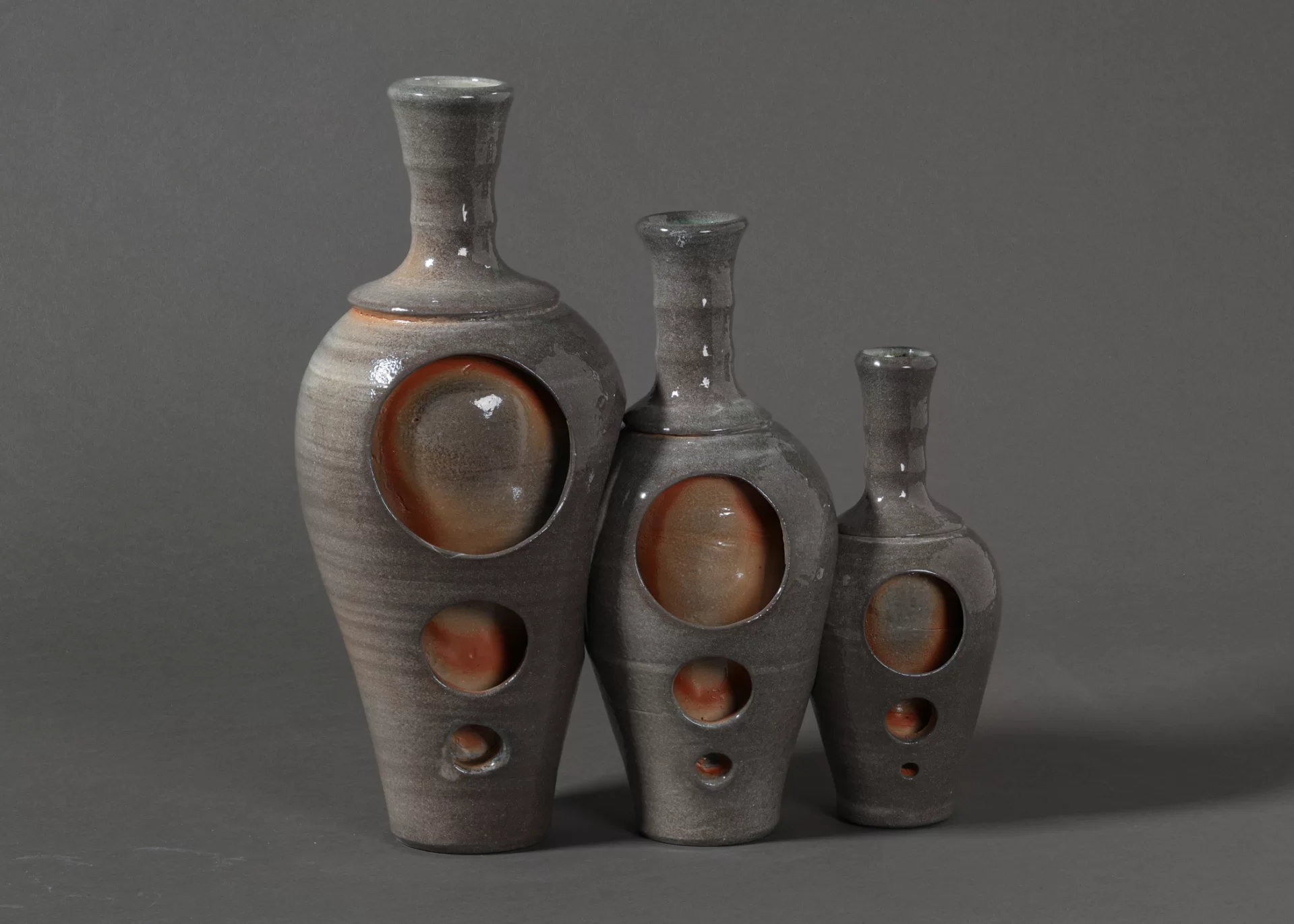
With his ceramic works, both art and vessel, Jeremy Felton of Sebastopol, Calif., interrogates the value of a piece.
“Each piece can and should be used, but I think of the visual and conceptual components of my work as valuable in themselves, beyond any functional enhancement,” Felton writes.
Felton, a double major in art and visual studies and philosophy, decorates his pieces with clay, wood, and rocks collected in Maine, imbuing each work with a sense of place. He completes the pieces in a kiln with soda firing, a process in which the draft of the kiln pulls a vapor of sodium carbonate across the pots, leaving dramatic marks of flames across the works.
“Raw clay is exposed when flame is blocked, each surface dictated by its context in the kiln. Many pieces are designed around this process — a ewer and its stand, or a teapot and its cups — each aspect working as negative or subject for its counterpart; a story only revealed when they’re separated.”
Aratrika Ghosh
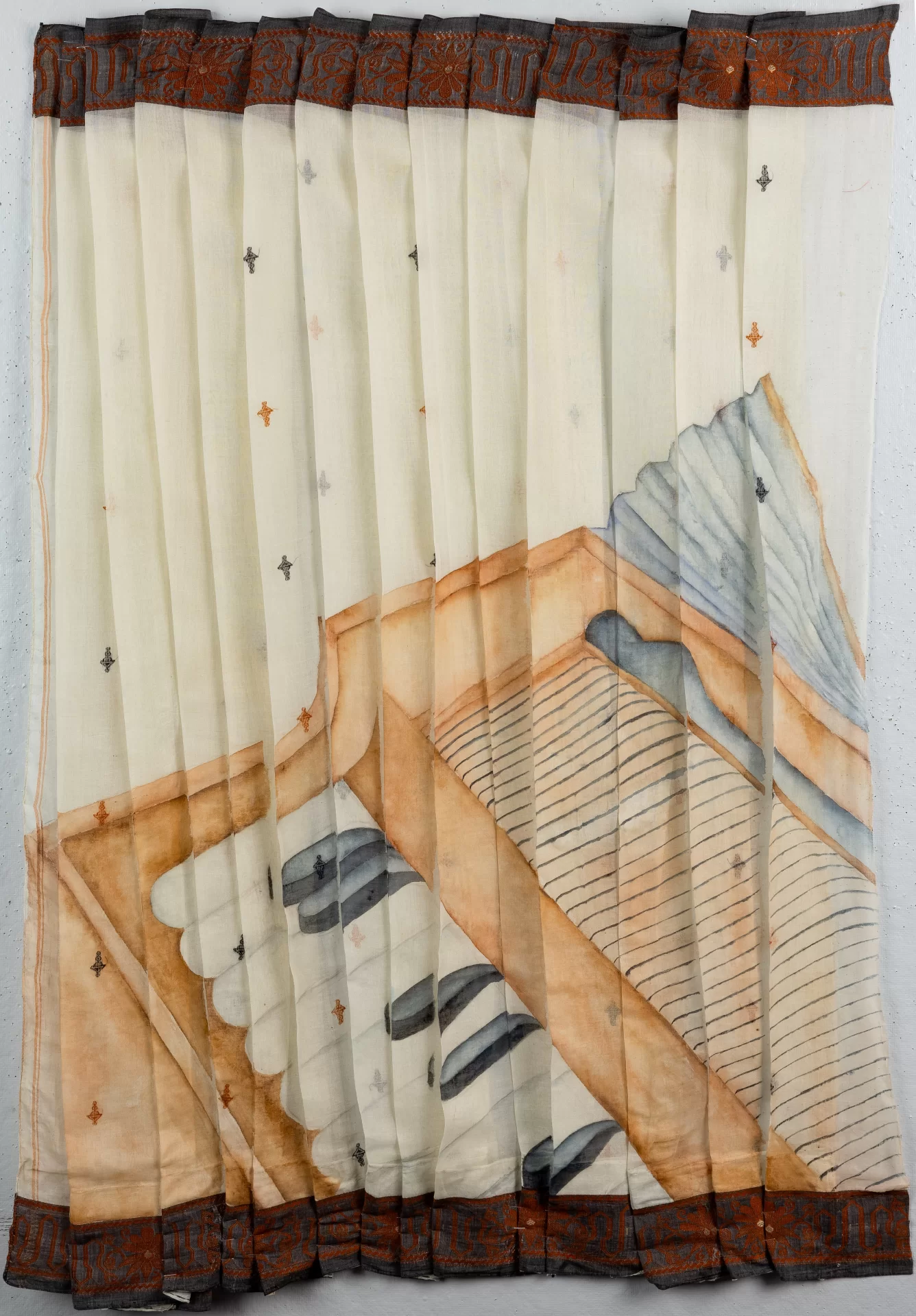
Aratrika Ghosh of Mumbai, India, explores memory, distance, and culture by painting on top of saree — also known as “sari” — garments. Her piece in the exhibition features a harmonium painted across her grandmother’s white, pleated saree, exploring her now fading memory of the instrument she was trained in for 10 years. She paints from memory instead of photographs, employing various degrees of opacity and completion across her works to further illuminate the incompleteness of memory.
“The folds disrupt the image, partially obscuring it, paralleling my fading tactile memory of playing the instrument,” Ghosh, a double major in art and visual culture and mathematics, writes. “What once lived in muscle memory now exists as visual memory — fragmented, softened, and mediated through distance.”
An international student living far from her family, Ghosh uses her artistry to connect with her ancestors and culture, participating in the Bengali tradition of passing sarees down through generations.
“Across my practice, I use inherited textiles to bridge physical separation and emotional continuity. By layering my own memories onto fabrics that pre-date me, I create a dialogue between past and present, absence and presence, inheritance and authorship. The work becomes both an act of preservation and an acknowledgment of loss: a recognition that memory, like fabric, stretches, folds, and inevitably changes with time.”
Mia Goodwin
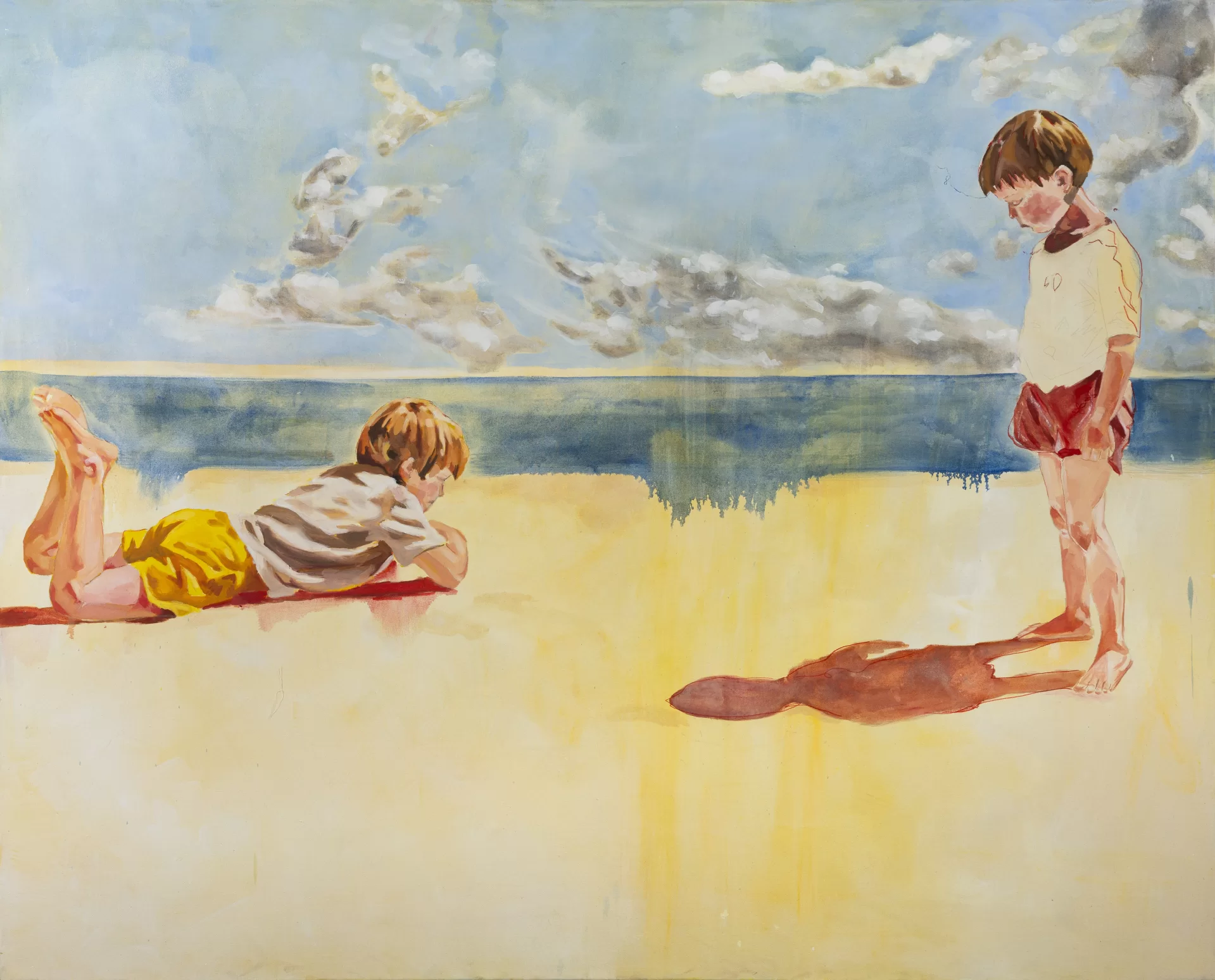
Mia Goodwin of Freeport, Maine, also explores memory through oil painting. She creates paintings, inspired by her grandfather’s photographs made on film, on large canvases that require bodily movement, mimicking the way that one moves through memories.
“These photographs encapsulate familial memories, ones that my memory doesn’t directly live in, but still is physically and generationally tied to,” Goodwin writes. “Although these moments predate my own lived experience, they have been passed down through stories, images, and emotional inheritance, allowing them to feel both distant and deeply familiar.”
Playing with color, washes, and empty space, Goodwin, a double major in psychology and art and visual culture, explores how memory takes shape and is warped by time and distance.
“I hope my paintings give a feeling of lost time and space. These thinned areas of paint act as visual pauses, mimicking the moments memory cannot fully retrieve. Ultimately, the absence becomes just as meaningful as what is rendered. I hope they allow the onlooker to reflect on what was lost through time. My paintings function as sites of collective reflection, inviting viewers to project their own histories, absences, and emotional memories into the work.”
Ella Hannaford
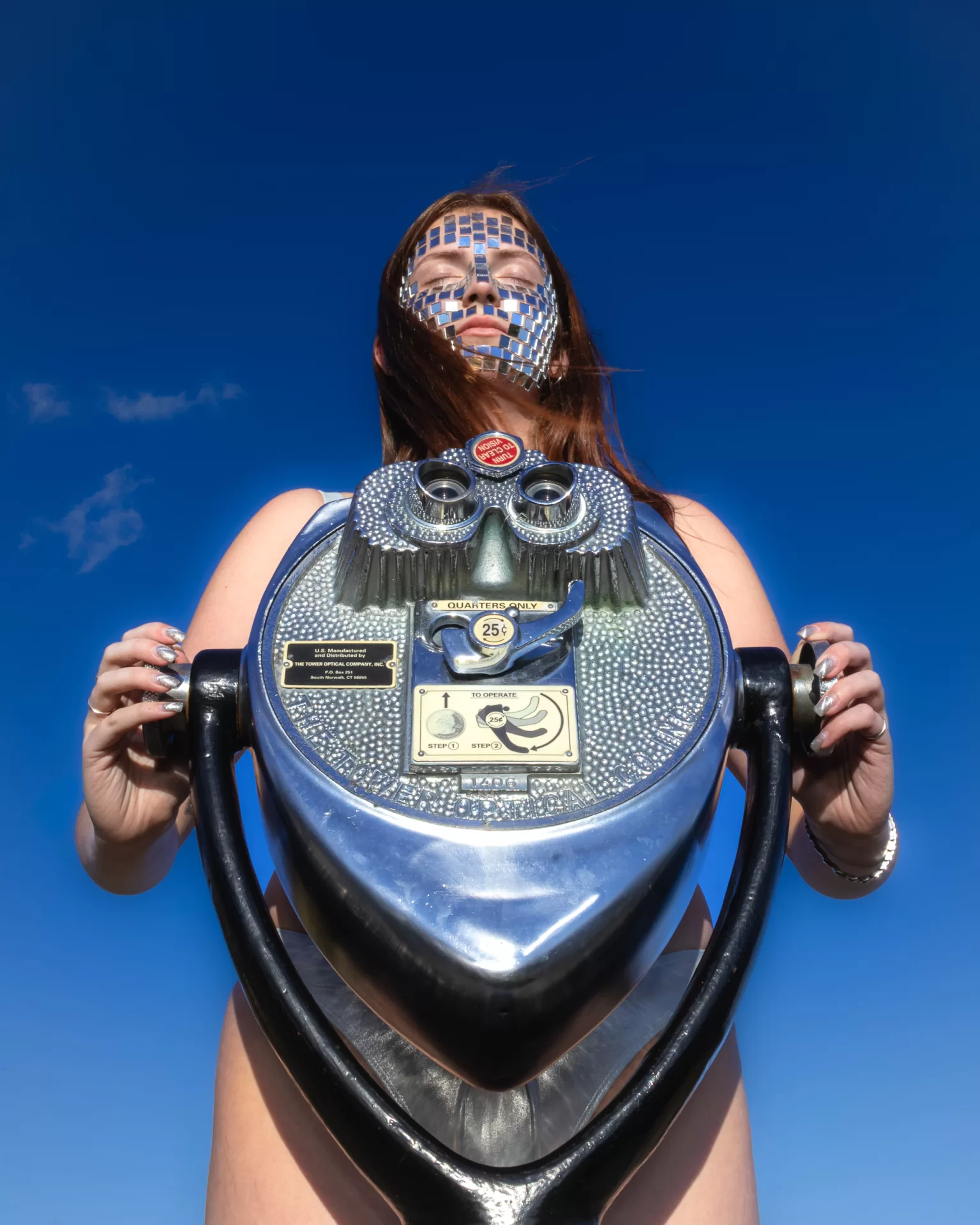
In her self-portrait photography, Ella Hannaford of South Portland, Maine, is both art and artist. She photographs herself on the coast of Maine, where she grew up, incorporating elements of reflection such as mirrored tiles placed across her face in order to blur the lines between body and landscape.
“I engage self-portraiture and performance as methods capable of confronting the boundaries of the body and landscape — where a body reads as terrain or a landscape behaves like a portrait,” Hannaford writes. “Here, looking becomes implicated, carrying intimacy and scrutiny at once.”
She primarily photographs during Maine’s off-season, challenging notions of how the coastline is defined and exploring “how a landscape shifts once it is no longer performing itself.”
“Control over my image is not given but produced through creative and embodied risk. Printing large-scale extends that negotiation outward, inviting a physical encounter in which viewers must register their own looking and position in relation to the image. The exchange holds intimacy and distance, recognition and uncertainty — held in suspension.”
Bissan Kablawi
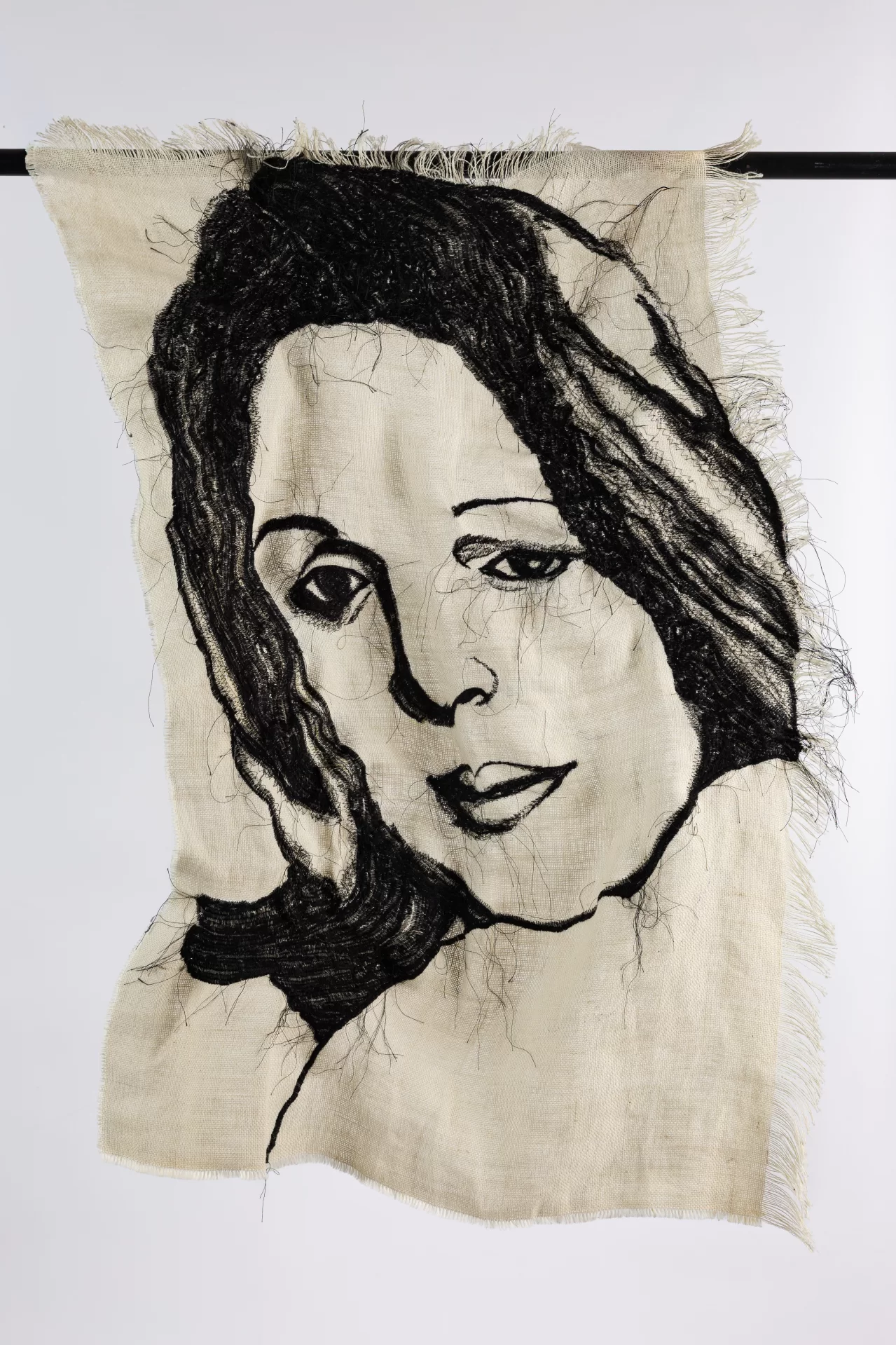
With her mixed-media works combining oil painting, threadwork, sewing, fabric, gelatine, and layered surfaces, Bissan Kablawi of London expands the boundaries of tatreez, the centuries-old practice of Palestinian embroidery that she learned from her grandmother Badriyeh.
Kablawi stitches and sews directly onto canvas and embroiders over oil paintings, “creating a dialogue between heritage and contemporary interdisciplinary studio practices,” she writes. “In the repetitive act of stitching, a historically feminised and unrecognised form of labour, I mirror and induct myself into the legacy of Palestinian women preserving culture and identity in diaspora.”
Kablawi explores the tension of diaspora, weaving symbols representative of traditional Palestine among fractured images representing her memory and imagination of Palestine. The slow nature of embroidery, she writes, is an “act of care, resistance, and identity-making.”
“My cultural preservation work represents more than tradition; it is testimony to our existence, perpetual and immemorial. In stitching, painting, and reimagining Palestinian art practices, I join Palestinian artists whose work asserts our presence and rejects our collective erasure.”
Simon Klompus
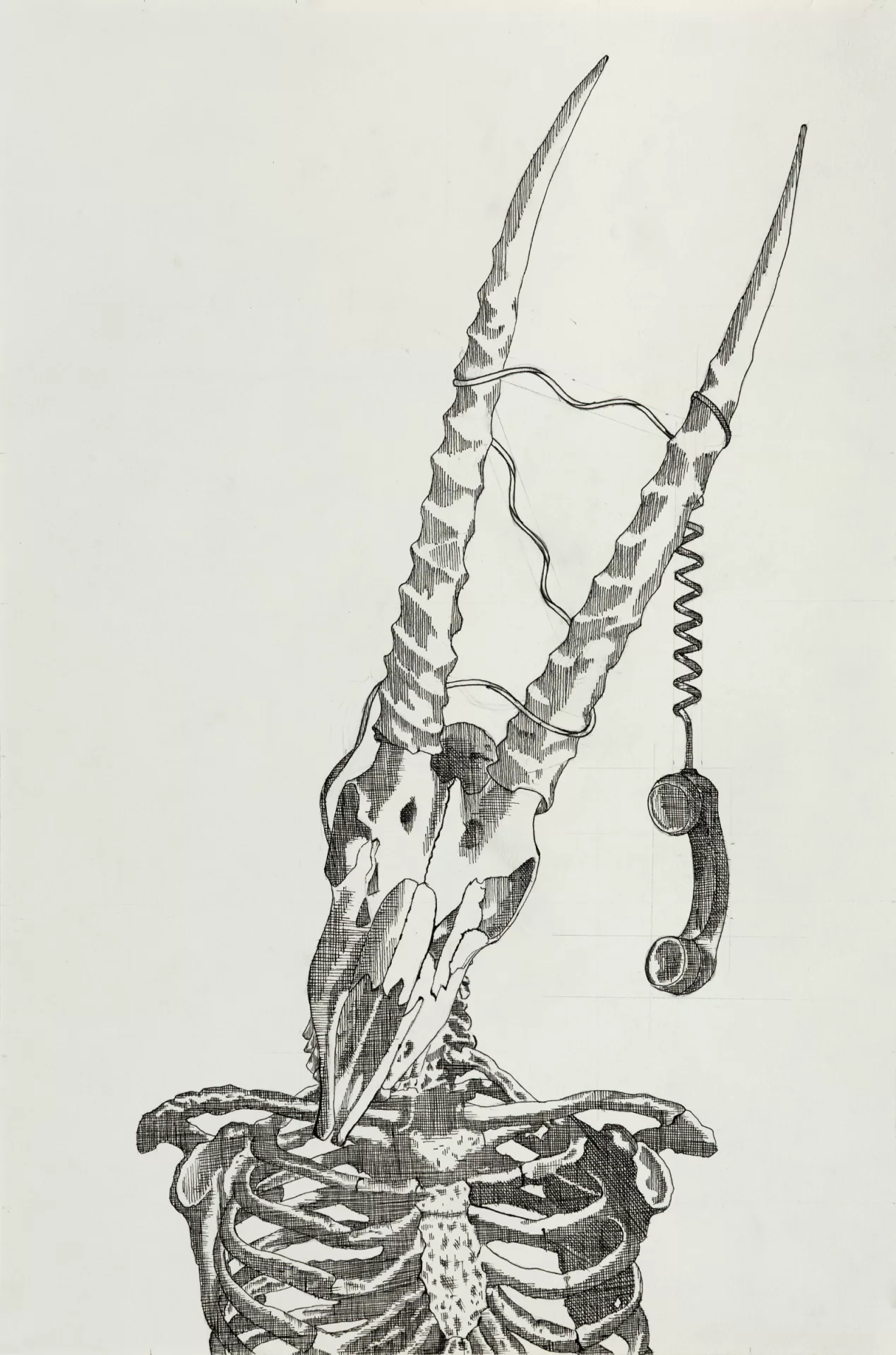
In his pen drawings, Simon Klompus of Williamstown, Mass., combines anatomically accurate depictions of bones from different species to highlight the elements that unite all biological creatures.
“While we strive for fulfillment, financial success, and material goods, we often forget the raw, biological fragility that underlies and ties all organic things together,” Klompus writes. “I create drawings that allow me to play with the composition of differing species, often creating something illogical and awkward, though occasionally shockingly plausible.”
Through this “creative paleontology” practice, Klompus begins by creating drawings exploring each animal’s bones individually, then randomly selecting a group of the drawings and assembling them.
“The build up of something semi permanent through the use of thousands of small fine lines is reminiscent of our bodies’ construction. When viewed from further back, the intricacy disappears until what is left is form and shadow. Yet upon closer viewing, the form’s creation is nothing more than a great many lines.”
Qwynn Kobertz
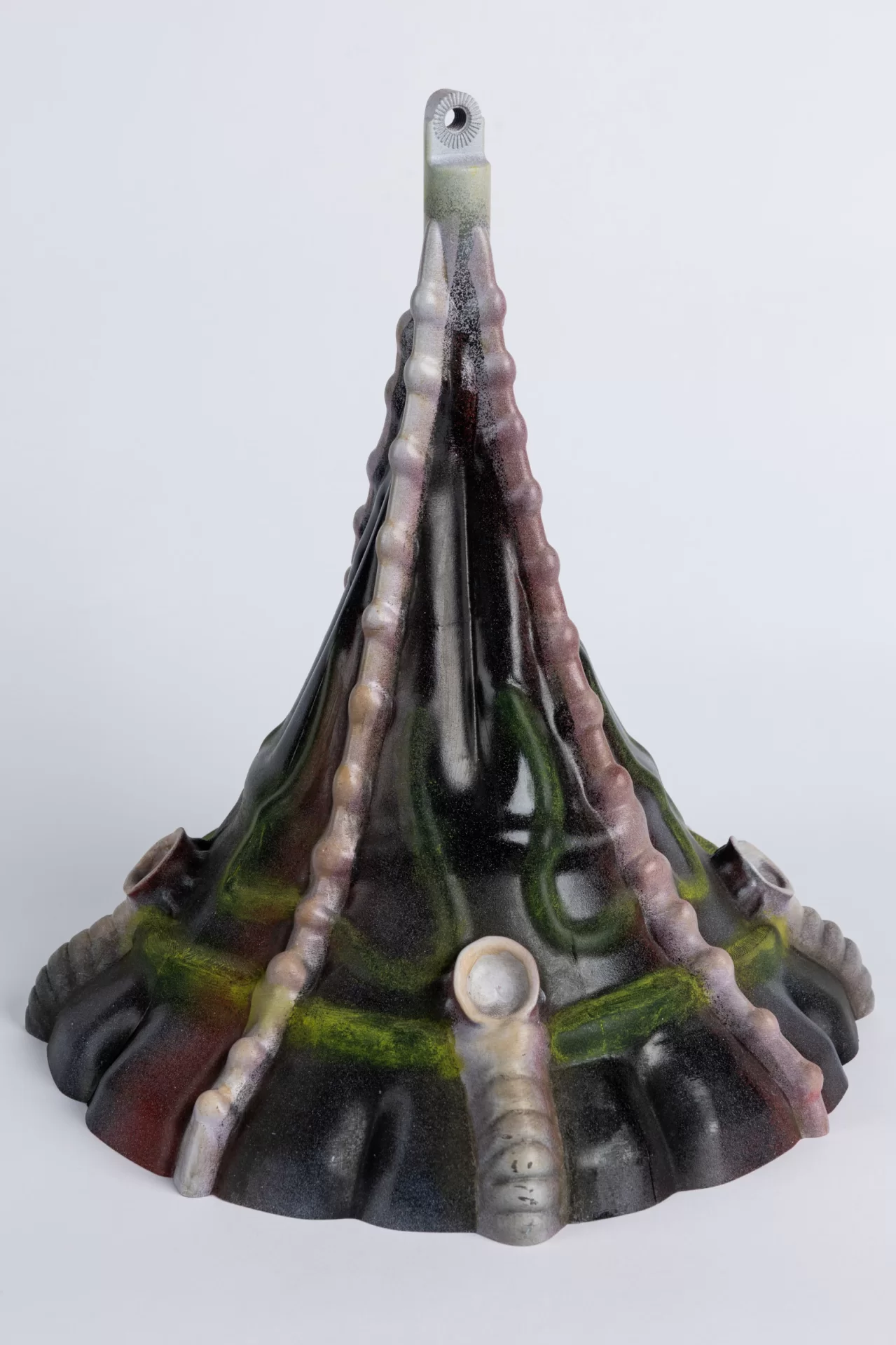
Qwynn Kobertz of Framingham, Mass., uses coding and 3D printing to create interactive, sculptural, and participatory games. Kobertz’s work asks questions about how we interact with technology such as, “Do we all live in a hyperrealistic computer simulation? Does it even matter if we do?”
The 3D-printed sculptures are based on ecological features such as countershading, a color pattern animals use to blend into their surroundings. Kobertz’ thesis project is an interactive game in which participants stand in front of a projected live video of themselves and must move their body to fit into continuously changing outlines superimposed over the video, with at least 70% accuracy to advance to the next outline.
“In playing or engaging with the projector screen in some way, participants are moving around in physical space, but their behavior is being dictated by or following rules conceived in the land of ones and zeros. The ecology inspired sculptures enter into the same play area as the participant, and in doing so complete their lifecycle from digital conception to physical sculpture and then finally being brought back into a semi digital space by the player.”
Maia Schifman
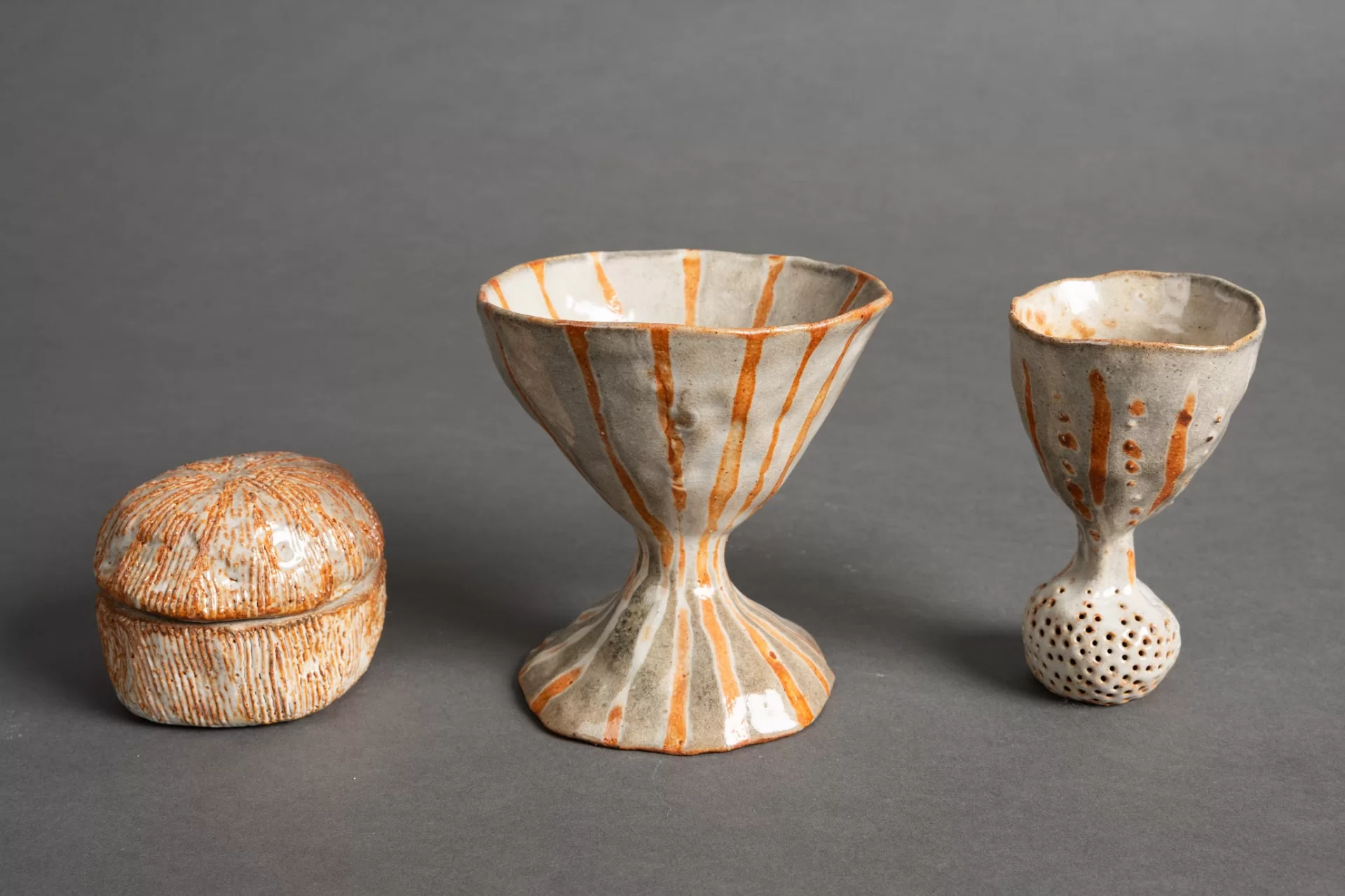
Maia Schifman of Minneapolis, a double major in biochemistry and art and visual culture, crafts stoneware pieces from hand, forgoing a pottery wheel to instead meticulously pinch and smooth the pieces into shape.
“Stoneware is durable but not indestructible,” Schifman writes. “I like the idea of creating something with materials that will last centuries, like archeological findings displayed in museums hundreds, sometimes thousands of years after their original owners’ lifetimes.”
Schifman’s pieces reflect the textures and forms of nature, using Japanese glazes like celadon and shino that draw inspiration from nature.
“These forms are practical containers to hold food and drink, but the goblet, or chalice, has a spiritual meaning as well: symbolically, the chalice represents the deep feminine capacity to hold complexity, intuition, and emotion. It is a vessel in which transformation occurs and is the physical embodiment of the part of the psyche that holds and nurtures creative and transformative energy.”
Grace Thomas
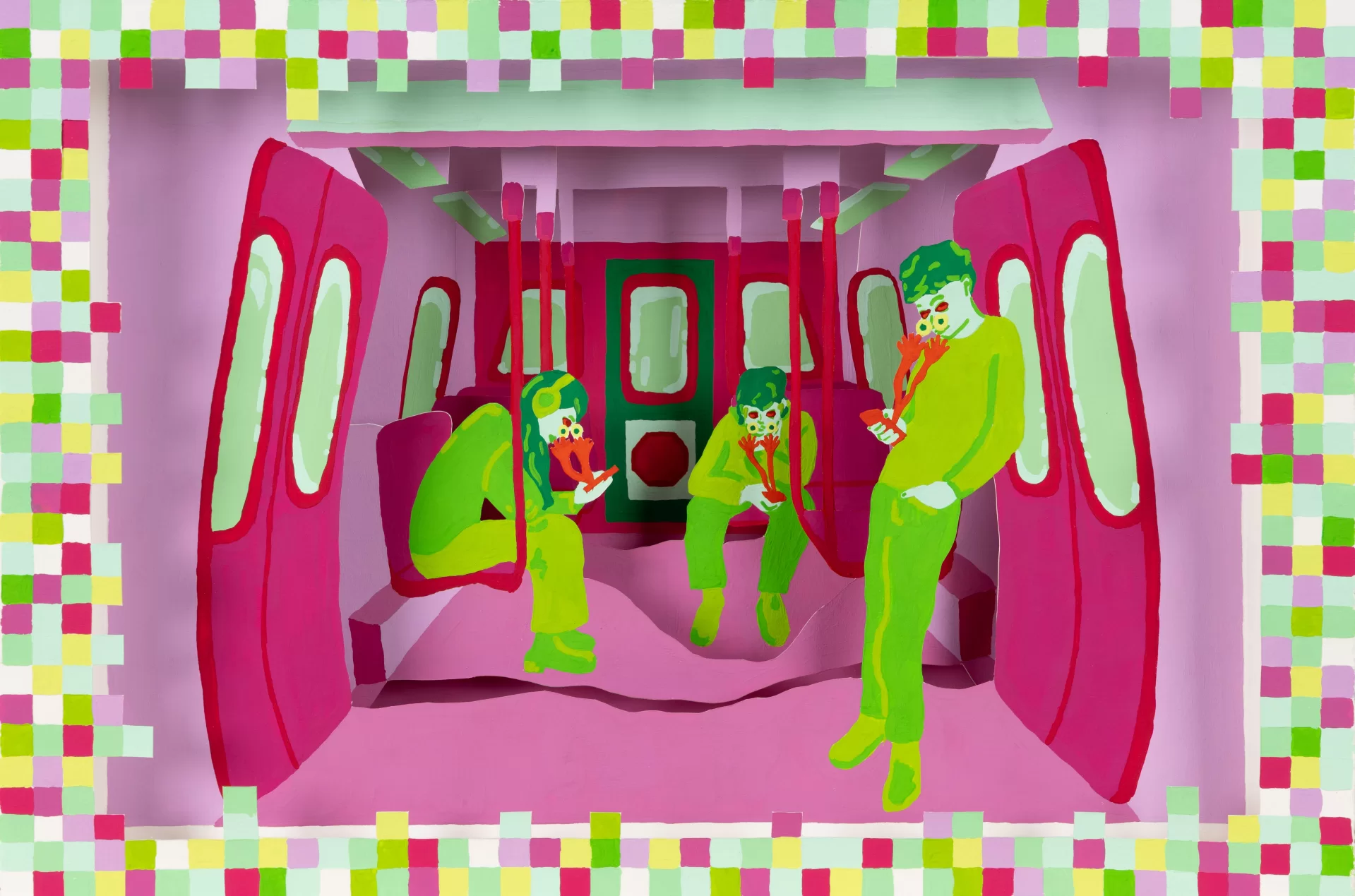
Grace Thomas of Bethesda, Md., creates tunnel books, crafted from a series of cut-paper panels placed atop each other to create an optical illusion of depth, painted with gouache. In her pieces, Thomas compares societal behaviors, such as excessive screen time, to cannibalism to evoke a sense of discomfort and disgust, reflecting on how we consume and are consumed.
“The intense reaction and curiosity cannibalism brings out of people allows me to call attention to situations and experiences we have intense feelings for but have been numbed to,” Thomas writes. “These range from hegemonic systems, to interactions with material culture, to societal norms, and to the consuming nature of my own emotional and mental states, which I translate into images.”
Thomas draws inspiration from Hayao Miyazaki, beloved Japanese filmmaker of such animated classics as My Neighbor Totoro and co-founder of Studio Ghibli.
“I am not interested in creating gory or disturbing images,” Thomas writes. “Rather, I want to draw my viewer into my work through bright and interesting colors and then allow them the space to take in all the details.”
Faculty Featured
Carolina González Valencia
Associate Professor of Art and Visual Culture