For more than 10 years, for five days a week — “at least” — art historian Gail R. Scott worked on the Marsden Hartley Legacy Project: The Complete Paintings and Works on Paper. The Legacy Project, now live and available to anyone with access to the internet, is a comprehensive, annotated online catalogue of all known paintings and works on paper created by the Lewiston-born Hartley (1877-1943).
It chronicles more than 1,600 works — including several paintings and nearly 100 drawings owned by Bates — and contains an extensive history of Hartley’s life, his writings, and his whereabouts. Scott started cataloguing his work by herself in 2012, then in 2019, began collaborating with Bates as her institutional partner. The chronology, often broken down by month or season, traces Hartley’s path, from childhood to his European adventures before World War I to his last years living in the small Maine fishing village of Corea.
There are photographs, excerpts of letters, and a vast cast of characters — friends, likely lovers of Hartley (who was gay), art rivals, allies, enemies, and the family members who never let him down, particularly Norma Berger, the niece who protected his legacy. (She’s the one who made sure many of his works became part of the Bates College Museum of Art’s permanent collection.)
On Oct. 30, Bates will celebrate the launch of this major accomplishment at Olin Arts Center, with Scott in attendance. The event includes an afternoon talk by Barbara Haskell, the curator who gave Hartley his first major retrospective, which opened in 1980 at the Whitney Museum of American Art and then traveled the country. Through the Whitney retrospective, she introduced Hartley to many new admirers and cemented his legacy as a great American modernist.
“This October has been a momentous time for the museum,” said Carrie Cushman, the director of the museum. “We opened a gorgeous exhibition of the work of Carl Sprinchorn, a contemporary and friend of Hartley’s, and celebrated 40 years of the museum in the Olin Arts Center. Capping it off with a visit from Barbara Haskell, who will speak to the importance of stewarding Hartley’s legacy, feels like the perfect way to celebrate this new online resource.”
Haskell and Scott are both octogenarians now, and became acquainted more than 50 years ago when both were living and working in the Los Angeles area. Scott had finished her master’s degree at the University of California, Berkeley and moved to Southern California with her husband. In 1969, the year Haskell graduated from UCLA, there was a large Hartley exhibition nearby at the University of Southern California.
For Scott at least, that memorable show “was the beginning,” she said during a recent visit to the Bates museum. Her first job in the 1970s was at the Los Angeles County Museum of Art, where she did some research for a possible show built around Hartley’s early abstractions. It never happened, but she “got hooked.”
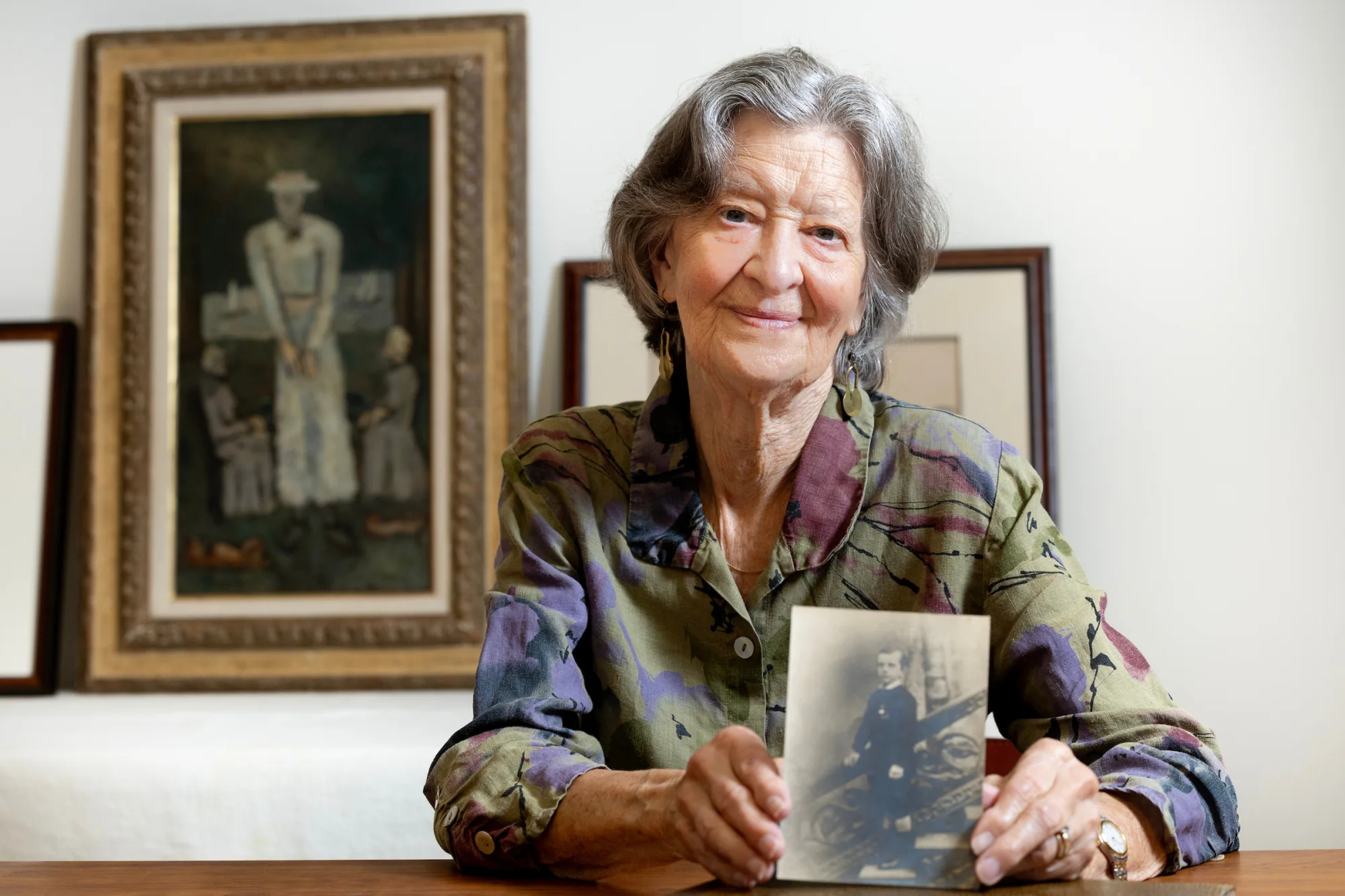
Scott continued to pursue her interest in Hartley and received a grant from the National Endowment for the Humanities to publish some of Hartley’s essays and poems. Then Scott’s husband was offered a job at the University of Maine Presque Isle. “It was just coincidental,” she said. “We moved to Hartley’s native state right at the point when I was ready to publish a book of his essays and then a book of his poetry.”
In 1982, she organized a touring show of Hartley’s works coupled with readings of his poetry and prose, called Marsden Hartley: Visionary of Maine, which traveled to five Maine locations. “It was not a very sophisticated experience as such things go, but we borrowed works from the Whitney and from all the Maine museums, a New York private collector, and a leading New York gallery. It was a great show.” It opened at the University of Maine, Presque Isle in Sept. 1982, then traveled to Westbrook College. The Treat Gallery at Bates — the museum’s predecessor — welcomed the show in Dec. 1982, with then English faculty member John Tagliabue reading Hartley’s poetry (Tagliabue, who was a poet himself, retired from Bates as an emeritus in 1989 and died in 2006).
Meanwhile Haskell had taken jobs at the Pasadena Museum and then the San Francisco Museum of Art before joining the curatorial staff at the Whitney. Her Hartley show opened in March of 1980, accompanied by a 224-page exhibition catalogue loaded with color plates and the kind of rich detail one expects in a biography.
There’s a great deal of “mutual respect” between the two art historians, Scott said. Both interacted with Norma Berger, before her death in 1981, and both know a great deal about Marsden Hartley. “Whenever I get into a quandary about a Hartley work, especially work that Barbara would know something about, I shoot her an email,” Scott said. “She’s been helpful all along and I’m really happy to have had her as a resource.”
For Scott, the launch is truly a cause for celebration. The work took place across such a long period of time. An earlier attempt in the 1950s to create a catalogue raisonné for Hartley by scholar Elizabeth McCausland was unsuccessful. After publishing a monograph on the artist in 1952, McCausland worked on a full Marsden Hartley biography but did not finish it before her death in 1965.
Hartley was a prolific essayist and letter writer. And he frequently wrote about his work. “So every little tidbit that I could find that would help explain why he did a work, where he did a work, when he was working on certain things, I would record it,” Scott said. “The website chronology was built on years of notes and information from his own words recorded in letters and published or unpublished writings.”
On his return to Maine, where he mostly lived between 1937 and his death, he became obsessed with visiting Baxter State Park to paint Katahdin.“ He had this incredible experience at Mount Katahdin,” Scott said. “He wrote to probably 10 people in great detail about what it meant to him.”
The end result of cross referencing all of this correspondence and linking it to specific works? A rich catalog of the works and a chronology alive with detail, the kind of Marsden Hartley rabbit hole designed to lure a visitor in for a long visit. And now, for Scott, a moment of pride.
“I’m so proud of the work that our small staff has done,” she said. After establishing the Marsden Hartley Legacy Project at Bates, she worked closely with Bill Low, a former curator at the museum, and two research assistants, first Colton Klein and then Charlie Parsons. “Charlie had access to all the New York galleries, museums, auction houses, libraries, and archives, which is what we needed to do the needed research on so many works, each with its own exhibition and publication history.”
Many donors helped make the Marsden Hartley Legacy Project possible, including the Horowitz Family Foundation, Vilcek Foundation, and Wyeth Foundation for American Art. Private donors also contributed gifts to keep the project going. For a full list, visit the project’s page.
There will always still be some work to be done, as more details may emerge about Hartley’s life and work, but Scott felt “huge relief” when the project launched. “I knew that it would be hard in one sense to let go of the intense schedule of commitment and detail and passion,” she said. “On the other hand, was I ready? Yes.”
To put a cap on it all, she has given her entire Marsden Hartley research library — 50 years worth of books and materials — to the Muskie Archives at Bates. “That was a satisfying end to the whole process,” Scott said.
“The Museum of Art is honored to host the Marsden Hartley Legacy Project, and we are eternally grateful to Gail for entrusting us with its stewardship,” Cushman said. “Her commitment to building this site is what makes Gail a true scholar’s scholar. She’s not in it for the glory, but to create a resource that can spawn a new era of engagement with Hartley — his impact, his networks, and, of course, his artwork.”
Categories BatesNews