Who Sews, Who Reaps?
This spring for the second year in a row, Bates students organized a grass-roots Short Term project to explore trade issues in Nicaragua and Maine. The first trip, in 2005, was born from then-senior Sarah Sherman-Stokes’ intellectual frustration. Investigating economic globalization for her senior thesis, she had already twice visited Nicaragua, learning first-hand how harsh poverty keeps the globalization debate roiling there. At Bates during the winter of 2005, though, the thesis wasn’t happening.
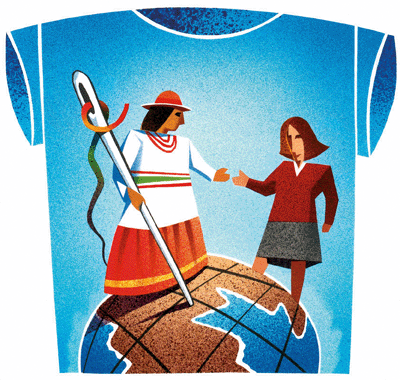
Illustration by Marty Braun.
“My thesis was just a bunch of words analyzing a community that I couldn’t begin to understand fully,” she says. What followed was pure Bates. Sherman-Stokes and other students asked College Store director Sarah Potter ’77 about carrying T-shirts made in Nicaragua by the Nueva Vida Women’s Sewing Cooperative. The factory, built by women who lost everything to Hurricane Mitch in 1998, had become the centerpiece of Sherman-Stokes’ thesis, modeling a possible “alternative to sweatshops and corporate globalization and unchecked power,” she says.
The bookstore conversation became a plan to visit the cooperative. And before long, that fact-finding visit morphed into a non-credit Short Term, with Bates students and others, including Potter, on board. The project had Maine and Nicaragua components. Maine research sites included union organizations, farms, “sweat-free” clothing campaigns and a call center.
The Nicaragua portion exposed the group to all facets of the globalization issue. In nine action-packed days, they ran the gamut of economic activity from a fair-trade coffee plantation to a foreign-owned garment factory in a major free-trade zone to, of course, Nueva Vida. Nicaragua and Maine parallels were apparent in ways pragmatic — with a per capita income of about $2,500 U.S., Nicaragua, too, is losing its manufacturing to countries with cheaper labor — and moral. In both regions, “we saw public interest pushing up against corporate power,” says Sherman-Stokes, who now works at an immigration-rights organization in Washington, D.C. “We saw communities struggling, and often succeeding in rendering alternatives. I think we understood that it’s not globalization per se that’s harmful, but more often, the way it is done and by whom.”
Another participant was Matt Schlobohm ’00, director of the Maine Fair Trade Campaign. “The program confirmed both how important collective action is,” he says, “and how important it is to look at everyday things – where our food and the things we purchase come from, and how we can try to move that toward supporting fairness, equity, and justice.”
Veterans of the 2005 program hope to see the alternative Short Term and a Bates-Nicaragua link become permanent. Lacking official sanction, though, the program depends on the initiative of students and the support of staff and faculty. Still, this spring a second group followed a Maine-Nicaragua itinerary similar to last year’s.
Amanda Harrow ’06, a Watson Fellowship recipient and a winner of the College’s 2006 Stringfellow Award, led the group of 12 students (including seven first-years), three staffers, and a participant each from faculty and community. “I was bummed that I couldn’t be there” in 2005, Harrow says. “And people who did it said it was one of the most important things they’ve done at Bates.”