It’s 9:30 a.m. on Sunday, and the 160th Bates Commencement procession has just set off from Alumni Walk. It will wind along campus walkways en route to the Historic Quad and its final destination, Coram Library.
Jeremy Caron of Lewiston has been waiting in his wheelchair on the Quad for nearly three hours. He got there early to secure a location where he could easily see and greet the Bates seniors he’s come to know over the last four years.
For many, Commencement is a whirlwind, one-time visit to Bates. But for some like Caron, who choose to attend year after year, it is an annual touchstone, a chance to support the graduates while reconnecting with a community that has shaped their lives and created a lifetime of memories.
Not far from Caron, a trio of octogenarian Bates retirees — Judy Marden ’66, her classmate Bill Hiss ’66, and Elaine Freeman — watch the proceedings from a prime perch, the steps of Hathorn Hall. Collectively, they’ve seen around 150 Commencements.
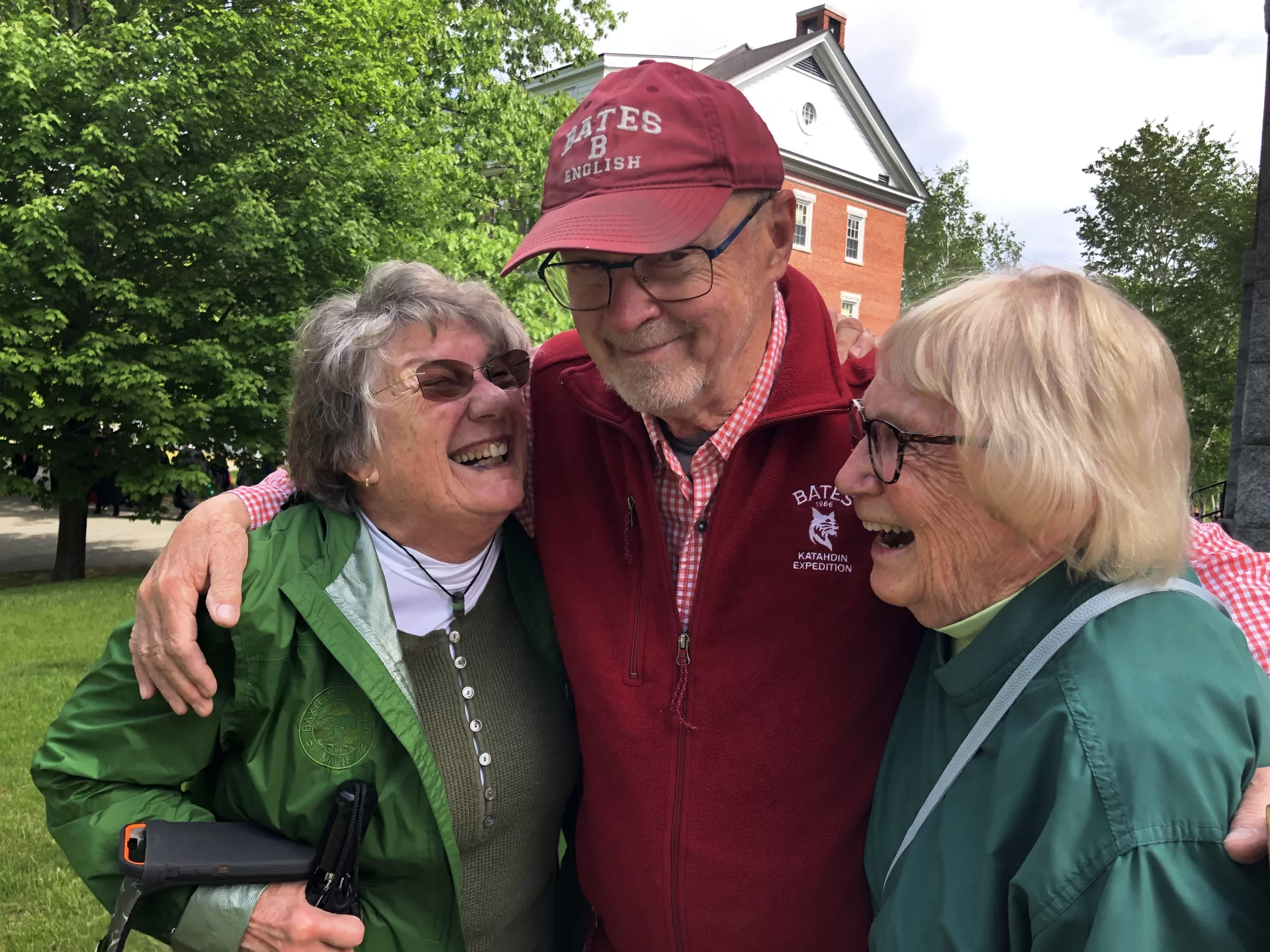
Marden joined the Bates Advancement staff shortly after her own graduation, which was held in the Armory a few blocks from campus. (Lore has it that the Armory was an especially stuffy venue because the circus and its elephants had just left town.) By the mid-1970s, Marden had assumed a new position created by President Thomas Hedley Reynolds, “liaison officer for college functions.” A veteran World War II tank commander, Reynolds might’ve pulled the job title from an Army handbook.
A big part of Marden’s job was to run Commencement and Convocation, plus summer programs, which she did with help from Freeman, a director in Facility Services. Marden also advised the Bates Outing Club.
Decades later, the twin Bates events help anchor and give meaning to Marden’s annual trip around the sun. “My year ends with Commencement and begins with Convocation,” she says. “If it did not, it would have no form.”
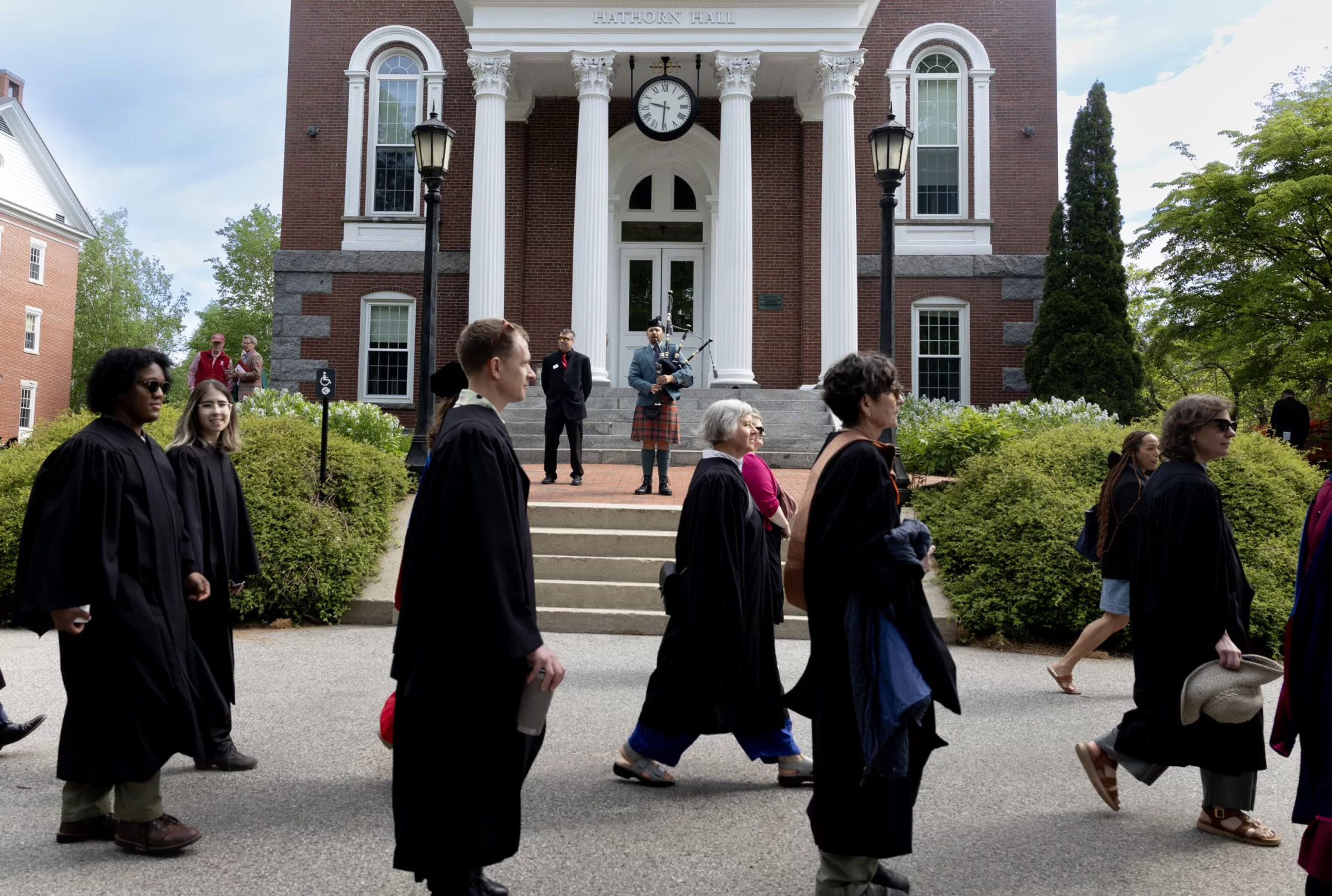
Ever since Reynolds introduced the tradition, a bagpiper has led the Bates Commencement procession. (Reynolds was also responsible for relocating Commencement from the Armory to the Quad.) On Sunday, the piper’s arrival on the Quad reminds Marden and Freeman of a Commencement task back in the day: appearing with goblets and scotch so Reynolds could share a down-the-hatch drink with the piper at the end of the ceremony.
For Hiss, a retired Bates admission dean who forged the college’s famed test-optional admission policy, attending Commencement is an act of bearing witness. “Commencement is about Bates doing, and continuing to do, what America needs. It’s that simple,” he says.
Meanwhile, down on the Quad, Caron awaits the procession. He hasn’t missed a Bates graduation since 2006, but he’s more than just a Commencement regular. He attends scores of campus events each year, especially Bobcat sports. Which ones? “Every single one,” he says. That’s around 125 contests annually. “I love sports, and I always tell the athletes that I’ll support them through thick and thin,” he says. “I want to celebrate all their hard work and effort.”
By 9:45, the seniors are nearing Caron’s spot on the Quad. The procession route is full of parents standing elbow to elbow taking pictures and the passing grads, seeming to tower above Caron in his wheelchair. But no matter: They spy their loyal fan, break from the ranks, and reach out for a fist bump, handshake, or hug.
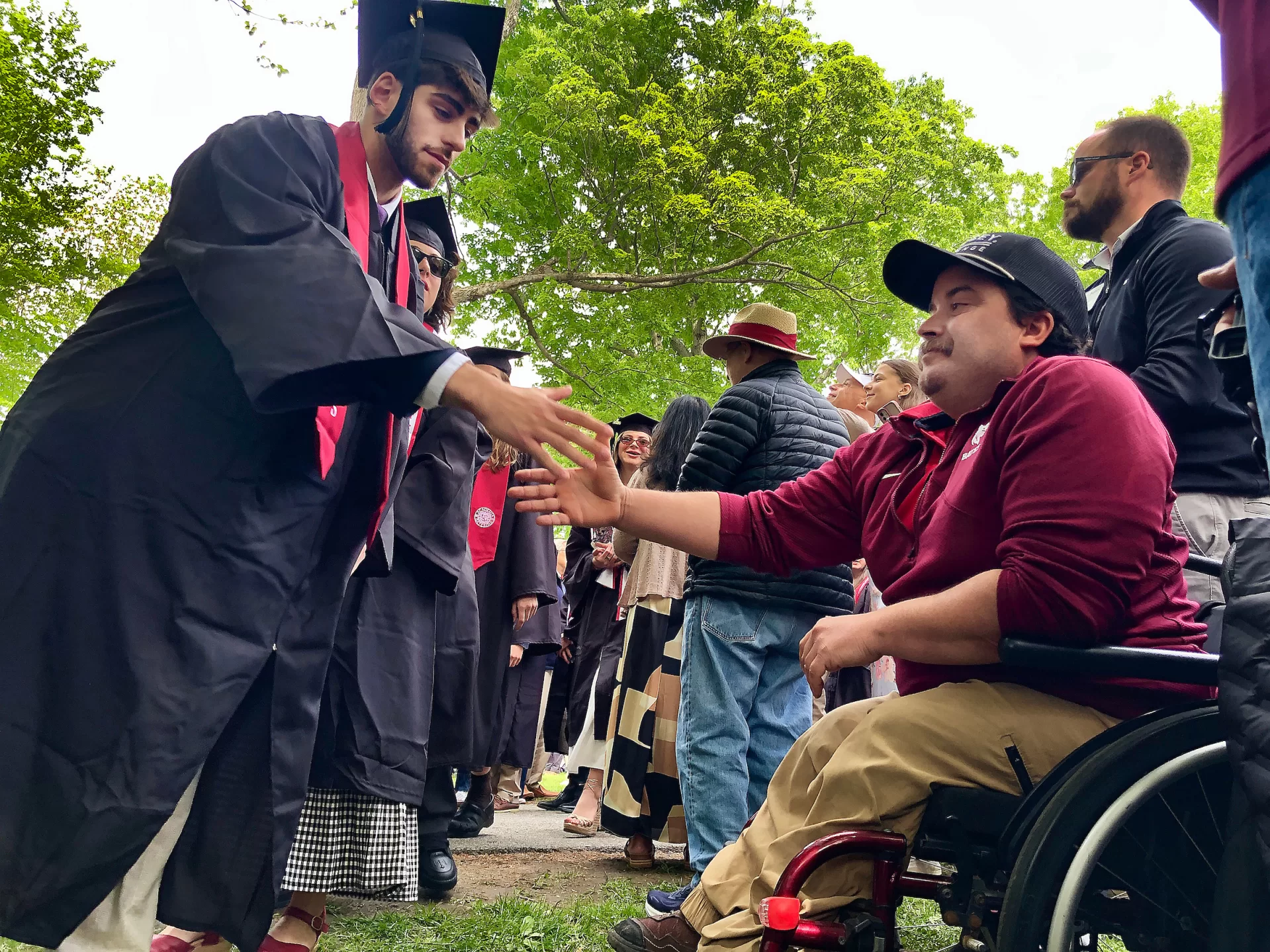
That included Zach Rosenthal ’26, a politics and history double major from Chicago who handled game-day operations for Bates Athletics as a student worker. Seeing familiar Bates faces like Caron’s on Commencement day was “really cool,” he said later. “It’s cliché, but it’s a full-circle moment. You see these people all the time throughout the past four years, and to see them at the final stop of your academic journey is really special.”
Caron was born without the use of his legs. At age 10, he learned to use an adaptive bicycle, and he’s been an avid biker ever since, including riding in the annual Dempsey Challenge for cancer support. Asked to offer advice to seniors, Caron reflects on his own experience. “There are times you have to adapt,” he says.
Longtime Lewiston resident Ernie Ashton, a retired local elementary school teacher, has been a driver for the Bobcat Express student shuttle for 23 years. Ashton wasn’t shuttling on Sunday, but there’s no way he would miss graduation. “It’s a pleasure to be here year after year. I just love them,” he says. “You watch these kids for four years, and they do such a great job. They keep me young.”
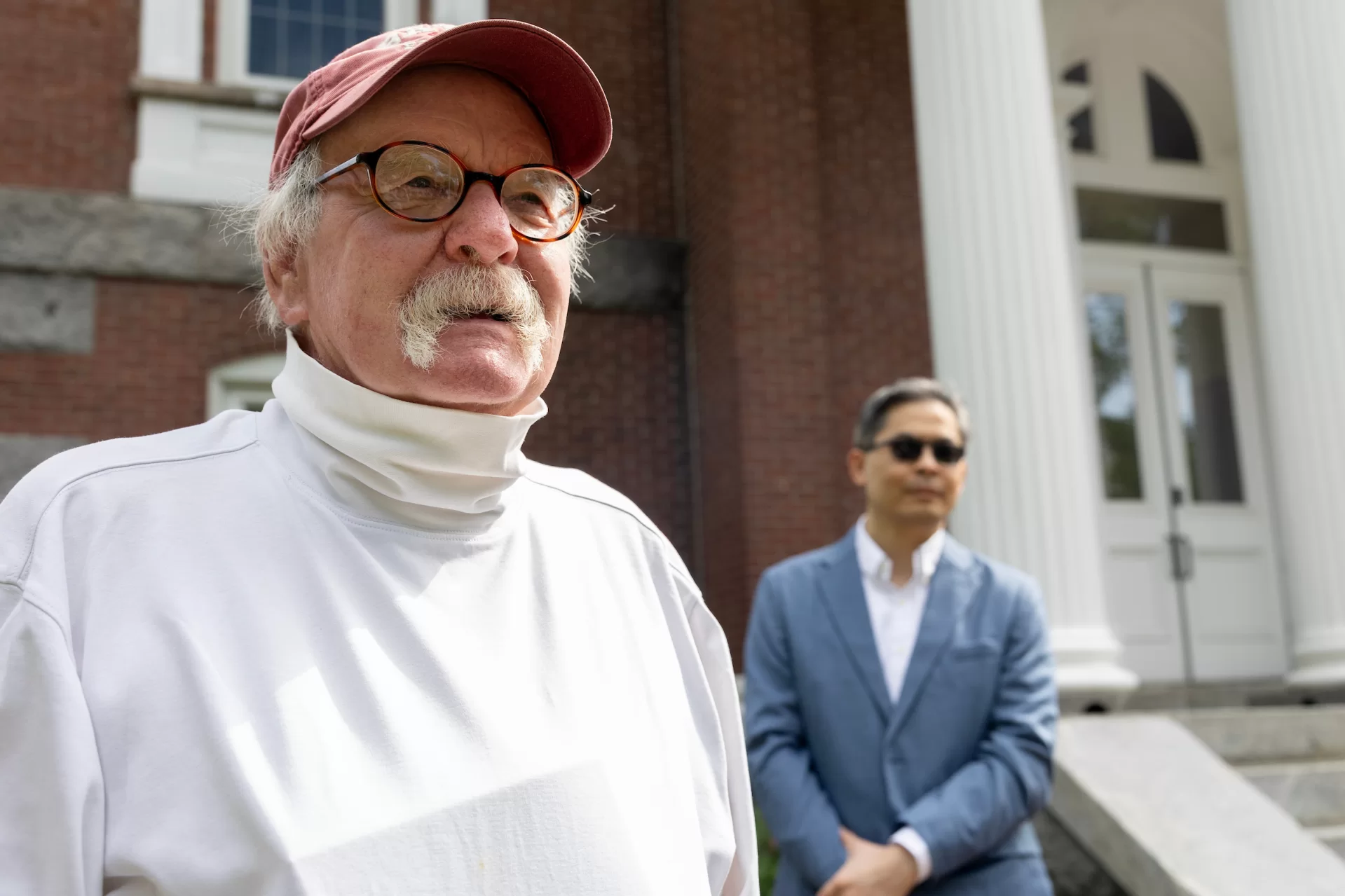
He likes to talk up Lewiston to his passengers on the shuttle, “places they should see before they leave,” like Thorncrag Nature Sanctuary and Veterans Memorial Park by the Androscoggin River. “And they do.”
This March, Paul Menice retired as head of Campus Safety after 36 years of service to the college. He’s seen and supported students at their best and worst. “Everyone makes mistakes when they’re young,” he says. When he sees students at Commencement, he sees maturity and appreciation. “It’s a highlight, getting hugs and handshakes, and them saying ‘thanks.’”
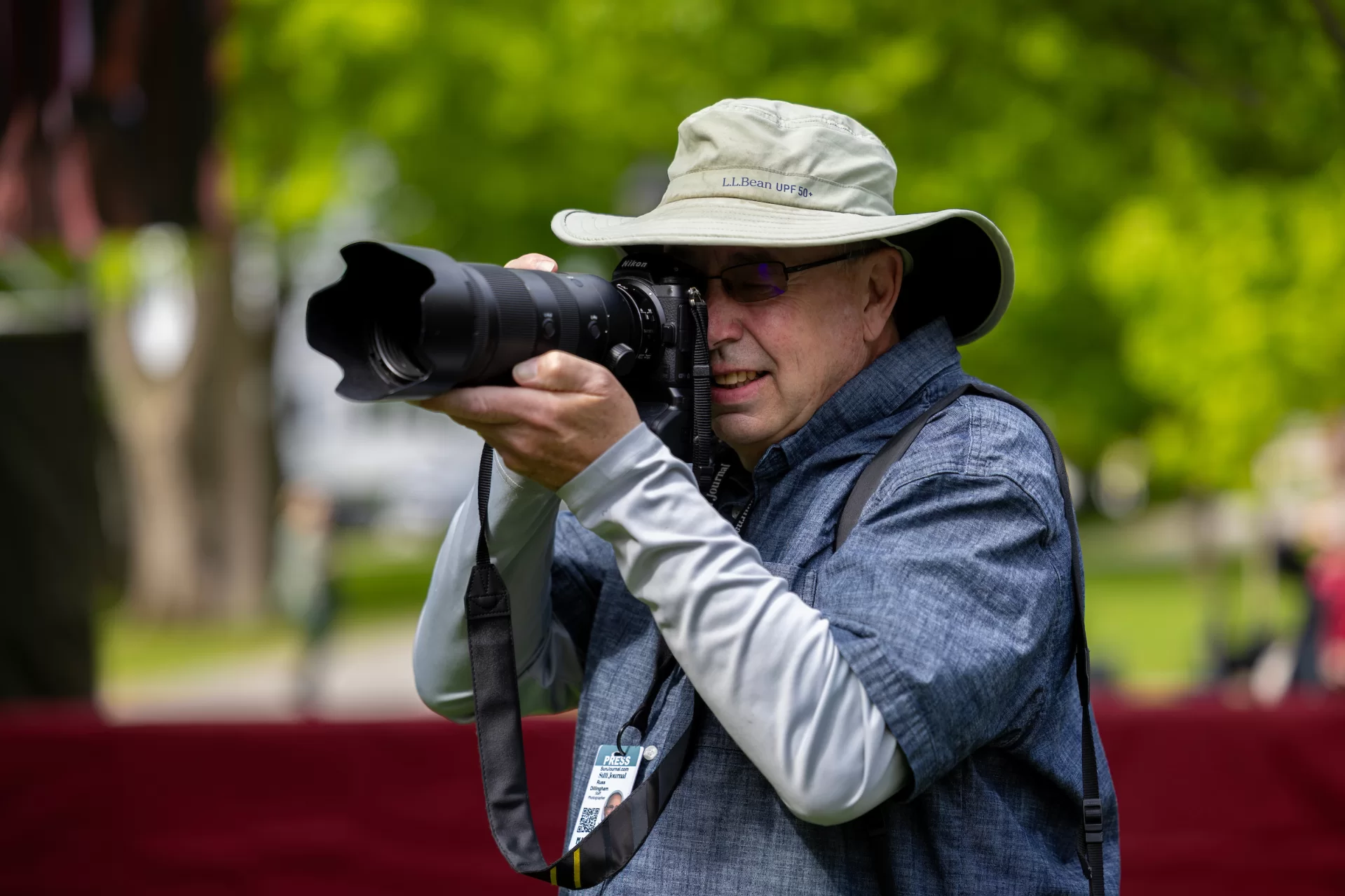
Another local at Commencement is Russ Dillingham, an award-winning photographer for Lewiston’s Sun Journal. He’s on the job today, but the event tugs at his heart. “I grew up over there,” he says, pointing to Campus Avenue, where there used to be wood-frame residences, replaced in recent years by college buildings like Bonney Science Center and Chu and Kalperis halls.
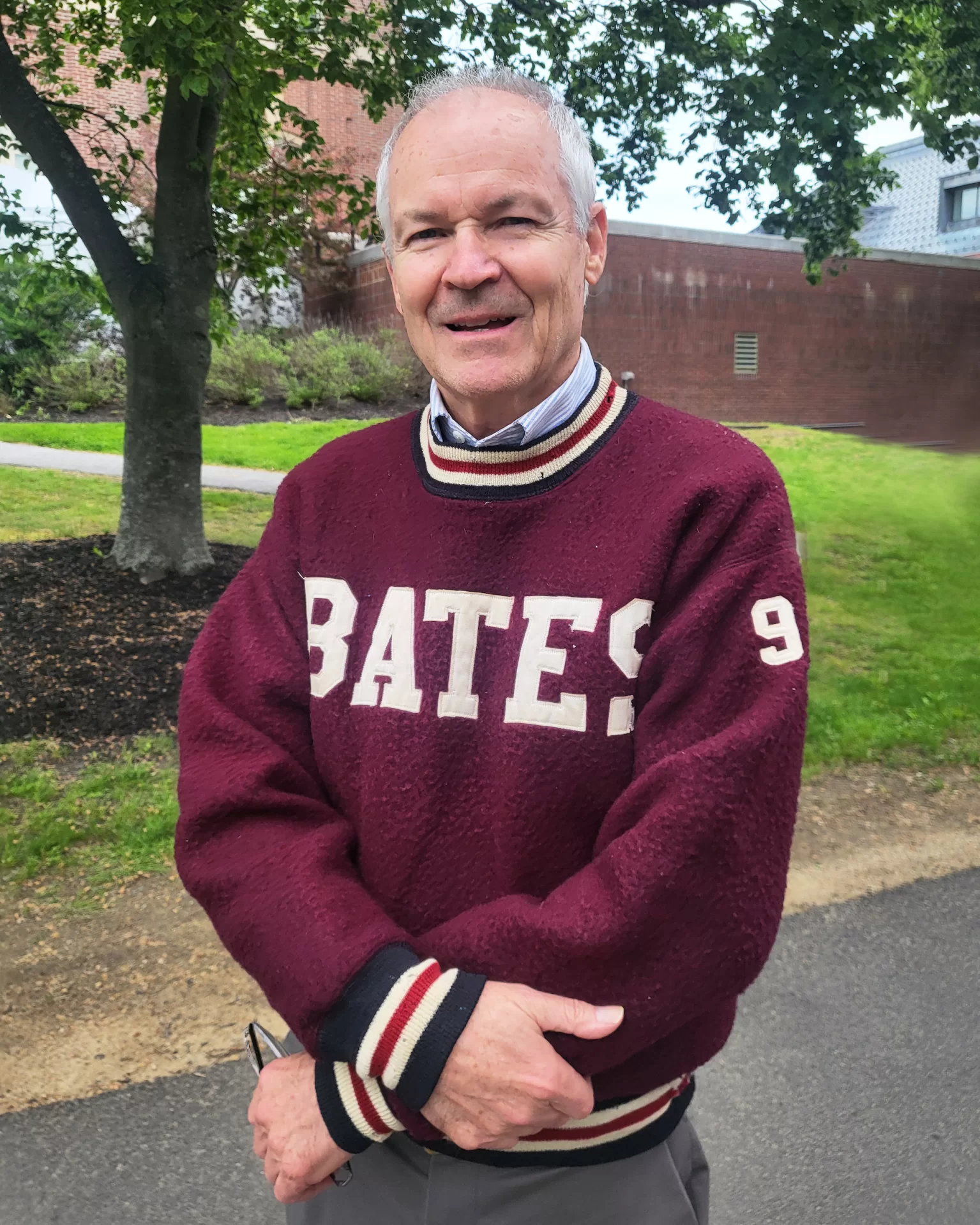
When he was a child, Dillingham wore corrective leg braces. A Bates student who babysat the Dillingham children would bring Russ over to campus for walks. He got stronger, and his legs straighter. “I’m pretty sure that’s why I can walk straight today,” he says. He enjoys covering Commencement. “It’s relaxed, friendly, and joyful.”
On a walkway near Carnegie Science Hall is Peter Slovenski, son of legendary Bates track coach Walter Slovenski. Retired after coaching track at Bowdoin for 34 years, Slovenski stopped by to support graduate Zach Jawor ’26 of Lewiston, one of his very best counselors at his Slovenski Camps on Panther Pond in Raymond.
Slovenski remembers being awed as a little kid by towering Bates athletes of the day, figures like Howard Vandersea ’63 or Thom Freeman ’63. “As the years go by, as you see more and more students being able to grow into adults at a place like Bates, you realize it’s less about individuals. More of a relay race, passing it forward.”
One of Walt Slovenski’s former Bates runners, Tom Leonard ’78, is another Commencement stalwart. An accomplished amateur photographer based in North Granby, Conn., Leonard travels around the Northeast each year from his home to photograph Bobcat athletes in action. Commencement is the final meet of the year, as it were. “Today recognizes the fact that all Bates students have accomplished something incredibly meaningful,” Leonard says.
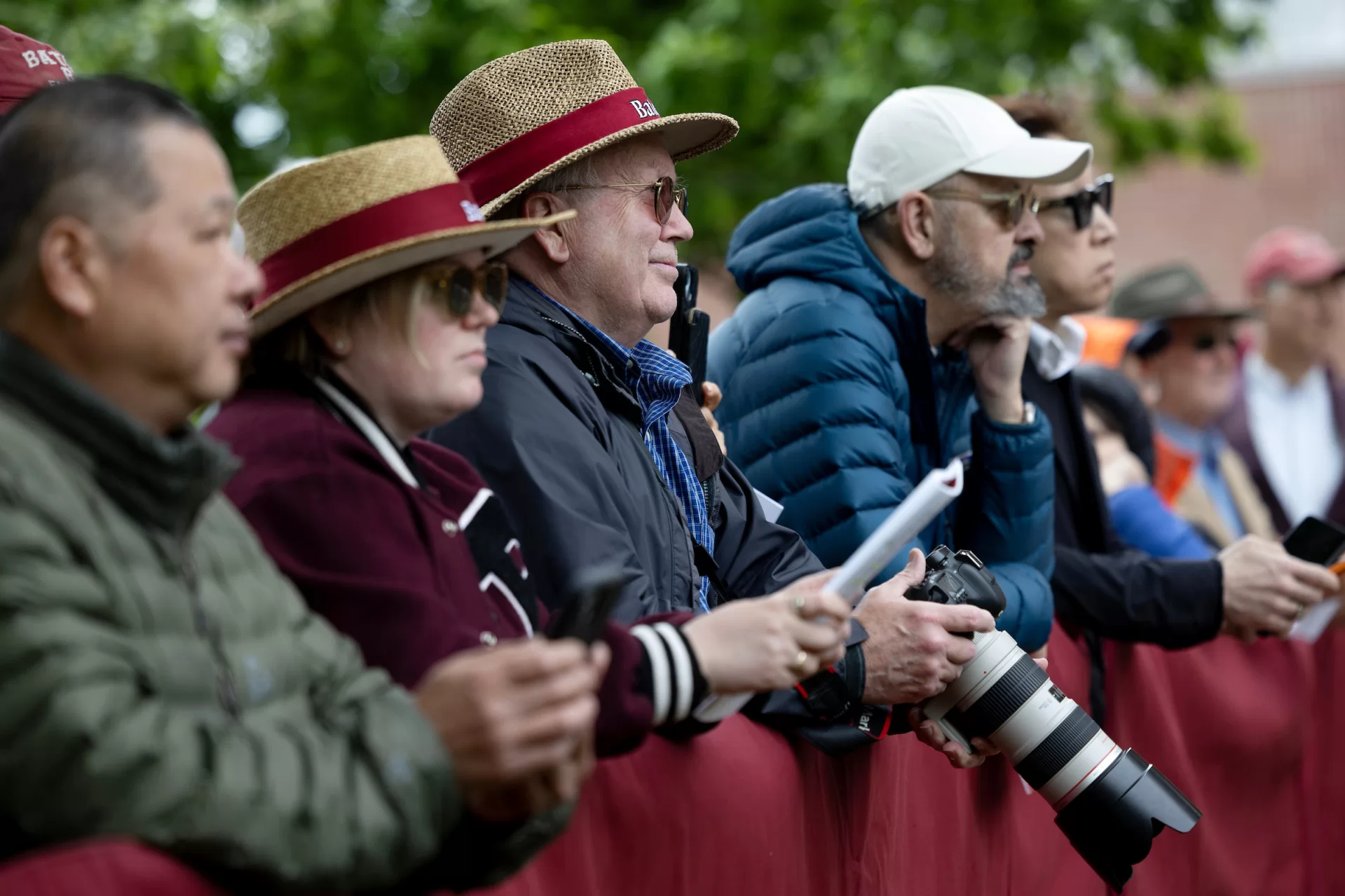
“When I was a student, I don’t know if I appreciated the scene as much as I do as an old person,” he adds. “I mean, my God, look at all these people who helped get these kids to where they are today. And that’s a beautiful thing.”
Categories Alumni Annual events