Bates mathematician awarded $107,000 grant
Peter Wong, a professor of mathematics at Bates, has received a grant of nearly $110,000 to support his research in topology.
Topology is the branch of mathematics studying the properties of a space that are preserved under continuous deformations. A common example is a clay “doughnut” that is reshaped into a coffee cup: The hole in the handle, corresponding to that in the doughnut, is preserved during the reshaping.
Wong’s particular research, supported by the $107,226 National Science Foundation grant, is in fixed-point topology — a concept better explained with sheets of paper than coffee mugs and doughnuts.
“If you crumple a piece of paper and then compare it to the space the paper originally occupied, fixed-point theory says that somewhere there’s a point on the crumpled piece of paper that will be in the exact same space it originally occupied,” Wong explains.
Paper is one tool for visualizing the complex mathematics in Wong’s field. Fixed-point theory generated much research in algebraic topology in the first half of the 20th century. Wong is using that classical algebraic topology — but with a twist, so to speak. To address the problem of finding the minimum number of fixed points a given transformation can have, he is comparing a geometric method with an algebraic method.
This interest in the overlap of algebraic and geometric methods is an example of Wong’s eye for connections, and may have given him an edge in winning the highly competitive NSF grant.
“Grants usually focus more on current topics, but because I am connecting algebraic topology with more ‘fashionable’ areas in mathematics, I’m showing that it’s still useful,” he says.
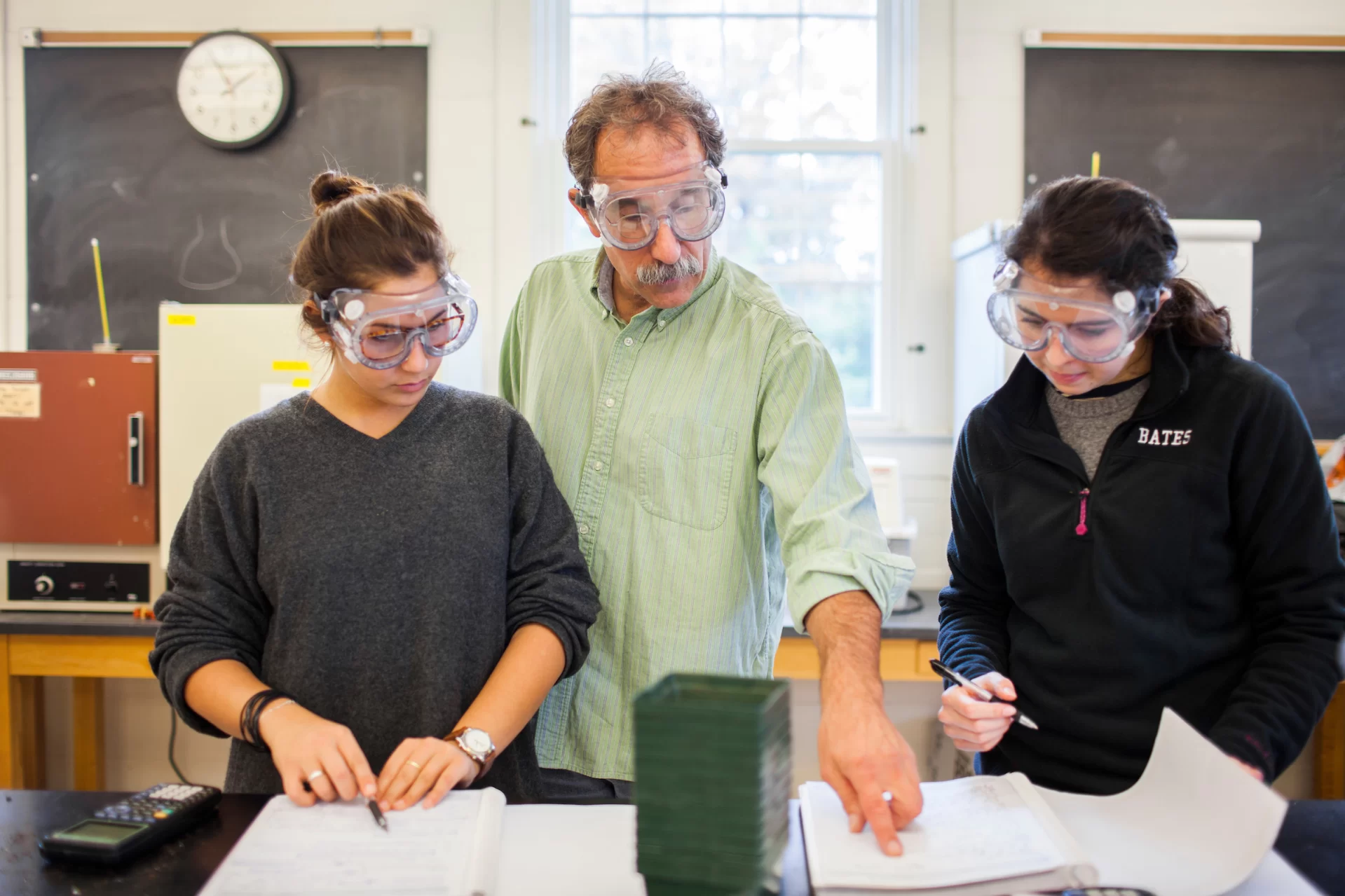
Wong also speculates that the NSF considered his grant proposal favorably because of his success in using topology to involve undergraduates in mathematics. “Some problems in topology don’t require highly technical training, so with some help from me, students have been very involved in research,” he says.
Interest in fixed-point theory extends beyond the offices of a few math experts scattered around the world. While his own work is highly theoretical, Wong explains, in general “this kind of mathematics has real applications for economics” — for example, in determining equilibriums, or states when opposing economic forces are in balance.
Wong earned his undergraduate degree in mathematics and Ph.D. in algebraic topology from the University of Wisconsin-Madison. He has taught at Bates for 20 years.