VBC to RJR to RBC
By Doug Hubley
The first broadcast radio at Bates was sanctioned by neither the administration nor the FCC.
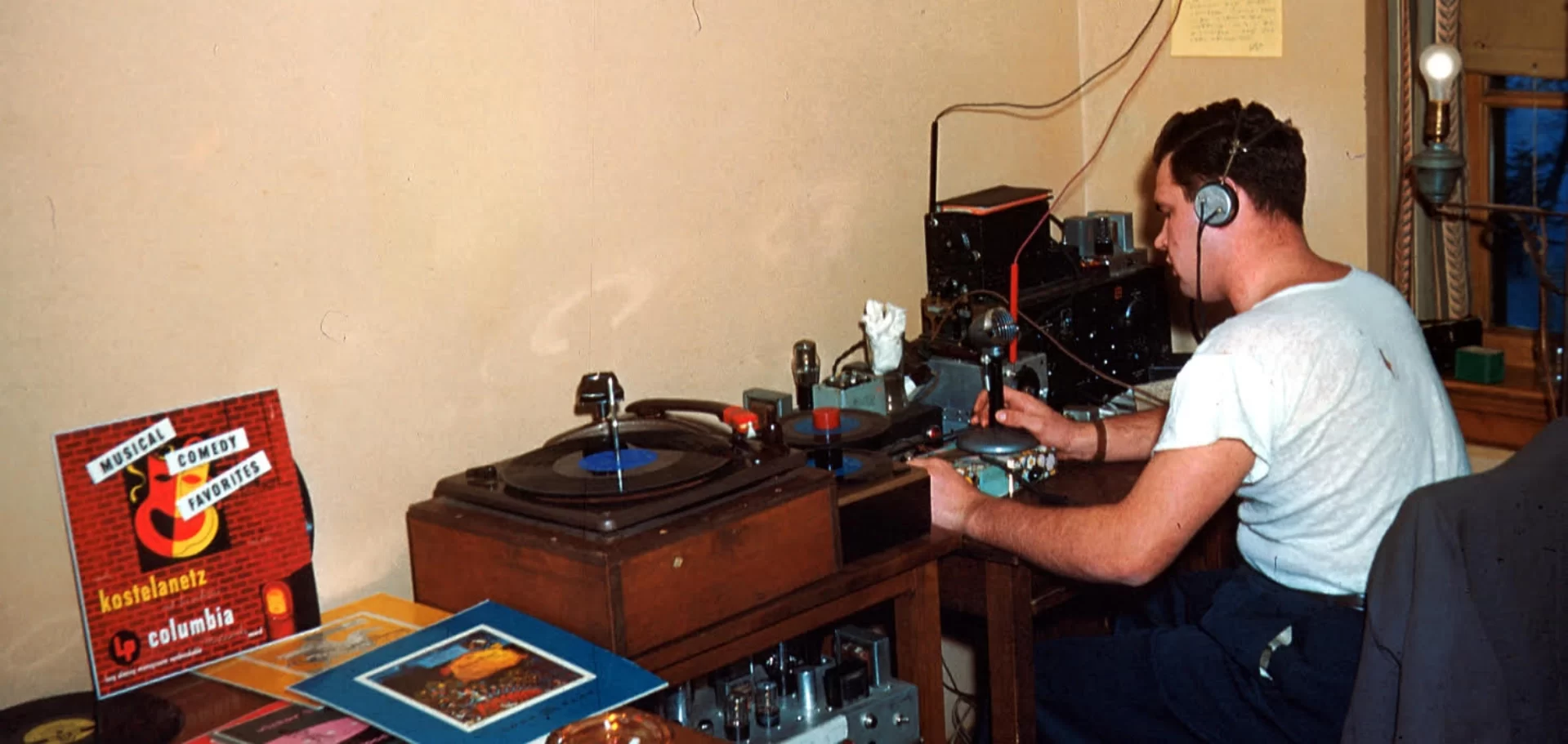
In 1949, Parker Hall roommates George Conklin ’53 and Clark Griffith ’53 were music lovers who happened to have something relatively scarce — a portable turntable that could play a stack of vinyl. These tinkerers found it only natural to marry the record changer to a tiny kit-built AM transmitter.
On good nights, Conklin says, the women living across the street in Rand Hall could pick up the signal; it “probably bounced off passing cars,” Conklin says. Occasionally, seasoned World War II veterans in their dorm would sneak in and slip racy “party records” onto the changer, treating the dorm (and perhaps the women across the street) to daring entertainments like “He’s Got the Cutest Little Dinghy in the Navy.”
Legendary rhetoric professor and debate coach Brooks Quimby helped radio come to Bates in a more formal way. In 1945, the College premiered “Bates on the Air,” a program of music, issues, and Quimby’s cherished debates. Students produced this half-hour show in a tiny Chase Hall studio.
Since Bates didn’t have a transmitter, the show wasn’t broadcast from campus; instead, it was sent over the phone line to local AM station WCOU for broadcast.
On Friday, Nov. 2, 1951, the College’s own transmitter smote the airwaves — sort of. Using a war-surplus transmitter converted by two physics majors, WVBC (“Voice of Bates College”) used the College’s electrical wiring as its antenna, since Bates could not obtain a federal broadcasting license. At 640 on the AM dial, WVBC reached every building on campus save the infirmary.
Programming consisted of music, campus news, and interviews. Conklin recalls one self-styled “mystery woman” who broadcast with a blind pulled over the studio window. A laughable conceit, Conklin says — “With a student population of 800, it was pretty hard to hide.” Still, he doesn’t recall her name, so she must have done something right.
In the late 1950s Bates finally nabbed its FCC license and a frequency of 91.5 on the emerging FM band. The feds’ choice of call letters from the College’s list was the cryptic WRJR, consisting of staffers’ initials. This plus a negligible 10-watt signal ensured the obscurity of radio at Bates.
But the late 1970s and early ’80s saw the station begin evolving into its present form, with equipment upgrades, expanding broadcast schedules and the move to the basement of the Office of Career Services. Not to mention, thanks to the demise of a Mississippi station, the assignment of pertinent call letters: WRBC, “Radio Bates College.”