Welcome to the LeFlore Lab for Human-Wildlife Coexistence at Bates!

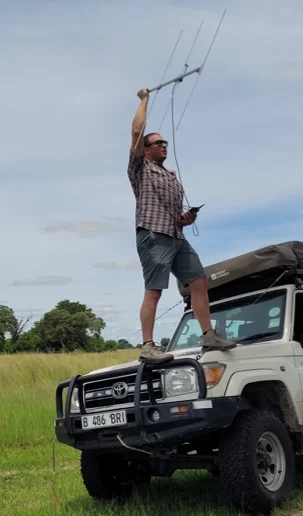
Our lab studies the ecology and conservation of wildlife in human-modified landscapes, with a particular focus on the ecological, social, and historical forces that shape how people and animals share space. We mainly work across two systems: the Okavango Delta of northern Botswana, where I have spent over a decade studying human-lion conflict, lion movement ecology, and the sociocultural dimensions of coexistence, and the greater Lewiston-Auburn area of central Maine, where we are investigating how bobcats and coyotes partition space and time along an urban-rural gradient. Across both systems, our work is united by one core belief: successful wildlife conservation and management require an understanding of people, history, and power just as deeply as they require an understanding of ecology. At Bates, research in the lab is driven by students, who are involved in every stage of the process from question development to fieldwork to publication.