When Jonah Yaffe ’26 of Dallas got a serious concussion this spring, his activities were immediately limited. Luckily, he had a low-impact but very sweet new hobby that took up enormous amounts of time: boiling maple tree sap into syrup.
“I couldn’t do anything else,” Yaffe said. “I could just sit there. It’s a very passive activity.”
And Yaffe had a lot of sap that he needed to boil. This past winter semester, Yaffe and the Bates Maple Syrup Club earned a Bates Green Grant to bolster the club’s on-campus sugaring efforts. They produced seven caramel-colored gallons of maple syrup from Bates trees and with Bates people.
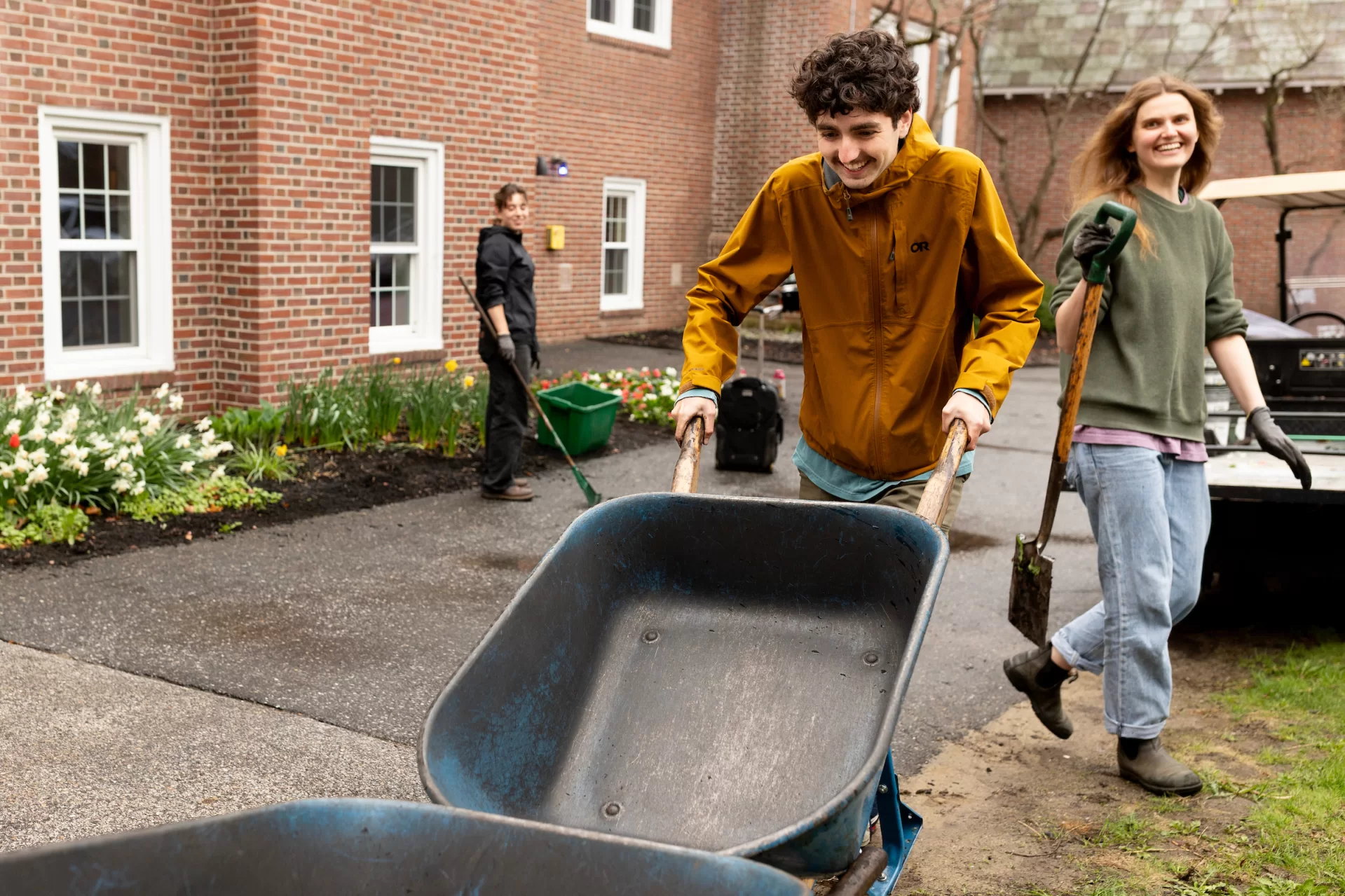
Through the annual Green Grants program, the college offers grants of up to $2,000 to campus sustainability projects led by students, faculty, or staff. In addition to Yaffe’s project, four other projects earned Green Grants this year:
- An effort to revamp the college’s green bike fleet led by EcoReps — students who work to promote environmentally responsible behavior on campus — Liza Bell ’26 of Putney, Vt., and Greta Hendrickson ’28 of Duluth, Minn.
- A collaboration with the on-campus cafe Le Ronj to offer discounts for students who bring disposable cups, led by the Bates Environmental Coalition
- An initiative to increase recycling education and materials around campus led by EcoReps Caroline Mayer ’26 of Wolfeboro, N.H., and Sarah Smith ’26 of Severna Park, Md.
- An initiative to install native trees around the Bates Garden to prevent wind and noise pollution by Riley Baker ’26 of Northfield, Ill., and Yaffe
“What’s so unique about the Green Grants program is that it puts the stewardship of campus sustainability in the hands of the students themselves,” said Assistant Director of Sustainability Tom Twist. “They are empowered to be the project managers for their own sustainability ideas, and to see a project through from its original spark of an idea, through all the detailed minutiae, to its final completion. Having the students shepherd a project through this entire arc transforms not only the campus, but the student as well.”
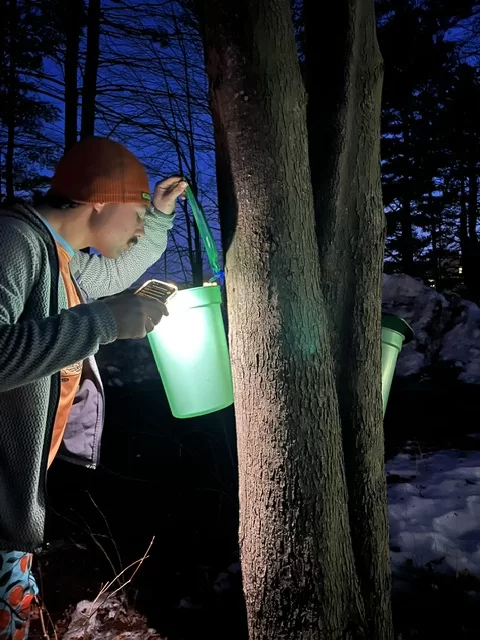
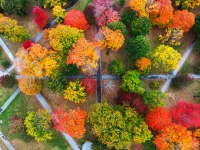
The idea for the Maple Syrup Club originated from Yaffe’s work as a student groundskeeper and EcoRep. Yaffe, an environmental studies major, had spent many hours working in the Bates Garden — a.k.a the PLOT — and began wondering if it would be possible to tap the garden’s dozens of maple trees.
When he posed the question to Facility Services staff, whom he’d come to know well across his years working outside, they encouraged him to pursue the idea. Yaffe joined Jeremy Lavertu, a carpenter with Facility Services, for a University of Maine workshop on tapping maple trees to learn the basics of sugaring, then founded the club with Angus Carter ’25 during the 2024-25 academic year.
That first winter, the Maple Syrup Club collected 10 gallons of sap from 10 trees in the PLOT. But the club lacked the funds they needed to purchase the proper equipment for filtration and boiling, key steps of the sugaring process that turn sap, which is 98 percent water and 2 percent sugar, into syrup. Yaffe had to complete the boiling process in Vermont with a friend’s home evaporator, a wood stove that can filter and boil large quantities of sap.
Those 10 gallons of sap boiled down into two mason jars worth of syrup. The experience was fun, but Yaffe had his eye on something bigger for the following winter that would not only generate more syrup but also bring together students, faculty, and staff.
To achieve that goal, he’d need proper technology and machinery, hence his application for a Green Grant. He used the awarded funds to purchase an evaporator, taps for the trees, and buckets to collect sap. After extensive conversations with Facility Services and the City of Lewiston about safely installing the evaporator, the club installed the stove outside of Cutten Maintenance Center.
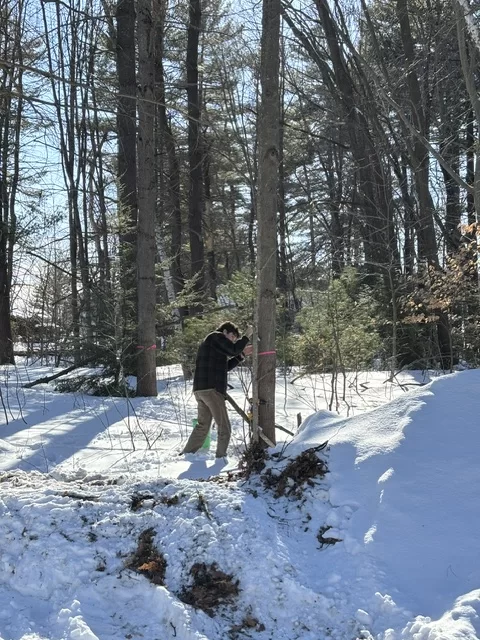
Haskel McKee-Seegal ’29 of Honolulu, a friend of Yaffe’s from the Orange Whip Ultimate frisbee team, became Yaffe’s co-conspirator in this season’s sugaring efforts. The two of them, with the help of a dozen or so other dedicated club members, collected 180 gallons of sap from 30 maple trees behind Leahey Field, which they stored in metal drums outside of Cutten.
“The Green Grant really helped us get off the ground,” Yaffe said. “We couldn’t have done anything without it.”
Equally vital were community members. Mike Walsh, a project manager with Facility Services, helped students with logistical and scientific components. Having first learned how to tap trees as a Boy Scout growing up in Maine, Walsh now produces gallons of syrup each year on his 50-acre property in Poland, Maine. He donated 150 gallons of his own sap to the students, nearly doubling their supply.
“I had extra this year,” Walsh said. “I could have boiled it myself, but they were having such a good time. I said, ‘You know what? I will just load it up in the truck and bring it in.’”
Wood for the Bates evaporator came from Walsh and grounds and maintenance workers Ian Brownlie, Amy Ray, and Nate Calden. Projects like this help demonstrate to students the vital, sometimes unseen role that staff play on campus, Walsh said.
“We have a lot of our own talents, and a lot of us want to give back to the student base,” Walsh said.
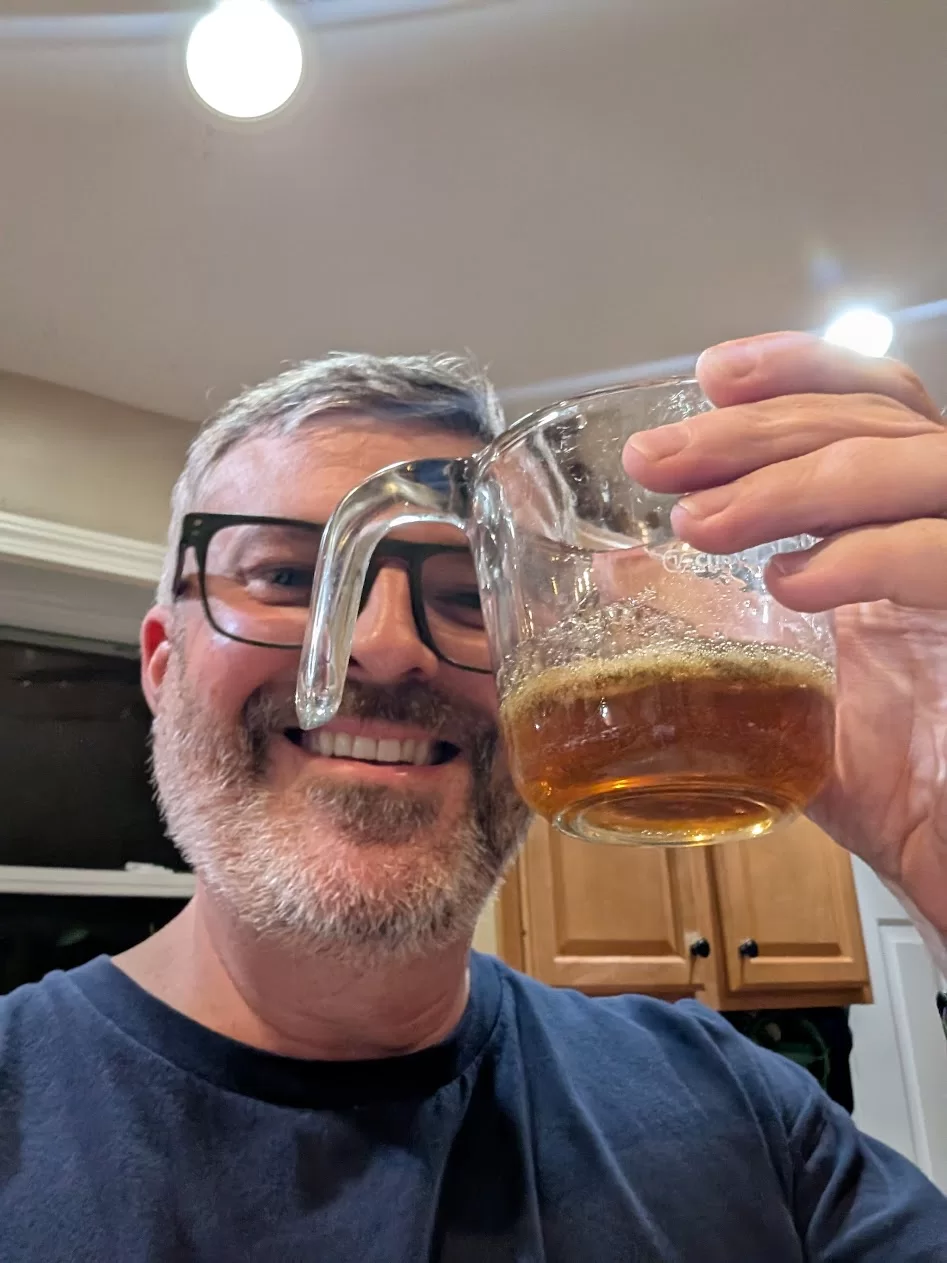
Professor of Sociology and Associate Dean of the Faculty Mike Rocque donated several gallons from trees tapped around his home in Litchfield, Maine. Sugaring was new to him, and he enjoyed learning alongside the students and staff.
“I really like that part of engaging in the Bates community, where people aren’t in their silos, but we’re all together and learn about what people do across the different areas on the campus,” Rocque said.
After running those 300-plus gallons of pure tree sap through another piece of equipment called a reverse osmosis system, which served as a filter, the students were left with about 150 gallons of concentrated sap. Then, they boiled on the evaporator. And boiled, until all that sap was distilled into seven gallons of pure maple syrup.
“Haskel and I spent many a night in the very cold sitting by the wood stove, boiling sap,” Yaffe said.
Yaffe and McKee-Seegal, an earth and climate sciences major, put in the most hours beside the evaporator, but they weren’t alone. Other club members took shifts, and Facility Services staff often stopped by.
“They were all super, super interested, super excited to talk with us and learn about the process,” McKee-Seegal said.
In addition to bringing together the Bates community, another one of the club’s goals was to help students engage with Maine’s nature and culture through hands-on learning.
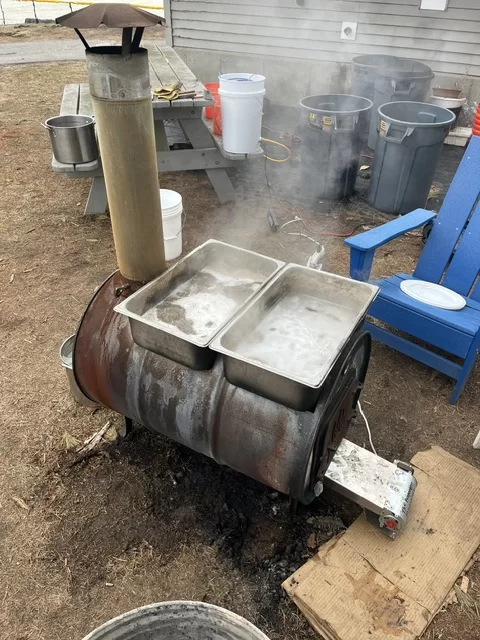
It worked.“You feel a different way after doing something with your hands all day rather than doing something on your computer,” Jaffe said
Each club member who spent time at the evaporator went home with syrup. Then, during the Short Term Earth Day celebration, Yaffe and McKee-Seegal gave away Commons ice cream cones drizzled with their very own Bates maple syrup. The students also gave a couple of jars to Facility Services staff, who stored their stash in the Cutten breakroom for sweetening coffee.
“That was one of my favorite parts, giving away the syrup and saying, ‘This came from Bates trees,’” Yaffe said.
After graduating in May, Yaffe headed to Hiram, Maine, for his summer job working at Ossipee Valley Music Festival. McKee-Seegal plans to spend the winter 2027 semester abroad. But the two say that Maple Syrup Club will keep sugaring next winter under the leadership of several other club members, continuing the club’s goal of bringing together the Bates community while learning about Maine’s nature and culture.
Faculty Featured
Michael Rocque
Professor of Sociology and Associate Dean of the Faculty