Shortly after Courtney Smith joined Bates in the fall of 2024 as an associate professor of theater, he floated an idea for a production that was both over-the-top ambitious and absolute catnip to his colleague Sally Wood, a visiting lecturer in theater who was trying to decide what play to direct in the fall of 2025.
His suggestion would require help from an unprecedented number of campus partners and doing due diligence to be compliant with local, state and federal regulations — and test Schaeffer Theatre like nothing else in its 65-year history. What Smith had said to Wood was: “You know what would be really awesome? Metamorphoses.”
Wood is used to pulling things off. When she’s not in the classroom or in one of Bates performance spaces, she’s working with professional theaters and actors all over the region, including Portland Stage Company and the Theater at Monmouth. But the 1998 play, an omnibus interpretation of Ovid’s Greek mythology written by MacArthur Award winner Mary Zimmerman, has one foundational issue that makes it seriously complex to pull off. There’s just one set. But it’s a swimming pool. As much as Wood was thrilled that Smith was game for this project, she said would not have suggested it.
“Just because it’s too much to ask,” she said, sitting on the stage this fall as the dress rehearsal was about to get started for what would be a sold-out run of Metamorphoses encompassing Halloween weekend. “It’s so big.”
To do it right, you need to build a pool on a stage that can handle, say, 22,000 extra pounds in the form of water, as well as performers who don’t mind getting wet. That means lots of laundry. Major technical challenges. Because of all Metamorphoses requires to bring it to life, Wood said the play is rarely produced except in academic settings. It can be done without the full soaking experience, say with kiddie pools or some sort of reflective surface, she said.
“And I think it still works. But there’s magic in the water. Real magic. When people see it, it’s like, they always remember it. And I don’t know of any other play that has that kind of stamp.”
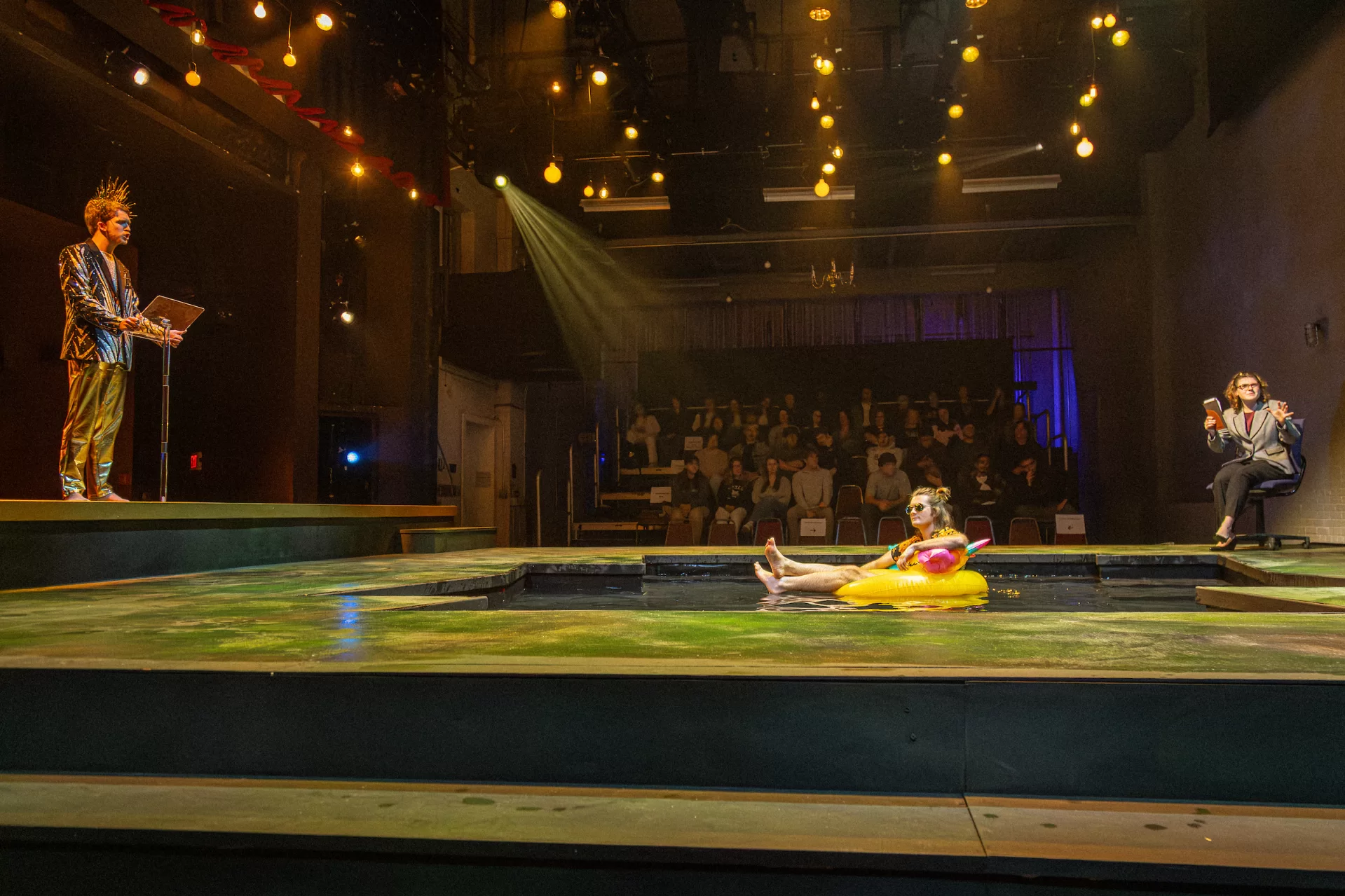
+Click here to learn more about what Graham Austin was thinking during this scene
Graham Austin ’28, on providing some levity after the intense, dramatic tale his castmates Liu and Hagan had just performed, and what was motivating his character.
“I love comic roles. I think the play sort of heightens [the comedy] a little more by having that absolutely horrible, evil, dark tale right before it. And then it sort of just goes dark. They clean things up, and then you have Isabel in her office suit in the rolly chair, and then this guy comes up with a gold chain on his neck, flashy sunglasses, the pool floaty. I think the contrasting natures of the [two scenes] are really highlighted.
At that point, I’m trying to impress my father. It’s like when a little kid goes and writes all over their father’s paperwork on his desk or something, or messes up his work life. I’m really trying to get him to notice me and get him to say, ‘Oh, that’s my son right there. I’m proud of him.’ So I’m projecting myself onto that. And it’s just falling a little flat.”
The actors are in and out of the pool throughout the play, with one character drowning in a shipwreck, along with his crew (Bates dancers in this case), another conducting a seduction in the water, King Midas hanging out poolside with a drunken Bacchus, and even a god’s offspring undergoing modern therapy while spinning across its surface in a round pool toy.
The first time Wood saw Metamorphoses was in New York at the Circle in the Square, with Zimmerman directing (the writer/director would go on to win a Tony for that production in 2002). “I remember just not breathing,” Wood said. “I’ll never forget just not breathing, for like an hour and a half, and being so sad when it was over.”
“I’m convinced it’s the water,” Wood added. “The play on the page is beautiful and really good, but there’s a trance. It’s crazy. There’s a literal transformation that happens once you get in there.”
And it happens for the actors. “I loved getting in that swimming pool,” said Graham Austin ’28 of Basalt, Colo., a likely theater major, who like the more than a dozen student cast members played multiple roles. As Phaeton, son of Apollo, he is the character getting therapy in the pool, and Austin played the part with the gusto of Sean Penn as the iconic Spicoli of 1982’s Fast Times at Ridgemont High. “It was a highlight of every time I did that play. Just overall, fantastic time in that thing.”
Engineering the pool into being was a major feat that started in August, about a week after another theater and production veteran, Mike Quinn, started his new role at Bates as technical director. He and Smith, who served as production manager, lighting and projections designer, and faculty advisor for students on the technical side of the production, are splitting some of the duties formerly performed by longtime Bates theater leader Michael Reidy before his recent retirement from his position as senior lecturer in theater and managing director of Theater and Dance.
A Maine native who spent 14 years in scenery construction and technical design in New York, Quinn had been working in Portland since 2023 with various venues and organizations. At the dress rehearsal, Wood joked that Quinn might not have taken the job if he’d known what his first month would be like, but Quinn said he’d been warned. “He [Smith] said, you’re going to have to build a pool if you take the job.”
Getting the specifications right — no one wanted to capsize the Schaeffer stage — was key. In the end, the depth of the empty pool was 24 inches, but the water itself couldn’t be that deep.
“It is not a 16th over 16 inches,” Quinn said. “As prescribed by the structural engineer.”
“We had to task a fairly wide group of people to make sure that as an institution we were checking boxes and crossing our ‘t’s and dotting our ‘i’ s,” said Chris Streifel, Bates’ director of capital planning and construction. “There were all kinds of different codes and building ramifications that we had to work through structurally.”
Because the audience needed to be able to see into the pool, Schaeffer also had to be reimagined as a venue. Risers were constructed in the wings of the stage in lieu of the regular seating . This limited the audience size somewhat, but made for an intimate experience; during particularly splashy scenes, audience members in the front row might have gotten a little damp (although crew members whisked through between scenes, wielding mops to put the water back into the pool).
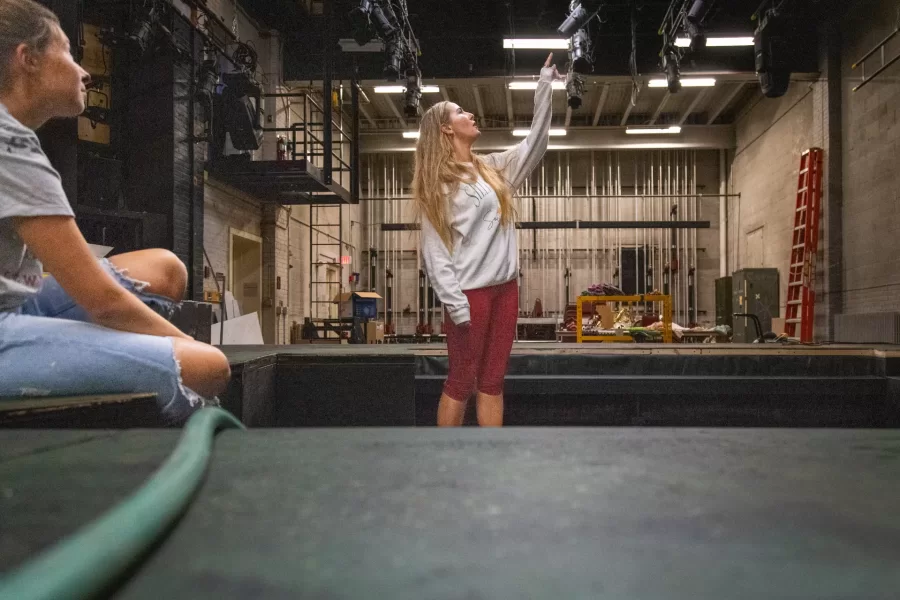
Getting the chemistry of the water just right kept Quinn busy as well. At first the team hoped to keep it fresh with herbal and natural remedies, but after draining it over October break, they opted to add chlorine, since there were many bodies moving in and out of it during rehearsals. But not too much. “We did not want it smelling like the Y,” Wood said. At ABC Pool and Spa Center on Lisbon St., one of the workers groaned when Quinn stopped by; queries from Bates had apparently become that much of a regular thing. “I think they were like, ‘Oh my God, why don’t you guys just get it together?’” said Wood.
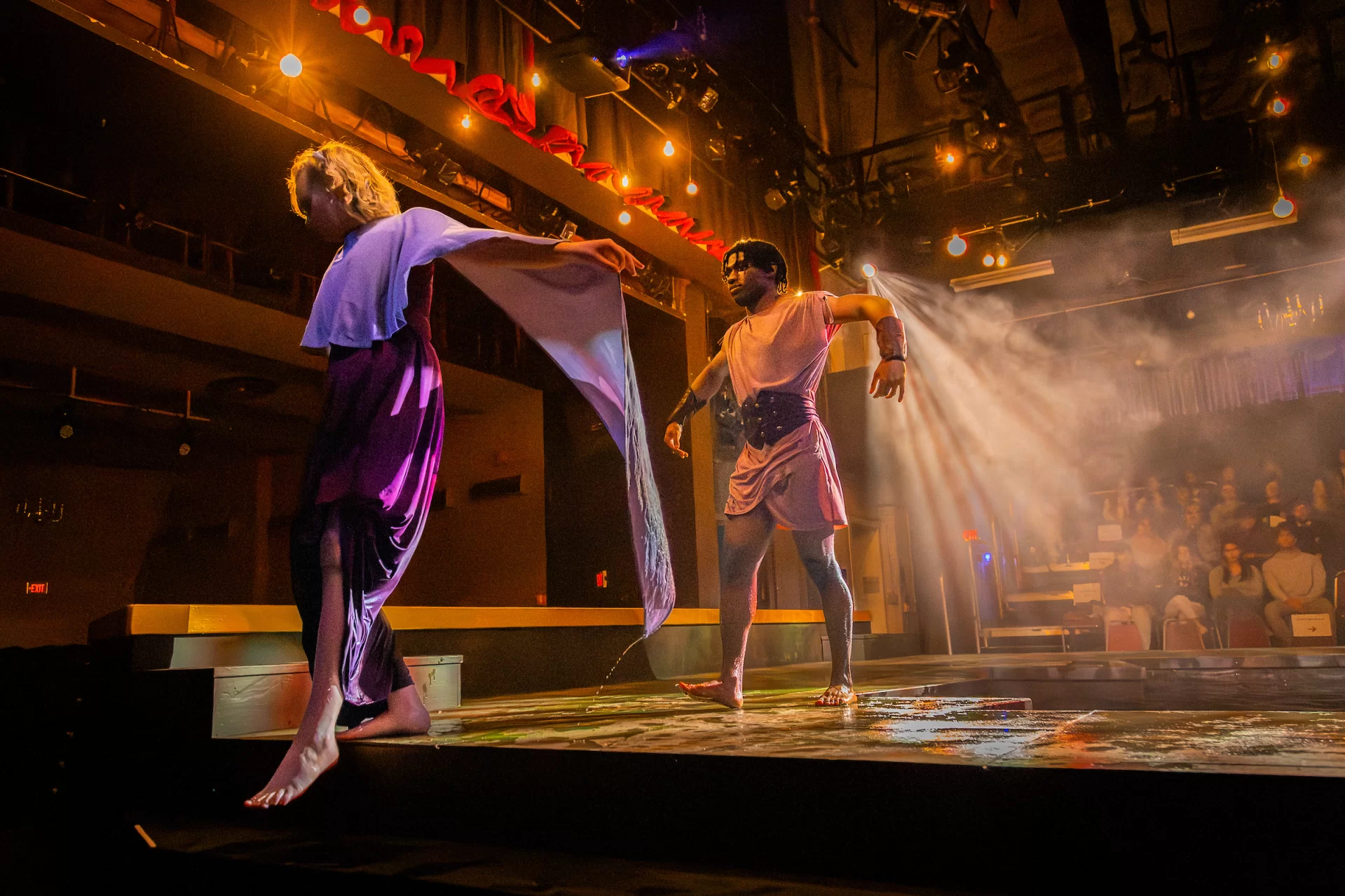
+Click here to learn more about what was going through Eirene Furr’s mind as she acted in this scene
Eirene Furr ’28 on this scene, where Alcyone and Ceyx are reunited for eternity. Ceyx had gone to sea against Alcyone’s wishes, and he was drowned during a terrible storm. Alcyone collapsed on the shore, looking for him, but here, in this deeply emotional scene, the gods have decided to allow them to be together, but not as humans. Instead they are transformed from their human forms and exit the stage on wings, as seabirds.
“That definitely was the most daunting moment of the play for me because I think it’s very easy for it to feel stupid, you know? And for it to not feel in the world because you’re playing this pretty much like a metaphor of being free and letting life change you in whatever way that may be.
For me, that moment, it was less about being made into birds and more the fact that he came back. It was this hope, because I think Alcyone is a character who is terrified of change. And so to see this moment where Ceyx comes back and he’s different, but she doesn’t care and she gets to be free, and they both get to be free together. That’s something that I thought about, like the love and the happiness and the hope in that moment. And I think once you lead with that, everything else kind of becomes clear in a way.”
The pool was both a weird quirk and an inspiration for Eirene Furr ’28, a rhetoric, film, and screen studies major from Washington, D.C., who plans to focus on playwriting. She came to Bates after four years at the Chicago Academy of the Arts and has been in many productions, but none like this. “It’s not like an August Wilson play where it’s very much grounded in reality,” Furr said. “You have to live in this world where there’s gods and there’s love, and there’s betrayal, and there’s curses, and it makes for a very challenging experience.”
Like most of the cast, she played multiple roles, most prominently the role of Alcyone, whose husband, King Ceyx, is lost at sea. “I’m lucky because I only had to go about knee deep in the pool,” Furr said. “But I know people who fully dived in and in each scene had to be completely wet.”
Included among them was Jenny Liu ’29 of Suzhou, China, who plays Myrrha, daughter of King Cinyras, cursed by Aphrodite into falling in love with her own father. She’s tossed around the pool in a particularly intense scene. “I was so excited when I heard that we were actually going to be in the water,” Liu said. “And I actually enjoyed it. It was warm.”
The everybody-in-the-pool experience brought the cast closer together, Furr said. “Because when 15 people are running around the stage with towels and having to dry off and change, and there’s a whole laundry system going on, it makes it chaotic but it also makes it really, really fun.”
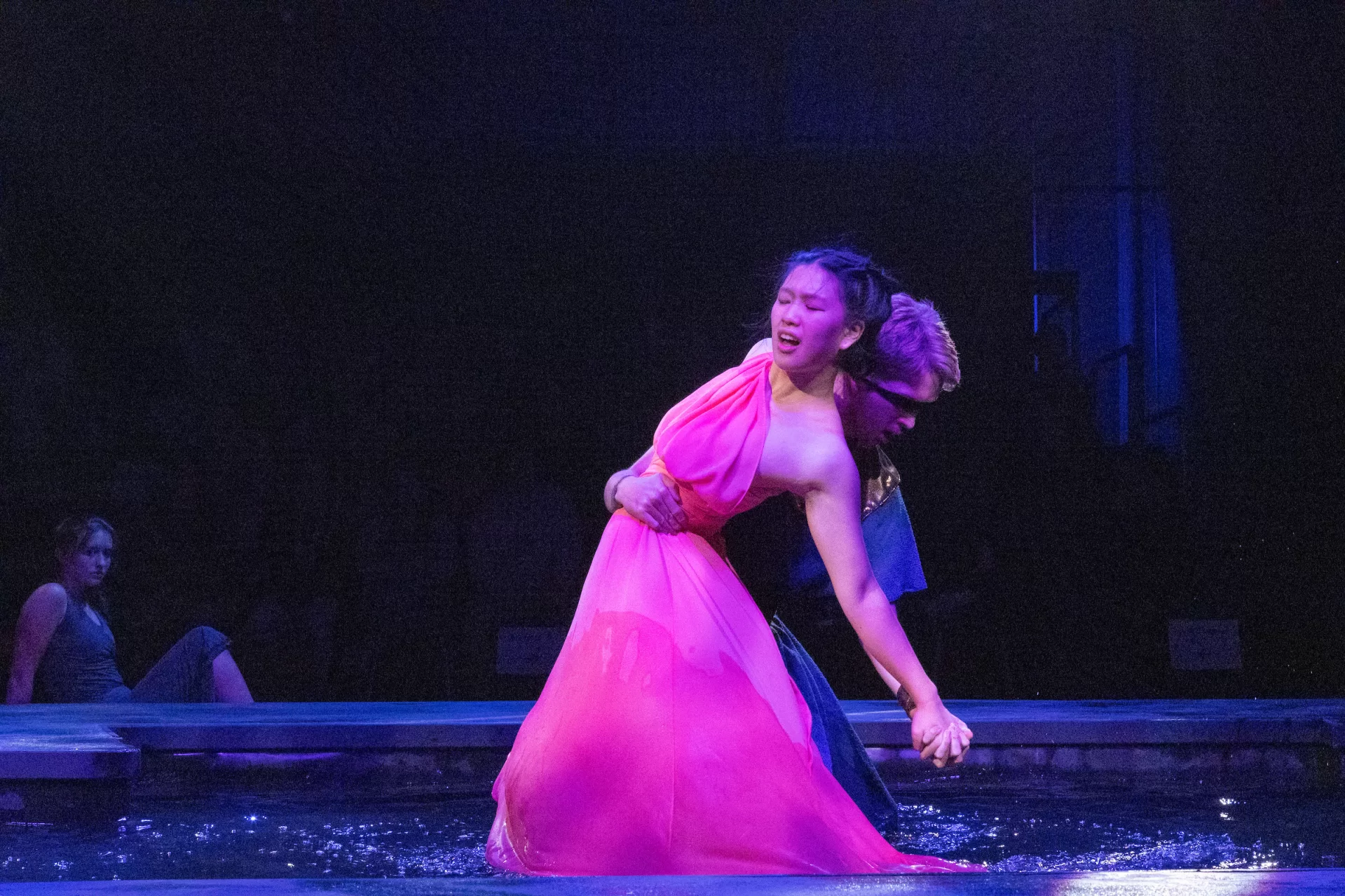
+Click here to learn more about what was happening for Jenny Liu in this scene
Jenny Liu ’29 on performing in what is the most intense scene in the play. Cinyras, blindfolded, and Myrrha are passionately entwined, but her character is in agony, torn between getting what she wanted but what she knows is terribly wrong:
“It’s a very, very personal moment. So many things are going on and it varies from show to show. Sometimes I can get into the character, sometimes I cannot. That moment with Jack is a pretty strong moment where we had that connection and trust.
It’s complicated, especially for my character, I think, because she’s the one who’s struggling within herself. She has her pride, and the strong desire, so we see the fight, and it’s beautiful. Three nights out of six I’m locked in and it just depends [on the performance]. But the last night, it felt different because it’s the very last time I played this character. It felt like saying goodbye to the character when I was walking off stage. And I felt this character more for the last time.”
For Smith, seeing this kind of student experience is a large part of what drew him to Bates during the hiring process. “What I think that the department really does well is creating the space for students to learn the craft and do their thing.” That might be a common enough sounding goal in the liberal arts, but at Bates it felt like a reality. “I really felt it. It was really obvious to me,” Smith said.
Though when Smith arrived at Bates last fall, he did develop a wish list of things he wanted to improve. Reidy had been a master of keeping old resources and materials going but it was time for upgrades. “Some instrumentation was dated back as early as the ’70s,” Smith said. It was held together by tape, or worse. “It had, oh gosh, it had asbestos wiring. I think most of it was probably from the ’80s, and that’s just not equipment that we use anymore.”
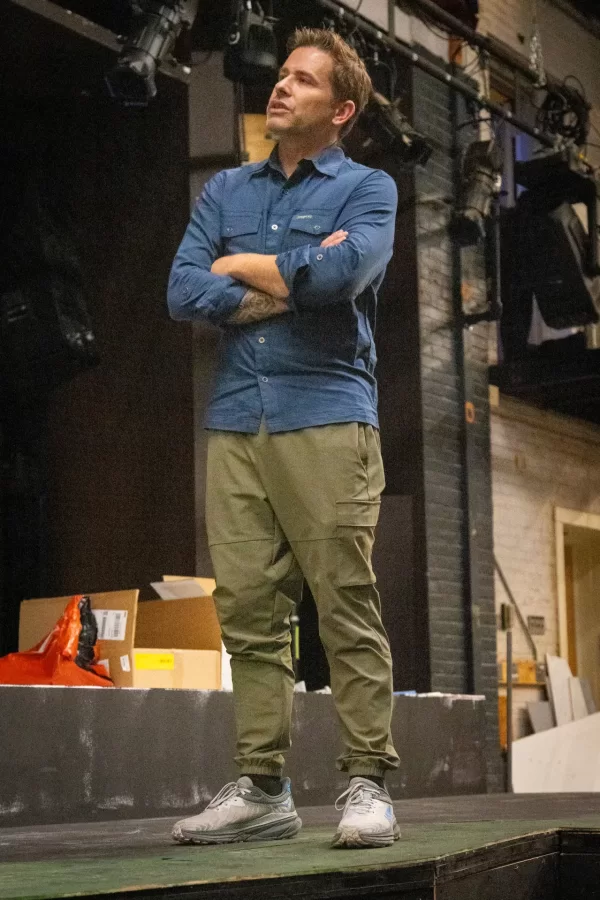
Rachel Wray, senior director of corporate and foundation relations at Bates, worked with the George I. Alden Trust, based in Worcester, Mass., which generously provided a $175,000 grant for the necessary theater tech upgrades. Bates contributed more funds, and now all three theaters — Schaeffer, Gannett Theater, and the Martin Andrucki Black Box Theatre — have new and improved equipment, including four big moving lights that were vital to making Metamorphoses glow, and a central control board (an ETC Ion Xe lighting control console) that can function as a true teaching tool. Some describe it as the guts of the whole operation.
For Smith, it was essential that Bates graduates who want to work as professionals in the world of stage, lighting, and theater, be trained on current equipment. “Students in my classes, including Introduction to Digital Media, and in lighting projection design related courses, are learning on the tools they’ll see in the real world,” Smith said. “That was a huge lift to the program to be able to do that, and it was all because of that award.”
Furr’s first Bates production left her with a deep appreciation for her new community. That includes the responsive audience.
“It’s easy to kind of compartmentalize your work as an actor, and kind of separate it from yourself,” Furr said. “Part of that is healthy and it’s good, but it can sometimes make you unaware of the amount of work that you put in. So it is definitely very rewarding to hear people come up and say how much they liked the show. It makes me very proud of all the work that the entire ensemble put in and the directors and then each and every stage hand and the theater directors and the sound designers. Really, everybody put their maximum amount of effort in.”
Faculty Featured

Courtney P. Smith
Associate Professor of Theater
Sally M. Wood
Visiting Lecturer in Theater