The skies were changeable but the mood was resoundingly upbeat on Sunday, May 31, as 480 members of the Class of 2026 celebrated their Bates graduation surrounded by family and friends, and bolstered by speeches that dwelled on bright promises, both those already delivered and those to come.
From the bestselling author of the All Souls series, Deborah Harkness, speaking to the alchemy of a liberal arts education to a beloved classmate who talked of encountering a true institutional belief in diversity, the steps of Coram Library rang out with words of awe and appreciation for the Class of 2026. The new graduates were surrounded by family, friends, faculty, staff, well wishers from the community, and what were an unusual number of dogs. (Even the celebrity going almost incognito in the audience took note of at least one of them.)
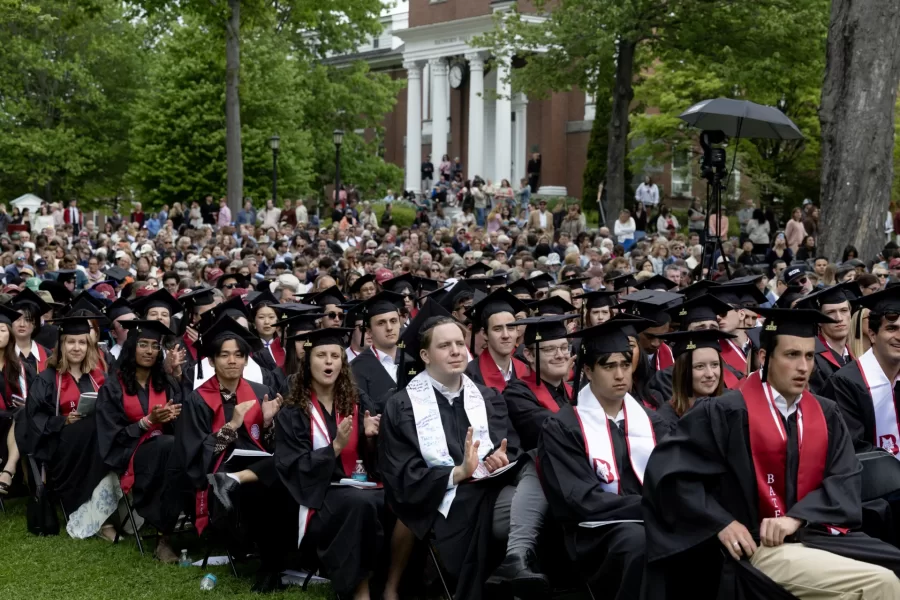
President Garry W. Jenkins opened the ceremony with a review of some of the remarkable accomplishments of the group, which represented 41 states, as well as the District of Columbia, and 30 countries. He described athletic triumphs, including those who have been named All Americans. “And a small handful of you were even crowned NCAA National Champions,” he said. “And just this weekend, national runner-up.” (Women’s rowing.)
“An astounding number of you have been recognized with prestigious national honors,” he continued. “Two of you are Goldwater Scholars. One of you is a Truman Scholar. One of you is a Watson fellow and a whopping 15 of you are Fulbright Scholars.” One of the biggest cheers of the morning was for the 59 members of the class who were the first in their families to graduate from college.
This group of 480 individuals was bound together by some special shared qualities, Jenkins said. “For me, the headline qualities are heart and humanity. You possess within you uncommon, unlimited, unparalleled, heart and humanity.”
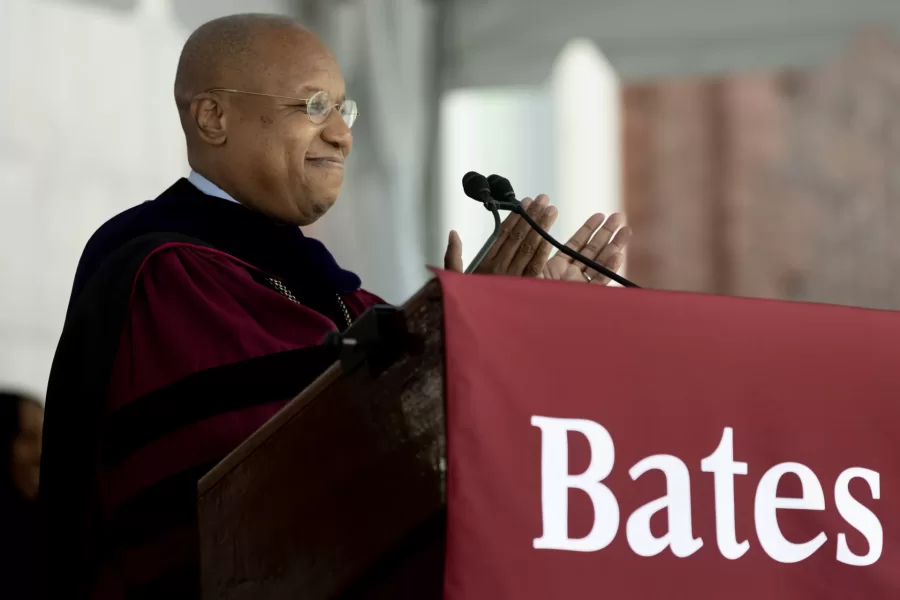
“Class of 2026, you all make my heart sing because whatever you do, I know you will do it with heart and humanity. And in so doing, you will elevate both the realities and aspirations of those around you, making this world a better place. You have all you need to succeed in whatever you choose. And whatever you choose, wherever life takes you, your college will always be here for you.”
Delivering the senior speech, Sebenele Lukhele ’26 of Manzini, Eswatini, spoke of what drew him to Bates, a place he enrolled in without visiting first. Back in high school, he was looking for an institution that offered more than just an academic education — one that would challenge “not only how we think, but also the very core of who we are.” He came upon Bates’ mission statement and the message immediately resonated.
“This specific line stood out for me: ‘With ardor and devotion, we engage the transformative power of our differences, cultivating intellectual discovery and informed civic action,’” Lukhele said. “As an international student and a person of color preparing to move thousands of miles away from home, those words felt more than just empty rhetoric. They felt like a promise. A promise that I would find not only an education here at Bates, but also a community, a sense of belonging, a place to feel at home.”
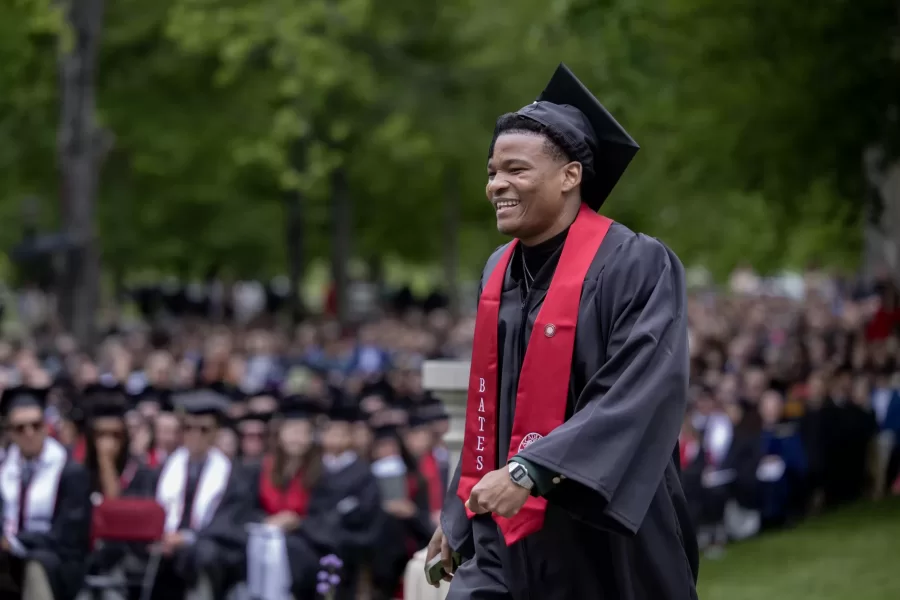
Arriving on campus in 2022, Lukhele watched that promise come to life. He moved in alone but soon found company in his peers, many of whom, like Lukhele, had chosen Bates because of its promise of community.
And this community was not homogenous; it was full of people who were different from each other, whether in nationality, identity, or other background. Such differences, Lukhele explained, are, elsewhere, sometimes approached with apprehension. But at Bates, true to the college’s mission statement, Lukhele watched differences be embraced, as students with various backgrounds strived to understand and connect with each other.
“Being surrounded by these differences does not automatically create a community,” Lukhele said. “Diversity is easy to celebrate. It is something we highlight and take pride in as individuals, but coexistence, the act of meaningfully living alongside difference, see, that is much harder. It requires effort, passion, and a willingness to be uncomfortable.”
The gift that Bates has given the Class of 2026, Lukhele said, is the knowledge of how to foster this coexistence. Knowing how to communicate across differences and transform “fear into curiosity and eventually action,” Lukhele said, is particularly important as graduates prepare to live in today’s world.
“The world we’re entering is not simple,” Lukhele said. “It is increasingly diverse but also deeply divided. Too often difference is treated as something that separates us rather than something that can bring us together. What Bates has given us is the ability to choose differently, to stay in conversations that are uncomfortable, to listen when it should be easier not to, and to see others not as strangers, but as part of a shared human experience.”
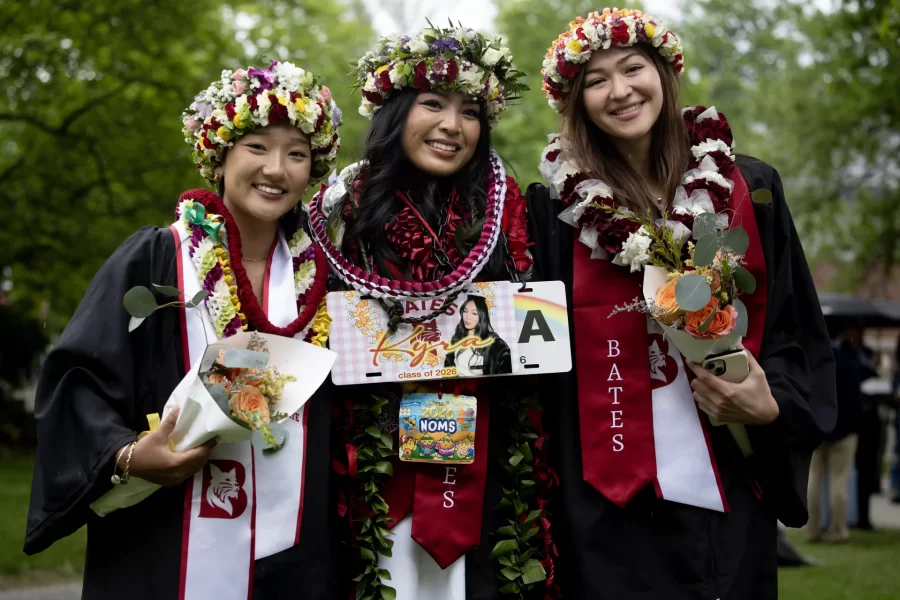
Bates awarded three honorary degrees Sunday. H. Scott Bierman ’77, a leading economist in the study of game theory, president emeritus of Beloit College, and a former member of the Bates Board of Trustees, received a Doctor of Humane Letters degree. Seema Hingorani, an investment executive at Morgan Stanley and founder of the nonprofit Girls Who Invest, received a Doctor of Humane Letters degree. (Due to a family emergency, a planned honorand, Ru Gunawardane ’95, a biologist who has led groundbreaking research efforts in cell biology and drug therapies, will receive her Doctor of Science degree at a later date.)
Sunday’s third honorary degree was conferred upon Deborah Harkness, who received a Doctor of Letters degree. For more than 30 years, Harkness taught the history of science, medicine, and magic, and recently retired as professor emerita of history at the University of Southern California. During that time, she published five novels in her All Souls series, including her debut novel, The New York Times best-selling A Discovery of Witches, which was also adapted into an enormously popular television series by the same name.
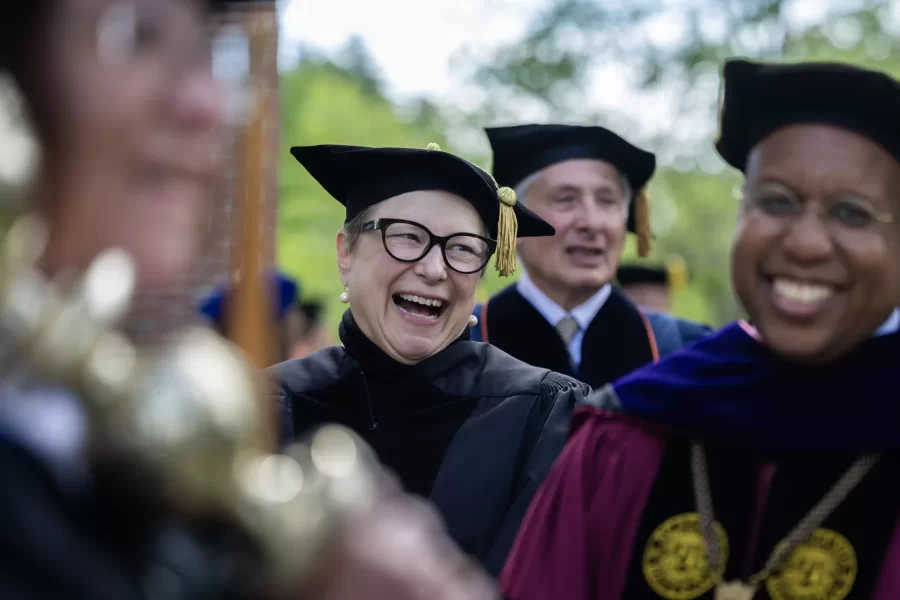
She holds a master’s degree from Northwestern University and a P.h.D. from the University of California, Davis. During her doctoral studies, she researched the history of magic and science in Europe, particularly in the 16th, 17th, and 18th centuries, not unlike her All Souls protagonist, Diana Bishop, a brilliant student of alchemy and history.
In making Bishop a graduate of Bates, Harkness has said that she was partly exploring a “road not traveled.” While Harkness graduated from Mount Holyoke College, she had applied to Bates.
She began her Commencement address with a reference to that long ago (and successful) application. “It was 44 years ago that I came to Bates as a prospective student,” she said. “And I am so grateful that today, I finally am a Batesie after all those years.”
The role of any Commencement speaker is traditionally to send graduates off with some “rousing words about their glowing future,” Harkness said. But she faced a task complicated by the fact that “we are amidst what pundits, headlines, and influencers assure us are unprecedented times of chaos and uncertainty.”
The tricky thing about inviting a historian to give a Commencement address during “unprecedented times,” she said, is that they’ll offer counterarguments dating back centuries.
“A historian will regale you with countless examples dragged out of the past that prove there is nothing unprecedented under the sun,” Harkness said.
Her own example from the past centered around the year 1671, when two things were happening simultaneously in the world. In Virginia, the governor, Sir William Berkeley, railed against a new invention, the printing press, and increased access to education. He resisted the uncertainty of changing times. “Modern neuroscientists can explain why the governor of Virginia was so anxious back in 1671,” Harkness said. “It turns out the human mind is simply not wired for ambiguity.”
Watch the 160th Bates College Commencement. Speaker Deborah Harkness’ address begins at the 56-minute mark.
But that same year, in England, a young man in his 20s named Isaac Newton was installed as a member of the Royal Society, a new London club established to investigate the mysteries of nature.
Newton, father of modern science, “was also a liberal arts student and an alchemist,” she said. And instead of resisting uncertainty, Newton took an approach that the Class of 2026 knows well, she said: “relentless curiosity.” Newton persisted with his alchemical questions, and they permeated every aspect of his thought, including his laws of motion and gravity.
She imagined Newton giving the Class of 2026 advice: “First, you must start the great work with what is, not what once was or what might one day be. Every alchemist from Nicolas Flamel to Isaac Newton began thinking they weren’t worthy and they weren’t ready to face the uncertainty for them. You too must have faith that all you require in your ambitious great work is lying within you waiting to be activated.”
Expect that the great work of your life will be messy, she said, channeling Newton’s approach to experimenting. Question everything as you undertake it. Lean into your Bates education. “The liberal arts, you see, have their own special kind of alchemy,” she said. And most important, “You must keep going.”
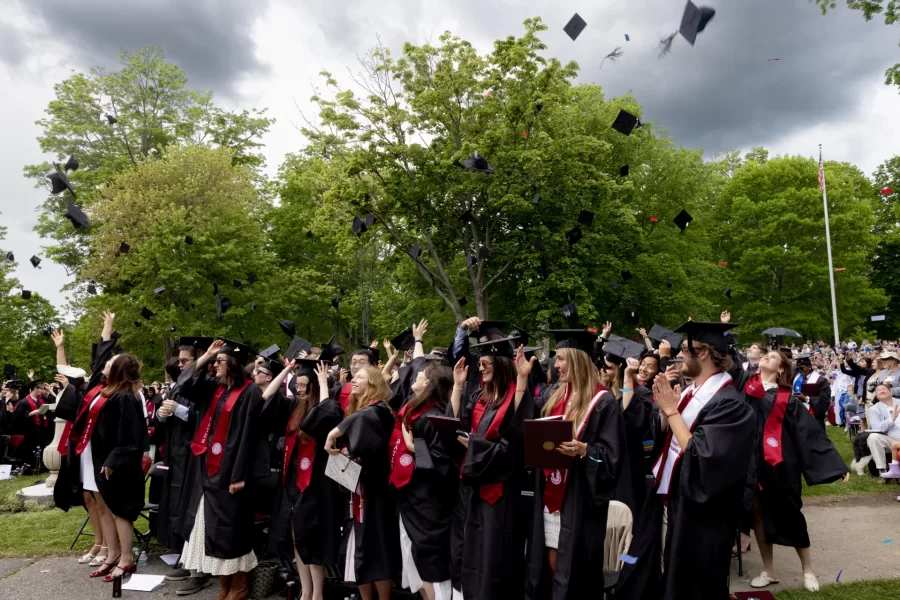
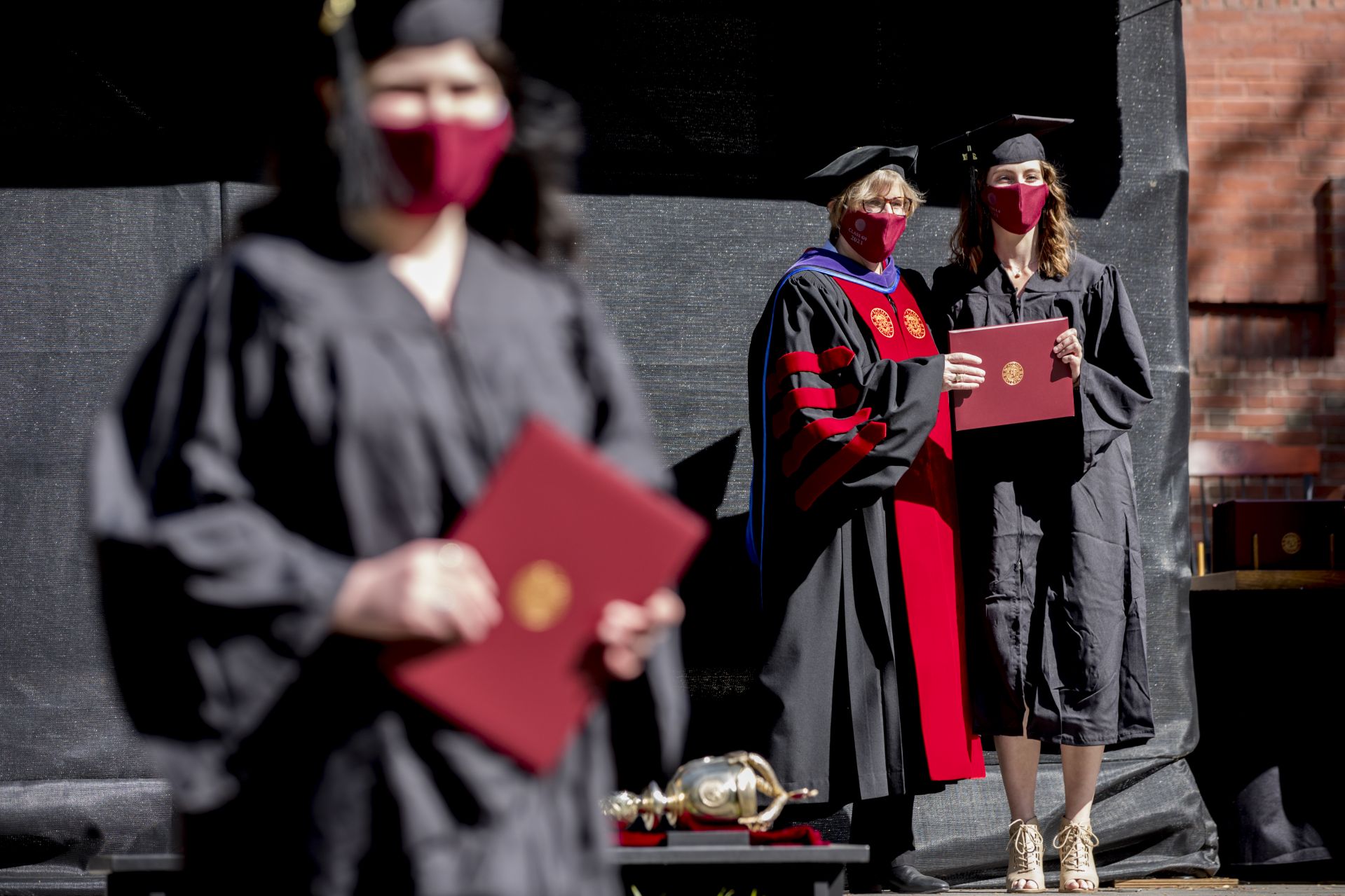
That spirit of keeping going played out as the ceremony moved into the tradition of graduates walking across the Coram stage, moving through the alphabet from A to Z. As the students with last names beginning with Cs began their walks, rain began to fall.
Fortunately, the crowd had come prepared, with layers. One woman put the puffer coat she’d brought back on. Umbrellas went up. The music star Gracie Abrams, who had come to see her cousin Abby Waisler ’26 of Venice Beach, Calif., graduate, relied on a Red Sox ball cap and a thick fleece to keep her warm and dry.
It was one of the many dogs attending Commencement that had alerted some fans to her presence. Abrams had posted a photo on her Instagram story of an extremely jowly — and cute — white and gray bulldog, along with the Commencement program.
Predictions were for it to drizzle for the coming hour. Maybe even the dogs would have been bothered by that. Instead it stopped after 10 minutes, just the right kind of uncertainty.
Categories BatesNews Livestream