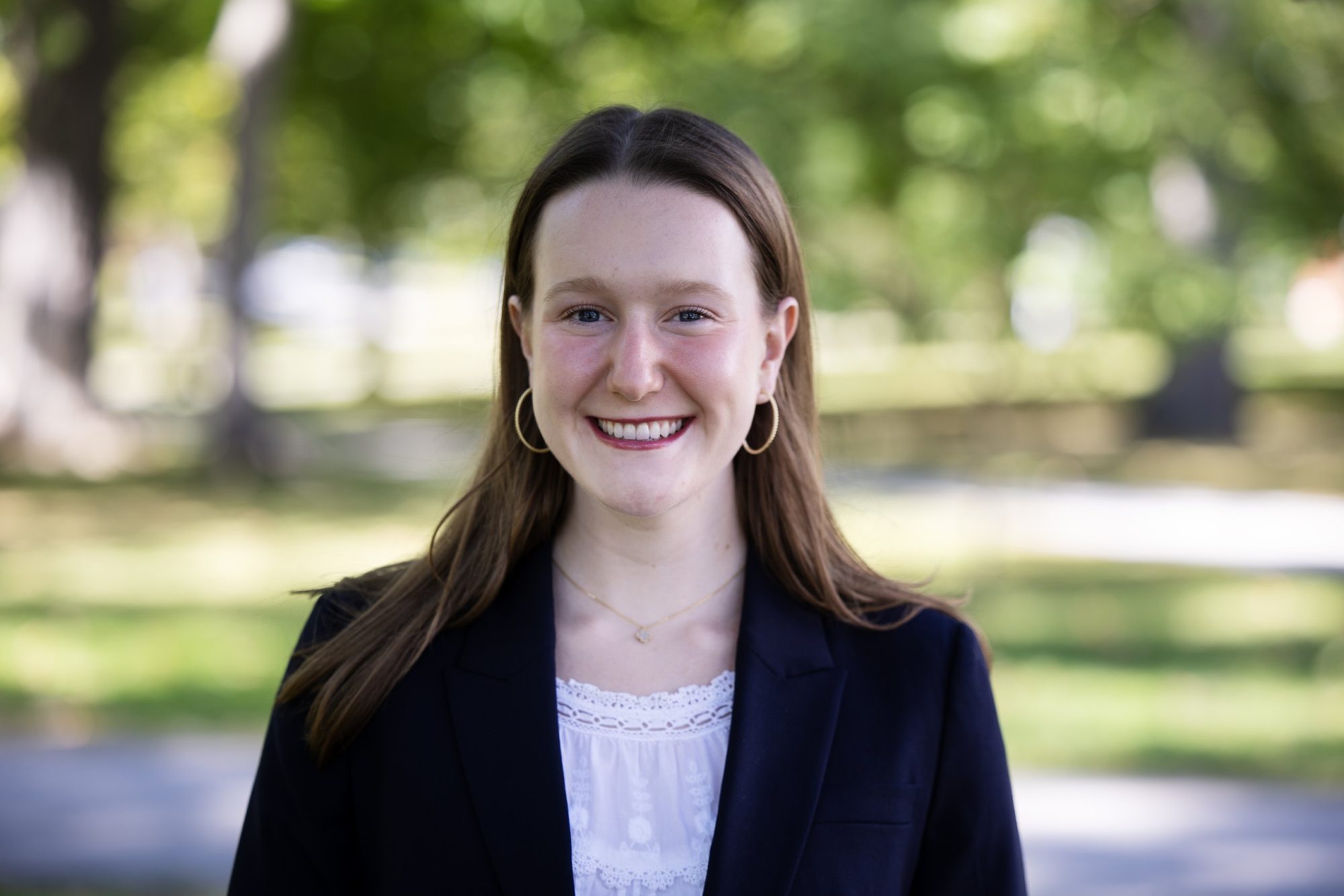
Each year the graduating class at Bates picks a faculty or staff person to offer the Baccalaureate Address. The Class of 2026 selected Professor of Rhetoric, Film, and Screen Studies Stephanie Kelley-Romano. After the ceremony on May 30, 2026, so many people asked for a copy of Kelley-Romano’s speech that Bates News is printing it in full here. (There is also a video embedded below if you prefer to watch it.)
When I was just a couple years younger than you, my high school guidance counselor told me, “Stephanie, you’re not college material.”
To be fair, I was using drugs and alcohol excessively and barely attending class.
And yet, here I stand: a woman in long term recovery from alcohol and substance use, and a professor at the absolute best liberal arts college.
When Caroline [McCarthy ‘26 of New Haven, Conn.,] asked if I would give this baccalaureate speech, my immediate thought was: “No. You cannot possibly do that.” Hell, I can’t even spell Baccalaureate.
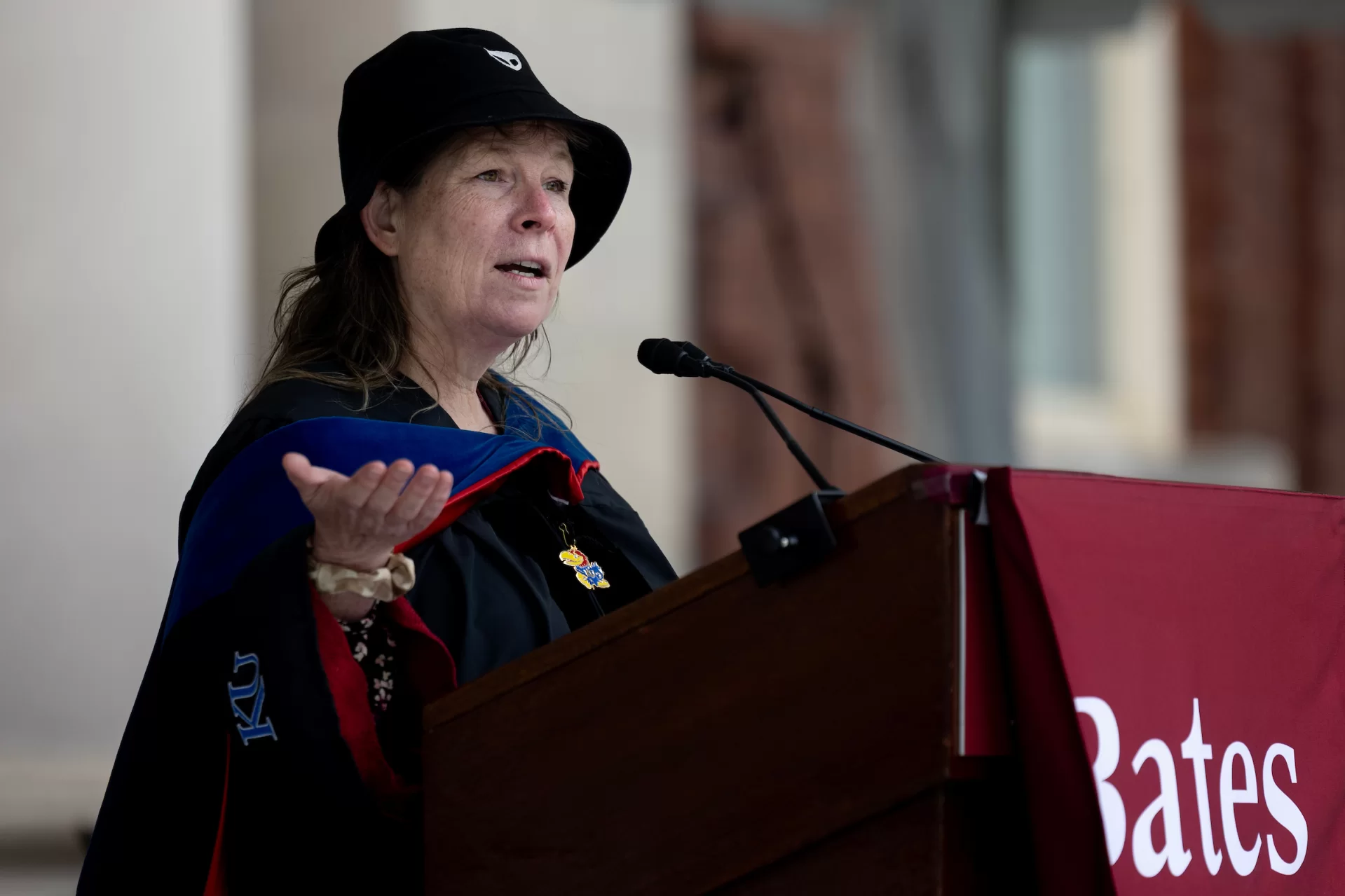
You see, I still struggle sometimes with imposter syndrome — the fear that my entire life has been a series of mistaken judgments by other people who will eventually realize I do not belong here. But over time, I’ve learned something important: that voice usually shows up when I’m going to try to do something new — and usually something hard.
And standing up here, telling you honestly what I think matters as you leave Bates and move into the world — that feels pretty vulnerable. That voice tells me you’ll think it’s cheesy or overly sentimental, but then I realized, the life I have lived, the things I have overcome to be the person I am today, absolutely qualify me to give this speech.
So today, I want to share three things I’ve learned throughout my life — and essentially my recovery — because I was basically your age when my life fell apart and I had to start over. And yes, there are three because I’m a rhetoric professor, and if I don’t follow the ancient “rule of three,” all my students will come for me.
First: actions indicate priorities.
Your life is shaped far less by what you say matters than by what you repeatedly do.
Decisions without action are just intentions.
I can’t tell you the number of times I woke up and said to myself, “Today, I’m not going to drink, I won’t smoke, I’ll go to the gym, I won’t eat like a feral child… .” But I took no action. I still went to the bar — hopeful that I’d drink Diet Coke — kept Oreos in the house, hoping my willpower would prevail. Spoiler alert — that didn’t work.
So I want you to think honestly about your life: Do your actions reflect the person you want to become? How do you spend your time?
If you are not your authentic self, the people who need you — and the people you need — will not be able to find you.
We talk about time as if it were money. We spend time. Save time. Waste time. But this metaphor makes us think of efficiency as the ultimate goal of life, and it prompts us to value productivity instead of meaning.
As many of you know, I am extremely busy. I’m a single mom. I chair the RFSS department. I am the faculty liaison to the baseball team. Hum Babe! I work with a lot of people in recovery. I maintain a ridiculous number of friendships. And I periodically lose entire afternoons to Fortnite.
But this year, I realized something: I was becoming efficient at things that were less important to me than the people in my life.
So I made a commitment to put people first.
Not theoretically. Practically. Because remember, decisions without action are just intentions. So I took actions:
I started calling friends instead of texting. Scheduling trips and visits. Asking students how they were liking Bates, or asking them how they were, and actually listening — rather than just directly telling them immediately how to improve their paper. I tried (and am still trying) to make my actions reflect my actual values. On my “to do” list every day is “build connections” — and I have to take an ACTION every day to do that. Not just think about it, meditate on it, plan on it, or figure how how to — actually do.
I also realized I did (and still do) this thing called “story stealing” — if you told me about something you did, or a place you visited, I automatically jumped in with MY experience with that thing or place. UGH. That doesn’t build connection, that builds my ego. So instead, I try to ask a couple questions about YOUR experience before I run my mouth about myself. I try to demonstrate my concern and care about you and your experience.
Because my priorities are not what I say they are. My priorities are what my life demonstrates.
Second: becoming is a process, not an event.
And it is almost always a messy process.
We live in a culture that wants certainty immediately. You want to know who you are, where you’re going, whether you’re succeeding, whether you’re doing life “correctly.” I have more goal trackers and daily success planners than I can count! But the truth is most meaningful growth happens before clarity arrives and usually when I don’t notice.
As a professor, I see this all the time. Students often want to know exactly what they think before they’ve done enough thinking to know anything yet. But real learning requires uncertainty. It requires experimentation. It requires the willingness to start with something imperfect and revise it.
My students know I use the metaphor of a cement mixer. You come to Bates as a giant rotating drum, and we shovel in ideas, experiences, theories, books, conversations, mistakes, and possibilities. Then you start trying to build something with all of it.
At first, what comes out is a messy, gloopy blob. That’s what drafts are for. That’s what student office hours are for. That’s what conversations are for.
You shape it. Refine it. Strengthen it. Eventually, you create something sturdy enough to stand on.
Life works the same way.
Most failures are not verdicts. They are information. It’s all just data.
If something doesn’t work, that does not mean you are broken or you have failed. It means you learned something valuable about what needs adjusting.
When I first tried to be sober, I learned that at that point, I could not go to a bar and expect not to drink. For a while, I had to change my physical surroundings and learn how to socialize sober.
Becoming is iterative. You are allowed to revise yourself. You MUST revise yourself. When you wake up tomorrow morning you will not be the person you are today. You’ll be tomorrow’s person. You are not your final self today. So what will you do today to live your values and be the best you? How will you spend your time today?
And finally: be you, bravely.
This may be the most important thing I have to say today:
If you are not your authentic self, the people who need you — and the people you need — will not be able to find you.
We are all performative to some extent. We learn how we are “supposed” to act if we want to be cool, successful, respected, ambitious, impressive, accepted. When I first became a professor, I had a very specific image in my head of what a professor was supposed to be.
I thought professors were people who stood at the front of rooms delivering expertise. The sage on the stage. So I lectured a lot. I graded aggressively. I tried to perform authority.
But eventually, I realized that at my core, I’m not someone who only loves teaching, I’m someone who loves learning with people and gets to do so through teaching.
And once I leaned into that, I became a better professor. I stopped treating classrooms as places where I proved my intelligence and started treating them as spaces of shared curiosity. I became more collaborative, more open, more comfortable admitting that no matter how much I know about rhetoric, there is always more. Enheduanna! Google her! Enheduanna!
I see you students do this too — you try to give the right answer, behave the way “good” students do — use very big words and long sentences. To get it “right.” To impress, to earn, to succeed. But what if success was just being authentic as you learn?
The goal is not perfection. The goal is not endless accomplishment or accolades. The goal is to build a life that feels honest and that fosters meaningful connections. From that base, that foundation, I can do the hard things I want to do to change the world.
The people who need you cannot find you through a performance. If I didn’t tell people that I once struggled with substance use, people who need to explore that topic for themselves wouldn’t know they have a listener in me.
The life meant for you cannot be built on what you think you should want, or sadly, even the things you want to want. It will be built on what you are and what you do. So start there.
As you leave Bates, I hope you take risks. I hope you allow yourselves to become, un-become, and then re-become. I hope you measure your life not only by what you achieve, but by how authentically you exist in the world.
So my advice to you?
Be you — fully, imperfectly, bravely.
Find your people. Find your places. Find your causes.
Make them better by being there as you — fully, imperfectly, bravely.
Watch Professor of Rhetoric, Film, and Screen Studies Stephanie Kelley-Romano’s full speech at Baccalaureate, starting with an introduction by Kelly Saldana ’26 of East Harlem, New York.
Categories BatesNews