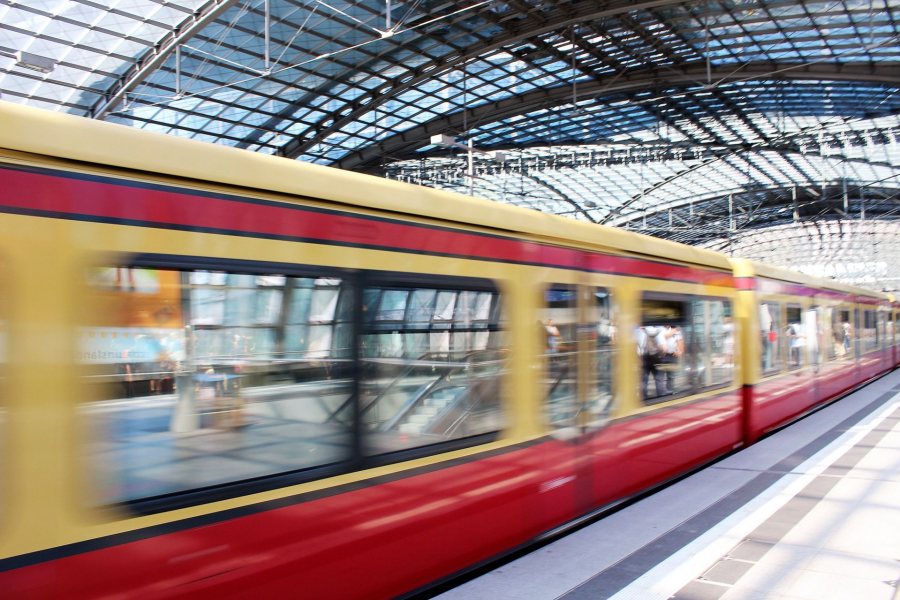
Contemporary central and eastern Europe consists of heterogeneous societies with contested cultural traditions. Offerings in the Department of German and Russian Studies investigate important interconnections among history, society, culture, and language in the region.
🇺🇦 The Department of German & Russian Studies stands with Ukraine.

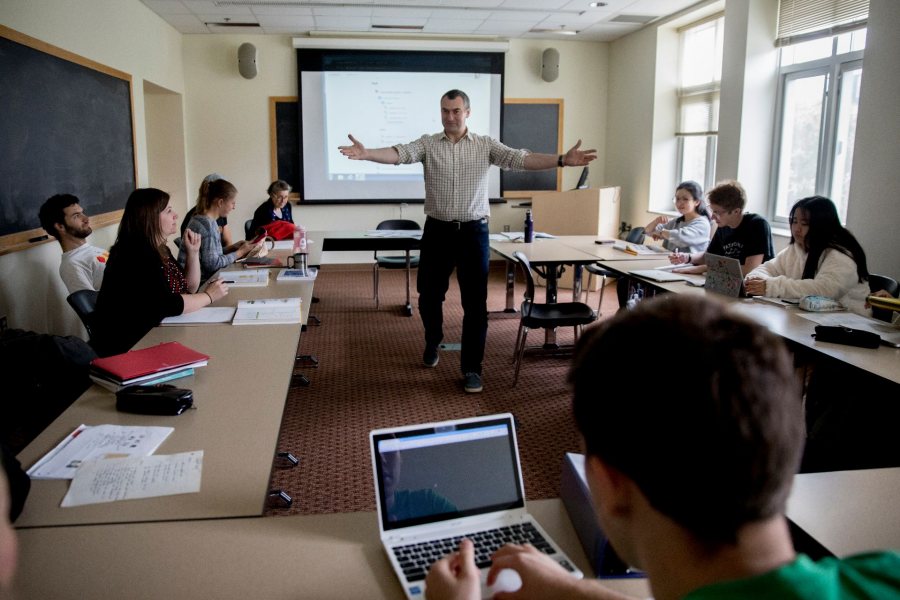
The curricula in German and Russian explore societies challenged and invigorated by change and stress the importance of attaining fluency not only in the language but also in the nuances of cultural understanding.

The department offers a German Major, a German Minor, and a Russian Minor. The department also contributes to the European Studies Major and Minor.

Incoming students with previous knowledge of German should complete the German Language Placement Questionnaire on the departmental website to determine the appropriate German course to take.

Incoming students with previous knowledge of Russian should complete the Russian Language Placement Questionnaire on the departmental website to determine the appropriate Russian course to take.

Entering students are assigned to the appropriate level in language courses according to relative proficiency based on length of previous study and/or their performance on the Advanced Placement Test of the College Entrance Examination Board taken in high school.
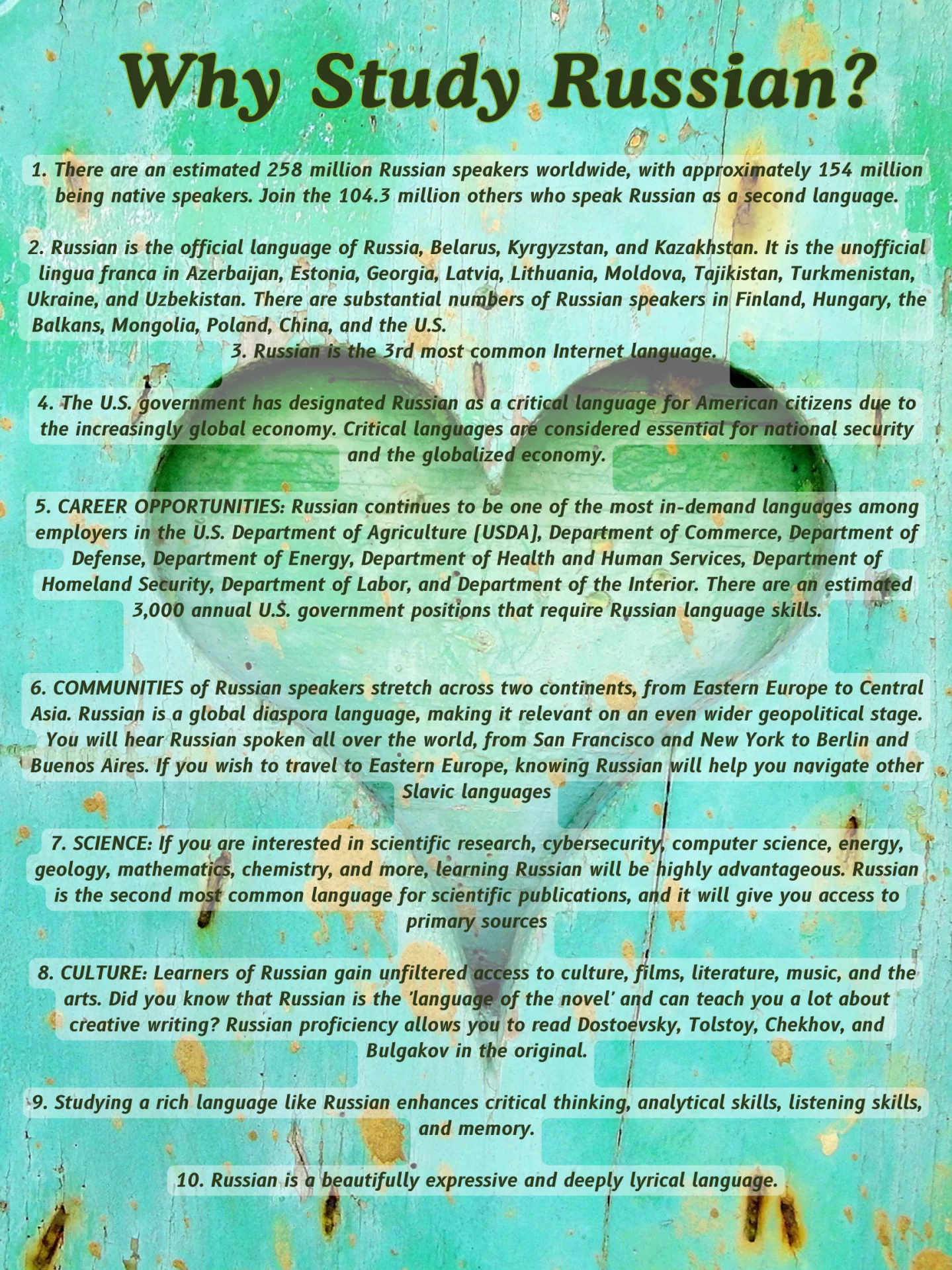
A poster with 10 reasons to learn Russian

Why Study Russian?

Unlock a world of literature, business, and history by studying Russian. Connect with millions, boost your brainpower, and gain insight into a global superpower. Explore rich culture, navigate diverse career paths, and enjoy a unique linguistic challenge. Discover ten compelling reasons to learn Russian today!
Learn Russian in the European Union - logo

We are delighted to announce that Bates students can now study Russian abroad in Latvia. “Learn Russian in the EU” is offered by Daugavpils University, the foremost academic and research institution in Eastern Latvia, located in Daugavpils, Latvia’s second-largest city and the largest Russian-speaking city in the European Union and NATO. “Learn Russian in the EU” provides a broad range of study programs in the Russian language, literature, culture, history, political science, Eastern European studies, and other areas.

Please talk with your Russian professor about your study abroad options.

Spotlight on Our Courses:

Contemporary Russia on Film

FALL SEMESTER ’26:
EUS 247 / RUSS 247
Contemporary Russia on Film

The course engages students with contemporary Russia through cinema and discusses a European culture that is, at the same time, non-Western in its political make-up. Topics discussed include the colonial center and its contemporary political and cultural ambitions, imperial periphery and Russia’s “quiet others,” the Russian Idea in New Auteurism, Putin’s blockbusters, Russia’s alterities (minorities, sexualities, taboo Russia), and Global Russia (the United States, Europe, Russia, and Ukraine).
Instructor: Marina Filipovic
Language: English

RUSS s21 course poster

SHORT TERM ’26:
S21 Puppets: Theory, Practice, and Play
Puppets? Puppets! This class introduces students to the huge variety of practices, ideas, traditions, and innovations surrounding puppets and puppetry, asking how and why puppets have been a nearly universal element of human culture for millennia. Students explore puppets and puppetry through hands-on work, discussions, community engagement, and research into global puppetry practices. Through all of these approaches, we think through big questions about ways puppetry engages ideas about the body and identity, about puppets as a tool for expression and protest, and about the relationship between creating and performing.
Instructor: Cheryl Stephenson
Language: English

German stamp

FALL SEMESTER ’26:
GER 319 Imperial Imaginary: German Colonialism Revisited
This course examines the complex history of German colonialism, focusing dually on overseas holdings (Africa, Pacific Islands, Qingdao) and the colonization of East-Central and Eastern Europe. Students explore how these distinct expansions operated through interconnected mechanisms and analyze how national identity, science, and culture justified colonial conquest. By engaging with literary works, historical documents, and film, the course investigates how colonial fantasies persist today and how artists and scholars engage in decolonial advocacy and contemporary debates on restitution. 
Instructor: Jakub Kazecki
Language: German

Hard and Soft Socialism poster

EUS/RUSS 313 Hard and Soft Socialism: Literatures, Films, and Cultures of the USSR and Socialist Yugoslavia
This course spans the literatures, films, and cultures of the Soviet Union and Socialist Yugoslavia (from 1934 to the early 1990s). It focuses on the development of socialist cultures that, following the Tito-Stalin split in 1948, pursued divergent paths in the interpretation of socialist art and proposed their true versions of Marxism. Yugoslavia constructed its image as an unorthodox communist country that eradicated ideological and aesthetic impurities of Stalinism and introduced a more democratic, West-friendly socialism. The course also examines the inception of dissident cultures, internal and external exile, and late communist texts and films produced on the eve of socialism’s collapse in the early 1990s.
Instructor: Marina Filipovic
Language: English

course poster

GER 262. The Split Screen: Reconstructing National Identities in West and East German Cinema
The course will introduce you to the turbulent history of Germany and its people in the 20th and 21st centuries through the medium of film. The selection of films focuses on the Nazi past and the consequences of the lost war, stories of divided Germany created on both sides of the border, and productions that portray the reunification of Germany in the 1990s and the processes of European integration in the 2000s.
Instructor: Jakub Kazecki Language: English

course poster

GER 341. Landscapes and Cityscapes in German Media
This course examines the construction of space in a variety of historical and contemporary German media, answering questions such as: What landscapes and cityscapes contribute to German identity and how? How do geographical location, cultural particularity, and historical context contribute to (sometimes contested) discourses on these spaces? And how have German speakers conceptualized and colonized “other” spaces in Europe, Asia, Africa, and the Americas?
Instructor: Jakub Kazecki
Language: German