— Work In The Lab
Currently, each tenure-track member of the department has their own 19’ x 9’ lab adjacent to their office. Each lab is configured differently, allowing for survey or experimental research (with computer assistance as needed) or neuropsychological testing, as the faculty member’s and their students’ needs dictate. There is also shared lab space, outfitted with video recording capability and the capacity for observation through a one-way mirror.
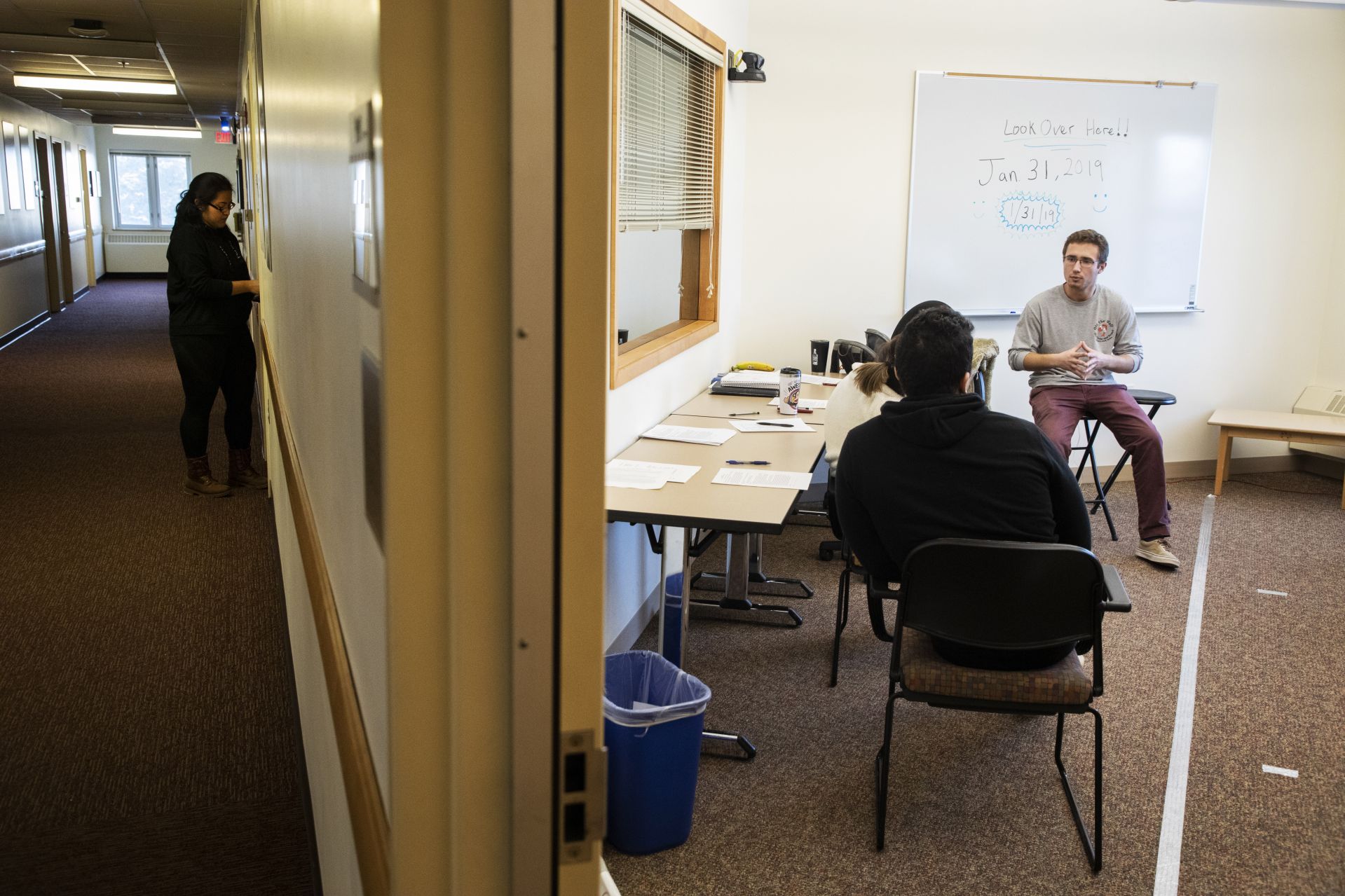
Students using the shared lab space to collect thesis data. (Photo: Bates Magazine)
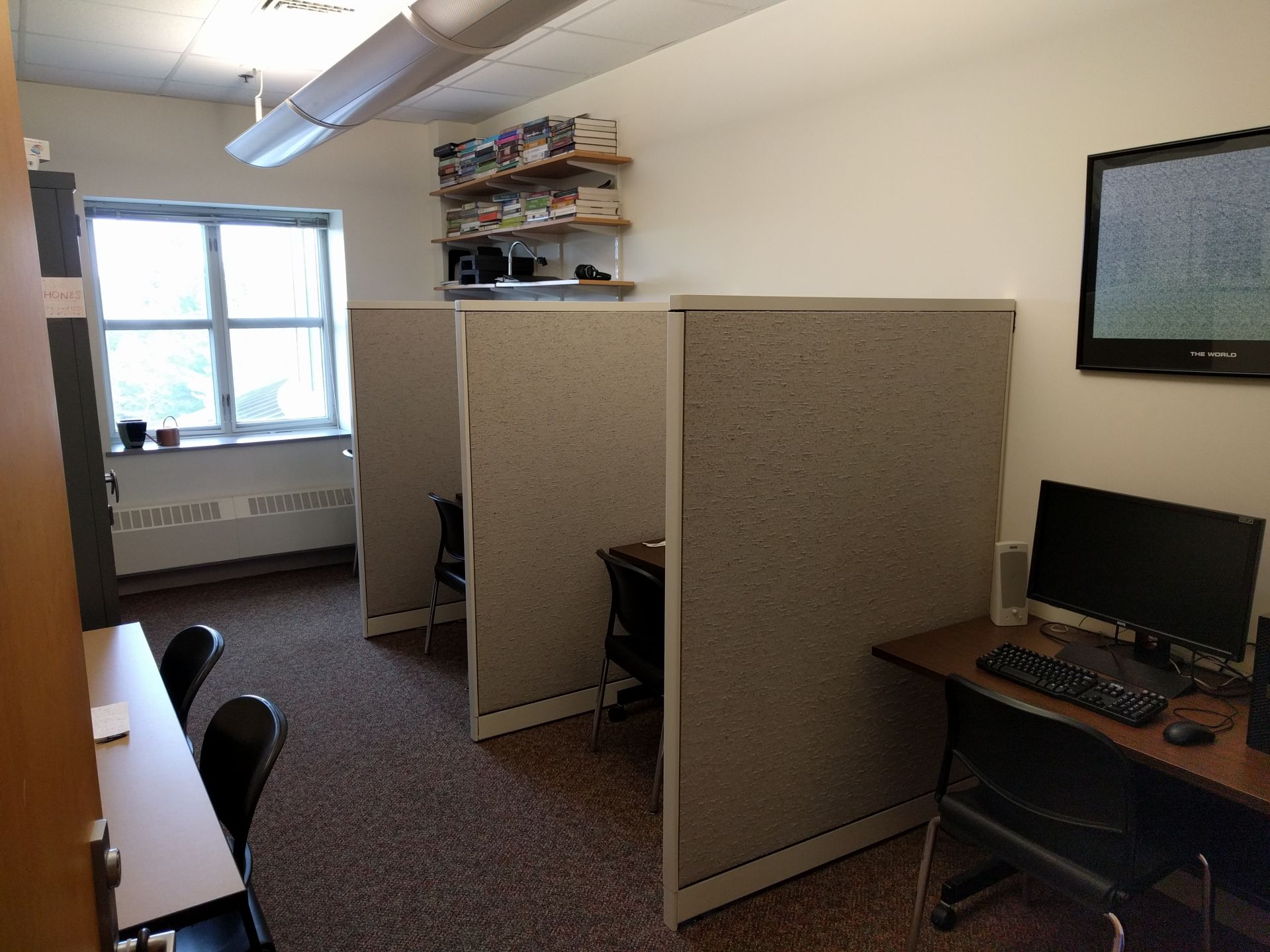
An example of a faculty member’s private lab, Prof. Todd Kahan’s cognitive psychology lab. (Photo: Brian Pfohl)
The current faculty have published in such journals as
- Adolescence
- Annals of Behavioral Medicine
- Body Image
- Cognitive Neuroscience
- Cultural Diversity and Ethnic Minority Psychology
- International Journal of Intercultural Relations
- Journal of Applied Social Psychology
- Journal of Cross-Cultural Psychology
- Journal of Experimental Psychology: General
- Journal of Experimental Psychology: Human Perception and Performance
- Journal of Experimental Psychology: Learning, Memory, and Cognition
- Journal of Experimental Social Psychology
- Language and Cognitive Processes
- Law and Human Behavior
- Personality and Social Psychology Bulletin
- Psychological Bulletin
- Psychology, Health, and Medicine
- Psychology, Public Policy, and Law
- Psychonomic Bulletin & Review
- Psychotherapy and Psychosomatics
- Self and Identity
- Social Behavior and Personality
- Teaching of Psychology
- The Arts in Psychotherapy
They have also served as either associate editor or editorial board members for such journals as
- Attention, Perception, & Psychophysics
- Cultural Diversity & Ethnic Minority Psychology
- Journal of Experimental Psychology: Human Perception and Performance
- Law and Human Behavior
- Personality and Social Psychology Bulletin
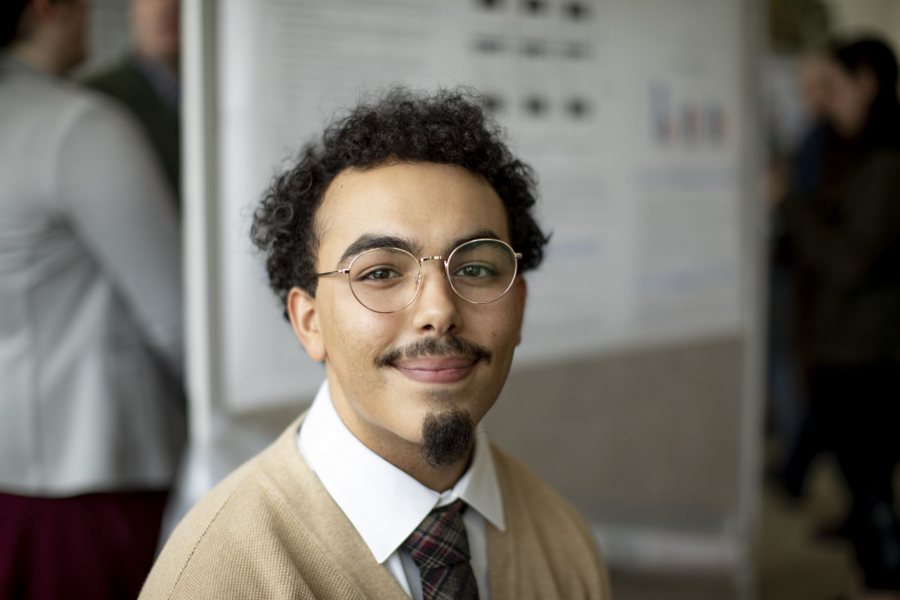
Coy Candelario ’19 presents his thesis project (Photo: Phyllis Graber Jensen)
Our students are excellent, with their work in the major culminating in a required thesis, which can take one of three forms: empirical, community-based research, or theoretical review and integration. All students present their thesis work on campus (e.g., at our annual Mount David Summit), and many also present at regional, national, or international conferences. Additionally, their thesis work, and other empirical work done under our supervision, often forms the basis of co-authored publications with us. Here are a few examples of recent empirical theses that students have completed with us:
- Jonathan Aprea — Perceptual Vigilance: Attention to Meaning as a Form of Terror Management
- Natasha Kalra — Numbers and Shapes: Is Math Learning Enhanced by a Fantastical Context?
- Connor Pacala — Doing the Wave: Number and Length of Lines in the Standing Wave Illusion
- Nina E. Tupper — Eyewitness Self-Awareness and Confidence: Will Videotaping the Identification Procedure Eliminate the Post Identification Feedback Effect?
The college also provides resources to support research by our students and our own research and professional development. There are multiple small internal grants for which students can apply, such as the Bates Student Research Fund. Additionally, faculty can apply for internal funds through the Bates Faculty Development Fund, to support research. The BFDF also supports other professional development activity, including travel for curricular development or research, or conference travel. Finally, two offices on campus provide support for faculty seeking external grant support from either government agencies or private foundations. For example, Amy Douglass is co-PI on a National Science Foundation grant of almost $326,000, focused on the costs and benefits of video-recording eyewitness identification lineups.
Browse. Imagine. Apply.