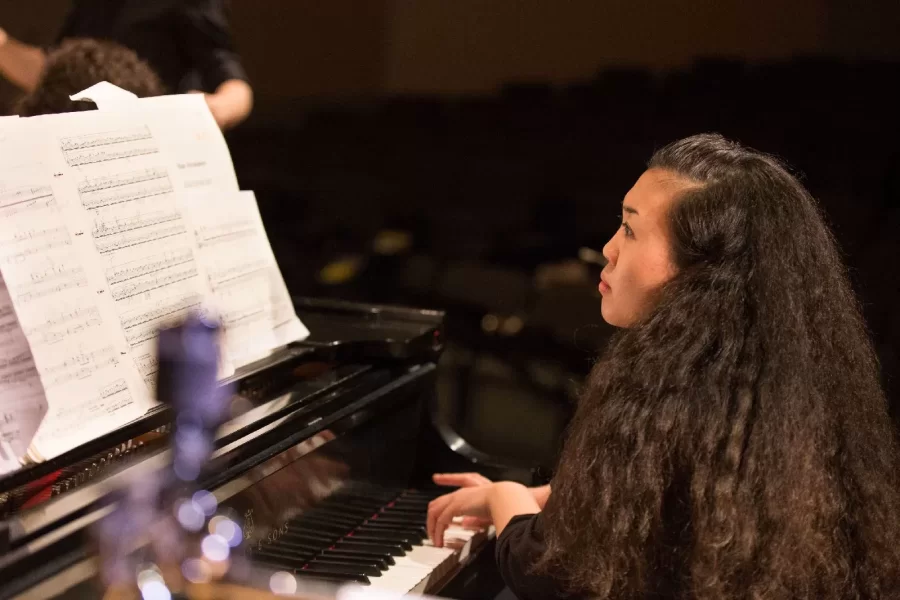
Yumi Suehiro – Northern Lights and French Dispatch: Works by Barbara Kolb (in memoriam), Danish Composers, and Former/Current Bates Composition Faculty
75 Russell St
Lewiston, ME 04240
Presented By: The Bates Department of Music: Concert pianist, Yumi Suehiro, presents a program titled, Northern Lights and French Dispatch: Works by Barbara Kolb (in memoriam), Danish composers, and former/current Bates composition faculty.
Extra Composer Bios from Program:
Born in Hartford, Connecticut, Barbara Kolb (1939-2024) was celebrated for her intricate, impressionistic textures and a freely atonal yet deeply expressive harmonic language. The Chicago Tribune wrote: “[Kolb] hears timbres as precisely as she manipulates intricate motivic structures.”
Kolb was the first American woman to receive the prestigious Rome Prize in music composition (1969-71). Her numerous accolades included three Tanglewood Fellowships, four MacDowell Colony Fellowships, two Guggenheim Fellowships, and a Fulbright Scholarship that took her to Vienna. Throughout her career, she continually pushed the boundaries of classical music, creating evocative music that drew inspiration from literature and visual arts.
Kolb received her Bachelor of Music degree (1961) and Master of Music degree (1964) at the Hartt School of Music of the University of Hartford, where she studied with Arnold Franchetti, Lukas Foss, and Gunther Schuller. Her music found a home with some of the world’s most prestigious orchestras, including the New York Philharmonic, Boston Symphony Orchestra, and the Atlanta Symphony Orchestra. Her works were conducted by Pierre Boulez, Seiji Ozawa, Robert Shaw, and Leonard Slatkin.
In 1984-85, Kolb held the post of visiting professor of composition at the Eastman School of Music. She also taught theory and composition at Brooklyn College, CUNY, and Temple University. Between 1982 and 1986, she developed a music theory course, sponsored by the Library of Congress, for the blind and physically disabled.
Per Nørgård (1932-2025) was born in Copenhagen. His parents had a shop selling wedding dresses, and there were no artists in the family. Out of the blue, Per Nørgård’s extraordinary ability became apparent, and at the age of 17 he approached the most important Danish composer of the time, Vagn Holmboe, for an assessment of his music. Holmboe took him under his wing like a son of the family, and in the 1950s Nørgård expressed himself within what he called “the universe of the Nordic mind,” with Holmboe and Sibelius as models. He even managed to correspond with the old Sibelius, who recognized his rare musical insight.
In more than 400 works in all genres Per Nørgård developed his music, which is based on his inexhaustible ability to invent something new. He composed operas, string quartets, piano works, solo concertos and eight symphonies which, at intervals of about ten years, stand as pillars in his life with music; from the somber, Nordic Symphony no. 1 to the intense and chaotic Symphonies 4 and 5 and the ethereally beautiful and bright Symphony no. 8.
He was also, quite beyond comparison, the most important teacher and inspirer in Danish musical life; a generous personality who has ensured that several generations of composers and musicians have been given the power to grow for themselves.
For his more than 60 years of creative activity he was awarded the foremost prizes a composer can receive, including the Léonie Sonning Music Prize (1996); the Sibelius Prize (2006); the Marie-Josée Kravis Prize (2014); and most recently the Ernst von Siemen Music Prize (2016).
Pelle Gudmundsen-Holmgreen (1932-2016) was one of the most striking composers from northern Europe over the past half century—a unique personality and a major figure in Danish musical life, even though he considered himself to be an outsider.
He was born in 1932 and had his debut as a composer in 1955. In his early works, Gudmundsen-Holmgreen was inspired by such figures as Nielsen, Bartók and Stravinsky. Around 1960, he was influenced by post-war serialism, but soon rejected it once again and became instead a leading figure within “the new simplicity”: laconic music which nevertheless, in Gudmundsen-Holmgreen’s hands, can be extremely ambiguous. Equivocality and a provocative absurdity are recurrent features of his production. As he himself has formulated it: “I often write music that cannot make up its mind, and that is deliberate.”