Bates College First-Year Experience
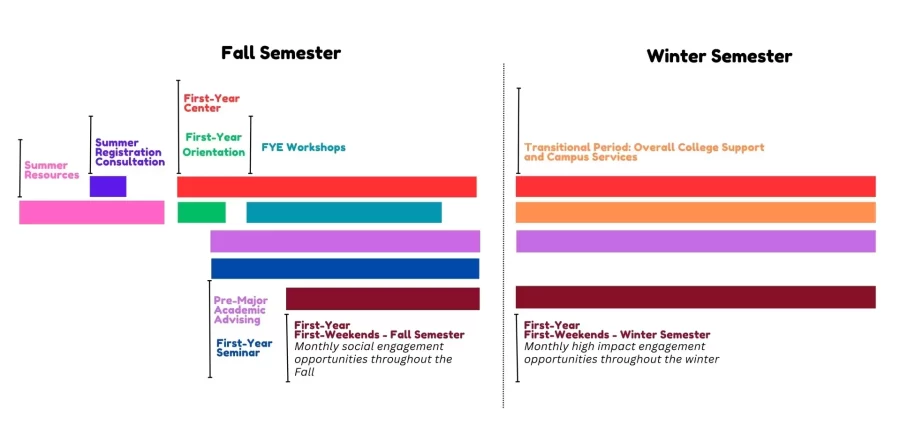
The First-Year Experience at Bates is an award-winning collection of linked programs and resources intended to support first-year students as they transition to college, and transfer students as they transition to Bates. Rather than think of this transition simply as a 6-day “orientation” in late August, the First-Year Experience enables students to utilize their entire first year as an opportunity to explore academic interests, to build community, to gain a sense of place, to engage with the values of equity, inclusion, and access that are at the core of the Bates mission, and to do so while maintaining their health and wellness and defining their own individual sense of purpose and identity.
The First-Year Experience (FYE) is grounded in a set of clear values developed in community with students, faculty, and staff to align with the Bates College mission statement and the “Values and Aspirations” articulated in the 2016 Institutional Plan.
First-Year Experience Values
The First-Year Experience is comprised of a variety of programs that lay the foundation for your undergrad experience and ensures a smooth transition into the Bates Community.
It is guided by and grounded in values central to the Bates community that students will engage with throughout their first year at Bates. We have provided further explanation of these values below.
Fostering Belonging for All Students through a Deep Commitment to Equity, Inclusion, and Access
Drawing upon our roots as a community and college founded by Free-Will Abolitionists, our shared value of fostering belonging for all students requires a deep commitment to equity, inclusion, and access. This value grounds Bates’ efforts to ensure that all members of our community are equipped with the resources needed to attain their goals and to contribute to a community that supports all of its members.
Building a Welcoming Community
Community is any collection of individuals who share a common set of values. Community is central to the student experience at Bates College. Students encounter it in their residence halls and classrooms, on athletic fields and in office spaces, on campus and beyond. Community is a fundamental point of intersection where all of the college’s values can be discussed, explored, respectfully considered, and renewed.
Encouraging Academic Inquiry and Exploration
A residential liberal arts education is a model of academic exploration grounded in openness that deeply values encounters with the unexpected. It is possible only through engagement in community with others as well as through ardor and rigor on one’s own. It aspires to provide opportunities within and beyond the classroom so that students can develop holistically. Students can connect their questions, experiences, and interests not only across their classes, but also between their classes and their co-curricular exploration. The inquiry can be problem driven and emphasizes approaches from distinct perspectives, often recognizing that solutions come through cross-pollination of ideas and approaches.
Cultivating Purpose and Identity
Identity is created through relationships, life experiences, cultures, family, talents, and world views. And, identities can shift. How a student identifies in the classroom may be different than how they identify with a group of friends, how they identify in the dance studio or how they identify as an athlete; at Bates we honor complexity and encourage students to explore and embrace the many layers within themselves. Purpose is about a student’s “Why”. When we think about purpose at Bates, it is often in relationship to others: the impact we have on the people in our communities, the environment, and the wider world. The process of exploring who we are cultivates meaning in our life and brings us a sense of purpose.
Promoting Health and Well-Being
At Bates we empower students to engage with their health from a values-based, intentional lens. Health and well-being is a multidimensional and lifelong practice for individuals that occur within the Bates community and the broader world. As such, we aim to equip students with the knowledge and skills to think critically about their experiences in order to advance and inform positive wellness decisions that are right for them.
Creating a Sense of Place
A student’s college experience will be defined not only by people — the people you meet, befriend, and learn from — but also by place. One of the great things about attending a small residential college is that we all become connected to a new world filled with new places, many of which will wind up being deeply meaningful to you. These places will help shape your college experience, and sometimes even your future path in life.
First-Year Experience Components
Bates 101 Online Resources
Bates 101, hosted on Lyceum, the college’s online learning platform, contains essential resources for new students, released in waves in June, July, and August. Students will receive emails to their Bates inboxes starting in June with instructions on how to engage each section of Bates 101.
Summer Registration for Fall Semester Classes
All new incoming students to Bates have access to information on Bates 101 that focuses on the liberal arts, academic information, and course registration. This information will become available in June. Students should review this information before the course selection period opens.
In addition, all new incoming Bates students are assigned a Summer Registration Consultant, who is a member of the Bates faculty or staff and can be available to assist students with the registration process. Registration consultants will contact their assigned students via Bates email and they will be available to meet with students (by Zoom video conference, by phone, or by email) at a mutually convenient time during the registration period. Registration is NOT first-come/first-served, so consultation meetings and subsequent course selection can take place any time when registration is open.
Selections are made on Garnet Gateway. If this information is not provided, the Registrar may place the student in courses that are appropriate for new students, fit with their course schedule, and fulfill general education requirements such as Mode of Inquiry requirements.
Initial fall course schedules for new students will be available to students in mid August. Initial schedules will be frozen (no changes permitted) until the add/drop period opens – typically on the day prior to the first day of fall classes. Students will be able to meet with their pre-major academic advisor/First-Year Seminar instructors during Orientation to discuss their schedules and possible changes. In addition, students seeking specific information about specific areas of study are encouraged to attend the Academic and Resource Fair during Orientation.
New Student Orientation
New Student Orientation is designed to welcome new students to campus and provides students the opportunity to begin forming friendships with their peers. In addition students will meet campus partners, student leaders, learn about resources offered on campus, and participate in interactive activities on and off campus. Students will become familiar with the Lewiston / Auburn area and campus.
First-Year Seminar (FYS)
The FYS is a core component of first-years’ academic experience at Bates. Each first-year student takes a first-year seminar or FYS that is designated as a W1. This is a limited-enrollment course specifically designed for first-year students. Topics vary from year to year, but seminars represent a broad range of interdisciplinary issues and questions addressed within the tradition of the liberal arts.
First-year seminars enable entering students to work with faculty and other students in a small class; they provide closely supervised training in techniques of reasoning, writing, and research; and they foster an attitude of active participation in the educational process. First-year seminars carry course credit toward the baccalaureate degree and are offered only in the fall semester.
In addition to fulfilling the first-level writing requirement [W1], they may also fulfill other General Education, major, or minor requirements. A student’s FYS instructor is also their pre-major academic advisor.
Pre-Major Academic Advising
The FYS instructor serves as a student’s first academic advisor (pre-major advisor) until the point of major declaration, which usually takes place between October and March of the student’s second year. The FYS instructor/pre-major advisor partners with students on their academic exploration, referring them to relevant resources as well as engaging with other members of their advising team, such as their Student Support Advisor, when and if appropriate.
Additional Info – Academic Advising Portal
First-Year Experience (FYE) Workshops
FYE Workshops are Lyceum-based workshops that are tethered to the student’s First-Year Seminar (FYS), and are meant to provide all students with clear and consistent access to information on a range of topics that strengthen academic skills or provide deeper dives into ideas initially explored during Orientation. Topics have included: time management, note taking, drafting essays, health and wellness resources, exploring equity, inclusion, and access, and deepening study skills.
They are grounded in the same set of 6 values that animate the entire FYE, and they encourage successful academic and social transition to college. The FYE workshops are anchored in narrative values structure as well as tethered to the FYS and spaced over the first Fall semester because they draw student development research that suggests comprehension increases when programs have thematic coherence and resonate with student needs, i.e., information is provided when it is most useful or applicable to their lives).
Residential First-Year Centers (FYCs)
First–Year Centers (FYCs) are small residential communities where first-year students are supported by a member of the Residence Life Staff known as a Junior Advisor (JA). FYCs are designed to foster inclusive spaces, to nurture authentic relationships, and to promote intentional living practices.
Most FYCs are located in larger residence halls with multiple class years where new students can interact with a cross-section of other class years and learn from the experiences of older peers. The Healthy Living communities of Clason House are substance-free and thrive without the presence of alcohol, tobacco, or other drugs. Finally, the First–Year Houses, Milliken and Frye Houses, are home to FYCs where students live only with other first-year students and experience college together in close-knit and cozy communities.
Additional Info – First–Year Centers
First-Year First Weekend-Fall Semester (FYFW-FS)
This is a collection of social and networking programs during the first weekend of the Fall semester and the first weekend of each month after the start of classes. Programs are organized by Campus Life, student clubs, Campus Activities & Traditions (CAT), and others campus partners. These programs foster a sense of place and foster community-building across class years.
First-Year First Weekend-Winter Semester (FYFW-WS)
This is a collection of resource-based programs during the first weekend of the Winter semester and the first weekend of each month after the start of classes. Programs are organized by campus partners including but not limited to the Office of Campus Life, Harward Center for Community Partnerships, Student Center for Belonging and Community, Multifaith Chaplaincy, and Center for Purposeful Work. These programs encourage further co-curricular exploration by students and opportunities to link the curricular and co-curricular, and they foster community-building across class years.
Bates 101 Online Resources
Bates 101, hosted on Lyceum, the college’s online learning platform, contains essential resources for new students, released in waves in June, July, and August. Students will receive emails to their Bates inboxes starting in June with instructions on how to engage each section of Bates 101.
Summer Registration for Fall Semester Classes
All new incoming students to Bates have access to information on Bates 101 that focuses on the liberal arts, academic information, and course registration. This information will become available in June. Students should review this information before the course selection period opens.
In addition, all new incoming Bates students are assigned a Summer Registration Consultant, who is a member of the Bates faculty or staff and can be available to assist students with the registration process. Registration consultants will contact their assigned students via Bates email and they will be available to meet with students (by Zoom video conference, by phone, or by email) at a mutually convenient time during the registration period.
Selections are made through the transfer student’s Summer Registration Consultant. If this information is not provided, the Registrar may place the student in courses that are appropriate for new students, fit with their course schedule, and fulfill general education requirements such as Mode of Inquiry requirements.
Initial fall course schedules for new transfer students will be available to students in July. Initial schedules will be frozen (no changes permitted) until the add/drop period opens – typically on the day prior to the first day of fall classes. Students will be able to meet with their pre-major academic advisor during Orientation to discuss their schedules and possible changes. In addition, students seeking specific information about specific areas of study are encouraged to attend the Academic and Resource Fair during Orientation.
New Student Orientation
Orientation for transfer students is comprised of a mix of sessions that balance custom-tailored content with engaging experiences for all new students, sensitive to the fact that they may be new to Bates, but aren’t new to the college experience.
New Student Orientation is designed to welcome new students to campus and provides students the opportunity to begin forming friendships with their peers. In addition students will meet campus partners, student leaders, learn about resources offered on campus, and participate in interactive activities on and off campus. Students will become familiar with the Lewiston / Auburn area and campus.
Academic Advising
An Associate Dean of the Faculty serves as a transfer student’s first academic advisor (pre-major advisor) until the point of major declaration, which usually takes place between October and March of the student’s sophomore year. The pre-major advisor partners with students on their academic exploration, referring them to relevant resources as well as engaging with other members of their advising team, such as their Student Support Advisor, when and if appropriate.
Additional Info – Transfer Student Advising
Residential Transfer Community
Transfer Communities are small residential communities where new transfer students are supported by a member of the Residence Life Student Staff known as a Transfer Community Advisor. Transfer Communities are designed to foster inclusive spaces, to nurture authentic relationships, and to promote intentional living practices. They are intentionally located in a mixed-class residence hall to help foster connections with non-transfer upperclass students. New transfer students may be housed with other new transfers, or with non-transfer upperclass students.
First-Year First Weekend-Fall Semester (FYFW-FS)
This is a collection of social and networking programs during the first weekend of the Fall semester and the first weekend of each month after the start of classes. Programs are organized by Campus Life, student clubs, Campus Activities & Traditions (CAT), and others campus partners. These programs foster a sense of place and foster community-building across class years.
First-Year First Weekend-Winter Semester (FYFW-WS)
This is a collection of resource-based programs during the first weekend of the Winter semester and the first weekend of each month after the start of classes. Programs are organized by campus partners including but not limited to the Office of Campus Life, Harward Center for Community Partnerships, Student Center for Belonging and Community, Multifaith Chaplaincy, and Center for Purposeful Work. These programs encourage further co-curricular exploration by students and opportunities to link the curricular and co-curricular, and they foster community-building across class years.