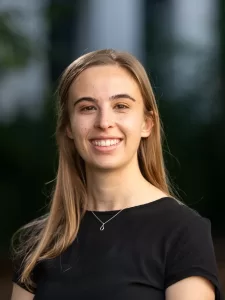
Charlotte H. Connop
Assistant Professor of Earth and Climate Sciences
About
Charlotte is a metamorphic petrologist and geochronologist whose research focuses on investigating the processes which lead to changes in the distribution of elements throughout Earth’s crust. Her research integrates field work, geochemistry, petrochronology, modeling and ‘big data’ analyses to decipher the mechanisms responsible for mass transfer on the micro-, macro-, and regional scale. She has active research projects in Baja California (Mexico), Syros and Sifnos (Greece), the French Pyrenees and the Italian Alps, and is excited to begin research in Maine and the broader New England area. Charlotte holds a Ph.D. in Geosciences from Pennsylvania State University and a B.S. in Earth and Environmental Science from the University of Michigan. She comes in Bates from Ann Arbor, MI, where she was a Postdoctoral Research Fellow at the University of Michigan.
Current Projects
- Investigating the formation of the lower continental crust (Ivrea-Verbano Zone, Italy)
- Assessing the connections between surface processes and the formation of granite over geologic time (using ‘big data’)
- Exploring mechanisms for melting the continental crust (Trois Seigneurs Massif, France & hopefully soon in Maine!)
- Evaluating trace element mobility during subduction (Syros and Sifnos, Greece)
- Studying the initiation of subduction under western North America and subsequent subduction mélange formation (Baja California, Mexico)
Expertise
Current Courses
Fall Semester 2026
Plate Tectonics and Hazards/Lab
Volcanoes, earthquakes, and tsunamis are examples of tectonic hazards that directly affect human populations. Yet the processes responsible for such natural hazards are an integral part of the global tectonic cycle that over millions of years results in the formation of ocean basins, mountain ranges…
Winter Semester 2027
Earth Materials/Lab
Many geochemical processes that occur within the lithosphere, such as crystallization of magmas, metamorphism, and weathering, are understood through the study of minerals and rocks. This course covers the occurrence and composition of the common rock-forming minerals; the mineral reactions and asse…
Geochronology
Understanding how Earth has changed over its 4.5-billion-year history is a fundamental goal of Earth science. Geochronology is the science of putting absolute time into the geological record to quantify and contextualize changes throughout Earth’s history. In this course, students will be introduc…
Senior Thesis
The thesis is a program of independent research conducted by the student, on a field, laboratory, and/or computational problem, under the direction of a faculty mentor. Seniors participate in the regularly scheduled seminar, which includes timely submission of written results and oral progress repor…