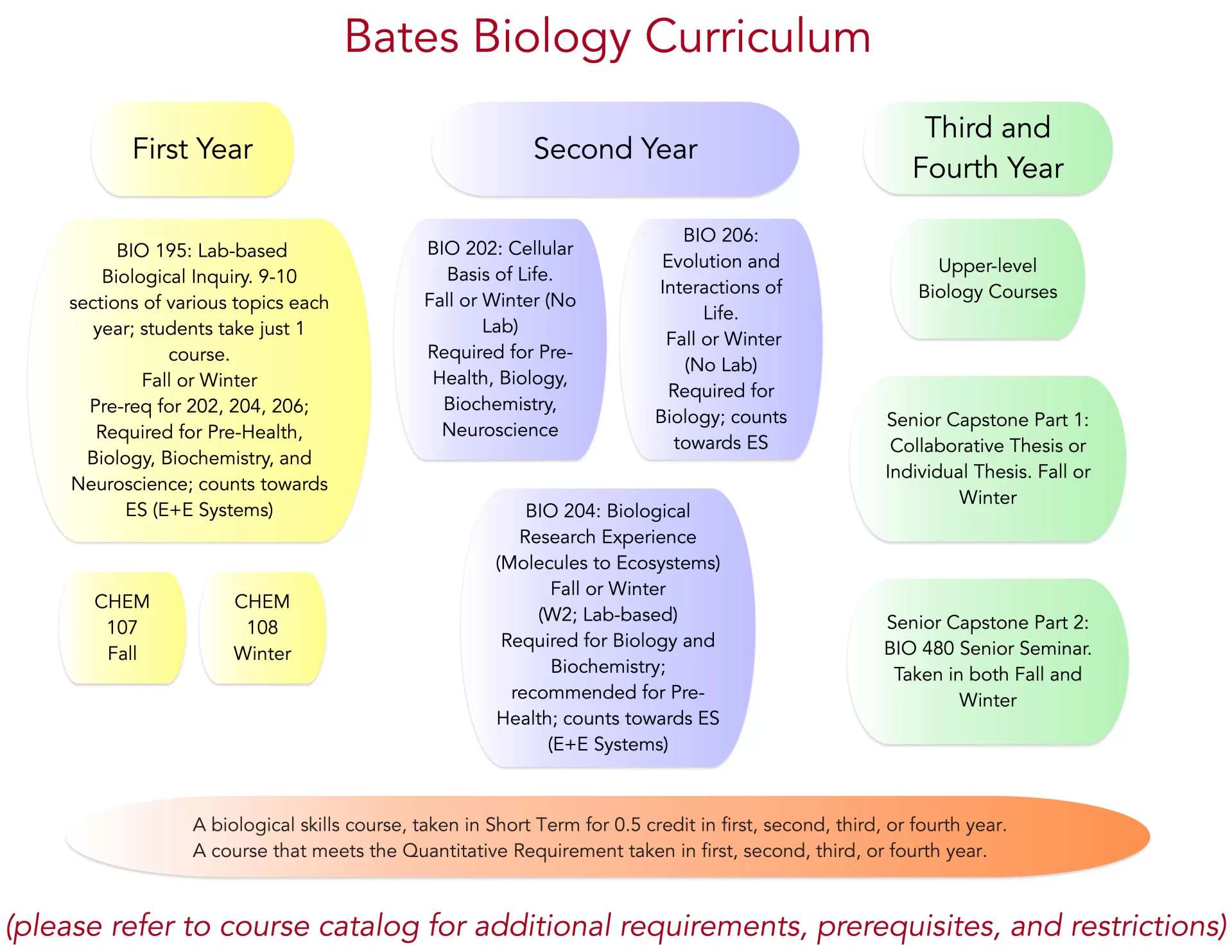
Major Requirements
Biology is the study of living systems and how they interact with the nonliving world and with one another. It is a discipline that bridges the physical and social sciences. Students who major in biology become familiar with all levels of biological organization from molecules to ecosystems, and gain practical experience in both laboratory and field studies. More information on the biology department is available on the website (www.bates.edu/biology).
Major Requirements.
1) CHEM 107A, CH/ES 107B, or FYS 398; and CHEM 108A or CH/ES 108B; and either CHEM 218 or BIO 244. The organic chemistry option (CHEM 217-218) is strongly recommended for students interested in attending graduate school, and required for those planning to apply to medical school programs. Prospective majors are strongly encouraged to complete CHEM 107A, CH/ES 107B, or FYS 398 and CHEM 108A or CH/ES 108B in the first year.
2) At least ten courses in biology, of which a minimum of eight must be taken from the Bates faculty. Eight of the ten courses must be advanced courses (200-level and above, or the equivalent). Two introductory courses (100-level and s20 – s28, excluding INDS s15) may be applied toward the major, as long as at least one has a full laboratory component (designated below in course descriptions by "[L]"). CHEM 125 and designated first-year seminars (FYS 243, 262, 282, 311, 372) may be used in place of a 100-level biology course. The ten biology courses must include:
a) Three biology core courses (BIO 190 [formerly 101], 242, and 270). Majors are strongly encouraged to complete these courses by the end of the sophomore year; they must be completed prior to the beginning of the senior year. BIO 242 and 270 have prerequisites.
b) Additional advanced courses (electives) to complete the ten courses required. The advanced courses may not include BIO 244 if Biology 244 is used to complete requirement 1) above, and may include no more than three research, junior seminar, or thesis credits from among the following biology courses: 360, 457, 458, 460, 470 through 478, and s50. CHEM 321, CHEM 322, or PSYC 363 may be substituted for one advanced course in satisfying the requirements of the major.
c) Completion of a capstone experience that includes either two of the following: BIO 457, 458, 460, 470, 471, 472, 473, 474, 475, 476, 477 or, with prior approval, BIO 460 plus a service-learning project. With prior departmental approval, a semester-long research experience in certain approved programs, such as those offered at The Jackson Laboratory or Memorial Sloan-Kettering Cancer Center, combined with BIO 460, may serve to fulfill the capstone experience.
3) Completion of the comprehensive examination requirement. The comprehensive examination requirement must be fulfilled by a satisfactory performance on the departmental comprehensive exam given once during the winter semester of the senior year, or by achieving a score corresponding to the fiftieth percentile or better on the Graduate Record Exam Subject Test in Biology. The GRE option must be fulfilled by the December test date of the senior year; students are encouraged to take this test early.
4) Double majoring in biology and biological chemistry or neuroscience: If a student undertakes a double major in biology and either biological chemistry or neuroscience, he or she may not use the same elective courses to fulfill both majors. Additionally, courses required to fulfill the major requirements of one of the majors may not be used to serve as electives for the second major.
Students planning to minor in chemistry may not use CHEM 321 or 322 toward both the chemistry minor or the biology major.
Planning for the Major. Prospective majors are urged to discuss course selection and scheduling with a member of the department in the first year, particularly if use of Advanced Placement credits or participation in an off-campus study program is anticipated. It is essential to take CHEM 107 and CHEM 108 in the first year. The department strongly encourages students to complete the required core courses before the end of their sophomore year to allow scheduling flexibility later. Completion of the core courses prior to the beginning of the senior year is required. The department also strongly advises that electives be chosen in close consultation with faculty to ensure breadth of knowledge within biology (from molecules and cells to organisms and ecosystems). Students may apply to include in the major a one-semester biology research internship at The Jackson Laboratory in Bar Harbor, Maine, or Memorial Sloan-Kettering Cancer Center in New York. Alternatively, students who study abroad may apply up to two courses toward the major as electives if the courses are appropriate and pre-approved by the chair.
Pass/Fail Grading Option. Pass/fail grading may be elected for courses applied toward the major except for: BIO 190, 242, 270, and all 400-level courses.
Bates Catalog
The current requirements for a major in biology are listed in the catalog. Majors must satisfy the requirements listed in the catalog under which they matriculate. The college catalog is now published in hard copy only every two years. Annual updates are made only to the on-line catalog. The links below will help you find the catalog under which you matriculated.
- Catalog Archive: ’95-’96 through ’03-’04 | recent catalogs