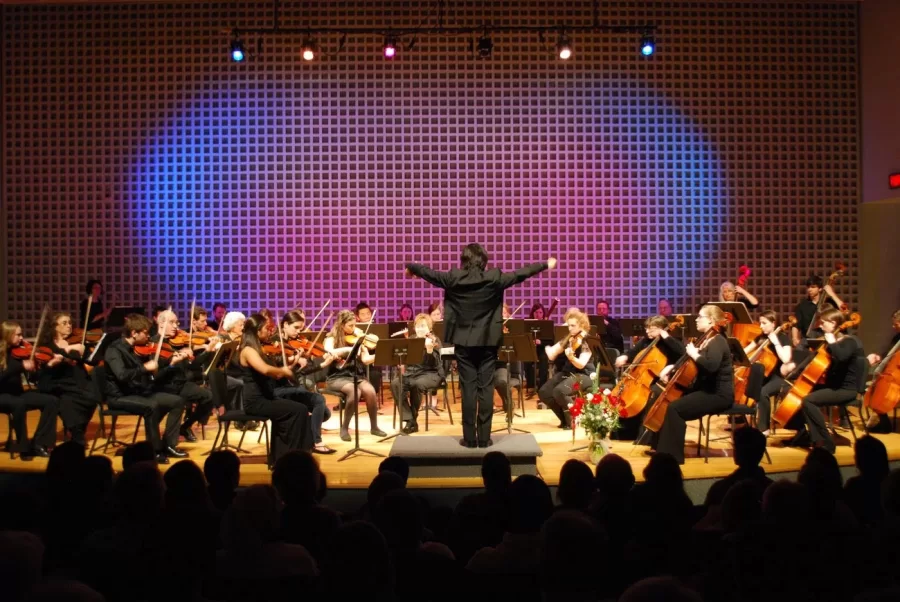
Bates College Orchestra
75 Russell St.
Lewiston, ME 04240
Presented By: The Bates Department of Music: The Bates College Orchestra performs the Bartók Romanian Folk Dances and Dvořák’s Symphony No. 9 “New World.”
Program Notes:
Over the years, I (Hiroya Miura, Director) had the chance to study with Czech conductors and later to work with Czech musicians. One violinist once told me something that stayed with me: “Czechoslovakia had the first country and western music radio station in Europe.” Hearing this, I immediately pictured Dvořák in Spillville, Iowa, where he spent the summer of 1893 with his family and is said to have sketched ideas for his New World Symphony.
In 1892, Antonín Dvořák came to New York at the invitation of Jeannette Thurber, a wealthy patron of music, to serve as director of the National Conservatory of Music (today’s Juilliard School). His salary was about three times that of a U.S. Senator. One of Thurber’s most ambitious projects was to encourage the creation of a truly American opera. Soon after Dvořák’s arrival, she suggested The Song of Hiawatha by Henry Wadsworth Longfellow as a possible subject. This epic poem, first published in 1855, was based loosely on Native American legends and had already been translated into Czech by Dvořák’s friend Josef Václav Sládek.
Although the opera never came to fruition, Dvořák was deeply moved by the idea. In 1893, the critic Henry Krehbiel wrote an extensive analysis of the New World Symphony in the New-York Tribune, noting that Dvořák had told him the second movement Largo was inspired by The Song of Hiawatha. In the same article, Krehbiel also referenced the work of Alice Fletcher, who transcribed Native American melodies in the late 1800s. Around this time, one of Dvořák’s assistants, the African American composer Harry T. Burleigh, also introduced him to spirituals—echoes of which can be heard in the Largo.
In performing the New World Symphony today, we are reminded of its wide-ranging American connections: to New York, to Iowa, and to Maine through Longfellow, born in Portland.Béla Bartók, too, had an intimate connection to America. In addition to his work as a composer, he was a pioneering ethnomusicologist. Alarmed by the spread of fascism, Bartók emigrated to the United States in 1940, where he was commissioned by Columbia University to transcribe a vast collection of Yugoslav folk music. Even earlier, before the devastations of the World Wars, he had traveled widely through Eastern Europe and Turkey collecting folk melodies. Though he was unable to publish all his research during his lifetime, he donated much of the material to Columbia University. The melodies heard in today’s Romanian Folk Dances all come from this remarkable body of work.